A person enters a monument that is already ancient and leaves a mark on its wall. Centuries later, another visitor tries to read that mark. At Maeshowe in Orkney, the walls do not belong to one historical moment. They hold evidence of a Neolithic tomb, later Norse visitors, and modern efforts to investigate and protect both.
The temptation is to let the liveliest writing take over the whole story. Runic graffiti can seem more conversational than a monumental stone chamber. Yet the runes are late arrivals in a much older building. Keeping those timelines separate makes the place more remarkable.
A tomb before the inscriptions
Historic Environment Scotland describes Maeshowe as a Neolithic chambered tomb, later entered by Norse visitors after a long interval. The inscriptions belong to that later phase. Their presence does not mean Norse builders constructed the chamber, or that the original builders used runic writing.
This sounds obvious when stated plainly. It becomes less obvious in a cropped photograph that shows a rune beside a carefully dressed stone. Images place things next to one another; historical argument has to establish whether they were made together. Physical proximity is evidence of a relationship, but not necessarily of shared date or purpose.
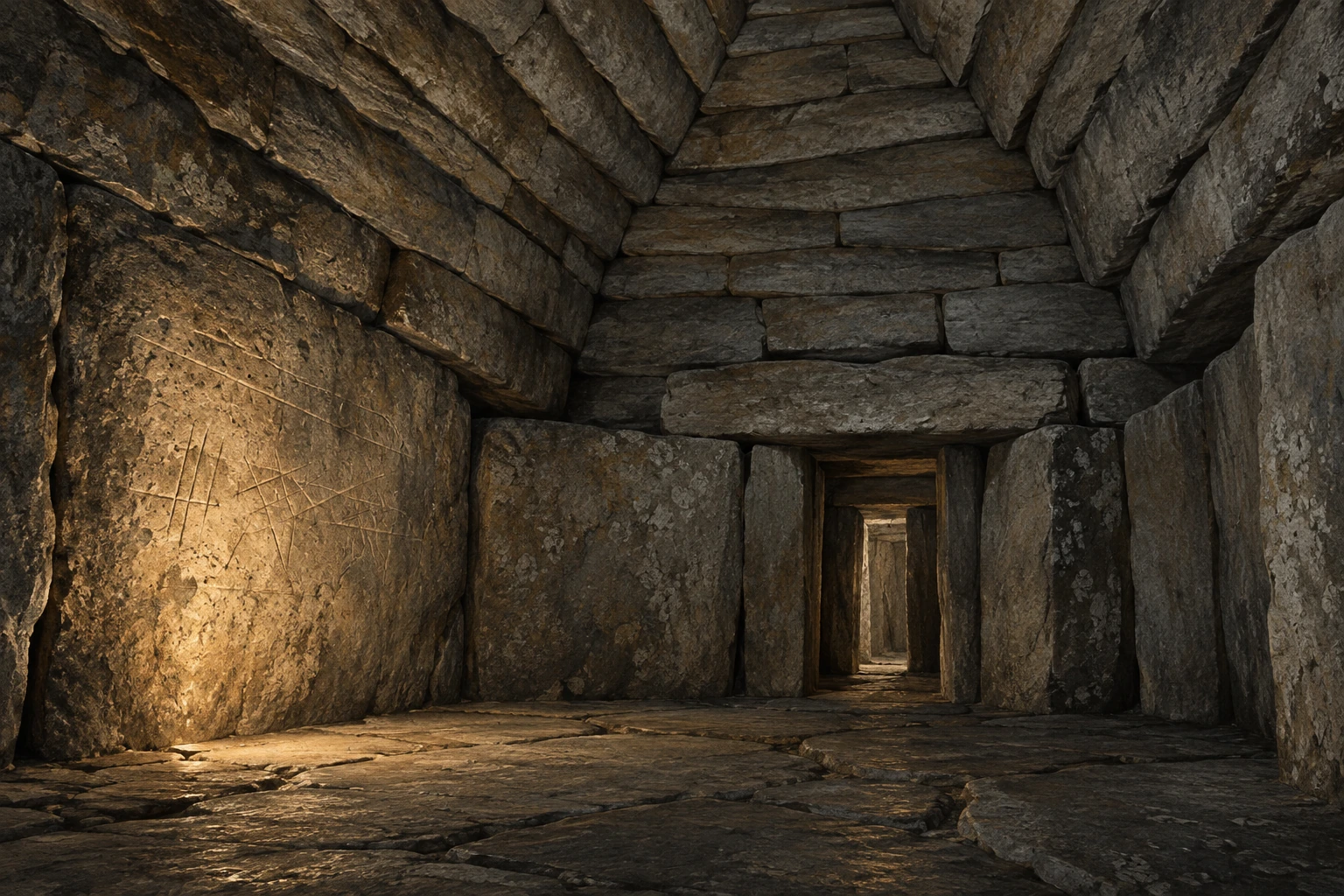
The tomb's construction also deserves attention on its own terms. A low passage leads into a central chamber with side cells. Stone size, positioning, and the transition from passage to room organize an experience that the later writers inherited rather than invented.
Where a line is matters as well as what it says
The World Heritage nomination dossier discusses the Norse inscriptions and the history of recording them. It includes the position of a high inscription as well as its reading. Placement can become evidence: a mark's height raises questions about the state of the chamber when somebody carved it.
A translation gives a modern reader access to language. A measured location gives access to an action in space. Together they can suggest more than either alone, but they still need careful limits. An inscription that boasts about a feat is evidence that someone made that claim. It does not automatically verify every event being described.
Names, declarations, joking, and claims about other visitors can all invite a very modern sense of recognition. That recognition is enjoyable. It should not turn every line into a reliable diary entry, or every modern translation into a direct recording of a speaker's voice.
| Layer of history | A useful question |
|---|---|
| Neolithic construction and use | What do the architecture and archaeological context show? |
| Later Norse entry and inscriptions | What was carved, where, and how is it dated and read? |
| Modern excavation and conservation | What has been exposed, altered, recorded, or supported? |
The monument you see also has a conservation history
The 2008–13 World Heritage management plan records an 11-meter passage and describes a concrete cap installed in 1910–13 above the chamber. It notes that the present upper height is probably lower than the original apex. A modern protective intervention is therefore part of the structure's present condition.
That is not a reason to dismiss the monument as inauthentic. It is a reason to ask better questions about which parts of a visible condition are ancient, which are reconstructed, and which support survival. Conservation choices can preserve access to evidence while also changing what a visitor experiences.
Try reading a monument photograph in two times
Choose a photograph in the official site account or nomination dossier. First describe only visible relationships: passage, chamber, wall, incision, light. Then add dates from the record. Mark any part for which you do not have a date. The exercise tests how quickly the eye turns several periods into one apparently continuous scene.
There is no need to flatten Maeshowe into either a solemn prehistoric mystery or a collection of amusing Viking messages. The building's long life includes both, alongside many gaps. Its depth comes from the coexistence of histories that remain distinct.
The next time you encounter writing on an old wall, begin with two questions: how old is the wall, and how old is the writing? The distance between those answers may be where the most interesting story starts.
Sources and further exploration
- Historic Environment Scotland: Maeshowe history and stories
- Heart of Neolithic Orkney nomination dossier
- Heart of Neolithic Orkney management plan 2008–13
Explore all 80 new articles · Browse the complete illustrated collection
Continue exploring art, ideas, and unexpected connections at Incoprea.