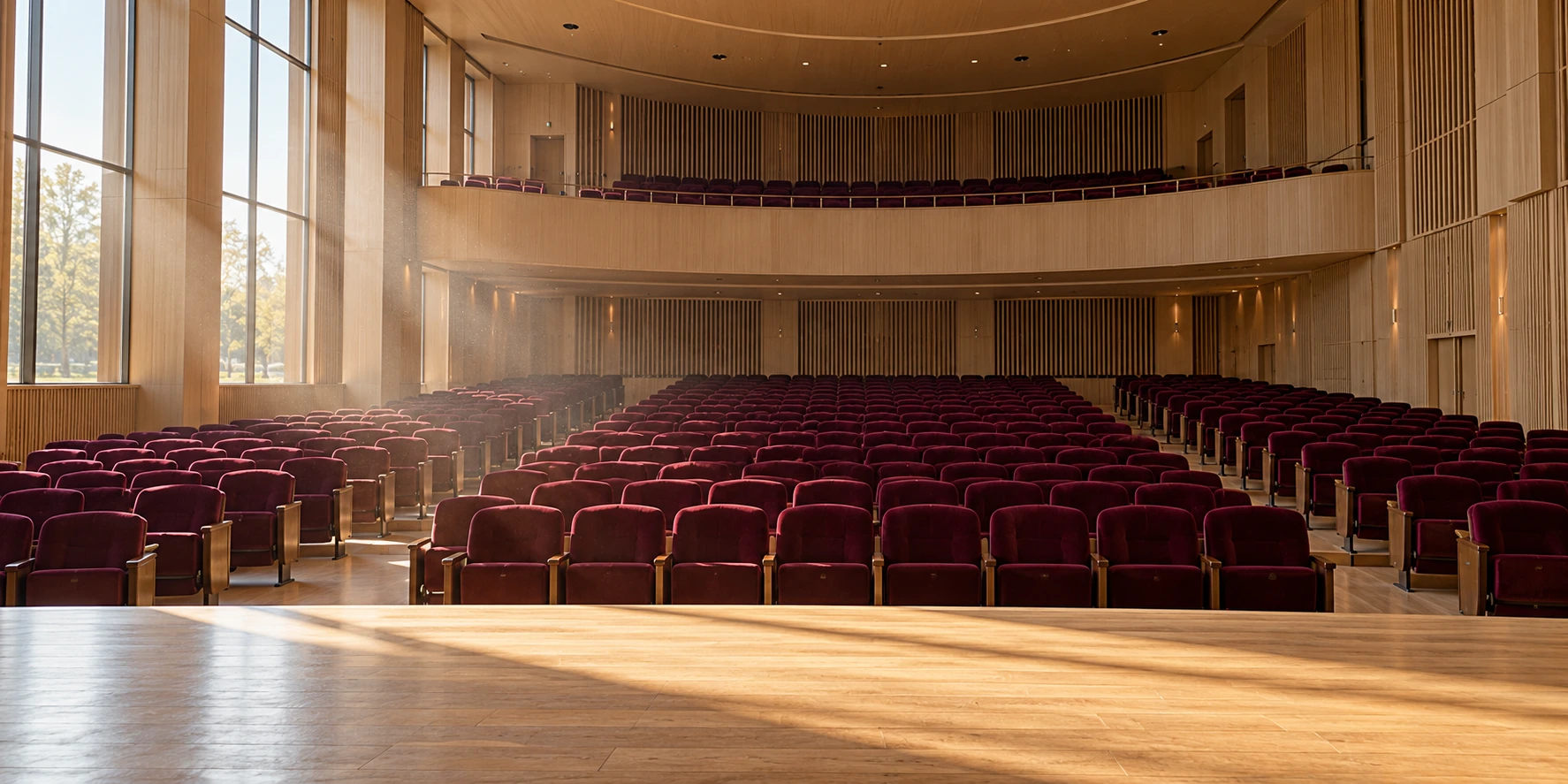
A wooden lattice can look almost weightless. Its pattern seems to consist of lines and air. Then the edge catches the light, and every line becomes a thin member with grain, thickness, an end, and a place where it must meet another piece.
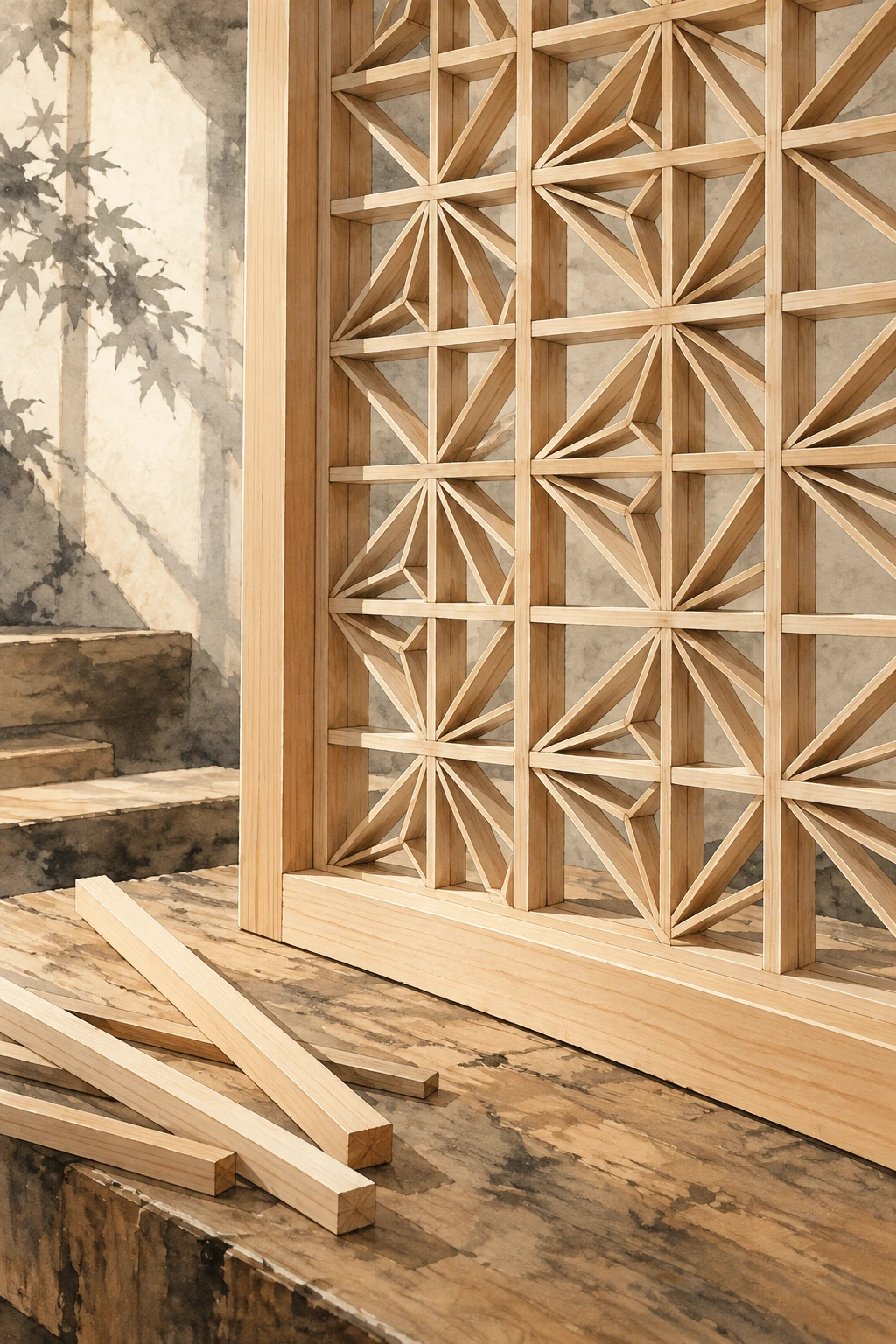
Kumiko is a Japanese latticework method in which slender wooden elements are carefully fitted into geometric arrangements. Japan House London's account of a 2022 Hida woodworking workshop describes patterns assembled without nails or glue. That concise description is a starting point for looking at fit, rather than a complete account of every component in an architectural fitting.
Separate the frame from the pattern
Begin at the outside. A surrounding frame gives the smaller work a boundary. Within it, a larger grid can establish cells. The infill then subdivides those spaces. A photograph may flatten all three levels into a single design, but their physical roles need not be the same.
Try covering most of an image with your hand, leaving one cell visible. Follow the wood rather than the empty shape. Which member continues through the cell? Which ends against another? Which piece seems to depend on being enclosed by its neighbors? These are observations you can make without pretending that a photograph reveals the hidden joint.
The distinction between wood and void is especially rewarding. One small piece participates in the outlines of several empty shapes. Your eye may group those spaces into stars, leaves, or larger units that no single wooden component possesses. The pattern is a relationship among materials and openings.
Fit changes the order of making
When pieces depend on close contact, dimension and sequence matter together. A component that could fit into a finished pattern might still be impossible to insert after its neighbors are locked in place. This is an elementary assembly question, not a claim that every kumiko pattern shares one solution.
A specific nejigumi coaster described by Japan House makes the issue vivid: its interlocking joint is difficult to undo once assembled. The important word is “specific.” A dramatic statement about a named joint should not be expanded into the rule that all Japanese joinery, or every lattice, is permanent and cannot be repaired.
Nor does “without nails” mean “without technique.” It shifts more responsibility onto shaping, proportion, and controlled relationships. The result can look quiet precisely because so much of the work is hidden in small differences that an experienced maker has learned to recognize.
Carpentry is not one scale of problem
The Masters of Carpentry exhibition account from Japan House Los Angeles places kumiko among refined woodworking practices for furniture and architectural fittings. It also distinguishes methods for joining structural members in different directions. A delicate interior lattice and a large load-bearing connection belong to a broad craft world without being interchangeable engineering systems.
This matters because a close-up of an elegant joint can invite exaggerated claims. A small decorative assembly is not evidence that an entire building uses no metal. A display model does not establish how a structure behaves under every load. The more precise description is usually the more impressive one, because it lets the actual problem come into focus.
Read a lattice in four passes
- Boundary: identify the enclosing frame and the edge of the visible panel.
- Grid: find the larger repeated cells.
- Infill: choose one cell and describe its smaller members.
- Light: compare the same region where shadows deepen or fade.
Keep a separate note for hidden details that the image cannot establish, including exact joint geometry, species, dimensions, and assembly order.
Light is the final participant. Thin members cast moving shadows, and an opening changes its apparent size when seen obliquely. A panel is therefore not only a pattern to recognize from the front. It is a shallow three-dimensional arrangement that changes as a viewer moves.
Kumiko becomes more engaging when you let the lines regain their material thickness. The pleasure is not only in repetition. It is in the way many small, carefully prepared parts allow a larger order to appear.
Sources and further exploration
- Japan House London: Making Kumiko Latticework,2022
- Japan House London: Kumiko Coaster Nejigumi
- Japan House Los Angeles: Masters of Carpentry
Explore all 80 new articles · Browse the complete illustrated collection
Continue exploring art, ideas, and unexpected connections at Incoprea.