From a distance, a tiled wall can look like a single image. Step closer and another picture appears: a field of edges. Each small piece has its own outline, color, glazed face, and relation to its neighbors. The large pattern exists because those relationships hold.
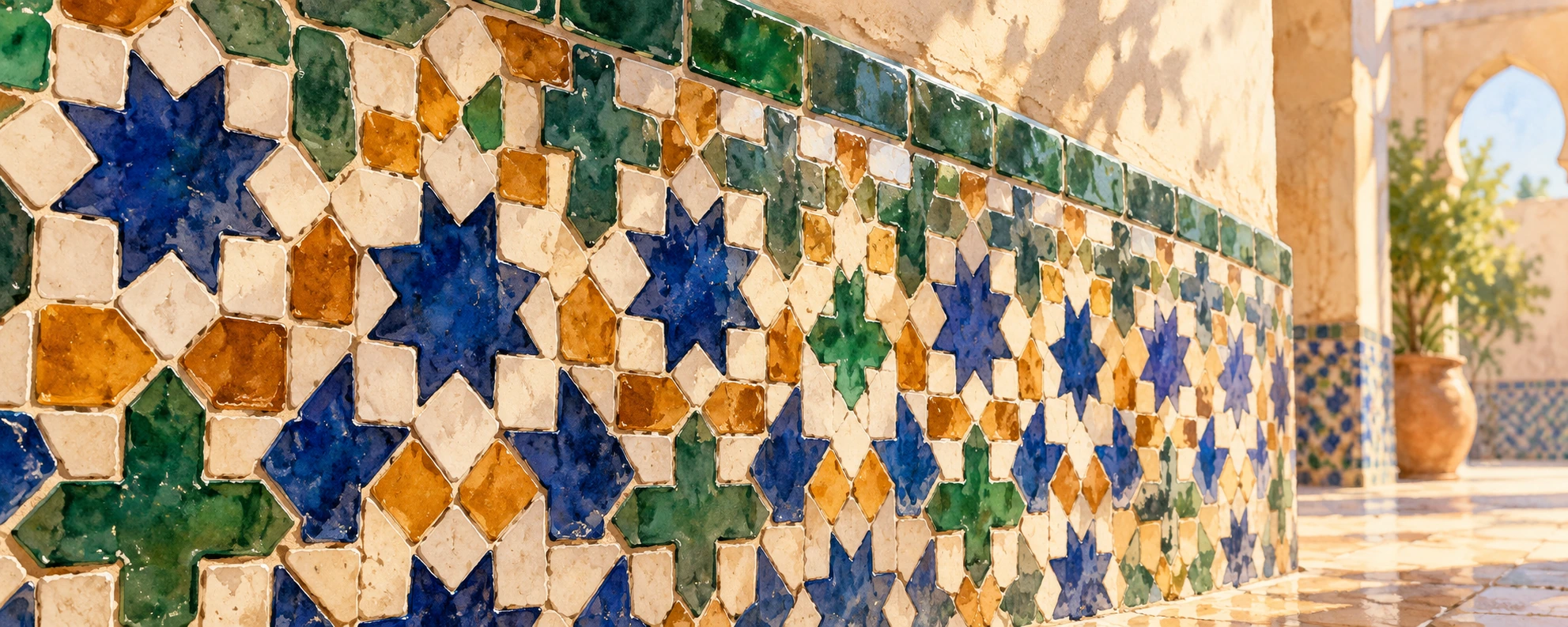
Zellige, also written zillij or zellij, is associated especially with Moroccan architectural tilework. Its separately cut glazed pieces allow complex patterns to be assembled across a surface. The labor is distributed between designing a field, preparing its units, and making the units fit.
A modern court makes the work visible
The Met's teaching account of its Moroccan Court identifies the Naji family and craftspeople from Fez who created the court on site in 2011. Cut tilework appears alongside carved stucco, cedar, and marble. The installation was intended to demonstrate the continuing vitality of skilled work, rather than to present a medieval room lifted intact from somewhere else.
That date is worth keeping in view. A traditional technique can produce a new object. Calling something traditional should not make its actual makers or moment of production disappear. The court's relationship to earlier Moroccan and southern Spanish architectural traditions is part of its story; its construction in a modern museum is another part.
The museum's 17-minute documentary, Building the Moroccan Court, follows the work from Fez to New York. Watch for the point where a broad description such as “geometric design” gives way to a hand preparing or placing a particular piece. A finished surface can conceal the order of operations. A making film can restore some of that order.
Read the small shape and the larger unit separately
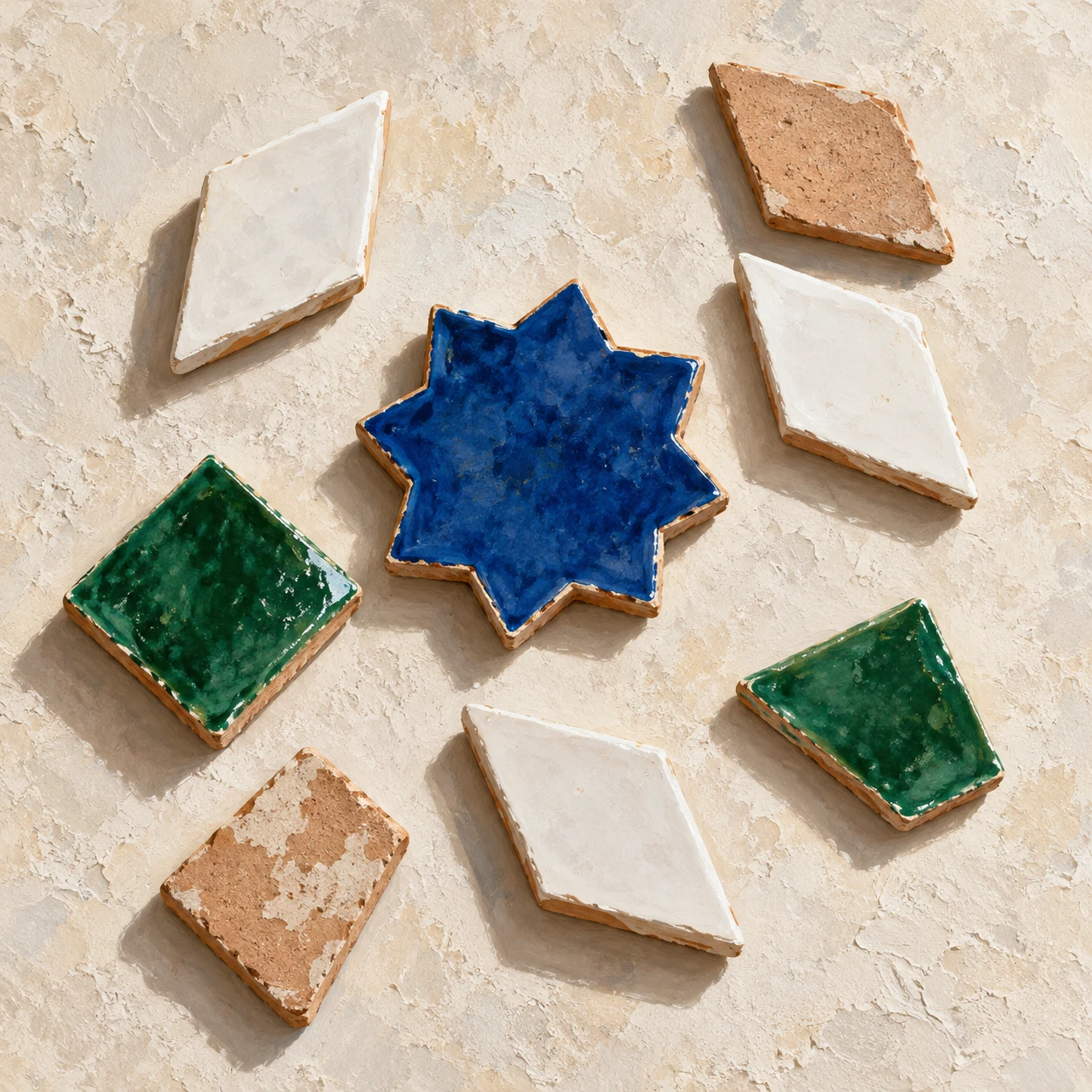
A star that you recognize across the wall may be one cut piece, a group of pieces, or a visual shape created between other units. Before tracing the whole pattern, choose one actual edge and follow it until it closes. Then ask where that outline repeats.
This is different from simply counting stars. The same surrounding arrangement can make an unfilled region look like a new motif. Color can persuade the eye to group several pieces into one form. A boundary between two colors may coincide with a joint, but the visual grouping and the physical assembly are not necessarily identical.
The Met's account of geometric ornament describes patterns built by combining, duplicating, and interlacing relatively simple elements. It also places geometric work alongside vegetal ornament and calligraphy. There is no need to turn a diverse artistic world into the claim that it contains only geometry.
A small pattern depends on orientation
Rotate four simple diagram tiles to see how unchanged pieces form a larger central shape.
Open a small pattern depends on orientation in its own window.
The four-tile exercise isolates orientation. Each diagram square stays the same while rotation changes how its blue half meets the neighboring pieces. Bringing the blue halves toward the center creates a larger figure. The exercise uses square halves for clarity; it does not reproduce the vocabulary, cutting practice, or assembly method of a historical zellige panel.
Look for where a pattern negotiates with architecture
A repeating field has to meet real corners, openings, edges, and changes of plane. Those are good places to look. Does a border interrupt the field? Does the design turn a corner as a continuation, or does another panel begin? Which parts organize the wall at room scale?
A short close-looking route
- Choose one small physical tile and trace its outline.
- Find a larger visual figure made from several pieces.
- Identify the smallest region you think repeats.
- Check that proposed repeat somewhere else on the wall.
- Move to an edge and see how the design finishes.
There may be more than one reasonable way to describe the visual repeat. That does not mean the craft is arbitrary. It means a surface can sustain several scales of organization. A useful description should make your chosen unit clear enough for another person to find it.
The slight differences among handmade pieces also deserve attention. They are not evidence that the geometry has failed. A designed relationship has been translated into fired material, cut edges, mortar, and a particular building. Zellige's appeal lies partly in that meeting between an ordered field and the work required to make it real.
Sources and further exploration
- The Met: Moroccan Court, geometric-design teaching unit
- The Met: Building the Moroccan Court
- The Met: Geometric Patterns in Islamic Art
Explore all 80 new articles · Browse the complete illustrated collection
Continue exploring art, ideas, and unexpected connections at Incoprea.