Enter a hall before anyone else arrives. A chair scrapes, and the sound seems to remain suspended after the movement stops. Return when the seats are full, and the same room may feel less acoustically spacious. The architecture has not moved. The contents have changed.
People are not merely listeners placed inside an acoustic design. Their bodies, clothing, and relationship to the seats become part of its sound-absorbing environment. They also make new sounds. Separating those two effects—changing the decay and adding noise—helps explain why an occupied room can sound different in several ways at once.
Follow the sound after the source stops
Brüel & Kjær's measurement guide defines reverberation time in terms of a 60-decibel decay after excitation stops. In practice, measurements commonly fit a shorter usable decay range and extrapolate. Results depend on frequency and position, so one casual clap does not yield a complete acoustic specification.
An echo and a reverberant tail are different listening impressions. An isolated reflection may be heard as a separate repeat. Many closely arriving reflections can merge into a continuing decay. The Acoustical Society of America's concert-hall explanation follows sound from its direct arrival through individual reflections into the later response.
Try listening to the end of an ordinary spoken sentence in a room you can use quietly. Attend first to the consonants, then to what remains after the speaker stops. Do not make unusually loud impulses or disturb a performance. This is an attention exercise; a phone recording with automatic level adjustment may alter the decay you hear on playback.
Absorption is a budget
The Lehman College room-acoustics notes introduce the Sabine relation: reverberation time is approximately proportional to room volume and inversely proportional to total equivalent absorption. In SI units, the familiar model is T ≈ 0.161V/A. Its simplicity depends on assumptions about the sound field and absorption; it is not an exact law for every room.
Compare two room states
Silent Sabine calculator and normalized decay lines; illustrative absorption totals, no room-design prescription.
The model gives you a fictional room volume and two absorption totals, representing two different states. It does not pretend that every person contributes a universal fixed number. Compare an empty-state absorption of 100 square meters with an occupied-state value of 200, while keeping the volume at 1,000 cubic meters. The calculated reverberation time halves, from about 1.61 to 0.81 seconds.
Now double the room volume while leaving the two absorption totals unchanged. Both calculated times double. The exercise identifies two different routes to a long tail: more volume for sound to occupy, or less effective absorption. A photograph that shows only the room's size cannot tell you its complete behavior.
An empty seat is not necessarily acoustically empty
Beranek and Hidaka's concert-hall study compared absorption inferred from reverberation measurements before and after seats were installed, including occupied and unoccupied conditions. The halls included different degrees of upholstery. Their work makes the seat itself part of the evidence, rather than treating an empty chair as acoustically absent.
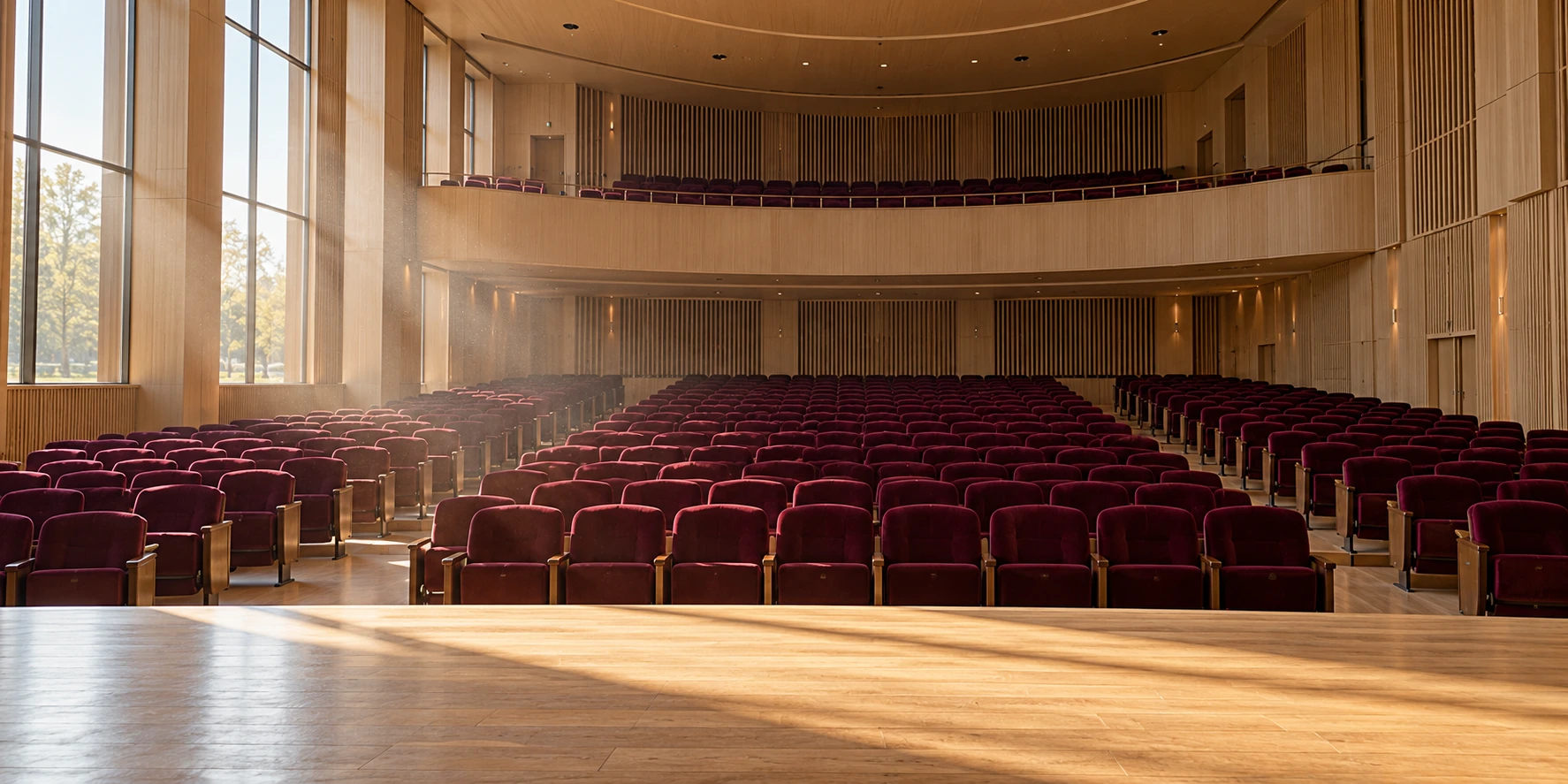
Look at the hero illustration's rows of chairs. Which visible features might matter: fabric, padding, exposed hard surfaces, spacing? You can propose hypotheses from the picture, but you cannot derive absorption coefficients from its appearance. A convincing visual resemblance to a good hall is not a measurement.
The listener has a task, not one ideal number
A room that sustains a choral phrase can also blur rapidly spoken words. That does not make long reverberation universally bad or short reverberation universally good. The source, repertoire, amplification, background noise, and listener's purpose all affect the judgment.
A two-visit listening notebook
If you visit the same venue empty and occupied with permission, keep your position similar. Note occupancy, seat type, whether doors or curtains changed, and any ventilation or crowd noise. Describe the apparent tail and speech clarity separately. Without controlled source and measurement conditions, write “seemed shorter here,” rather than claiming a verified numerical improvement.
For a second fictional scenario, make the occupied absorption smaller instead of larger. The formula now predicts a longer occupied-state decay. That is not a prediction about typical audiences. It demonstrates that the calculator follows the absorption totals you enter, not the words empty and occupied attached to them.
Finish by changing only one input in the model at a time. That restraint is useful outside a calculator too. A lively audience may shorten a decay while making speech harder to hear through added chatter. Once those mechanisms are separated, the change is no longer a contradiction. The room is responding to its contents, while the contents are contributing sounds of their own.
Sources and further exploration: Brüel & Kjær: reverberation measurement; ASA: comparing concert halls; Lehman College: room and auditorium acoustics; Beranek and Hidaka: occupied and unoccupied seats.
Explore all 50 new articles · Browse the complete illustrated collection
Explore more art, ideas, and independent projects at Incoprea.


