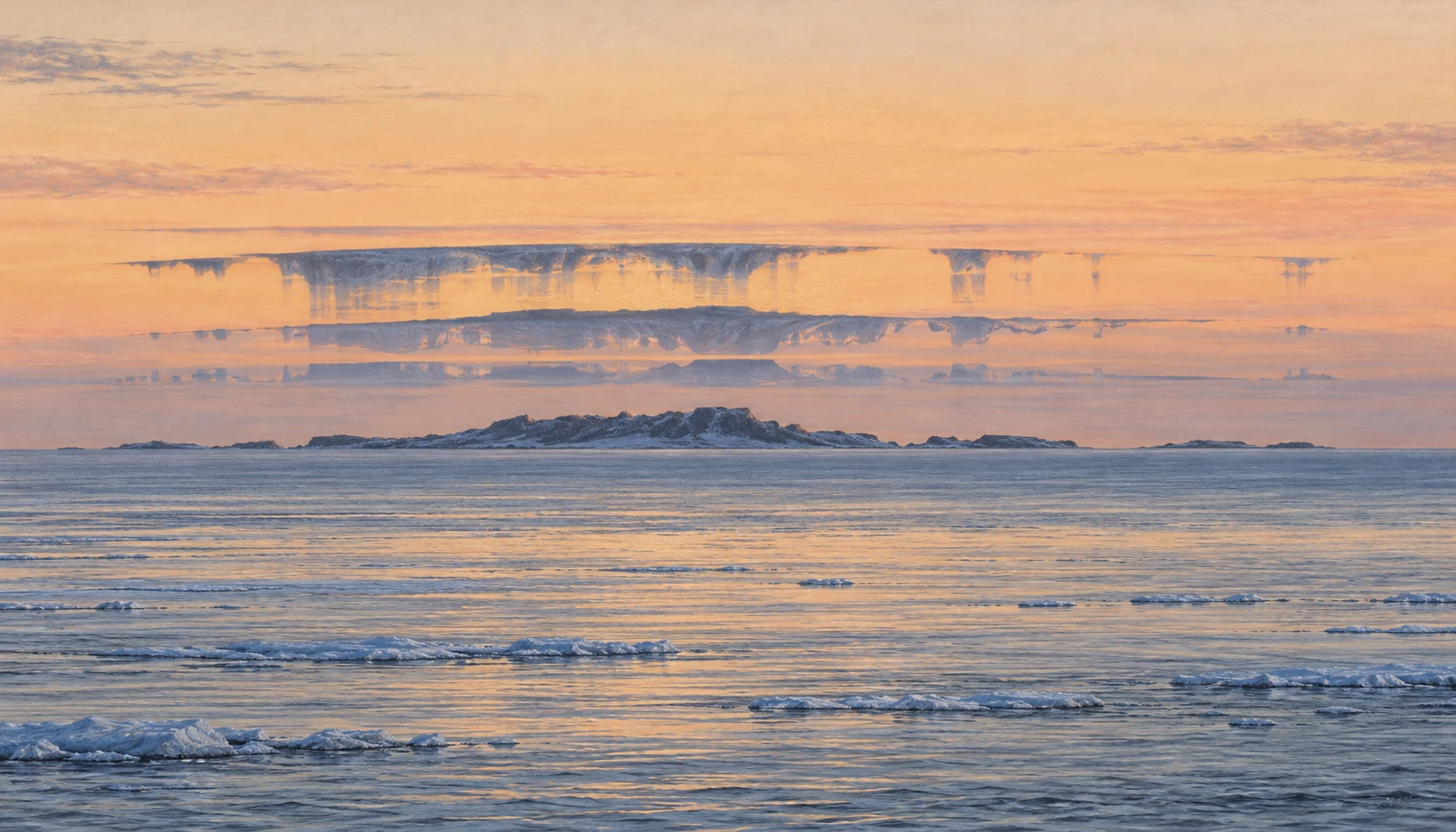
A distant shoreline can rise into a row of towers, stretch into thin pillars, split into upright and inverted pieces, then collapse back into a low strip of land. The landscape has not rebuilt itself. The route taken by its light has changed.
A complex mirage commonly called Fata Morgana can give the horizon this architectural appearance. Its fascination comes partly from a mismatch: your visual system tries to interpret familiar solid objects, while the atmosphere delivers a vertically scrambled image.
Start with an actual object
A mirage is not a hallucination. Light from real scenery reaches the observer along bent paths through air with a changing refractive index. A camera can record the resulting image. What becomes unreliable is the straightforward assumption that the object lies in the direction from which the arriving ray appears to come.
Atmospheric-optics researcher Andrew Young’s introduction at San Diego State University explains how temperature-dependent refraction creates mirages. The observer traces the final direction backward as though the ray had traveled straight. When the actual path was curved, that construction assigns the object an altered apparent position.
This makes a mirage a useful distinction between reliable detection and reliable interpretation. You truly received light. Its apparent direction does not necessarily provide the undistorted geometry you expected.
Layers can rearrange a horizon
Over a cold surface, warmer air can lie above colder, denser air. Strong vertical refractive gradients can produce superior mirages and optical ducts. Complex structures allow several ray paths to connect different parts of a distant object with the observer, producing stretching, compression, inversion, and multiple images.
Young’s detailed Fata Morgana discussion emphasizes the striking vertical elongation and apparent architecture associated with the name. It also shows why a picturesque historical description is not a complete physical diagnosis. Small changes in observer height and atmospheric structure can substantially change the display.
The mirage’s narrow vertical zone matters. Popular illustrations sometimes put a fully formed castle high in the sky. Actual complex horizon mirages tend to transform distant scenery within a compressed region near the apparent horizon. A giant fantasy city is a poor model of what an observer is looking for.
The name is less tidy than the physics
The American Meteorological Society’s glossary explicitly notes that the precise circumstances under which the term should be applied are ill-defined. That is a valuable limitation to retain. Not every photograph of a seemingly hovering ship establishes a complex Fata Morgana.
A superior mirage can elevate or invert an image without producing the elaborate stacking often associated with this name. Sometimes an indistinct or false horizon contributes to a floating appearance. A single cropped image may omit exactly the context needed to distinguish those possibilities.
Being cautious with the label does not make the phenomenon less interesting. It redirects the question from “Which exotic name wins?” to “Which refractive structure and viewing geometry could produce these observed features?” That is a question a sequence of observations can help answer.
A shoreline observation notebook
If a distant coast or ship looks distorted, stay at a safe public viewpoint and make a short sequence rather than one tightly cropped photograph. Include enough surrounding water and sky to preserve the apparent horizon. Record the time, approximate viewing height, direction, and the identity of fixed landmarks when known.
- Take a wide contextual image before zooming in.
- Photograph the same feature repeatedly as the atmosphere changes.
- If safely possible, compare a modestly higher or lower viewpoint.
- Describe what changed: inversion, duplication, vertical stretch, or disappearance.
- Keep “possible mirage” separate from the more specific classification.
This is an observational guide, not a way to measure the full air-temperature profile from photographs alone. Nearby weather-station data may also fail to represent the thin refractive layers along a long water path.
Why height is such a strong clue
Draw a distant lighthouse and two observers at different heights. In uniform air, the geometry changes predictably as the viewpoint rises. In layered air, each observer can sample a different collection of curved ray paths. A layer that produces multiple apparent images for one viewer may place another viewer outside the necessary geometry.
The sketch is not a ray-tracing solution. It is a way to understand why “I stood beside someone and saw a different shape” need not imply imagination. The two observers may have different optical access to the same distant object.
Roland Stull’s atmospheric-optics chapter provides the broader physical framework of refraction, optical paths, and atmospheric effects. A useful next exercise is to compare its ray diagrams with an observed sequence and identify which features the simple drawing explains and which require a more complex profile.
For a useful comparison, sketch the undistorted outline of a known island from a clear-day photograph. Beside it, draw only the features you can identify in the miraged view. Leave the uncertain connections blank. Matching a recognizable notch or headland across the distorted bands is stronger evidence than deciding that the whole shape resembles a familiar building. The comparison makes interpretation answerable to a real object.
A photograph can preserve the wrong inference
Digital zoom enlarges the distorted image; it does not remove the refractive distortion. Sharpening can make a narrow bright edge look more architectural without establishing a real tower. A caption should therefore describe both the distant subject and the optical conditions inferred from the image.
There is also a scale problem. A telescope compresses a huge horizontal distance into a small frame. Without a known object, the viewer may assign an invented size to a thin band. Keeping the uncropped frame and a familiar landmark makes the picture more useful than a dramatic isolated silhouette.
The wonder survives this discipline. An ordinary island has become an experiment in how we know where things are. The apparent castle belongs neither wholly to the landscape nor wholly to the mind: it is the product of a real object, a structured atmosphere, and a particular place to stand.
Sources and a next step
- Andrew Young, SDSU: introduction to mirages
- Andrew Young, SDSU: Fata Morgana
- AMS Glossary: Fata Morgana terminology
- Roland Stull, UBC: atmospheric optics
Continue exploring art, ideas, and unexpected connections at Incoprea.