At first, the sound seems to arrive from everywhere. A circle of voices repeats a clipped syllable, hands rise, and a figure steps into the open space. Then your ear catches something smaller: one pattern returning while another slips between its attacks. The excitement is being assembled, contribution by contribution.
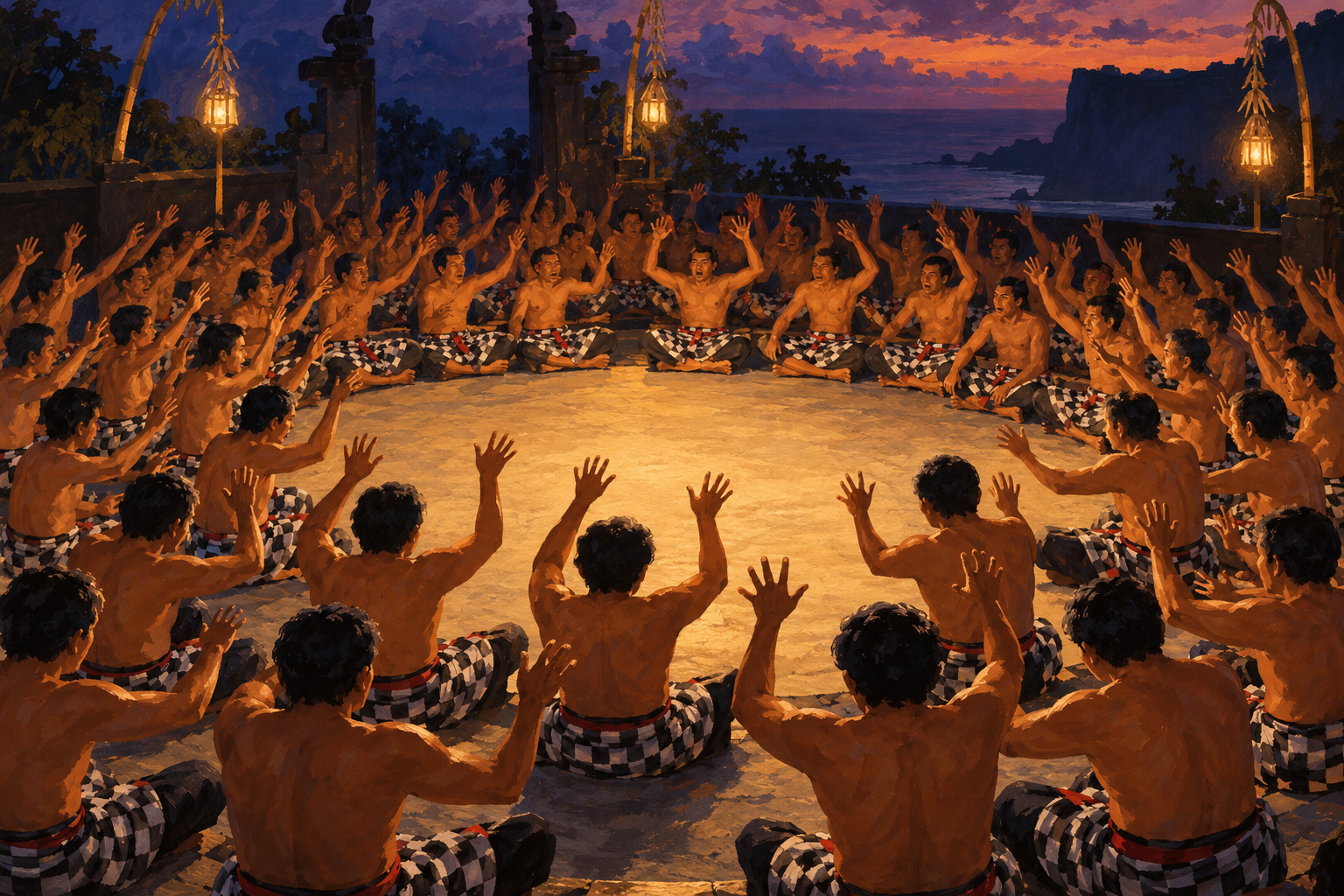
This is a rewarding way into Balinese kecak. You can enjoy the theatrical spectacle immediately, but hearing the relationships inside the chorus reveals a second performance. What seems like one enormous voice is coordinated work. Its history is equally intricate: the familiar dance drama took shape in the twentieth century through artists adapting inherited materials for changing audiences.
A chorus that behaves like an ensemble
The liner notes for Smithsonian Folkways’ The Bali Sessions describe kecak as a vocal orchestra. Interlocking parts create a texture that a listener cannot explain by following only the loudest voice. The repeated “cak” sound gives the genre its name, but naming the syllable does not explain the music any more than naming a drumstroke explains a whole rhythmic arrangement.
Listen for where a part lands in relation to its neighbors. Two contributions can be individually straightforward while their combination feels quick and densely populated. A useful question is therefore not simply “How fast are they chanting?” Ask which figure returns, which fills a gap, and which signals that the ensemble is moving into a new passage.
Body movement adds another layer of information. The circle can draw the eye toward a dramatic figure, expand a gesture across many performers, or change its collective shape. You do not need to decode every movement on a first viewing. Begin by noticing whether a change in posture coincides with a change in the vocal texture.
A modern form with older relationships
Ethnomusicologist Kendra Stepputat’s study of sanghyang dedari and kecak traces a close relationship between the trance-possession ritual and the later tourist performance. Related musical and movement materials traveled into a different setting. That historical connection does not make a ticketed stage presentation the same event as a community ritual.
The genre’s development in the 1930s is often associated with Balinese dancer I Wayan Limbak and expatriate artist Walter Spies. Yet a two-person origin story leaves little room for the ensembles, villages, and successive choreographers who made a repeatable performance possible. Stepputat’s broader research follows those interactions rather than treating the dance as a single invention preserved unchanged.
Many familiar productions draw dramatic episodes from the Ramayana. This helps explain the popular nickname “monkey chant,” but the nickname can also misdirect attention. A viewer looking only for monkey characters may overlook the chorus as musicians, or assume that all its sounds imitate animals. The dramatic story and the ensemble’s musical construction are related parts of the event, not interchangeable descriptions.
Tourism belongs in the story
The University of Music and Performing Arts Graz’s account of Stepputat’s research emphasizes the continuing interaction between Balinese performers and international audiences. It includes the genre’s economics alongside choreography, music, and history. That is a useful correction to the idea that a performance becomes culturally interesting only when visitors have had no part in shaping its presentation.
Think about the work required to make an evening performance happen again tomorrow. Performers need reliable cues and shared expectations. They also make choices about pacing, dramatic emphasis, and what an unfamiliar audience can follow. Repetition and creativity can occupy the same production. The question is how particular artists use the form, not whether a tourist happens to be watching.
Stepputat’s analysis of movement also distinguishes the histories of the soloists’ vocabulary and the chorus’s movement. A stage contains more than one line of development. Looking for those differences gives a viewer something more precise to consider than a general impression of timelessness.
Hear the same passage three ways
“Kepandung Sita,” credited to Sekaa Kecak Puspita Jaya, provides a named performance to explore through Smithsonian Folkways. The album page offers listening options; full streaming may require membership. Use an available excerpt, or a credited performance you can already access, and return to the same short passage for each pass.
| Pass | Give your attention to | Write one observation |
|---|---|---|
| One: a recurring part | One short figure you can recognize when it returns. | Describe its rhythm in your own words. |
| Two: the spaces around it | Sounds that arrive between or across those returns. | Does the texture feel fuller while the first figure stays familiar? |
| Three: the group’s decisions | A collective change in emphasis, sound, or movement. | Note the point in the recording so you can find it again. |
Do not worry if the first part becomes hard to follow. That difficulty is useful evidence about your listening attention. On the next pass, choose a shorter stretch or a more conspicuous sound. The aim is to hear a relationship you missed, not to demonstrate that you can keep track of every performer.
If the recording includes video, try one pass without watching. Then restore the picture and see whether visible gestures help you anticipate a change. A camera close-up can make one contribution seem central even when the sound places it inside a larger texture. Listening and watching separately helps you notice that choice.
A small experiment in shared space
With a partner, mark an even pulse softly on a table. Let one person tap on the pulses and the other tap halfway between them. Stop after a few seconds, then exchange roles. You have not recreated kecak; you have isolated the general problem of placing one contribution in the spaces of another.
Now return to the performance. The simple experiment makes coordination easier to appreciate without pretending to teach a repertoire or replace the musicians’ knowledge. The satisfying discovery is that an ensemble’s density need not come from everyone doing more. It can come from people doing different things in a well-maintained relationship.
Carry the performers’ names away with you alongside the sound. Kecak becomes more compelling when its modern history, skilled collective work, and individual productions remain visible. The circle is not a frozen image of a distant past. It is a group of artists making an event happen together.
Keep exploring
Compare a different kind of ensemble identity in Gamelan Tuning: Why an Ensemble Has Its Own Musical Voice, then hear coordinated musical lines emerge from one performer in The Kora: Two Hands, Many Musical Lines.
Explore more art, ideas, and independent projects at Incoprea.




