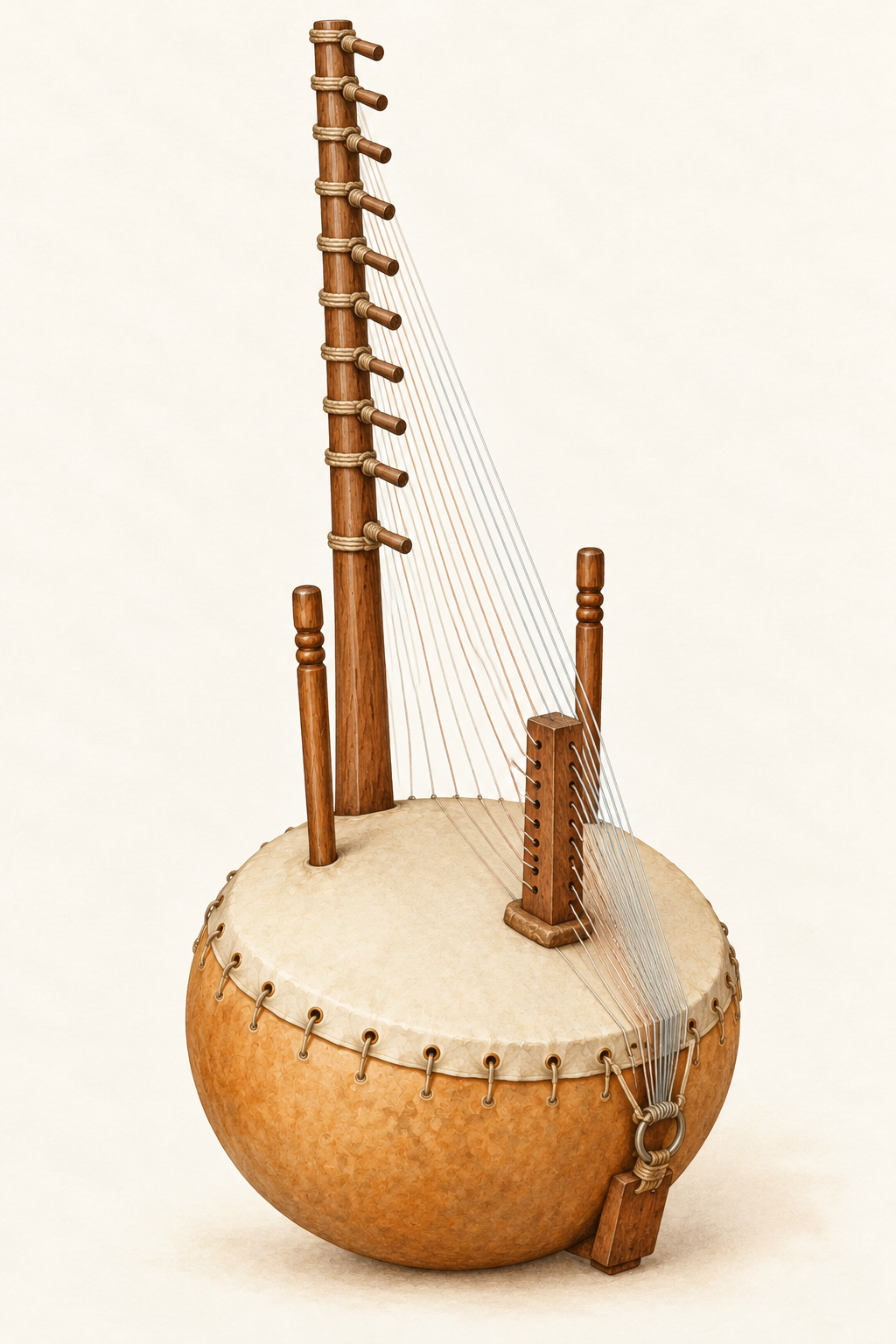
A kora's appearance is distinctive: a long wooden neck rises above a hide-covered gourd, with strings passing through a tall bridge. Its sound can seem equally surprising, as repeating patterns and flowing melodies emerge from the same player's hands.
The instrument is strongly associated with the Mandé region of West Africa and with jali or jeli traditions of musicianship, storytelling and social knowledge. Its musical importance extends beyond the sound of plucked strings.
A gourd becomes a resonator
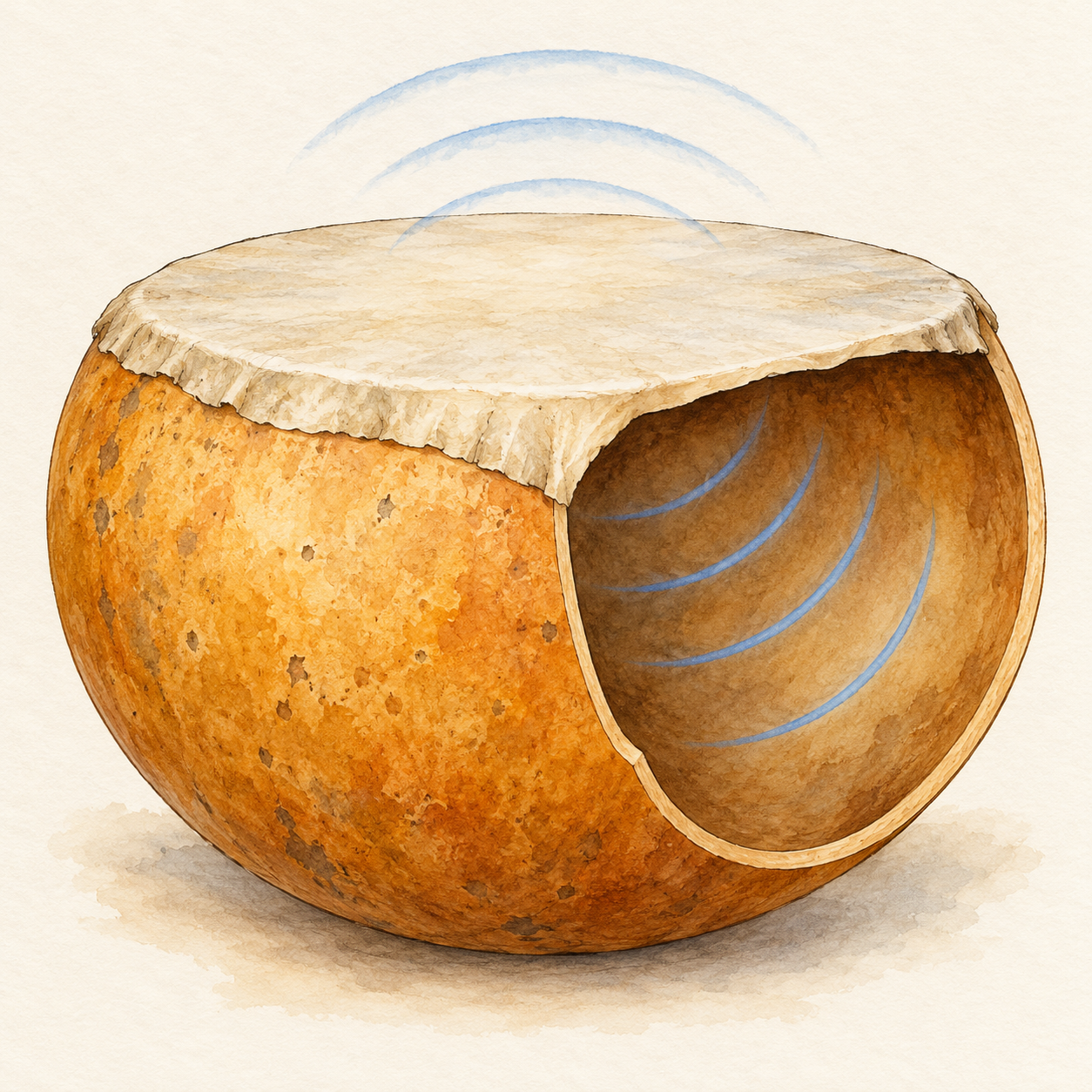
A common kora has 21 strings, arranged in two rows on either side of an upright bridge. The bridge stands on the hide soundboard covering a calabash resonator. The long neck supports the tension of the strings, while handles help the player hold the instrument in position.
The player plucks with the thumbs and index fingers of both hands. Different notes are distributed between the rows, so the arrangement rewards coordinated movement rather than the fingering used on a fretted guitar. The instrument is generally classified as a harp, although “harp-lute” also appears in discussions of its distinctive construction.
Materials and designs have changed. Museum examples preserve older string materials and leather tuning attachments; contemporary makers can use nylon strings and mechanical tuning systems. The 21-string description identifies a common form, not a prohibition on instruments with additional strings.
Patterns interlock
A player can maintain a repeating accompaniment while adding melodic and rhythmic variations. The resulting texture may suggest several musical parts, even though the coordination happens in two hands. Listening closely reveals how repetition gives the changing material a foundation.
The mechanics are only one aspect of the tradition. In the communities where jali or jeli roles are inherited, musicians can also be keepers of histories, praise, family connections and social relationships. Not every modern kora player occupies the same role, and the cultural setting should not be reduced to a generic description of “African music.”
Yacouba Sissoko's Carnegie Hall educational resources provide a specific personal account. Born in Kita, Mali, into a jeli family, he began learning the kora and its associated oral traditions from his grandfather. His later work includes sharing that knowledge with learners and collaborating across musical settings.
Watch the hands, then listen to the whole
Carnegie Hall's materials with Yacouba Sissoko include videos and listening resources. Begin with the hand movements, then follow a repeated pattern underneath a changing phrase. This is a better introduction to the instrument's musical possibilities than counting strings alone.
The accompanying cutaway simplifies the gourd and hide soundboard to explain the resonating body. It leaves out the rest of the instrument rather than pretending to be a maker's technical plan.
A kora performance brings together construction, coordination and knowledge carried between people. Its shimmering texture is an invitation to hear both the player's individual choices and the traditions within which those choices become meaningful.
Sources and further reading: The Met: Kora construction, history and technique; Carnegie Hall: Malian traditions with Yacouba Sissoko; Sierra Leone National Museum: Kora collection record.
Explore more creative discoveries at Incoprea.




