Watch the player's right hand before you listen for a melody. A finger travels along the front of a keyboard, apparently ignoring the keys. The sound bends with the gesture. Meanwhile, the left hand works inside a small drawer. One hand decides where the note goes; the other decides how it arrives.
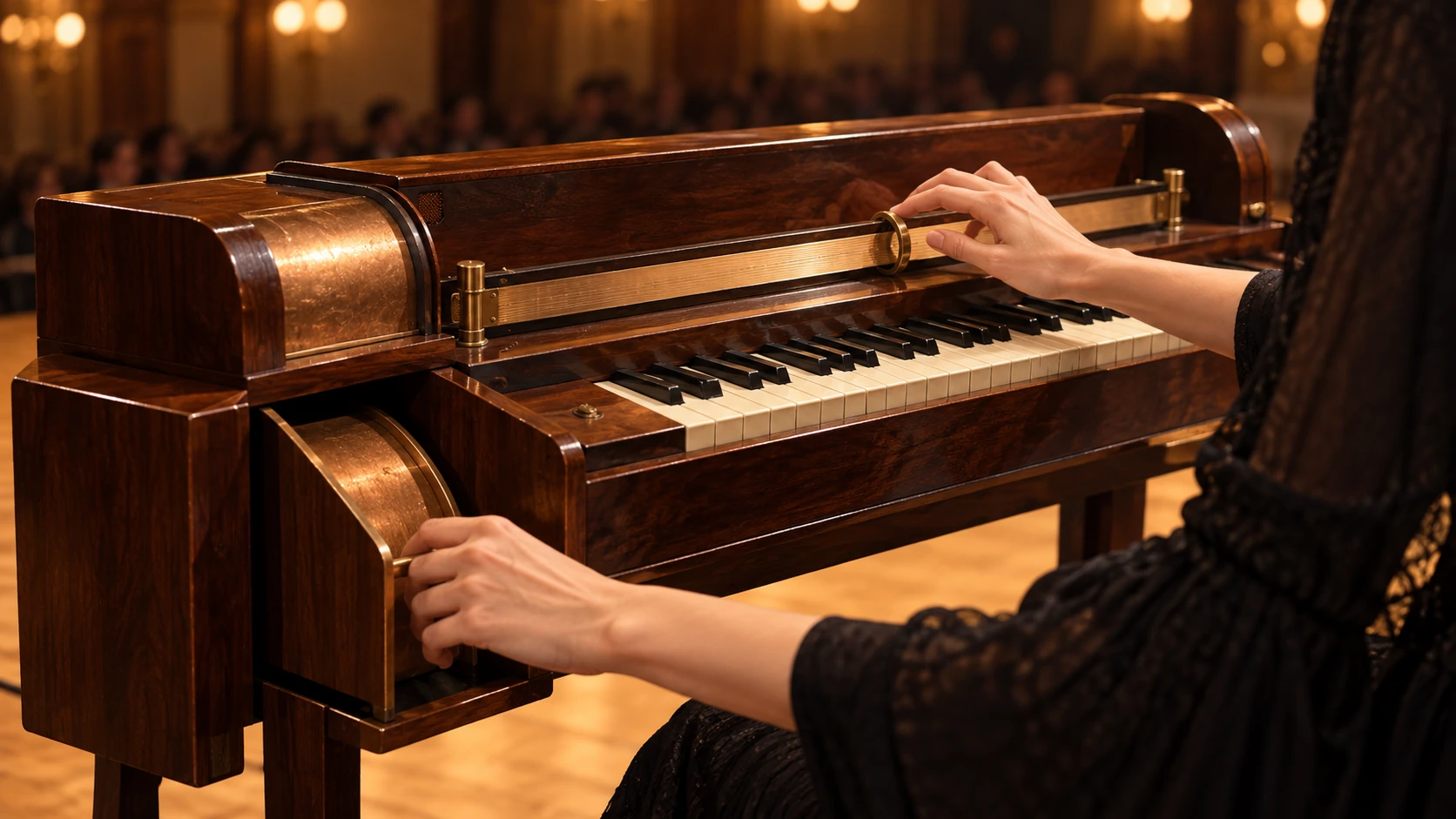
The ondes Martenot makes an unusually clear invitation to watch music being shaped. Its electronic sound can seem remote or ghostly, but the control is close, physical, and practiced. The instrument rewards a question more specific than “What makes that strange noise?” Ask which hand is responsible for the change you just heard.
Separate the jobs before joining them
The LAM acoustics laboratory describes a division between pitch control with the right hand and amplitude control with the left-hand expression key. Electronic oscillation supplies the tone. Changing the signal's shape supplies different timbres. Those are related parts of a performance, but they are not the same control.
You can explore the distinction without an instrument. Trace a slow rising line in the air with one hand. With the other, mime a pressure that starts gently, grows, and releases. Repeat the rising line with a sudden attack instead. The pitch route is unchanged; the imagined phrase is different. This is a movement exercise, not a claim that air gestures reproduce the instrument's resistance.
The ring makes the spaces between keys available
In performer Thomas Bloch's description, a ring on a ribbon allows the right index finger to travel continuously along the keyboard's front. A later mobile keyboard can also support vibrato through lateral movement. A familiar piano-like layout therefore sits beside a very different way of reaching and connecting pitches.
Imagine singing a single syllable while sliding between two notes. Now imagine playing the intervening piano keys one after another. Both gestures rise, but one crosses a continuous space while the other selects steps. A composer can use either kind of movement deliberately. Neither is automatically more expressive; each makes certain relationships easier to articulate.
In Bloch's linked demonstrations, choose a passage with an exposed solo line. First watch with the sound low and predict where a slide begins. Then listen at a comfortable level. Look for moments when the hand stops moving but the tone still changes in strength. You are listening for the relationship between controls, rather than trying to name a mood.
A museum object has a particular version
The Musée de la musique's 1930–1934 instrument is a useful antidote to treating every ondes Martenot as identical. Its account traces the 1928 public presentation, describes early ribbon playing, and identifies the expression key in the drawer. It also distinguishes that object's loudspeaker arrangement from additional diffusers introduced on later models.
That matters when reading a photograph. A feature described for a late concert instrument might not belong to an earlier surviving example. Before identifying a control in a video or museum image, look for a date or model description. A missing component can reveal the instrument's development rather than damage or incompleteness.
A close-looking checklist for a performance
Follow one phrase three times. On the first pass, track only horizontal right-hand movement. On the second, watch how the left hand starts and ends sounds. On the third, listen for whether the character changes while the melodic register stays similar. Write one observation for each pass. Leave uncertain mechanisms as questions instead of guessing from the sound alone.
The loudspeaker can belong to the instrument
Bloch describes different diffusers, including a conventional loudspeaker and resonating devices that add their own response. The sound reaching the listener is therefore shaped after the electrical signal is created. This is a useful reminder for any electronic music: the thing that radiates sound into a room can participate in its character.
Try a final thought experiment. Keep the same short melody, then change just its envelope: a slow swell, a clipped pulse, a gentle release. Next keep that envelope and replace the sliding route with discrete steps. You have altered two independent dimensions, one at a time. When you return to the performance, the seemingly mysterious voice becomes a set of decisions you can follow.
The fascination does not vanish when the controls become understandable. It moves into coordination. A line that sounds effortless may require both hands to solve different problems at exactly the same moment. Listen for the breath of the phrase, and watch where that breath is being made.
Sources and further exploration: LAM: the expression controller; Thomas Bloch: instrument and demonstrations; Musée de la musique: a 1930–1934 ondes Martenot.
Explore all 50 new articles · Browse the complete illustrated collection
Explore more art, ideas, and independent projects at Incoprea.