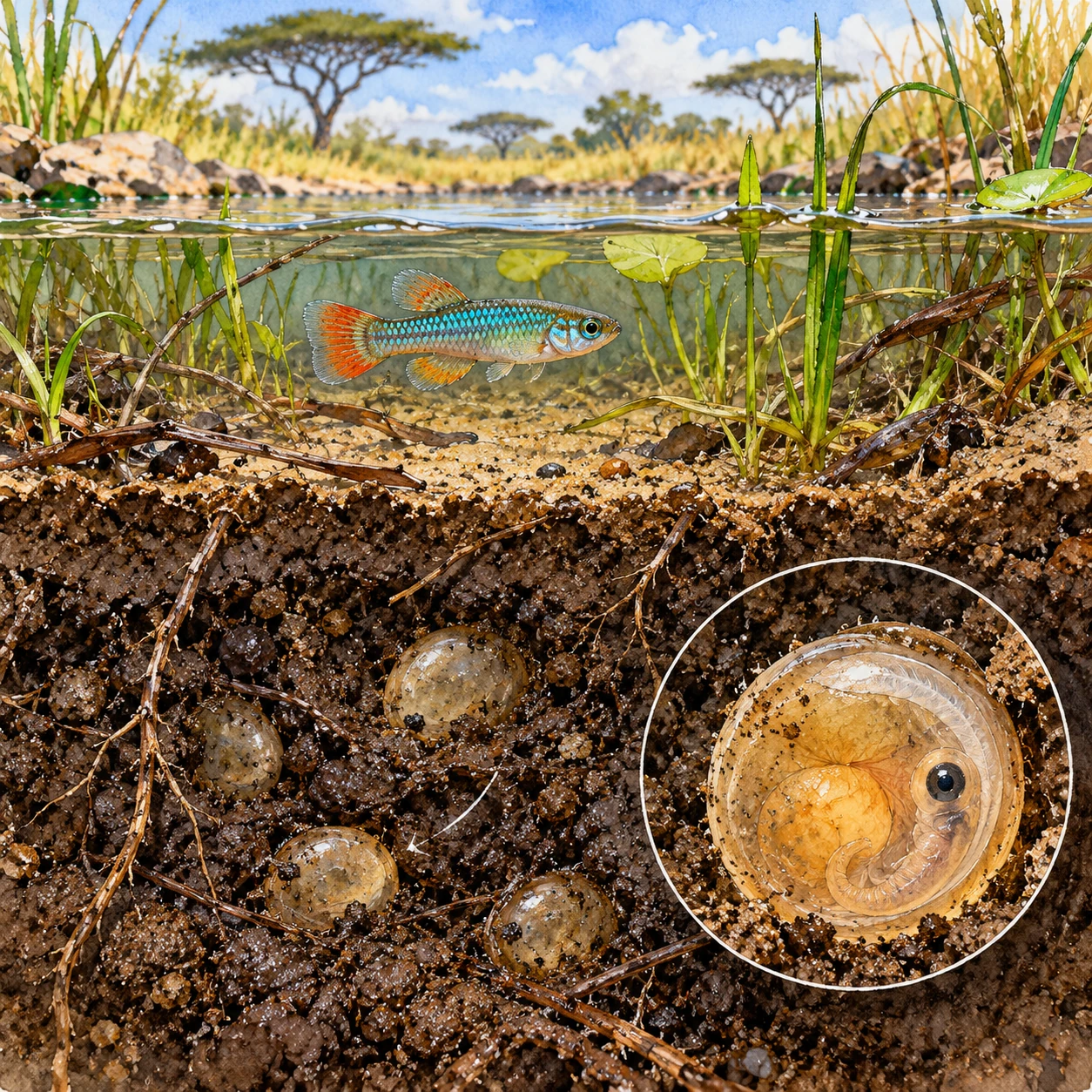
A pond can disappear without the local fish lineage disappearing with it. The apparent contradiction is resolved below the mud's surface. For the African turquoise killifish, Nothobranchius furzeri, the dry season can be crossed as an embryo inside an egg, with development held in a regulated pause. The adult is adapted to an urgent season. The embryo is adapted to waiting.
This is not a story of a fish flopping out of water and surviving until rain returns. The life stage matters. Adults inhabit temporary pools; embryos can remain when the adult habitat is gone. Calling the fish “drought proof” would blur the very division of labor that makes its life cycle understandable. One stage grows and reproduces within a limited opportunity, while another carries the lineage through its absence.
Paused development is still a biological activity
The term for this state is diapause. It is a programmed interruption of development, not simply a dead embryo that later becomes alive. The Brunet Lab's research overview identifies killifish as a model for studying both vertebrate aging and this unusual preservation state. Those subjects meet in a basic question: what must a living body keep doing when ordinary growth is stopped?
The useful image is not a film frozen at a frame. A film frame requires no maintenance. Cells still have structures and molecules that must remain functional if development is to resume. A pause must therefore include a strategy for preserving what already exists, not only an instruction to make fewer new parts.
In a 2020 study in Science, researchers followed gene activity during diapause and tested genes involved in chromatin regulation. Chromatin is the molecular organization of DNA and its associated proteins; changes in that organization help control which genes are used. The study identified members of the Polycomb system, including CBX7, as important for maintaining diapause and preserving muscle. Disrupting a regulator did more than change a molecular label: it altered the maintained state.
That moves the explanation from “the embryo slows down” toward a testable mechanism. A preservation program has components. If changing a component damages preservation or changes the timing of exit, researchers can begin to distinguish causal work from molecular changes that merely accompany the pause.
How do you test whether waiting has a cost?
The same 2020 research compared later outcomes in fish that had experienced diapause. Within the durations and conditions studied, the pause did not produce an apparent penalty in subsequent growth, fertility, or adult lifespan. This is striking, but its boundaries are essential: an observed absence of a cost in these measures is not proof that every possible cost is absent under every environmental condition.
The small fish is useful partly because its adult life is short enough for researchers to follow whole lifetimes within a practical study. Stanford's account of building the research model describes the development of genetic tools and shared resources. A compelling organism becomes much more informative when different laboratories can measure comparable traits and test the same biological components.
Evolution can rewire existing tools
A 2024 Cell study investigated how the diapause program evolved. It compared regulatory activity and gene expression across relevant species and developmental states. Its central finding concerned the reuse of ancient genes through changes in their regulatory landscape. Evolution did not need to invent every preservation-related molecule from nothing; changes in when and where existing genes were used could help build a new life-history program.
That is a different kind of ingenuity from the usual picture of evolution producing a novel anatomical gadget. A shift in coordination can change an organism's possibilities. The same general principle is familiar in making things: possessing a set of materials is different from organizing them into a working process. The analogy helps with the distinction, but the research concerns inherited biological regulation, not a designer making a deliberate plan.
Natural populations also prevent the species from becoming a simple symbol of one fixed lifespan. Max Planck research compared wild populations and linked differences in lifespan to population history and the accumulation of harmful mutations. Ecology, demography, genetic background, and laboratory conditions all matter when interpreting an aging result.
None of this establishes a method for placing a person in suspended animation. It does establish a vertebrate system in which long preservation, resumed development, and molecular regulation can be investigated together. The difference is substantial: one is a dramatic application we can imagine; the other is an experimental opportunity researchers actually have.
When the rains return, the pool looks like a place newly ready for life. The eggs tell a longer story. Life was already present, organized to wait through the period when its adult form could not live there. The most remarkable part is not that time was defeated. It is that evolution produced a way to spend one kind of time very differently from another.
Follow the evidence: Hu and colleagues: vertebrate diapause and Polycomb regulators; Singh and colleagues: evolution of the diapause regulatory program; Brunet Lab: aging and diapause research; Stanford: establishing the killifish research model; Max Planck Institute: lifespan differences in wild populations.
More curious connections, art and independent projects at Incoprea.