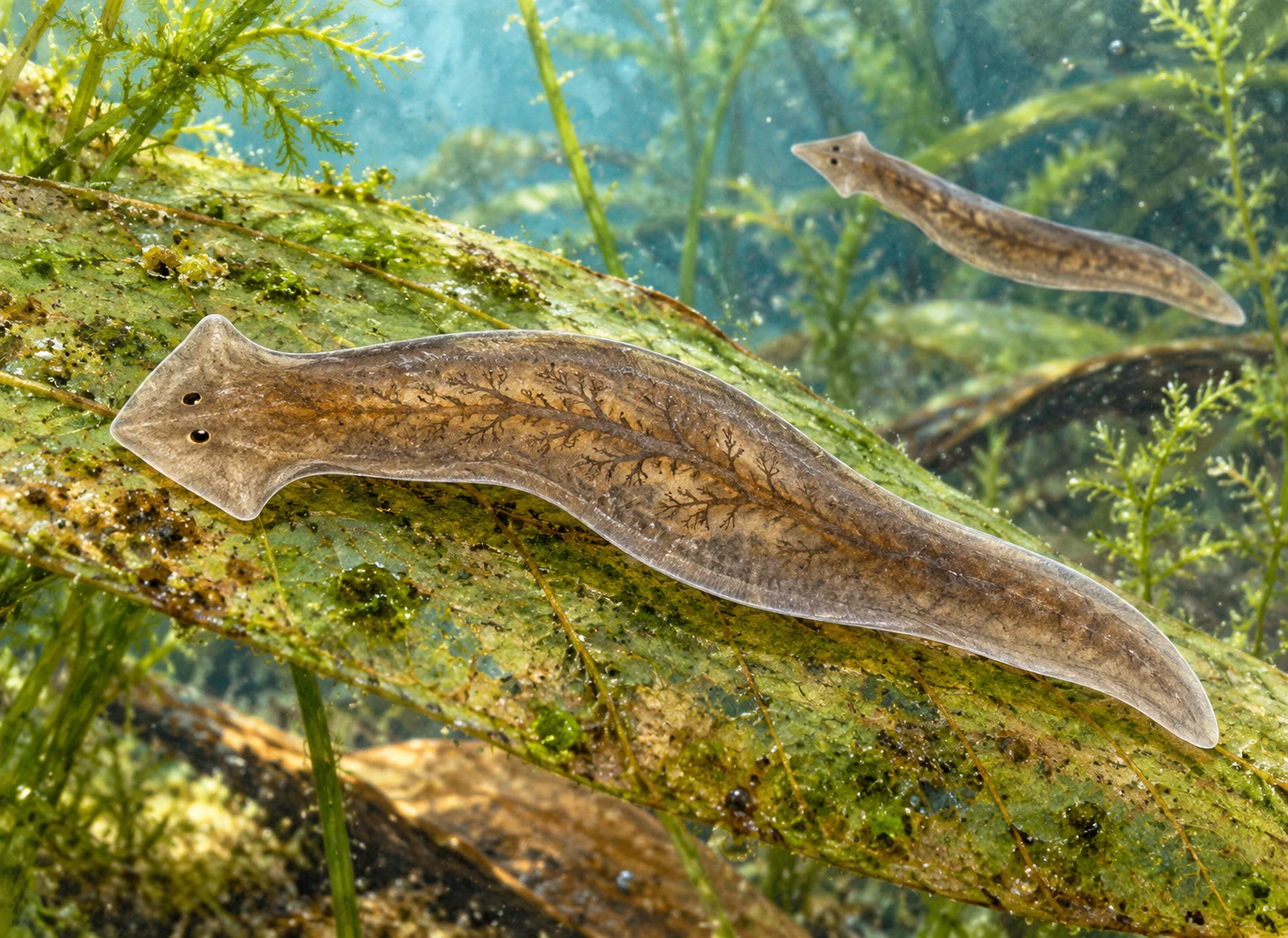
A regenerating animal has more to do than make new cells. It must make the right kinds of cells, put them in appropriate places, and connect them into a body that works. A freshwater planarian makes that problem unusually visible. Its capacity to replace missing tissue forces a question that a simple “it grows back” leaves unanswered: how does the new tissue know where it belongs?
The word “know” is shorthand. No cell consults a miniature picture of the completed worm. Researchers investigate signals, gene activity, cell populations, and responses to injury. The aim is to explain how local biological processes produce an organized result.
Material and instructions are different requirements
The Reddien Lab's research overview separates two central systems. Planarian neoblasts are proliferating cells that include pluripotent stem cells capable of giving rise to the body's different cell types. Positional information helps guide which tissues are produced and how the body is patterned. A supply of versatile cells alone is not a complete regeneration mechanism.
An analogy from building helps identify the distinction. A warehouse of useful materials does not specify where a doorway belongs. Conversely, a plan without materials cannot produce a building. The biological systems are not literally a warehouse and blueprint, but the comparison prevents “stem cells” from becoming an answer to every part of the problem.
It also clarifies why an experiment can disrupt pattern without simply stopping growth. Tissue may still be produced while its identity or arrangement changes. Measuring the amount of new tissue and identifying what that tissue has become answer different questions.
Muscle does more than move the worm
A 2013 study by Witchley and colleagues found that many position-control genes were expressed in planarian muscle cells. These included genes associated with signaling systems involved in head-to-tail and other body-axis decisions. Muscle was therefore a major source of information used in maintenance and regeneration, not merely a motor wrapping the organs.
This is surprising because familiar tissue names tend to come with a dominant job. Muscle contracts; neurons signal; stem cells generate descendants. Real tissues can perform additional roles. Discovering a positional signaling system in muscle changes what experiments should measure and which cells become plausible sources of instruction.
After injury, aspects of this regional gene-expression system can be reset. The remaining body is not only a fragment awaiting replacement material; it contains living tissues that respond and help establish a new patterning context. Regeneration includes reorganizing information as well as producing cells.
A coordinate system can be distributed
Research on FGFRL–Wnt circuits examined regional expression in muscle and its role in organizing the head-to-tail axis. Genes with different spatial patterns can provide overlapping information. The system does not require one special cell that stores the location of every other cell.
The Whitehead account of the work explains how experimental manipulation helped reveal those functions. Changing a signal and observing a corresponding patterning change provides stronger causal evidence than finding that a gene is active near a structure. Location suggests a hypothesis; perturbation tests a role.
Even a causal experiment has boundaries. Suppressing a gene can affect several processes, and one observed outcome does not establish every interaction in the network. Researchers compare markers, tissues, timing, and controls to decide which interpretation best fits. The complicated part is not a distraction from the spectacle; it is how the spectacle becomes understandable.
Regeneration is also ordinary maintenance made visible
A 2022 synthesis connects positional information with stem-cell biology in regeneration and normal tissue turnover. Maintaining an uninjured adult also requires replacing cells without losing organization. Injury reveals an especially dramatic version of a continuing biological problem.
That connection avoids treating the worm as a bag of magical cells that activates only when damaged. The living body already coordinates cell production, differentiation, and position. Regeneration redirects those capacities in response to a changed condition.
It does not follow that any microscopic fragment of any flatworm can produce a complete animal, or that the same signaling intervention would give a human the same capacity. Species, fragment properties, and experimental conditions matter. The transferable scientific value lies in discovering general questions and testable mechanisms, rather than promising an immediate medical application.
The illustration shows intact animals so that the organism remains more than an injury demonstration. Its subtle internal pattern is interpretive. The paper's microscopy and gene-expression data provide the evidence for the cells and signals discussed here; no cutting experiment is needed at home.
A planarian's achievement is organized renewal. New cells are only part of it. Existing tissue supplies a changing context, muscle carries positional signals, and stem-cell descendants form appropriate structures. The small worm makes visible a large biological truth: to rebuild a body, growth has to become a pattern.
Follow the evidence: Reddien Lab: stem cells and positional information; Witchley and colleagues: muscle provides regeneration instructions; Scimone and colleagues: regional FGFRL–Wnt circuits; Reddien: positional information and stem cells in regeneration; Whitehead Institute: experimental body-patterning mechanisms.
More curious connections, art and independent projects at Incoprea.