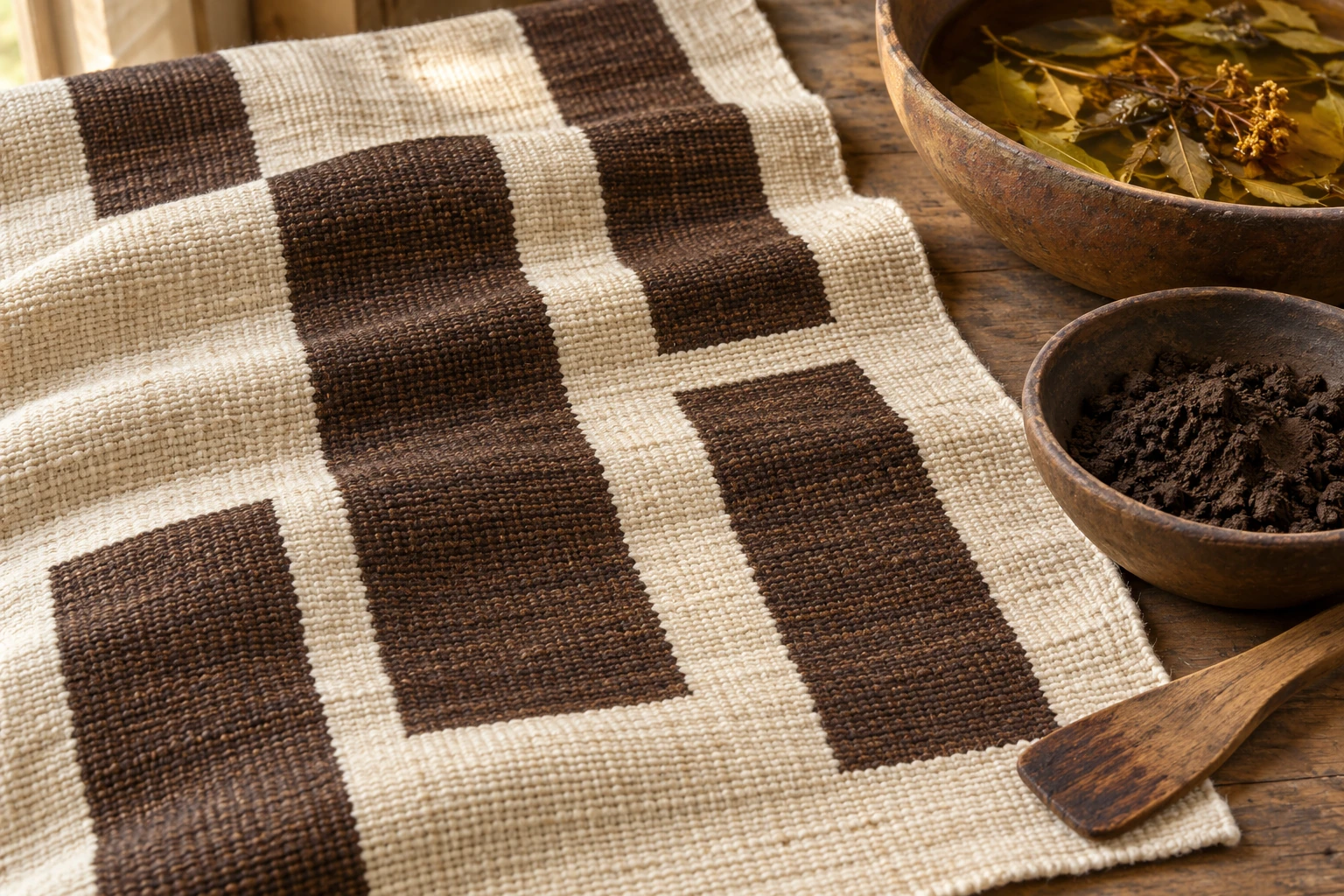
A dark field on cotton can look like an applied surface: a color laid over an already complete cloth. In bogolan, that first impression misses an interaction. Plant preparations, iron-bearing mud, fibers, washing, and the maker’s decisions contribute to the result. The cloth holds knowledge of materials as well as a visible arrangement of shapes.
It also holds somebody’s work. Begin with a named example rather than treating every brown-and-cream textile as an interchangeable “tribal pattern.” The Metropolitan Museum preserves a 1969 cloth by Gneli Traoré, a Bamana artist in Mali. Pascal James Imperato commissioned it and documented its making and designs. Its unusually specific record lets an individual emerge from a category often marketed anonymously.
Look for the cloth before the pattern
The Met’s record describes twelve narrow cotton strips supplied for the commission. These were joined into the larger surface Traoré decorated. The seam is therefore part of the object’s construction, not damage that interrupts an otherwise seamless design.
When studying the museum photographs, first locate a strip boundary. Then follow one shape toward it. Does the painted organization acknowledge the seam, cross it, or make it difficult to notice? Write down the observation before suggesting a reason. A shape that crosses a seam does not by itself prove that the cloth was painted before or after joining; the documented sequence is what can settle that question.
The artist’s biography also resists an easy inheritance story. The catalog identifies her teacher as her father’s youngest wife. It describes Traoré developing work for new markets later in life. Skill was learned, exercised, and adapted by a particular person, rather than transmitted by an undifferentiated “tradition” acting on its own.
Why mud is an incomplete explanation
A 2010 study in Applied Clay Science examined cotton, N’galama leaf extract, and mud used in the process in Mali. It identified iron-bearing material in the clay and investigated the dark complexes formed with compounds in the plant extract. Microscopy and diffraction also detected material attached to the fiber surface. The researchers were studying interactions, not simply matching the cloth’s color to the mud’s appearance.
A 2012 investigation by Mukta V. Limaye and colleagues compared traditionally made textiles with cotton treated using tannin and iron solutions. Infrared spectroscopy, electron microscopy, and X-ray absorption analysis supported the importance of iron–tannin complexes in the black coloration. Multiple methods addressed different parts of the explanation: what was present, where it was, and how its chemistry related to color.
Those findings illuminate the process without replacing the maker’s knowledge. A laboratory can identify a class of chemical interactions. It does not automatically know which local material to choose, how a preparation should handle, or when a particular painted area has reached the desired result. Naming a mechanism and reliably making an object are different accomplishments.
Ground and figure can exchange places
The Met emphasizes that the documented technique is not simply a wax-resist process. Colorant is directly applied to prepared cloth; light shapes can emerge through areas left unpainted and subsequent treatment. Keep that distinction in mind when a label uses the convenient phrase “mud cloth.” It identifies an association with a material, not a complete recipe.
Try looking at the cloth in two ways. First let the light shapes become the figures against a dark background. Then concentrate on the dark passages as connected forms. Which interpretation makes a junction easier to follow? Does either account leave an awkward unexplained edge?
This is a visual exercise, not a decoding key. A motif’s name, historical use, or social meaning needs appropriate documentation and context. Resemblance to a familiar ladder, animal, or letter does not authorize assigning that meaning to a Bamana design. An attractive guess can become misinformation when repeated without its uncertainty.
A small paper experiment in planned space
You can investigate the figure–ground problem without copying a documented motif or attempting an uncontrolled chemical dye process. Draw three adjacent rectangles on paper. Inside them, invent a continuous pale path by coloring only the surrounding space with an ordinary pencil.
- Begin with a path of even width. Notice how much of the dark field must be planned before you can keep the light shape continuous.
- Introduce a second path that nearly meets the first. Decide whether to preserve a gap or make a junction.
- Add a drawn “seam” across the sheet. Consider how it changes the composition even though it has no thickness.
- Give the experiment a descriptive name that does not borrow a cultural identity: “two paths and a gap” is sufficient.
The task reveals something practical about leaving areas uncolored. Empty-looking space may require as much advance attention as a dark mark. That is a useful insight to bring back to a textile photograph, while remembering that pencil on paper tells us little about the feel or chemistry of Traoré’s materials.
Read a product description with better questions
If you encounter contemporary cloth sold as bogolan, ask who made it, where, and by what process. A seller’s answer may be specific, incomplete, or absent. A printed cotton fabric inspired by bogolan imagery and a cloth made through plant-and-mud processing have different production histories, even when a thumbnail makes them look similar.
Do not infer authenticity from imperfection or an earthy palette. Irregularity can be imitated; precision can result from expert handwork. The useful evidence is a traceable account of makers, materials, and making. Nor does “natural” establish that every preparation is harmless or that a production chain is environmentally responsible. Those are questions requiring their own evidence.
The scientific papers suggest possibilities for conservation and further dye research; they do not provide blanket environmental certification for every object bearing the name. Keeping a claim at the scale of its evidence is part of respecting the craft.
Next time a dark-and-light textile catches your eye, begin with the seam, the edge, and the maker’s name. Chemistry can help explain why color remains. A careful object record can help explain whose choices it records. Together, they make the cloth more interesting than a surface pattern alone.
Sources and a closer look
The Met: Gneli Traoré cloth, 1969; Blanchart and colleagues: Mechanism of traditional Bogolan dyeing, 2010; Limaye and colleagues: Tannins and iron in Bogolan, 2012.
Find more art, ideas, and unexpected connections at Incoprea.