Showing posts with label Food History. Show all posts

Friday, October 23, 2026

A Banquet You Could Look At: Sugar Sculpture and the Work Behind Wonder

Imagine arriving at a banquet and finding architecture on the table: columns, figures, emblems, perhaps a whole miniature landscape. Some of it is sugar. The object is food, sculpture, stage scenery, and a statement about the people paying for the occasion. Its disappearance may be part of its intended life.

Such a work presents an unusual historical problem. The centerpiece is gone, but the print celebrating it survives. A mold can outlast hundreds of things made in it. A shipping image can make the source of sweetness look orderly while hiding the violence behind production. To understand sugar sculpture, follow several different kinds of remains.

Before the table: a material with a journey

Start far from the confectioner's bench. Royal Museums Greenwich's record of “Shipping Sugar” identifies an 1823 print from William Clark's views of Antigua. Raw sugar traveled in barrels to Britain for refining and sale. The museum explains how the plantation economy depended on enslaved Africans and how Clark's images concealed suffering from viewers in Britain.

This particular print is later than many early modern court spectacles. It should not be used as a precise illustration of the source of sugar for every earlier banquet. It does make one essential point concrete: a refined material at the end of a supply chain can conceal coercion at the beginning. The record also distinguishes the abolition of the slave trade from the later abolition of slavery itself.

That history belongs in an account of luxury, alongside the skill of the confectioner. Keeping both in view avoids two incomplete stories: one in which beauty makes labor disappear, and another in which a description of exploitation leaves no room to understand the object being made.
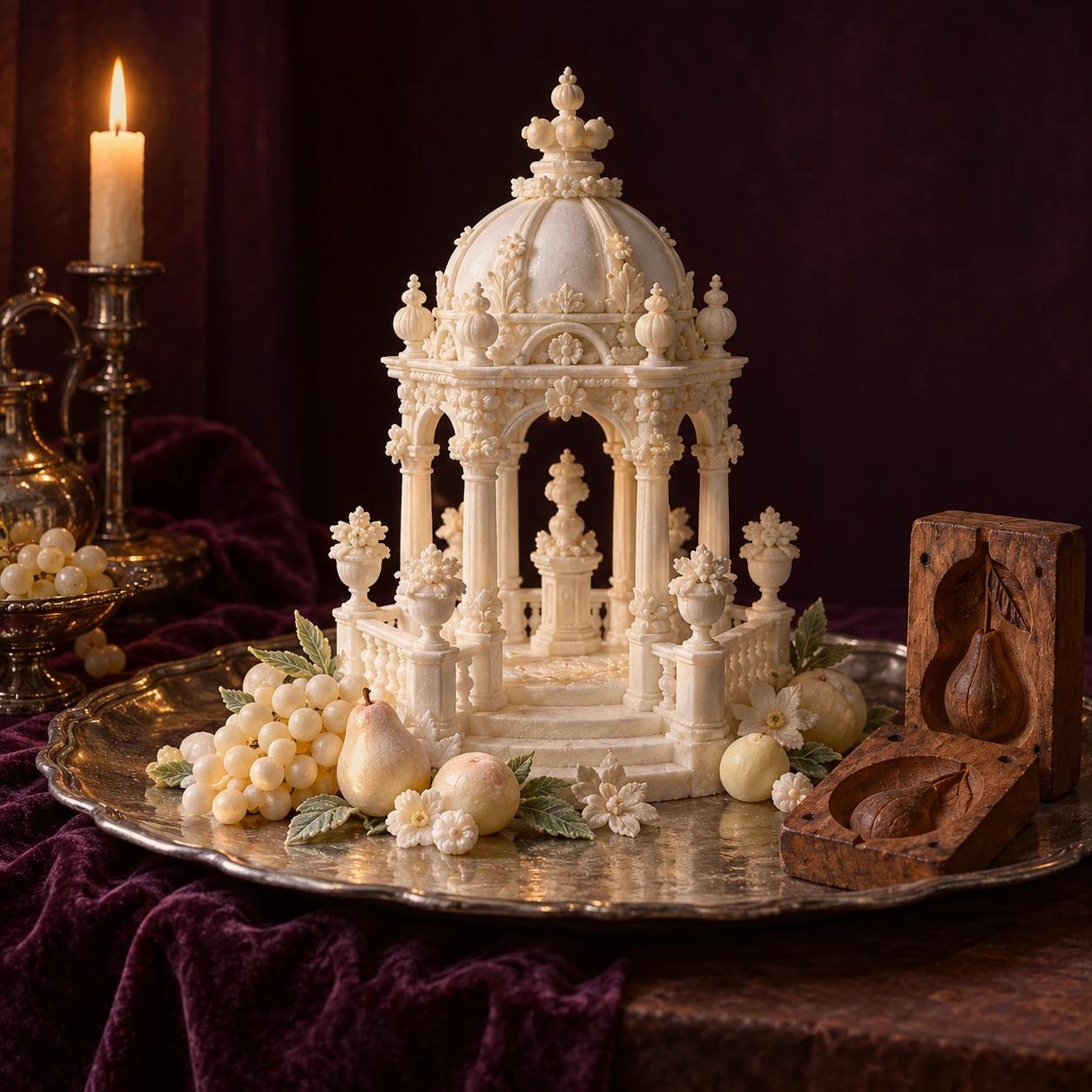
An invented early-modern European sugar banquet centerpiece on a silver-colored plain tray: delicate white sugar-paste architectural pavilion and small pale fruit forms beside a simple wooden two-part mold.
Sugar could be shaped into a temporary spectacle. This invented centerpiece directs attention to labor, molds, and materials rather than a named feast.

On the table: an object made to be seen

The Getty Research Institute's Edible Monument archive brings together festival prints, cookbooks, and serving manuals. Its examples include court table monuments made from sugar, flowers, and fruit. Heraldic and emblematic subjects connected what guests saw with the families, institutions, and occasions being celebrated.

Ask what changes when sculpture is placed among dishes. A figure on a pedestal and a figure on a dining table reach viewers under different conditions. The table establishes distances, seating, sightlines, and a sequence of service. Even a person unable to approach the centerpiece closely might understand its scale or recognize a repeated emblem.

A useful close look therefore begins with the surrounding room. Is the arrangement intended to be seen from one direction or several? Are guests represented at the table, elsewhere in the hall, or outside it? How much of the composition is allocated to food, and how much to the display of access?

Do not assume that “edible monument” means every support could be eaten. The Getty's account of festival structures describes cuccagna monuments built with wood, papier-mâché, and stucco, then decorated with food. These public constructions differ from a sugar table piece. The category gathers related forms of spectacle; it is not a single recipe or uniform object type.

After the feast: a print keeps performing

A festival print can survive for centuries after the occasion it represents. That changes its job. What began as a record or celebration becomes a source for historians trying to reconstruct a temporary environment. But a detailed picture does not stop being a designed image because its subject has vanished.

Look at the archive's digitized books as publications. Their titles, captions, and orderly viewpoints help frame what the viewer is supposed to admire. A representation can promote magnificence as well as describe it. The survival of that representation tells us something about what someone wanted remembered.

It does not automatically tell us whether every depicted detail was built, whether dimensions were exact, or what everyone present thought. Those questions require additional evidence. Treating an engraving as a photograph would lose precisely the choices that make it an interesting historical object.

Long afterward: a mold makes another object possible

A surviving tool provides a different kind of evidence. Getty's past sugar-sculpture demonstration describes food historian Ivan Day using historical equipment and original molds to ornament an eighteenth-century Twelfth cake. The resulting work was a modern reconstruction. It was not an original confection somehow preserved from the eighteenth century.

Reconstruction can answer practical questions that a flat image leaves open. How does a relief emerge from a mold? Which small forms are easy to repeat? What must be assembled after individual components are made? The answers remain connected to the particular tools, materials, and choices used in the experiment.

It is tempting to value a reconstruction only by how convincingly it resembles an old print. A more useful measure is what it makes testable and what it leaves uncertain. A failed attempt can reveal a difficulty. A beautiful success can still depend on a modern substitution. Recording both matters.

Put a mold beside a festival print in your notes. The print is strongest at showing an arrangement and the image an occasion projected. The mold is strongest at preserving one repeatable form. Neither alone supplies the entire workshop. Comparing their strengths helps explain why historians use several kinds of remains rather than choosing the prettiest surviving image.

At the end of this object biography, there may be no original sugar sculpture to point to. There are publications, tools, later experiments, and records of trade and labor. Together they allow a richer account than “people once made astonishing desserts.” The astonishing dessert becomes an entry into skilled work, controlled spectacle, selective memory, and the unequal world that supplied its material.

Sources and further exploration

Explore all 80 new articles · Browse the complete illustrated collection

Continue exploring art, ideas, and unexpected connections at Incoprea.

Wednesday, October 14, 2026

Chuño: The Andean Potato Technology Built Around the Weather

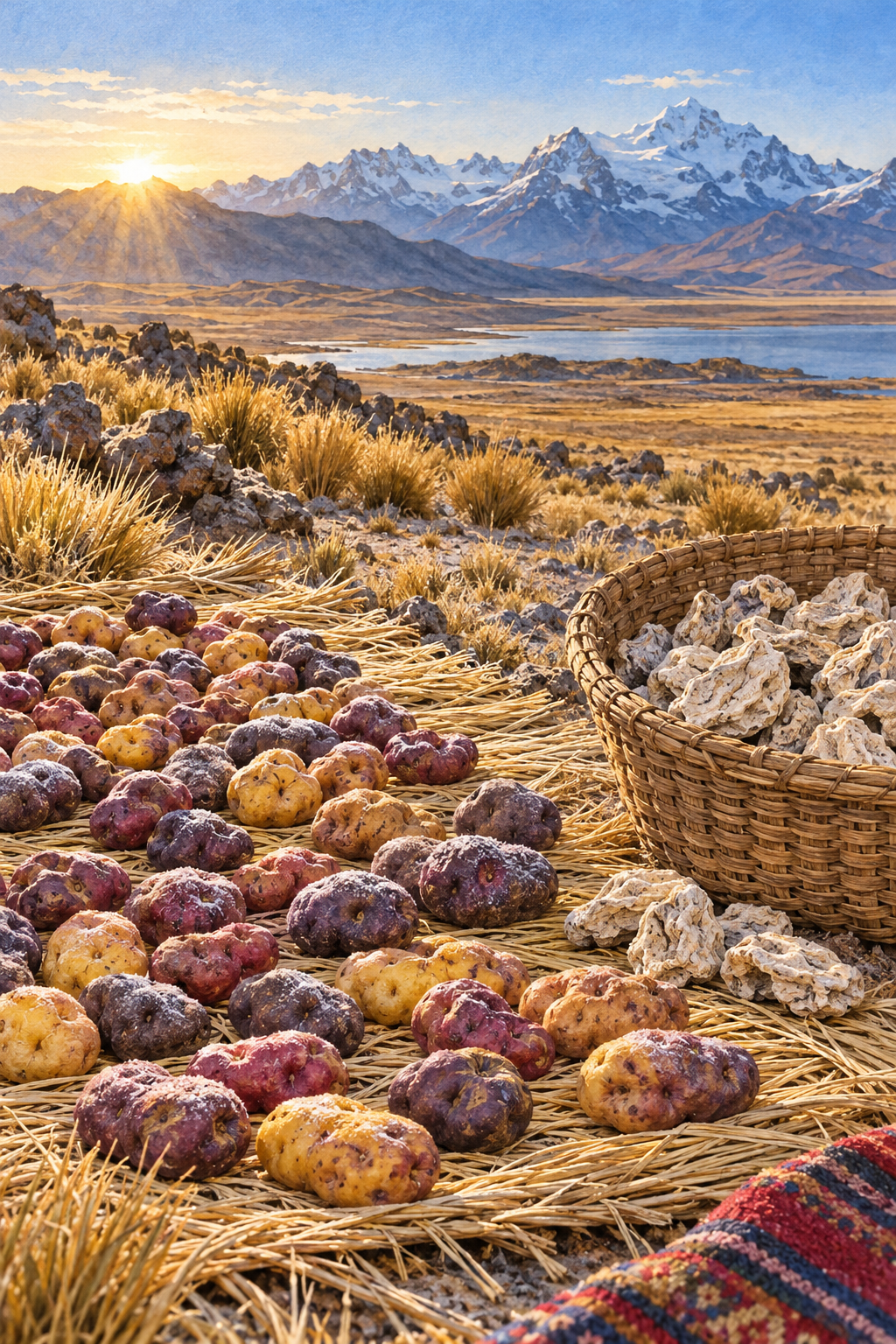
Illustration of potatoes and dried chuño in a woven basket on a frosty Andean plateau.
An interpretation of highland conditions and potato preservation, not a step-by-step processing guide.

A potato harvested today and a meal needed months from now are separated by more than time. Fresh tubers are perishable. A family also has to think about storage space, the next growing season, and what happens if a harvest disappoints. Chuño is an Andean response to that longer problem: change the potato so that part of a harvest remains useful well beyond the moment it leaves the soil.

The process brings freezing nights, daytime conditions, water where appropriate, and skilled labour into one system. Its ingenuity is often summarized as “the weather freeze-dries potatoes.” That description leaves out the people whose decisions make the conditions useful. Knowing a place well enough to work with it is part of the technology.

The potato changes; the work does not happen by itself

The Food and Agriculture Organization’s account of root and tuber storage explains why transformation matters. Freshly stored tubers continue to respire and lose moisture. Drying and other processing methods can turn a perishable crop into a more durable product, although the result depends on the crop and its environment. Preserving a supply is therefore a different task from keeping every harvested potato in its original condition. Read FAO’s discussion of storage and transformation.

In chuño production, freezing and thawing alter the tuber’s cellular structure, making it possible for producers to remove water through pressure. Drying removes further moisture. FAO’s account of traditional potato processing describes these linked physical changes. This is a description of the principles, not a processing schedule: the choice of material and the management of the whole sequence matter.

“Freeze-dried” is a useful familiar label, but it can make us picture one sealed machine performing one operation. Traditional chuño production includes several forms of work and several changes of condition. The tubers are selected, tended, handled, and judged. A night’s frost is one contribution to the system. It does not inspect the product, organize labour, or decide whether the next stage is ready.

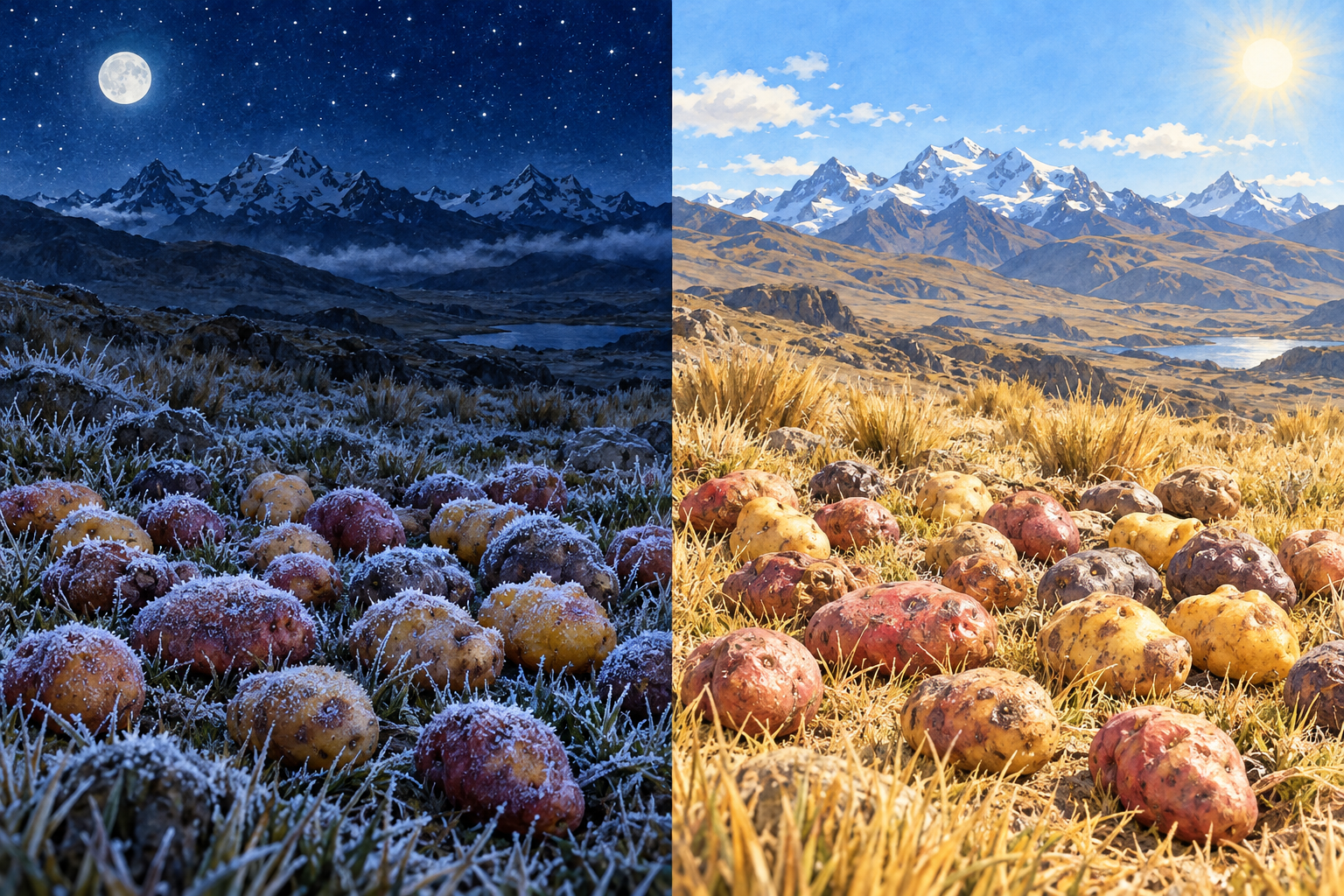
Comparison of potatoes exposed to a frosty Andean night and a dry sunny day.
Cold nights and dry daytime conditions are part of the environmental knowledge behind chuño. This comparison is conceptual, not a processing timetable.

Black and white are processes, not just colours

Black chuño and white chuño are connected traditions with different processing histories. Stef de Haan and colleagues documented regional methods in Peru, including variants from Puno and Huancavelica. White chuño generally included prolonged water exposure; black chuño followed a less elaborate sequence without that stage. The study emphasized variation in the order, repetition, and duration of operations. Read the farmer-managed processing study.

The paper also compared four potato cultivars processed in different ways. That design is worth noticing. Researchers were not testing an abstract “traditional potato” against a universal method. They were comparing named biological materials and documented local practices. Cultivar, environment, tradition, and the intended market could all influence the finished product. A photograph of white and dark tubers cannot tell you that whole history.

Names have local contexts too. White chuño is known as tunta or moraya in different linguistic and regional settings. It would be misleading to flatten every method and name into one timeless recipe. The variations are evidence of practiced knowledge responding to local materials, resources, and expectations.

Meet a producer, rather than an anonymous tradition

The International Potato Center tells the story of Aymara farmer Luzmila Jinez from Yaurima in Peru’s Puno region. Its report follows her journey to Lima to sell tunta at a culinary festival and seek better markets for her association. Her goal was practical: more reliable, better-paying sales that could support families and their children’s education. The account is a documented episode, rather than a claim about today’s prices. Read Jinez’s story at CIP.

The same report describes work with producers on processing quality and hygiene. This is an important part of a living tradition. Knowledge can persist while people improve practices, organize associations, and make decisions about selling their food. Calling a technique ancient should not force its practitioners into the role of preserving an unchangeable museum display.

FAO’s profile of EcoYary offers another specific example. It describes a family enterprise in Peru’s central highlands in which women manage chuño production, with local sales forming part of the business. The account stresses the skill involved in a long, repetitive process. These are people producing a valued food, with labour and quality decisions that deserve to be visible alongside the picturesque highland setting. Explore the producer profile.

Read the weather as a set of dependencies

Try looking at the night-and-day illustration again. Instead of treating it as a sequence to imitate, ask what each part of the environment contributes. The following table is a way to think about dependencies. It does not specify safe processing conditions, times, or temperatures.

What the system depends on
ContributionQuestion to investigate
Freezing conditionsDoes the season provide the conditions the documented local method requires?
Conditions for dryingHow does moisture leave the material after earlier processing?
Water access for relevant methodsWhich product and local process are being discussed?
Skilled labourWho selects, handles, monitors, and judges the product?
Storage and marketsWhat happens after processing, and who benefits from the sale?

Now imagine that only one part changes. There is a suitable harvest and skilled labour, but the expected freezing conditions do not arrive. Or the weather is suitable, but a producer cannot obtain the water needed for a particular white-chuño method. Would adding more of a different input automatically solve the problem? The exercise shows why a technique adapted to a place cannot be understood from its equipment alone.

It also suggests better questions for an account of changing climate. Which part of the seasonal pattern is changing? What have local producers observed? What adaptations are being tried, and what trade-offs follow? A general statement that “tradition is threatened” tells us less than evidence attached to a particular practice and community.

Keeping a harvest also means keeping knowledge

FAO’s account of agricultural heritage places chuño within a much broader Andean farming system. It connects crop diversity, Indigenous knowledge, and food kept for periods when fresh supplies are limited. It also identifies the loss of knowledge associated with migration of younger people as a concern. Preservation therefore has two meanings here: keeping food available and sustaining the people and practices that make that possible. Read FAO’s potato heritage account.

The dried tuber is the visible result, but the achievement extends beyond it. It includes knowing which materials work, reading a season, coordinating effort, and deciding what quality means for the intended use. Chuño becomes more interesting when the landscape and the producers remain in the same picture. The weather contributes to the process; generations of Andean knowledge turn that contribution into a food system.

Discover more creative connections at Incoprea.

Famous Last Meals is now in paperback — stories, history and 25 recipes

Famous Last Meals: Stories, History, and Recipes is now available in paperback on Amazon. The illustrated collection brings together 23 his...