The fragile-looking part of a bicycle wheel is doing something surprisingly robust. Its thin wires can pull hard, yet they would buckle easily if asked to act as little pillars. A rider can nevertheless sit above them. The explanation begins before the rider arrives: the spokes are already under tension.
Think of an unloaded wheel as an organized argument. Spokes pull the rim inward and the hub outward in many directions. Their forces balance. Put weight on the axle and the balance changes. In an ordinary tension-spoked wheel, a major part of the response is a decrease in tension among spokes near the ground contact region. They still pull, but they pull less.
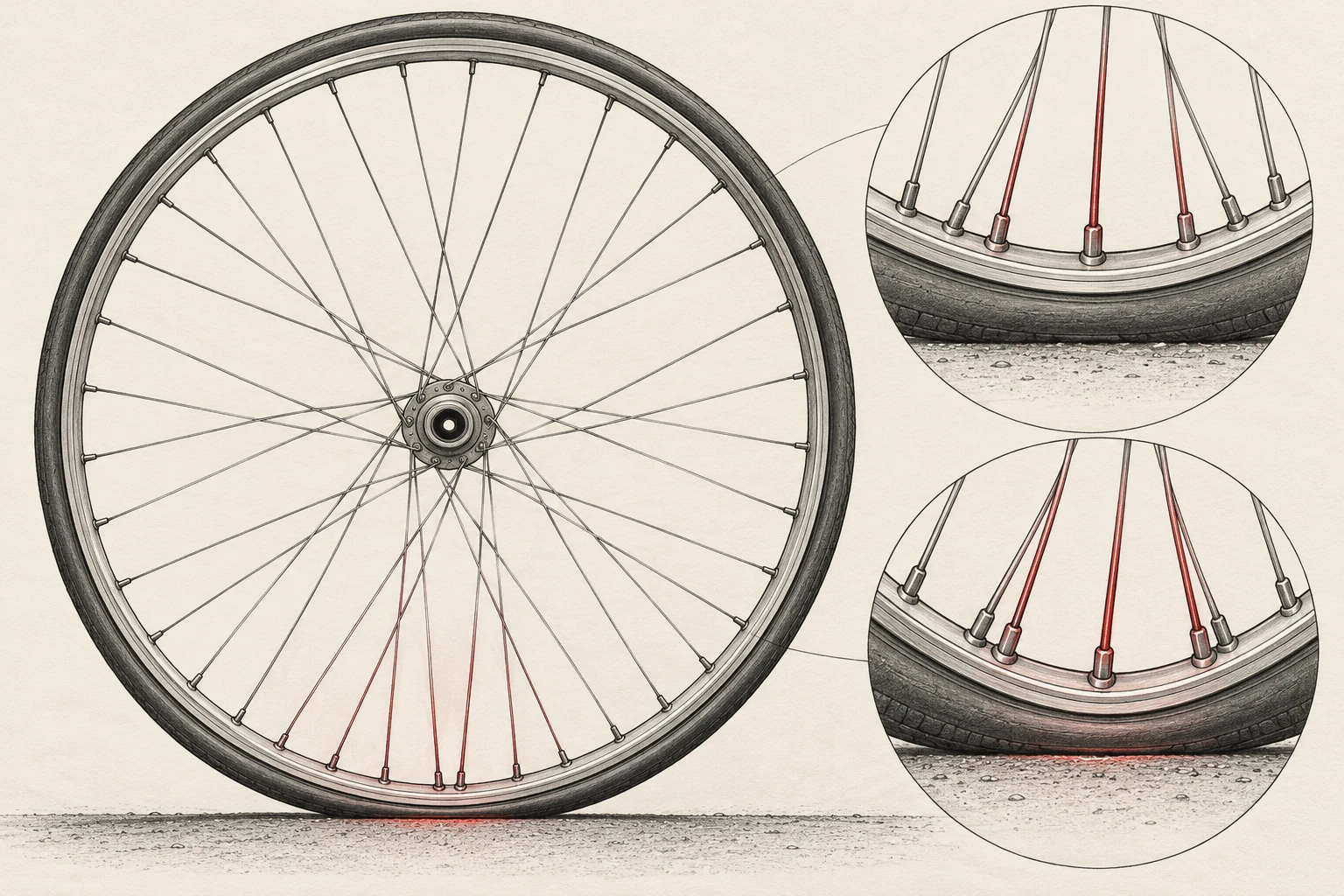
Subtracting a pull can create support
This is not a claim that the bottom spokes become compression columns. Imagine two opposed cords each pulling with 100 arbitrary units. Their net force is zero. Keep the upper pull at 100 and reduce the lower pull to 80: the remaining net force is 20 upward. Neither cord has pushed. An imbalance between existing pulls has appeared.
That is a deliberately stripped-down analogy, not a complete wheel model. A real rim bends, many spokes change force, and their directions differ. It nevertheless answers the apparently impossible question: how can a structure respond to a downward load through wires that work in tension? It can change forces that were present already.
In his analysis of torque and spoke tension, bicycle engineer John S. Allen also describes weight loading as reducing tension in spokes near the tire contact patch. The local group matters more than the picturesque idea that the axle simply stretches all the top spokes like a person hanging from ceiling ropes.
The rim is a partner, not a decorative circle
Henri Gavin's experimental study of bicycle wheels combined numerical analysis, laboratory measurements and riding data. It treated rim stiffness, spoke geometry and spoke dimensions as parts of one structural system. Strain gauges let the researchers measure changing deformation rather than infer it from how strong a wheel looked.
The study compared three lacing patterns. Within the tested conditions, spoke strains under radial loading were relatively insensitive to that pattern. That result has a boundary: it does not establish that every wheel, load direction or rim behaves identically. It does show why a visual feature such as the number of crossings cannot stand in for an entire mechanical assessment.
A useful reading habit is to ask what the experiment held similar and what it changed. “These tested patterns produced similar strain behavior under these loads” is a meaningful result. “Spoke patterns do not matter” discards the very conditions that make the result useful.
| Part of the system | Question it helps answer |
|---|---|
| Initial spoke tension | How much can a spoke unload before it becomes slack? |
| Rim stiffness | How does a local load spread around the circumference? |
| Lacing geometry | How can changing spoke pulls transmit hub torque? |
| Tire | How does the road contact load reach the rim? |
Driving and braking add another conversation
A rear hub must also transfer pedaling torque to the rim. A hub brake transfers braking torque in the opposite direction. Allen's torque account explains these through increases in tension in one group of spokes and decreases in another. A crossed arrangement lets spokes leave the hub at an angle, giving their forces a turning effect about it.
Notice the recurring theme. The spokes need not become rigid shafts twisting between hub and rim. Their changing pulls can transmit a turning action. The geometry determines how effectively those pulls act around the axle. A wheel therefore answers more than the vertical-weight question posed by a stationary rider.
A listening exercise with an important limit
A stationary, undamaged wheel offers a quiet way to encounter its stored tension. With the bicycle securely supported and the wheel completely stopped, lightly pluck a spoke away from moving drivetrain parts. It can ring like a short string. Allen's discussion of spoke pitch explains the connection among pitch, tension, effective length and spoke construction.
Compare that sound with a second spoke of similar geometry. You are hearing a mechanical condition, but not reading a universal tension number. Crossings, lengths and spoke types complicate comparisons. A different sound is a reason to understand the wheel's design, not an instruction to turn a nipple until every sound matches. A wheelbuilder uses the rim and hub maker's limits and appropriate measurements.
For a paper exercise, draw a wheel at four positions in one revolution and mark a single spoke. In each drawing it approaches, passes and leaves the loaded region. Even if the rider's weight stays steady, that spoke's loading history changes cyclically. This is the bridge from a static support question to a fatigue question: repeated variations can matter even when a single event is well below breaking strength.
The wheel's elegance lies in making that repeating cycle ordinary. You see a thin circle, a hub and a lacework of wires. Hidden in the apparently empty space is an intentionally prepared state of stress. The rider does not create the whole structure's strength by pressing down. The wheelbuilder has arranged forces in advance, and the road continually redistributes them.
Sources and a closer look: Gavin: measured spoke strain and fatigue; John S. Allen: torque and spoke tension; John S. Allen: spoke pitch and tension; Sheldon Brown: wheelbuilding.
Explore art, experiments and other unexpected connections at Incoprea.