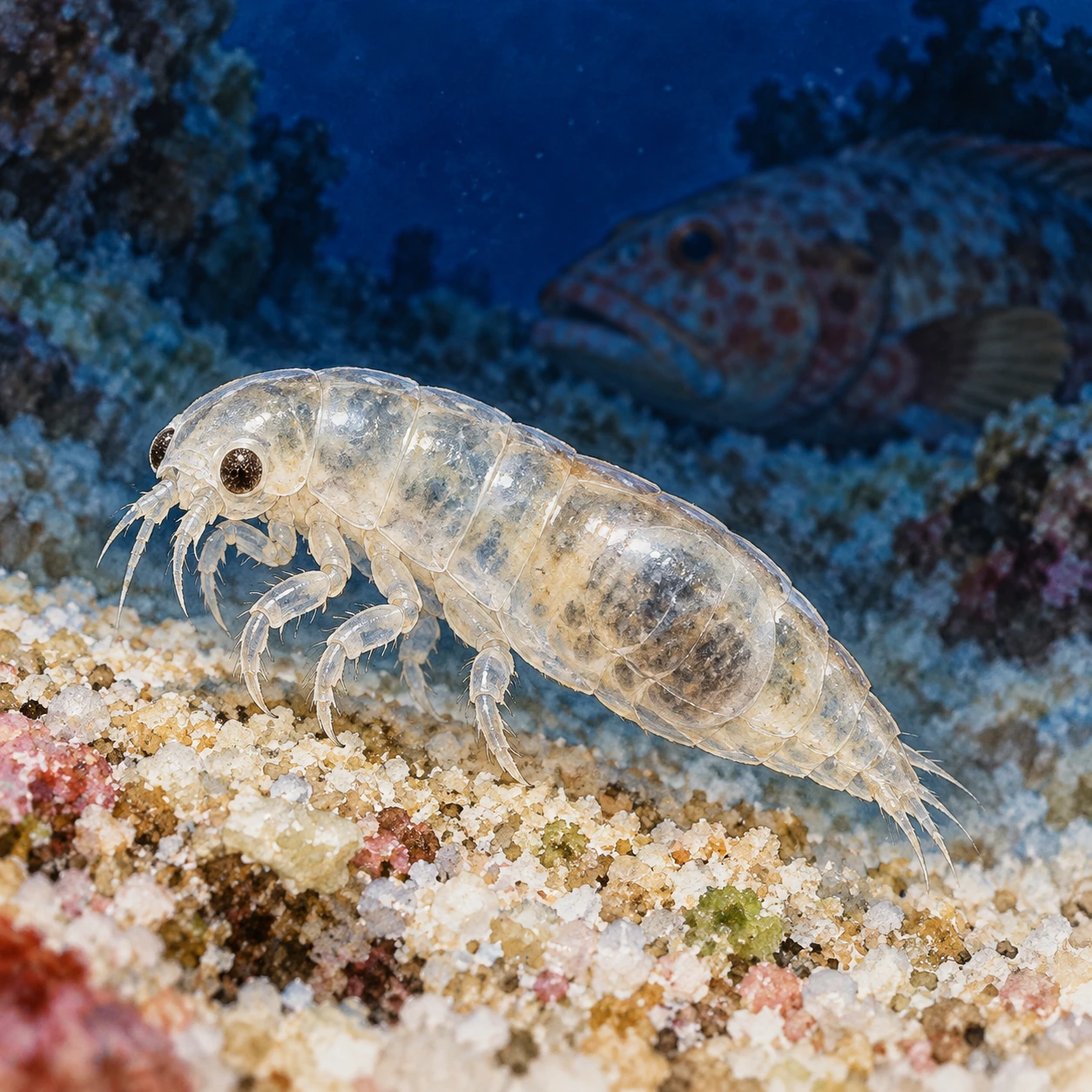
Showing posts with label Animal Behavior. Show all posts

Friday, October 23, 2026

A Bowerbird Builds a View for One Particular Audience

Stand above a great bowerbird's court and you see pale objects on the ground. Lower your viewpoint to the entrance of its stick avenue and you meet a different display. The arrangement has an audience position. That small change in where you look is the key to the story.
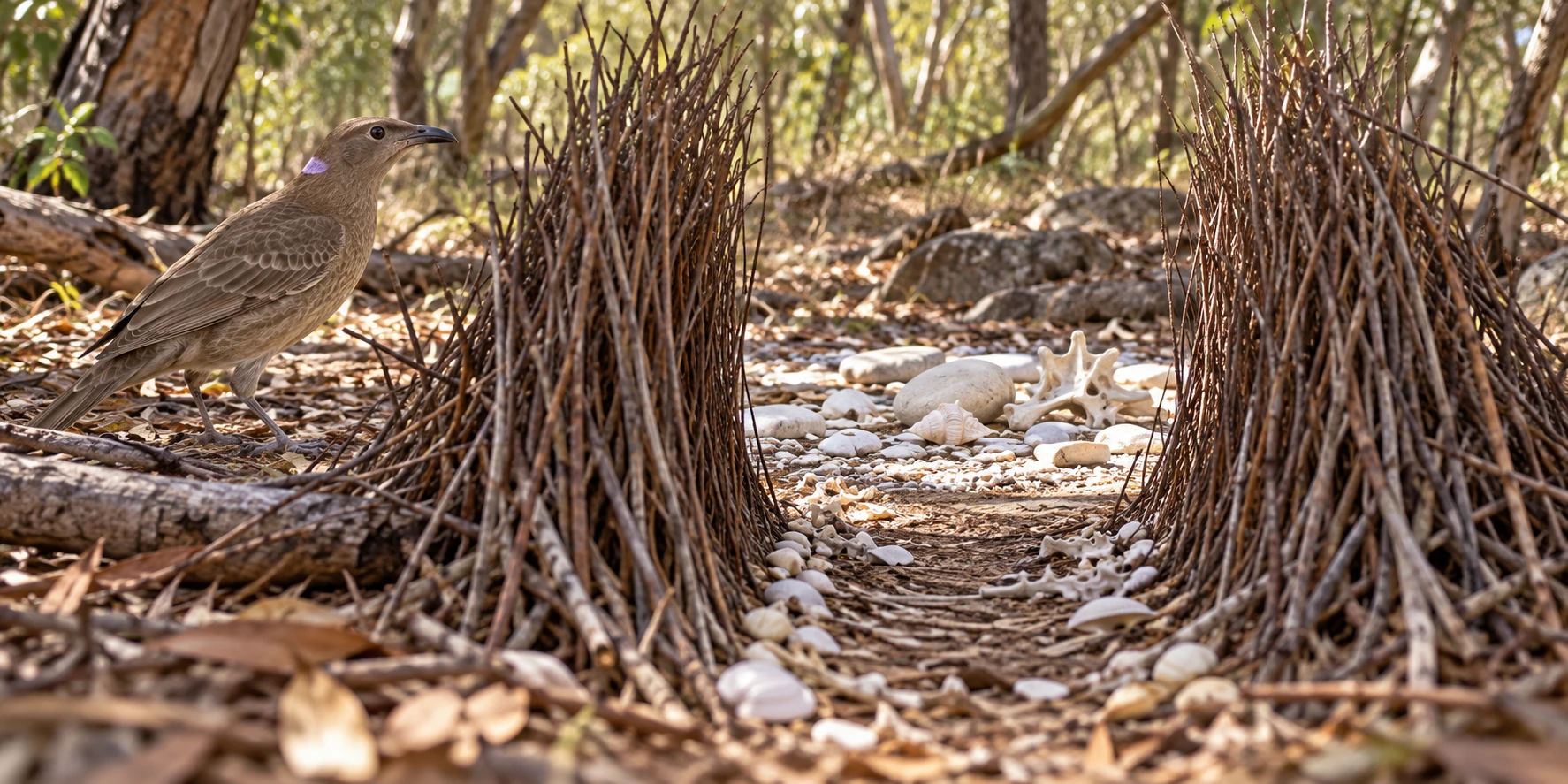
Great bowerbird beside a stick avenue and a court of pale objects
The display has a viewing position: object size and distance must be considered together.

Male great bowerbirds construct an avenue with courts beyond its ends. On those courts, pale stones, shells and other objects can increase in size with distance from the avenue. A larger object farther away can occupy a similar angle in the viewer's field of vision to a smaller nearby object. The result is a more uniform apparent texture from the avenue than an overhead inventory would suggest.

The 2010 study describing this arrangement connected object size, distance and the female's viewing position. Birds also maintained their arrangements after researchers changed them. This is much more informative than simply observing that a male collects attractive objects.

A scene depends on its viewing point

Perspective is easy to experience with a thumb and a distant building. Changing the thumb's distance from your eye changes how much of the building it covers. Nothing about the thumb's physical size has changed. Angular size and physical size answer different questions.
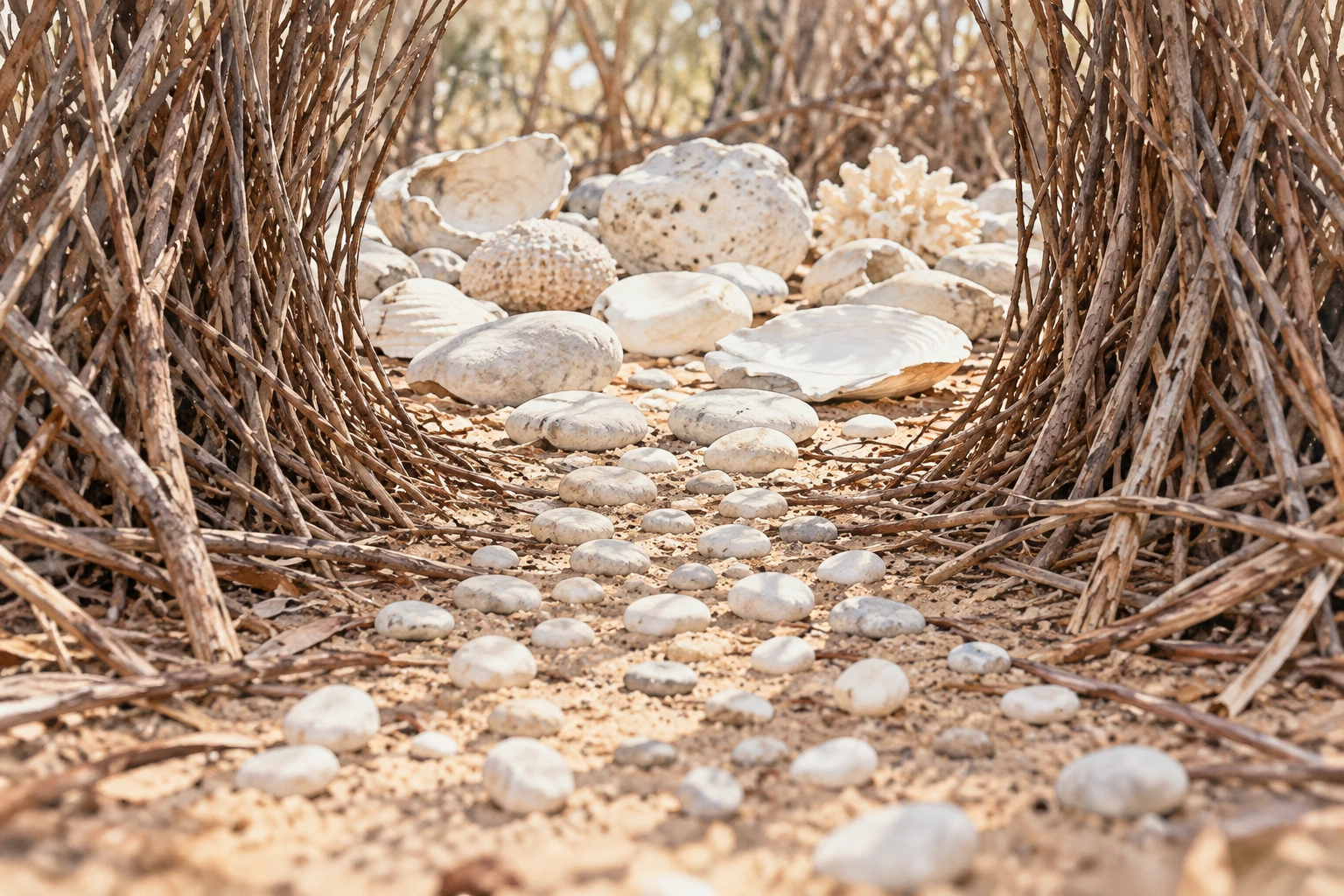
Low view of a bower court with larger pale objects farther away
An interpretive view of the court’s size gradient, rather than a measured bower or a test of a bird’s perception.

The explorer below makes only that geometric comparison. It represents four flat, facing objects. Select equal physical widths, then select widths that increase with distance. Finally move the hypothetical viewer backward. The objects remain in place while the pattern of angular sizes changes.

Change the audience viewpoint

Compare angular sizes for equal-width and size-gradient objects while moving the viewer.

Open change the audience viewpoint in its own window.

At the initial viewing point, widths of 2, 4, 6 and 8 centimeters at distances of 0.5, 1, 1.5 and 2 meters subtend the same angle. That is an invented numerical example, not a measurement of a particular bower. It shows why the relationship between size and distance matters.

The tool cannot tell us what a bird subjectively experiences. Real objects have height, shape, occlusion and lighting. A model of angular size is a useful first step toward a perceptual question, not a substitute for a behavioral test.

The biological interpretation is harder

A 2012 paper reported a relationship between mating success and the geometry of the view available to females. Its central suggestion was that arranging the stage can contribute to a male's display. However, an association among court geometry, behavior and mating does not isolate every causal pathway.

A published technical comment challenged aspects of the statistical support, excluded observations and alternative display traits. It also proposed that keeping larger objects farther away could help leave room for male movements. Those criticisms matter because several features of a complex courtship display can covary.

The measured gradient, its geometrical effect and the explanation for its reproductive importance therefore deserve separate confidence levels. We can calculate angular sizes without knowing whether uniform texture holds attention, changes apparent scale or accompanies some other useful display property. A vivid phrase such as “optical illusion” should open those questions rather than close them.

What happens when a human improves the arrangement?

Another 2012 experiment improved court geometry according to the researchers' measure. Males tended to restore their own earlier arrangements rather than keep the imposed improvement. Individual differences were relatively consistent.

That result interrupts an easy story in which each bird is simply climbing toward the single arrangement a human analyst calls best. The constraints and preferences behind an individual's construction remain relevant. Its behavior cannot be inferred from the model's optimum alone.

For anyone who makes photographs, exhibitions or gardens, this is a useful invitation to inspect a scene twice. First inventory the objects. Then choose a viewer position and examine the relationships among them. Those are distinct descriptions of the same physical place.

A bowerbird's court is especially compelling because the second description may be central to its biological function. The bird does not need to be credited with human geometry lessons for its construction to deserve careful attention. The arrangement, the maintenance and the audience together make the question interesting.

Sources and further reading: Great bowerbirds create theaters with forced perspective (2010); Illusions promote mating success in great bowerbirds (2012); Consistently different individual quality (2012); Comment on Illusions Promote Mating Success (2012).

Explore all 80 new articles · Browse the complete illustrated collection

Explore more art, ideas, and independent projects at Incoprea.

Thursday, October 22, 2026

Desert Locusts: How a Solitary Insect Becomes Part of a Swarm

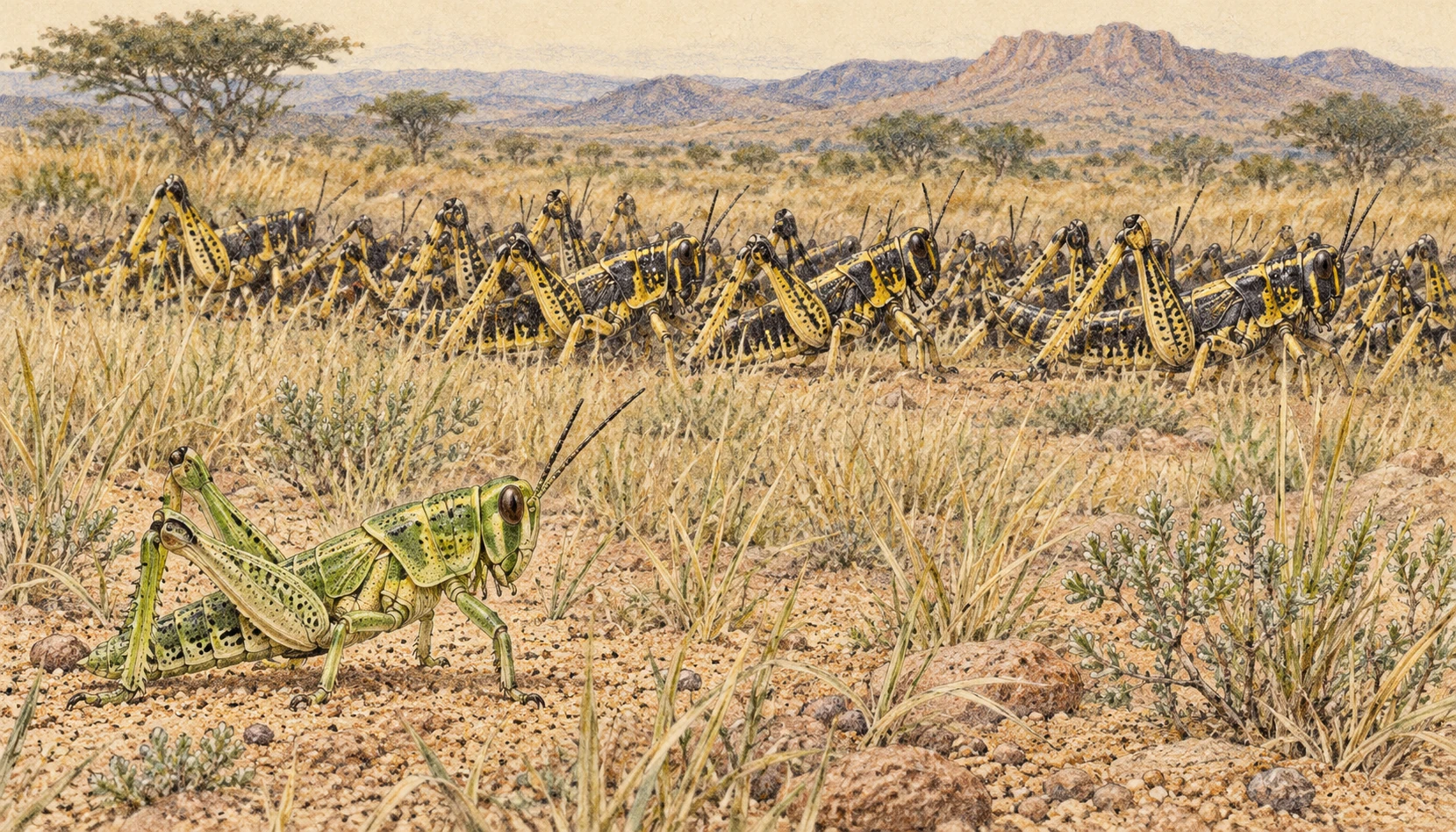
A solitary greenish locust hopper separated from a band of dark yellow-and-black hoppers in dry grass.
Conceptual field-guide comparison of locust social phases; illustrative coloration and setting, not a diagnostic field photograph.

Two young desert locusts can belong to the same species yet behave as if the presence of another insect means opposite things. One avoids company. The other moves toward it. Once attraction begins to reinforce crowding, a scattered population can start becoming a coordinated band. A swarm is not merely a large number of unchanged solitary insects accidentally sharing the sky.

Locusts are particular grasshoppers capable of a density-dependent transformation called phase change. In the desert locust, Schistocerca gregaria, that transformation can alter behavior, appearance, physiology, and body proportions. The FAO's biological overview distinguishes wingless hopper bands from flying adult swarms. “More insects” describes abundance; “different responses to one another” describes an important part of what makes the abundance dangerous.

The change begins with an insect-sized world

A broad environmental sequence can create the opportunity. Suitable rainfall and vegetation allow breeding and survival; population growth and later concentration bring individuals together. But the insect does not experience a regional population estimate. It experiences contacts, sights, smells, and its own changing internal state. Connecting those local inputs to large collective behavior is the scientific problem.

Research described by the University of Cambridge in 2009 identified a role for serotonin in the behavioral transition. Under the study's experimental conditions, changes in this signaling chemical helped initiate gregarious behavior. Sensory stimulation associated with crowding could therefore be linked to a measurable nervous-system response, rather than merely correlated with the final sight of a swarm.

It is tempting to turn that into “serotonin makes locusts swarm.” That sentence hides several scales. A behavioral shift in a test arena, a gradual change in body coloration, synchronized breeding, and a flying swarm crossing a landscape are not one event. Nor does a chemical's familiar name tell us what it does in every species or tissue. The useful question is which response was measured, where the chemical acted, and what else the experiment held constant.

A disagreement that improves the story

Not every experiment produced the same result. A 2013 study by Tanaka and Nishide reported that significant changes in attraction or avoidance took at least three days in their tests, and serotonin injection did not alter those behaviors or body color as it had been expected to. That is a substantive qualification, not a reason to erase the earlier work.

A 2014 study of rapid gregarization examined activity and attraction together and addressed how experimental design and behavioral measurement affect interpretation. A locust that moves more may encounter a stimulus more often even if attraction has not changed in the same way. Combining several measures into a behavioral score can be useful, but it also makes the score's construction matter.

For a reader, this is the best part of the research story. The uncertainty has a shape. It concerns protocols, rearing conditions, timescales, and the behaviors used to define transition. “Scientists disagree” would be too vague; “everything is settled by one chemical” would be too strong. The studies show why a phenomenon can be real while particular claims about its speed or mechanism still require careful comparison.

Three measurements that answer different questions
ObservationWhat it can showWhat remains open
Distance moved in an arenaActivity under the test conditionsWhether the insect is attracted to other locusts
Time near a group behind a barrierAttraction or avoidance in that setupHow it will behave in a complex landscape
Color and body proportionsPhysical features associated with phaseWhether every behavioral change happened at the same time

A coordinated band can contain many small pauses

From far away, a marching band seems to flow. Following one hopper reveals another rhythm: walk, pause, change direction, walk again. A collective can move coherently while its members remain intermittent. This is a different question from how a solitary-phase insect becomes gregarious.

2014 experiments on desert locust nymphs examined that pause-and-go pattern and its relation to interactions in a crowd. The work connected individual movement rules with the persistence of ordered marching. It did not require every animal to move at one constant speed or receive a command from a leader.

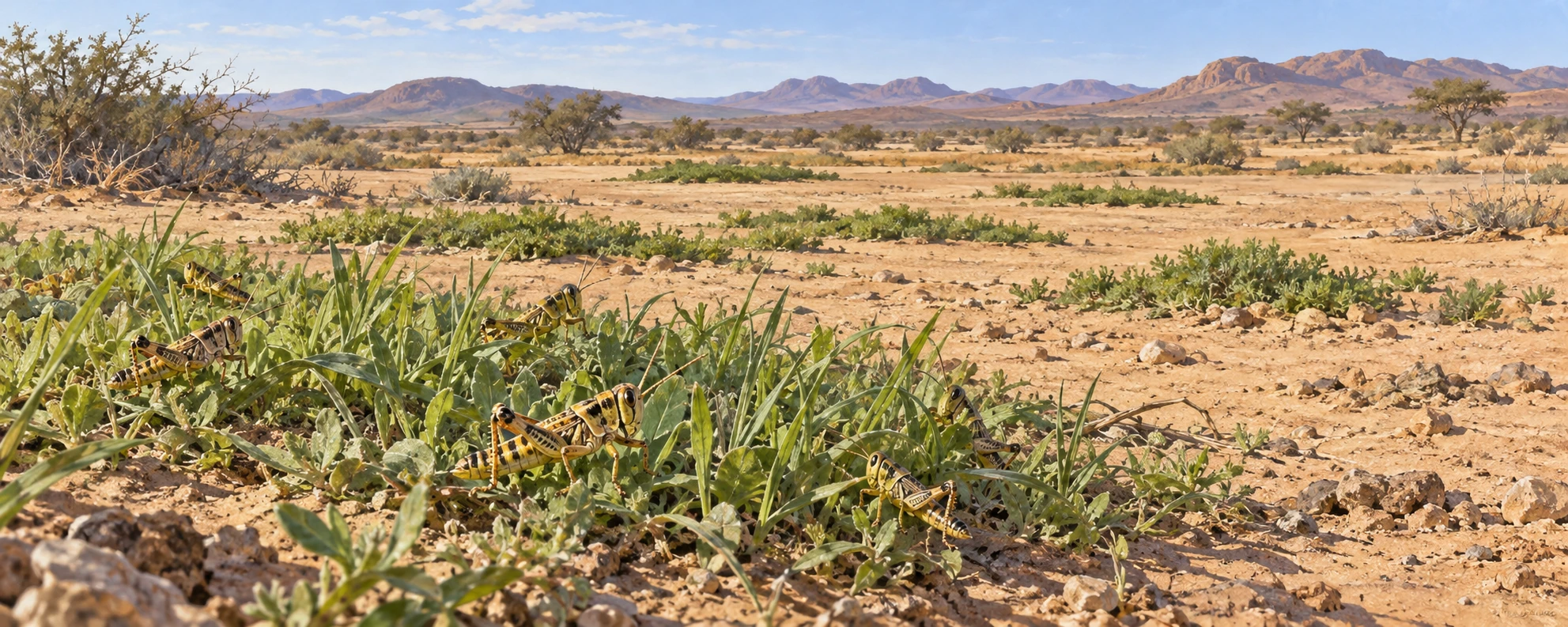
Remaining green patches concentrate locust hoppers in a broad drying landscape
Habitat can concentrate encounters. The later order of a marching band still depends on how individuals move and respond.

A 2023 visual experiment separated parts of the scene further. Tethered locusts saw moving dots whose direction, speed and coherence could be changed. Responses depended on those features, and the animals showed a tendency to maintain or join a heading. The researchers restricted comparisons to a responsive interval because the open-loop display did not change as a real scene would when the animal turned.

That methodological detail matters. A screen can isolate a cue while also removing the consequences of acting on it. A result from that arrangement supports a specific sensory-behavioral relationship. It is not a forecast of the speed or direction of a wild band.

Count movement and agreement separately

Imagine eight fictional hoppers on a straight track. Five walk right and three walk left at equal speeds. Eight animals moving vigorously would not tell you how coordinated the group is; you need the headings. A simple illustrative agreement score is the absolute difference between the two counts divided by eight: 2/8, or 0.25. Seven right and one left give 0.75. Eight walking right give 1.

What happens if half the animals stop?

The answer depends on the definition. A score calculated only among moving animals can remain high, while the fraction of the entire group that is walking falls. Report both. These fictional calculations illustrate why activity and directional agreement need separate measures; they are not a reproduction of the studies' tracking analysis.

In a research video, try following one individual for a short interval instead of following the front of the band. Mark its pauses, then look back at the group. The individual and collective views are complementary. The apparently smooth stream is made from many histories that do not look smooth at all.

From a behavioral switch to a food-security problem

A simple thought experiment clarifies the feedback. Put ten imagined insects among many scattered food patches. If each tends to move away from others, encounters help maintain separation. Change only that tendency so that encounters encourage proximity. The same starting abundance can now yield denser clusters. This is an illustration of feedback, not a simulation of real swarm prediction; food, development, weather, and many other influences would have to be added.

The distinction matters to monitoring. Waiting for an enormous flying cloud means waiting until several earlier processes have already unfolded. The FAO desert-locust guide describes surveillance, weather and habitat information, and coordinated early response. The biological story helps explain why prevention depends on dispersed field observations as well as dramatic satellite-scale events.

It also puts responsibility in the right place. A farmer facing a band is dealing with a material threat to food and livelihoods, not an entertaining behavioral puzzle. Understanding the transition can improve how we interpret reports without turning affected communities into scenery. Population stage, location, date, and the conditions for further breeding are more useful information than an isolated photograph captioned “plague.”

The generated artwork accompanying this article separates a solitary-looking hopper from a band to make the contrast readable. It is an interpretive comparison, not evidence that a particular green individual is about to transform, and not a diagnostic guide to every age and phase. Color is one part of a changing system, not an infallible label.

The deepest transformation is relational. An insect's response to neighbors changes; those changed responses alter the density of neighbors it encounters; the emerging group creates new conditions for its members. The swarm has no single commander, but it is also no accident of identical isolated individuals. It is a population whose members have become different through their experience of one another.

Follow the evidence: FAO: locust phase change; Cambridge: serotonin and behavioral change; Tanaka and Nishide: a different experimental result; Rogers and colleagues: activity and attraction in rapid gregarization; FAO: desert locust questions and monitoring.

More curious connections, art and independent projects at Incoprea.
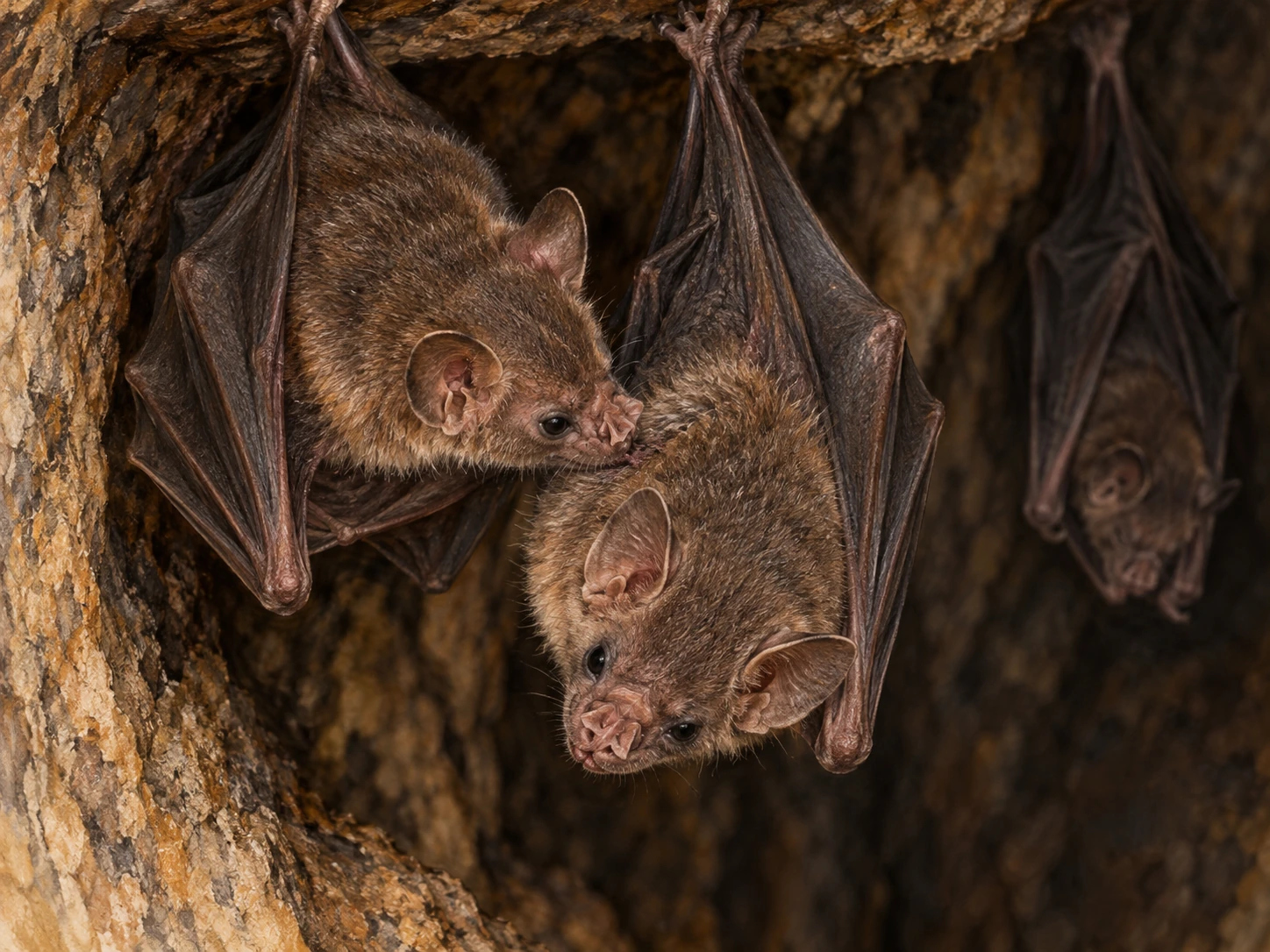
Vampire Bats Build the Relationships Behind a Shared Meal

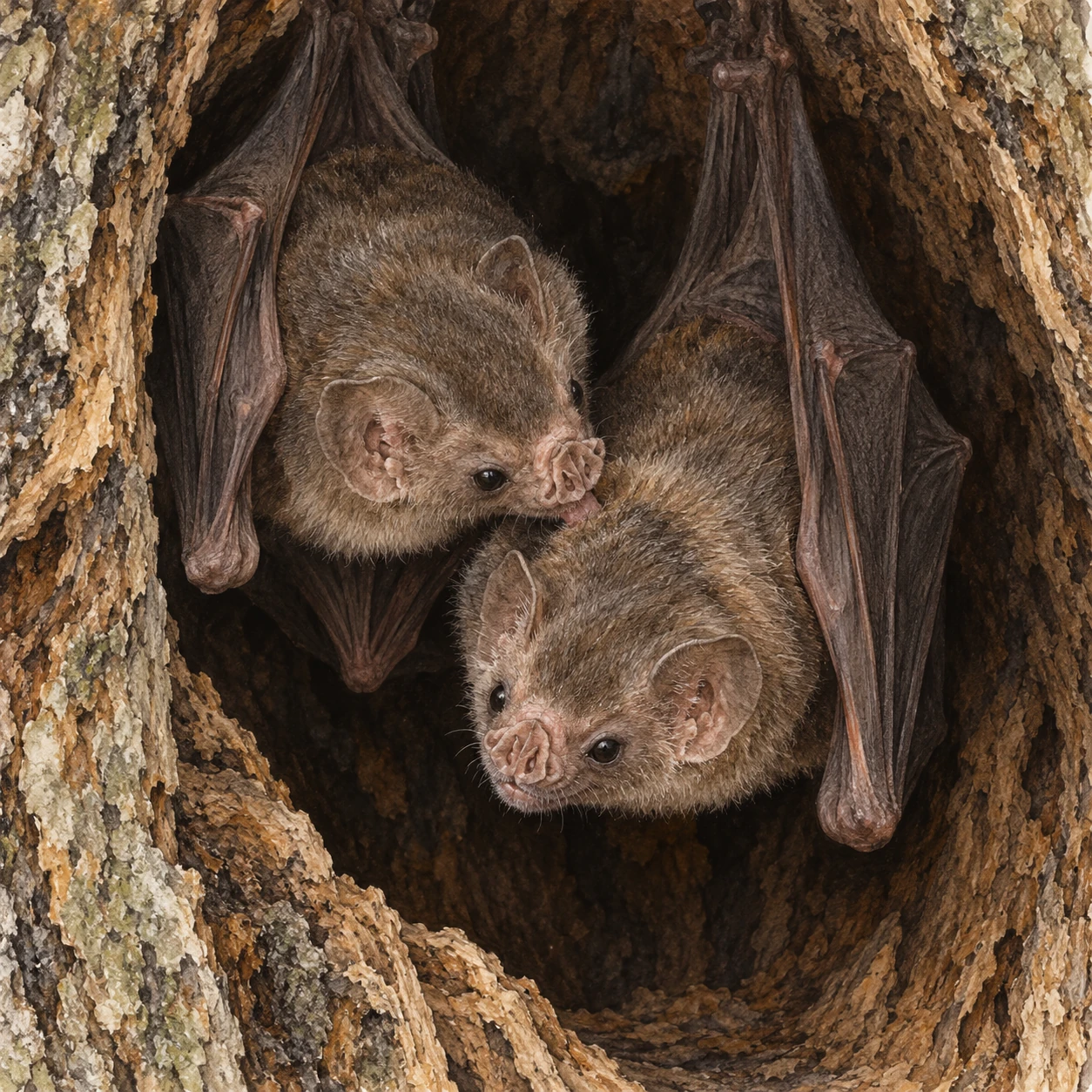
Two common vampire bats huddle in a hollow tree while one grooms the other.
Interpretive illustration of social grooming in common vampire bats; not an observation of a named study pair.

For a common vampire bat, a successful night can mean returning with a blood meal. An unsuccessful companion may receive some of that food through regurgitation. The act is small enough to happen in the dark interior of a roost, but its implications reach into one of biology's hardest questions: how can costly help persist between animals that are not simply close relatives?

The obvious human analogy is friendship. It can be useful, provided it remains an analogy rather than a claim to read a bat's private feelings. Researchers can measure who grooms whom, who shares food, how relationships develop, and whether they continue outside a laboratory. Those observations are already a rich social story. They do not require us to imagine bats keeping a written account of favors.

Reciprocity does not have to mean immediate repayment

A 2013 study by Carter and Wilkinson examined food sharing in a captive colony. Received help predicted donations more strongly than relatedness or harassment in the analysis. Sharing patterns were consistent with enduring relationships involving both food and grooming, rather than a strict sequence in which one animal pays back exactly what it received at the next opportunity.

That distinction is easy to miss. An exchange can be mutually beneficial over time without each event being matched immediately. If a bat is hungry today, its partner's ability to provide food matters now; the hungry bat may have an opportunity to help on another night. A long relationship can spread uncertainty across time.

Relatedness still matters biologically, and kinship and social history can overlap. The point is not that family relationships vanish. It is that explaining every donation as help for relatives alone leaves important patterns unexplained. Researchers compare multiple possible predictors because the same observed behavior can fit several stories.

How does a new relationship become costly?

To study the beginning rather than only the maintenance of a bond, researchers introduced unfamiliar common vampire bats and followed interactions. The 2020 study of new food-sharing relationships found selective escalation: low-cost grooming tended to build before more costly food sharing. Not every possible pair developed the same relationship.

This sequence matters because two explanations that sound alike make different predictions. If sharing simply followed indiscriminate familiarity, every familiar animal might become an equivalent partner. If animals selectively build a relationship through interaction, histories among pairs should diverge. Following the pairs through time lets researchers examine that difference.

The word “trust” is often used in accounts of this research. A cautious translation is a growing willingness to invest in a particular partner. The observations support a pattern of selective investment. Whether the animal experiences anything equivalent to a human's verbal concept of trust is a different question, and the behavior does not answer it by itself.

Nearness can be a cause as well as a consequence

Two bats found together repeatedly may be choosing one another because of an established bond. They may also be developing a bond because circumstances keep putting them together. The same association diagram can fit both directions of cause.

A 2022 experiment temporarily housed randomly assigned trios of previously unfamiliar, unrelated females in close proximity. When the bats could freely associate again, pairs that had shared that week of proximity increased their grooming more than control pairs. Repeated contact had changed a later cooperative investment.

Two common vampire bats groom in a dim roost while another rests apart
Repeated proximity can shape later grooming. A visible association still needs a history and a defined behavioral measure.

The measured result was grooming, not a demonstration that every such pair developed identical food-sharing bonds. The authors also left open the relative roles of mere association and the interactions occurring during that association. An experiment can establish one causal link while identifying a more precise next question.

A strong partner is not the only useful partner

A separate partner-removal study examined a different aspect of a relationship network. When a key donor was unavailable, females that had previously fed more unrelated females suffered a smaller drop in food received. Those wider investments did not simply yield more food under ordinary conditions; their importance became clearer when a major source of help disappeared.

This is a reason to distinguish a network's ordinary return from its resilience. A relationship can contribute little to today's total yet matter when another connection is missing. The study called this social bet hedging. That functional description does not require a bat to calculate insurance premiums.

A small network puzzle

Imagine Bat A receives eight fictional units from one donor. Bat B receives six from one donor and one each from two others. Both receive eight. Remove the largest donor: A receives zero and B receives two, provided the others remain available. These invented amounts demonstrate a dependence pattern, not the study's data or a rule that more partners are always better.

Now add a cost to maintaining each relationship. The conclusion becomes less automatic: a wider network may be costly, and partners may fail together. That is why measuring interaction histories, availability and actual donations matters more than simply counting connections.

A bat society can therefore be read through two timescales. Encounters help build a particular tie. A collection of ties shapes what happens when circumstances change. The shared meal sits inside both histories.

Does the bond survive leaving the experiment?

Captivity provides control and visibility, but it can force animals together. A 2019 study addressed that limitation by releasing bats after a prolonged captive period and tracking associations in the wild with proximity sensors. Earlier grooming and food-sharing relationships predicted later associations. The relationship was not simply erased when animals regained a choice of company.

Another study, described by Ohio State in 2021, followed 50 bats during foraging. Bats generally departed separately, but established social partners encountered one another during the night. Researchers combined sensor information with additional video and sound observations. The results suggested coordination associated with social ties, while the sensors alone could not show every detail of what a meeting meant.

Those limitations are informative. Proximity is a measurable event. Cooperation over a meal is an interpretation that needs behavior and context. A strong account combines methods rather than asking a tiny radio device to reveal an entire relationship.

An evolutionary review of food sharing considers whether behavior rooted in maternal care could have been extended into mutually beneficial adult relationships. That is a hypothesis about the historical origin of the capacity, distinct from showing that two present-day bats exchange food. Present function and evolutionary origin require different evidence.

The artwork accompanying this article focuses on grooming because the quieter interaction is part of the story. A regurgitated meal is the dramatic event, but the relationship around it can develop through many less costly contacts. The bat's social world is therefore not well described by a single heroic donation.

What emerges is a form of interdependence built through repeated encounters. A small mammal with a frightening popular reputation becomes a subject for precise questions about partnership, opportunity, and time. Watching who helps whom is only the first step. Watching how a pair becomes willing to help—and whether that history continues when circumstances change—is where the deeper social life comes into view.

Follow the evidence: Carter and Wilkinson: help predicts food donations; Carter and colleagues: development of new sharing relationships; Ripperger and colleagues: captive relationships persist in the wild; Ohio State: social partners meet during foraging; Carter: co-option and the evolution of food sharing.

More curious connections, art and independent projects at Incoprea.
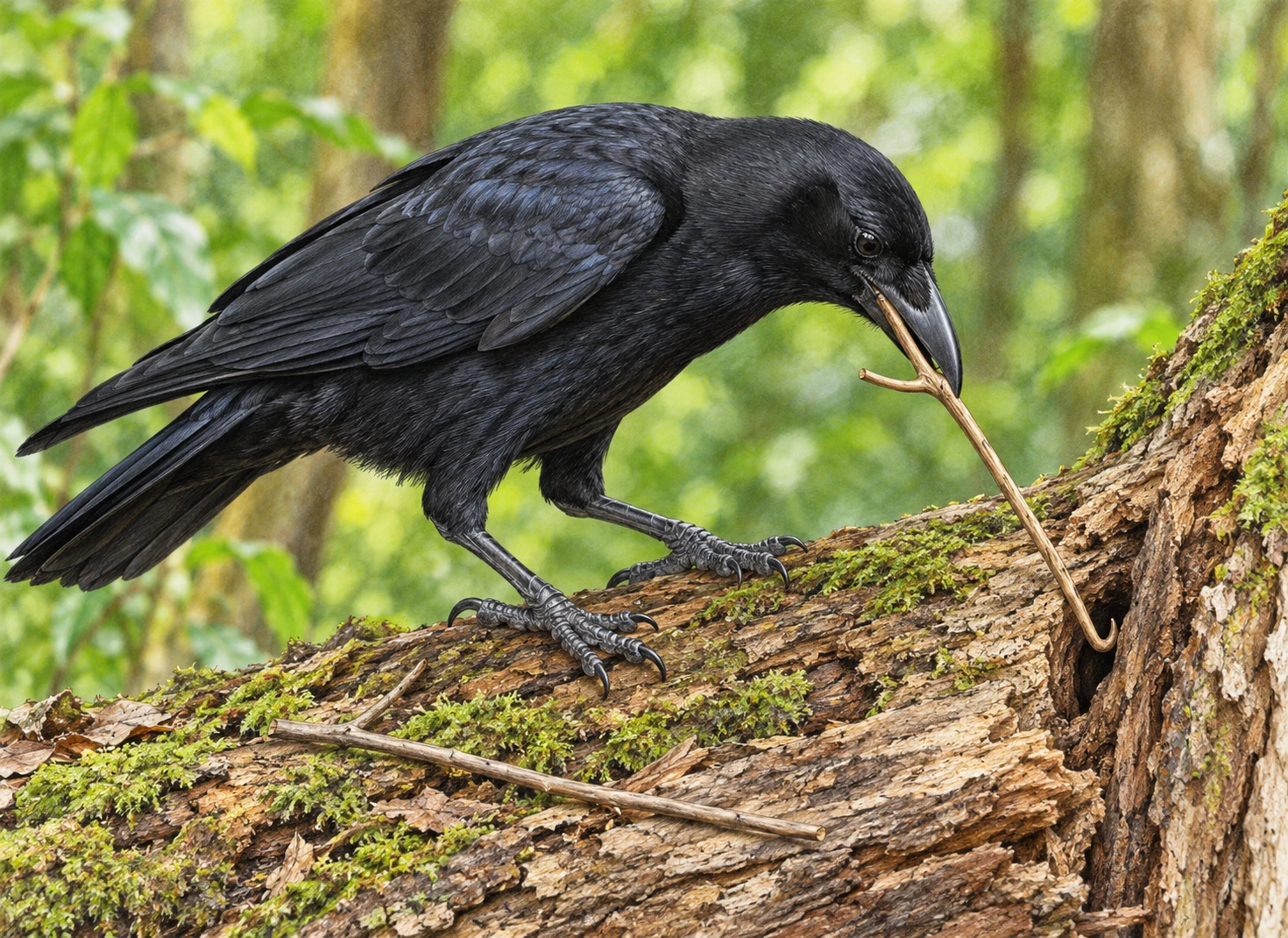
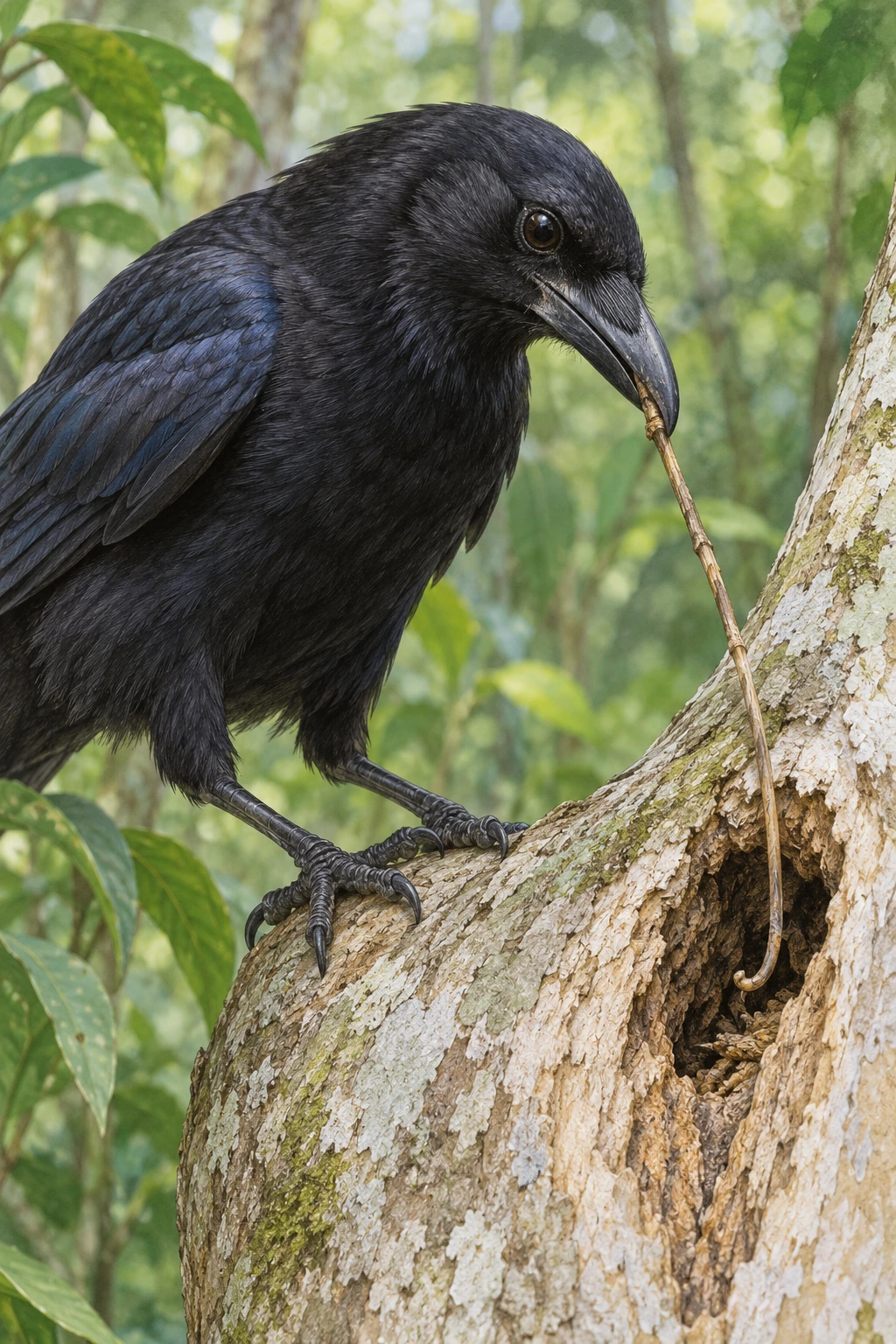
A Crow’s Hook Changes More Than the Shape of a Twig

A glossy black crow probes a log cavity using a slender hooked plant stem.
Conceptual illustration of New Caledonian crow tool use; the tool form is interpretive rather than a measured specimen.

A straight twig can reach into a hole. A twig with a small hook can also catch what it reaches. That modest difference helps explain why some New Caledonian crows spend time selecting and shaping a tool before they begin feeding. The bird's investment changes the mechanical possibilities of the task.

The species, Corvus moneduloides, is native to New Caledonia in the southwest Pacific. It is famous for tool use, but the most interesting question goes beyond whether a bird can use a stick. Why make a more elaborate tool when a simpler one is available? And once the bird has made it, does its subsequent behavior reflect the tool's usefulness?

A hook is a small design change with a measurable effect

A 2018 study compared foraging performance using hooked and non-hooked tools in naturalistic extraction tasks. According to the University of St Andrews account, hooked designs produced benefits that varied with the task, allowing food to be obtained between two and ten times more efficiently in the comparisons described. The range matters: there was no single universal multiplier attached to the hook.

A tool can alter contact. A straight tip may push, probe, or disturb prey; a hooked tip can engage an edge or body part and pull. Which action works depends on the cavity and the target. The scientific comparison therefore needs more than an impressive video of one success. It needs repeated tasks in which different tool types can be evaluated.

Efficiency also has more than one clock. A hooked tool can save extraction time while requiring extra time to obtain and manufacture. A complete ecological account must consider that investment and the likelihood of reuse. The experiment measures a substantial performance benefit; interpreting why tool manufacture persists requires connecting that benefit to the bird's wider life.

The tool has to stay in a useful view

A tool tip can be mechanically effective and still difficult to control if the animal cannot see where it is going. For a crow holding a stick in its bill, the eyes and tool move together. That creates a different coordination problem from a person's hand moving independently in front of the face.

New Caledonian crow holds a hooked twig near its straight bill and eye
The working assembly includes a viewing geometry. This portrait does not map the crow’s visual field.

A 2012 comparison of corvid visual fields and bills found unusually broad binocular overlap in New Caledonian crows, together with a relatively straight bill that helps position a tool. The work made morphology part of the tool-use explanation. Cognitive ability alone is not a description of the physical arrangement through which an action is performed.

A 2014 study sharpened the interpretation. During natural extraction, the diagonally held tool tip could be viewed by the opposite eye. Individual tool-side preferences correlated with eye dominance. The authors argued that the broad visual field need not imply simultaneous binocular viewing of the working tip; it could permit one eye to see far enough across the midline.

That is a useful example of progress through a more specific question. Measuring the region that both eyes can cover is different from establishing which eye actually controls a particular maneuver. The later work changed the interpretation of an impressive anatomical fact without making the earlier measurements disappear.

A diagram-reading exercise

In the published visual-field diagrams, locate the bill axis first. Then locate the projected tool direction. Finally ask whether a line falls within the field of the left eye, the right eye or their overlap. Do not substitute the camera's view of the crow for the crow's view along its tool.

You can illustrate the coordination problem with an ordinary pencil held safely in your hand well below eye level. Move your hand while keeping your head still, then move both together. The exercise only separates two arrangements of movable parts; it does not reproduce crow vision or establish how a bird experiences depth.

The new close view is therefore an invitation to notice the whole working assembly: eye, bill, grip and projecting tip. The hook's shape matters, but so does the body that must guide it. A useful object and a useful way of looking become parts of the same action.

The material is part of the problem

These hooks are not tiny metal fishing hooks. Crows work with plant stems and naturally branching material. A 2015 study of manufacture examined variation in the birds' behavior and the influence of raw-material properties. Selecting a stem and modifying it are not interchangeable steps. The material offers some shapes and resists others.

That is recognizable to anyone who has made something by hand. A successful procedure depends partly on what the material will permit. The comparison should not become a claim that a crow thinks like a human craftsperson; it identifies a useful shared constraint. A tool is made from a particular piece of the world, not from an abstract drawing.

It also helps explain why a single improvised act in a laboratory cannot tell the entire evolutionary story. Wild tool traditions, developmental experience, opportunities to practice, and the properties of local plants all deserve study. An animal's successful behavior can be clear even while the balance of learning and inherited predisposition remains a separate research question.

Making a better tool is one problem; keeping it is another

A crow may need to put its tool down while handling food. On a branch or log, setting it anywhere can mean losing it. The 2021 eLife safekeeping study tested whether birds treated hooked tools differently from simpler non-hooked tools. Wild-caught birds temporarily held for experiments strongly preferred the hooked tools offered in the study and more often kept them safe between uses, including by holding them underfoot or placing them in nearby holes.

The researchers used “value” to interpret this pattern. The operational evidence is preference and protective handling. It does not demonstrate that a crow has a human economic concept, but it does connect the tool's usefulness and acquisition cost with measurable choices about retention.

The distinction becomes clearer if we imagine two tools that differ in both material and performance. A preference might be driven by material, familiarity, shape, expected utility, or some combination. Good experiments work through those possibilities. Reading the methods and comparisons is more informative than deciding in advance that the animal is either an engineer or an unthinking machine.

A useful way to watch the linked research videos is to count the transitions. When does the bird select material? When does it modify a tip? Does it orient the hook before insertion? What happens to the tool when food is obtained? The quiet moment after success can reveal as much as the extraction itself.

The generated image here brings those ideas into one scene: a bird, a cavity, and a shaped twig. Its hook is illustrative. The research photographs and videos provide the evidence for actual tool forms and actions.

The crow's achievement becomes richer when we stop treating a stick as a yes-or-no intelligence test. There is a sequence of practical problems: finding material, producing contact geometry, extracting food, and avoiding the loss of a useful object. Small improvements at several points can change the return from a foraging opportunity. A hook is a tiny shape, but it opens a large set of questions about how an animal makes its world more workable.

Follow the evidence: St Clair and colleagues: hook efficiency study; University of St Andrews: tools and task-dependent benefits; Klump and colleagues: manufacture and raw materials; Klump and colleagues: hooked-tool safekeeping.

More curious connections, art and independent projects at Incoprea.
Buzz Pollination: A Flower That Has to Be Shaken

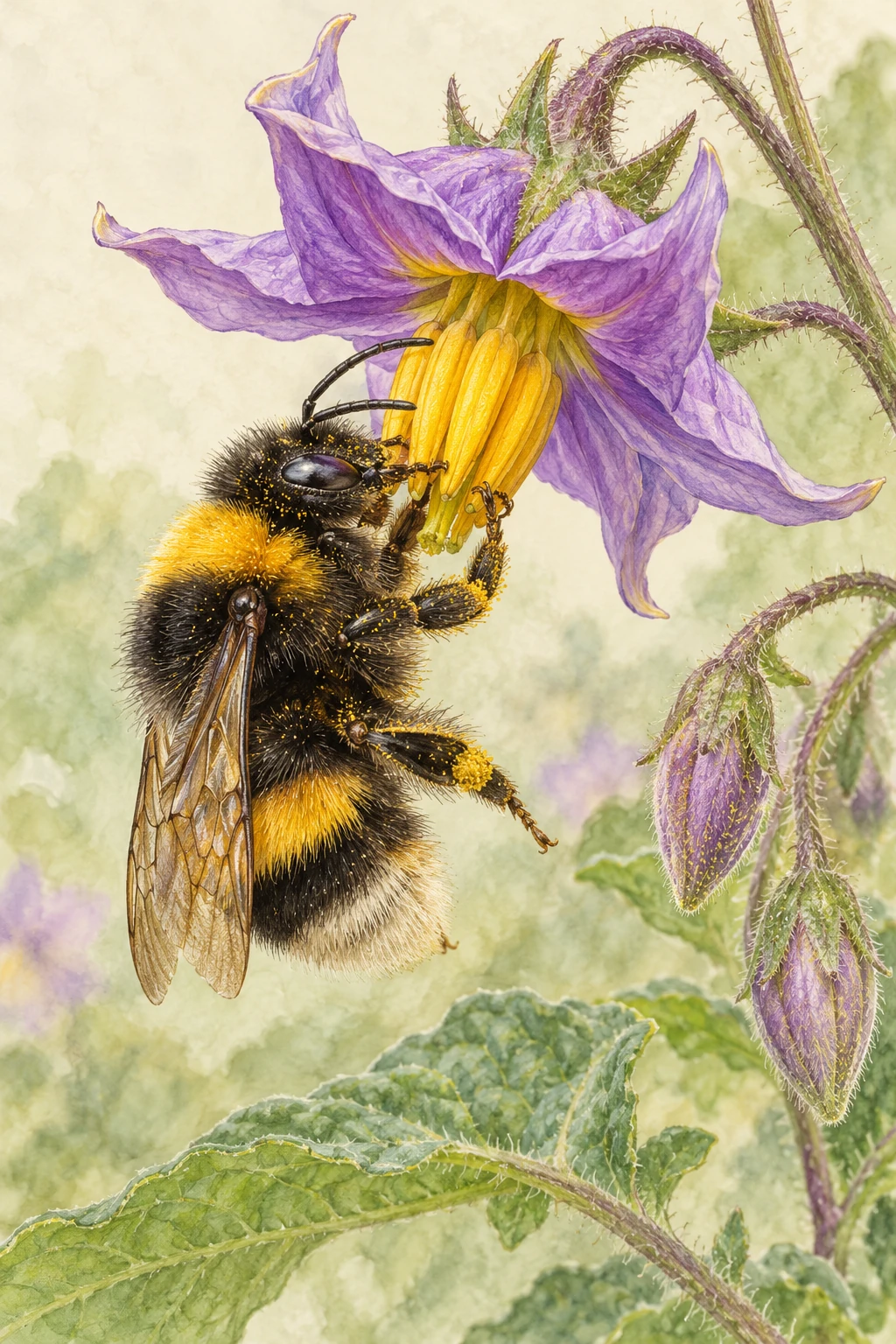
A bumblebee grips the yellow anther cone of a purple Solanum flower with pollen dusting its body.
Conceptual botanical illustration of floral buzzing; not a measured vibration or a diagnostic species plate.

Watch a bumblebee at a suitable flower and the sound can change. The insect lands, grips the pollen-bearing structures, and produces a concentrated buzz with its wings no longer doing the work of flight. The flower is being shaken. Its pollen is not simply waiting on an exposed surface for a visitor to brush past.

This is buzz pollination, or floral sonication. In many flowers adapted to the interaction, pollen is enclosed in anthers and leaves through small openings. Vibrations applied by a bee move through the flower and help eject the grains. The bee is collecting food; some of the pollen it carries can later reach another flower. A practical feeding action becomes part of plant reproduction.

The flower is a mechanical structure

The pepper-pot analogy is useful: shaking can make particles leave a restricted opening. But a real flower is not a rigid kitchen container. Its anthers, petals, connections, and orientation influence how a vibration travels. The relevant motion is not captured by the audible note alone.

Nevard and colleagues' research dataset describes how bees often grasp one or more anthers with their mandibles and transmit thoracic vibrations through floral tissues. Different flower architectures can alter the transmission to neighboring anthers. A bee's grip is therefore part of the contact through which the mechanical signal enters the plant.

In a study of Solanum rostratum flower biomechanics, researchers used contactless laser vibrometry to measure movement in three spatial axes. The study found that dominant vibration frequency was conserved through the flower while other aspects of vibration transmission differed. The direction and magnitude of movement can matter even when the main frequency remains similar.

That is why “the bee hits the flower's magic note” is an incomplete explanation. Frequency tells us how often a motion repeats. Amplitude describes how large the movement is; velocity and acceleration describe other aspects of it. Two vibrations with the same audible pitch need not shake pollen loose equally well.

One shaken anther can lend motion to its neighbors

A bee need not grip every pollen-bearing structure at once. The connection between anthers can make one contact affect several parts of a flower. That gives the arrangement of the anthers a job beyond displaying pollen to a visitor.

Close botanical view of yellow Solanum anthers and their terminal pores
Anther contact can transmit a vibration beyond the bee’s grip. This botanical study is not a measurement of movement or pollen release.

A 2022 study experimentally joined anthers in three Solanum species and compared their response with unjoined arrangements. Applied bee-like vibrations reached neighboring anthers at higher amplitudes in the joined treatment. Pollen release increased in two species with naturally loose arrangements, but not in the species whose anthers were already closely packed.

The exception is useful. A treatment can produce a measurable mechanical difference without increasing the final output in every species. Contact geometry, existing transmission and the amount of pollen available all belong in a complete explanation. The result is more informative than a universal claim that a tighter flower always releases more.

An earlier experiment with synthetic pollination buzzes varied frequency, amplitude and duration separately. Greater amplitude and longer duration released more pollen in the tested system; frequency contributed much less strongly over the investigated range. The work helps explain why a recording's pitch is an incomplete description of the mechanical input.

Read a mechanical experiment in two stages

Make two boxes on paper. Label the first “motion reaching another anther” and the second “pollen released.” Put the measurement in its proper box. Then ask what would connect them. This prevents a larger vibration from quietly becoming a measured reproductive benefit without evidence of the intervening steps.

What should a controlled comparison keep the same?

If the question concerns anther connections, apply the same selected input to both arrangements and measure their different responses. If the question concerns buzz duration, keep the flower arrangement and other input properties comparable. Changing both together would make the cause of a difference harder to identify.

The flower's close view now contains an experiment you can imagine clearly: one entry point, several linked structures and a particulate output. Its small pores are not a demand for one magic note. They are part of a living mechanism whose performance depends on how motion arrives, travels and continues through time.

The bee can change its performance

Research reported by Stirling in 2016 followed inexperienced bumblebees on their first encounters with flowers requiring vibration. Bees began buzzing without needing to watch an expert, but their handling and vibrations changed with experience. They increasingly focused on the pollen-bearing parts rather than the petals. An evolved ability and learned refinement were both present.

Another study comparing buzzing tasks found stronger flower buzzes than those associated with defense or flight under the tested conditions. One insect can use the same general muscular apparatus in different ways. Treating every bee sound as the same motor behavior would miss that flexibility.

There is also an important distinction between a flower visit and effective pollination. An insect might reach nectar, collect exposed pollen, remove pollen through another route, or contact the stigma poorly. A photograph of a bee on a flower cannot establish all the steps. To evaluate a pollination relationship, researchers need to measure what the bee does and what happens to pollen.

Separating bee choices from flower responses

A live bee changes its grip, effort, posture, and visit duration. That flexibility makes natural behavior fascinating and controlled mechanical tests difficult. A research project described by Stirling in 2022 proposed small robotic devices to reproduce aspects of buzzing at a more useful scale. Such tools let researchers vary mechanical inputs systematically rather than depending entirely on what a bee chooses to do next.

A robot is not a complete replacement for a bee. It can isolate a physical relationship, while live-animal observations reveal how an organism actually exploits that relationship. The strongest explanation joins both: the flower's transmission properties and the bee's changing behavior.

This also gives a more precise meaning to pollinator diversity. Flowers do not all present the same task, and insects do not all perform the same actions. Maintaining a collection of visitors is not automatically equivalent to maintaining every specialized function. Which flowers need which behaviors is a question of biological compatibility, not only insect abundance.

The next time a bumblebee stops flying but keeps buzzing, listen for work rather than background noise. A small animal is applying a controlled mechanical action to a living structure. The flower filters and transmits that motion, pollen moves, and both participants' reproductive stories may change. The encounter is audible, but its essential exchange passes through contact.

Follow the evidence: University of Stirling: floral buzzing and experience; Pritchard and colleagues: task-specific bee buzzes; Nevard and colleagues: vibration transmission dataset; Brito and colleagues: flower biomechanics, data and code; University of Stirling: robotics for testing floral vibration.

More curious connections, art and independent projects at Incoprea.
The Jumping Spider That Feeds Its Young a Milk-Like Liquid

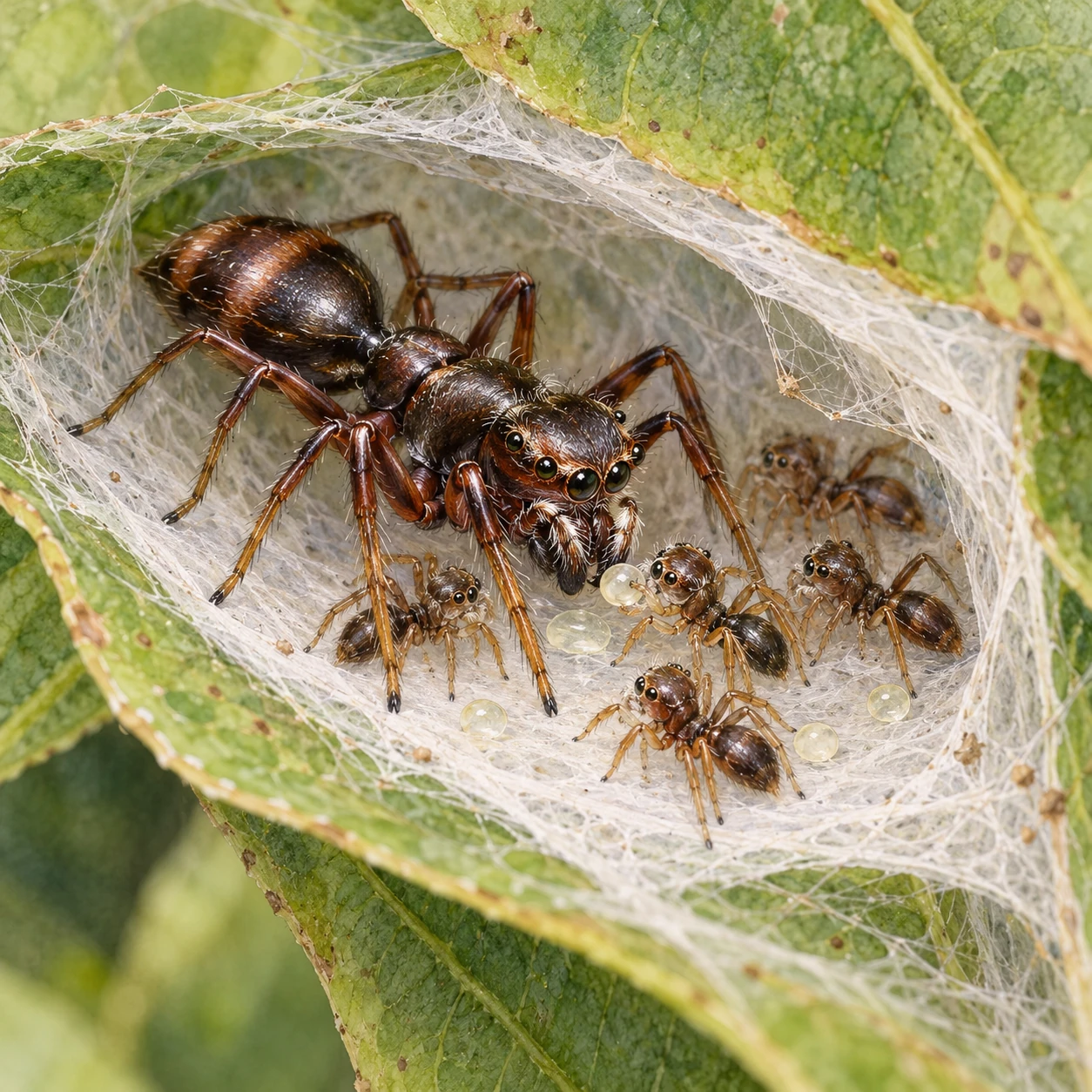
A dark ant-mimicking jumping spider and much smaller young in a silky leaf retreat beside pale droplets.
Conceptual family scene; droplets and anatomy are interpretive and do not document a feeding experiment.

A small dark jumping spider shares a silk retreat with young that are growing into recognizable versions of her. The arrangement is unusual enough to invite a question: what keeps the family together, and how are the smallest spiderlings being fed? In Toxeus magnus, researchers found an answer that challenged a familiar association between milk and mammals.

The mother supplies a nutritious liquid secretion. Young spiderlings take droplets, and later continue feeding from her even after they begin foraging. Calling it “spider milk” captures a functional resemblance, but the underlying biology is not a mammary gland transplanted into a spider. The distinction makes the discovery more, rather than less, revealing.

First observe a family that should not fit the simple picture

The Chinese Academy of Sciences account identifies Toxeus magnus as an ant-mimicking jumping spider native to southeastern Asia. Its breeding retreats can contain an adult female and juveniles at different developmental stages. Such grouping suggested prolonged care or delayed dispersal, possibilities that needed observation rather than an assumption that all spiders lead the same solitary life.

A 2018 study in Science followed the provisioning behavior and tested its consequences. Mothers secreted droplets from the epigastric furrow on the underside of the body. The youngest spiderlings initially obtained food within the retreat; later they could feed directly from the mother. The secretion was indispensable early and supplemented independent foraging later.

This is more than discovering a white liquid. A strong provisioning claim connects the substance, the parent's behavior, the offspring's use of it, and the consequences of losing access. Appearance alone cannot establish nutritional function.

Food and care are related, but not identical

The experimental design distinguished access to the secretion from the mother's continued presence. Those are different resources. A mother can supply nutrition, maintain a retreat, affect safety, or influence the social conditions in which young develop. Removing her changes more than the amount of liquid available.

That separation is one reason the study is informative. If preventing feeding and removing the mother produced identical changes, nutrition might explain more of the result. If outcomes differed, other forms of care would also need consideration. The actual research found benefits of prolonged maternal association beyond the youngest, fully dependent phase.

It is also important to specify a developmental stage when saying the young “can feed themselves.” Beginning to forage does not mean parental food has become useless, and reaching a particular body size does not establish full independence in every dimension. Development can contain overlapping sources of support.

Ask about the mother as well as the young

Once a secretion is shown to help offspring, a second question follows: what does producing it cost the parent? The answer need not be captured by comparing a mother with a female that never reproduced. Reproduction includes mating, egg production, secretion and other forms of care that can have different associations with lifespan.

A 2024 Toxeus magnus study compared females in different reproductive and care conditions. Females caring for offspring lived longer in the reported comparison than non-caring females. A separate comparison suggested a cost associated with continued milk provisioning without the full package of offspring care. The authors proposed that non-nutritional nursing could offset some costs of provisioning.

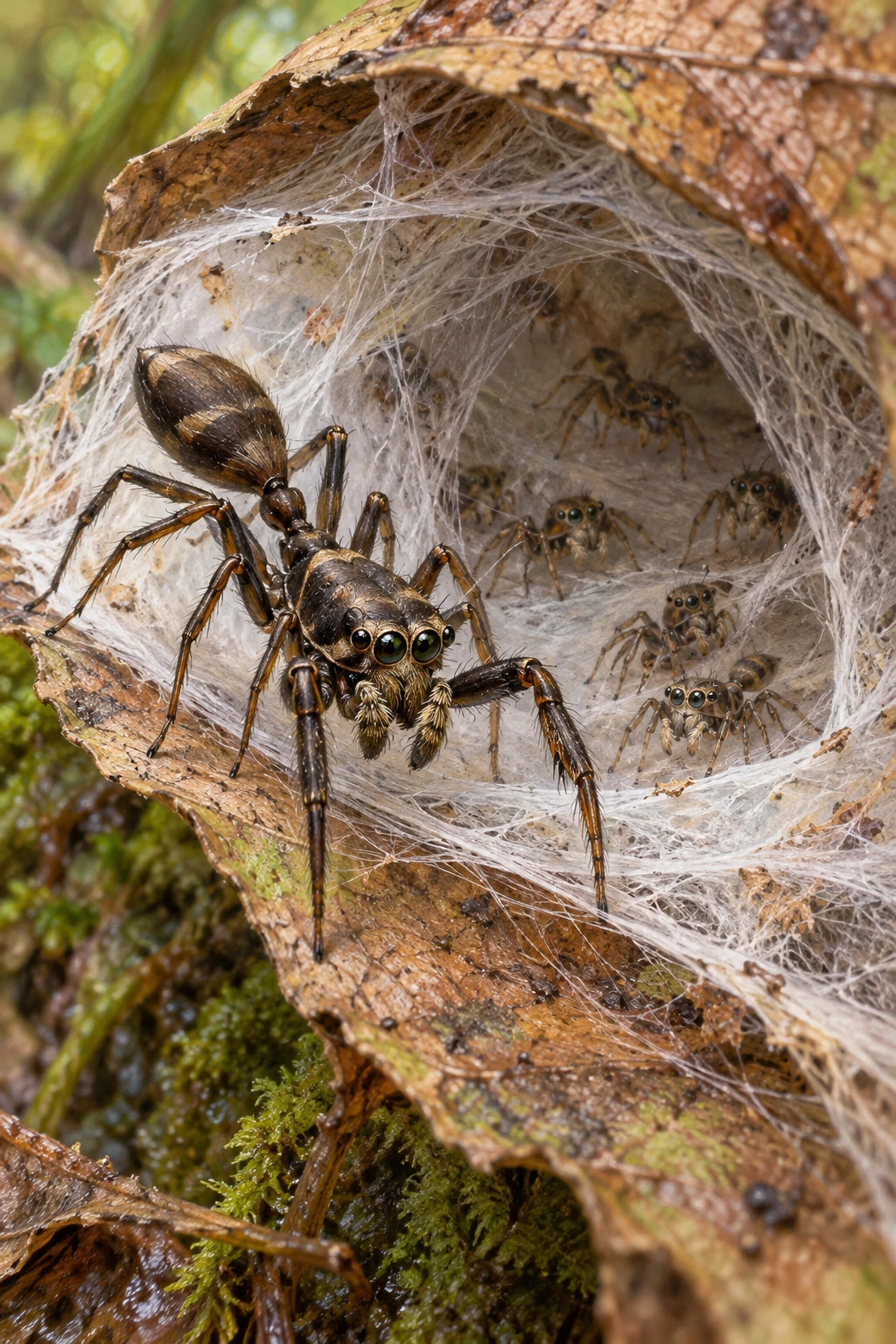
Mother Toxeus magnus beside a silk retreat containing smaller spiderlings
The retreat holds more than a food-delivery interaction. Care conditions and the chosen lifespan clock matter to the comparison.

That is not a general prescription that parenthood extends life. The study concerns laboratory spiders and defined groups. Some groups differed because of their reproductive histories, while egg removal was used in the provisioning-only condition. The group definitions are part of what a lifespan difference means, rather than interchangeable labels for “more” or “less” parenting.

The earlier researchers' discussion of the discovery already separated nutrition from extended maternal association. The later work turns attention back toward the parent's outcome. A mother can provide food and also maintain a retreat, guard young and interact with them. Removing one component does not simply subtract a fixed portion from an otherwise unchanged life.

Read the clock before the curve

In the 2024 figures, distinguish adult longevity from reproductive longevity. The first starts at the final molt; the second starts at production of the first egg clutch. A female's waiting time before reproduction enters one measure differently from the other. Two survival curves should not be compared as though they share a starting event unless they actually do.

A figure-reading task

For each curve, write four items: group membership, starting event, sample size and outcome. Then mark which groups were experimentally manipulated and how. This helps distinguish an observed group difference from a complete explanation of why the difference occurred.

The result deepens the original discovery because the family is now a two-way life-history question. The young's dependence is one outcome. The mother's survival and the work bundled into care are others. The silk retreat contains a relationship whose consequences cannot be reduced to the composition of one droplet.

The resemblance is functional, not evidence of one shared origin

In a 2019 discussion of the discovery, the researchers considered its biological implications and unanswered questions. The source and evolutionary origin of the secretion remain questions to investigate. Proposed relationships to other reproductive materials require evidence; they should not be presented as a settled explanation just because they sound plausible.

Different animal groups have evolved specialized ways of provisioning offspring. Similar functions can arise through different structures and histories. That is the value of the comparison: it helps us identify the repeated problem—supporting young through vulnerable development—while asking how each lineage solves it.

The same care is needed with “first.” The study did not discover that no nonmammal had ever supplied a specialized nutritive food. Its striking contribution was the combination and duration of milk-like provisioning and extended care in this spider. A narrower statement is both more accurate and more useful than a sweeping claim about the entire animal kingdom.

Reading the paper's figures, look for the age of the offspring, the treatment applied, and the outcome being compared. A survival curve and a photograph of feeding answer different questions. The first can reveal a dependency under defined conditions; the second documents an action and its context.

The generated illustration emphasizes the silk retreat and the size contrast between mother and young. Its droplets are conceptual. Their chemical composition and the anatomy of secretion come from the measurements and observations in the research, not from the picture.

The discovery changes a useful expectation. A jumping spider can be more than a solitary hunter whose parental contribution ends with eggs. In this species, the mother's body and behavior remain part of the young's food supply and developmental environment. The familiar word “milk” opens the door, but the lasting interest lies in the particular spider life behind it.

Follow the evidence: Chen and colleagues: prolonged milk provisioning in a jumping spider; Chinese Academy of Sciences: the discovery and study organism; Chen and colleagues: biological implications and unresolved questions.

More curious connections, art and independent projects at Incoprea.
A Parrotfish’s Mucus Cocoon Is a Barrier With a Specific Job

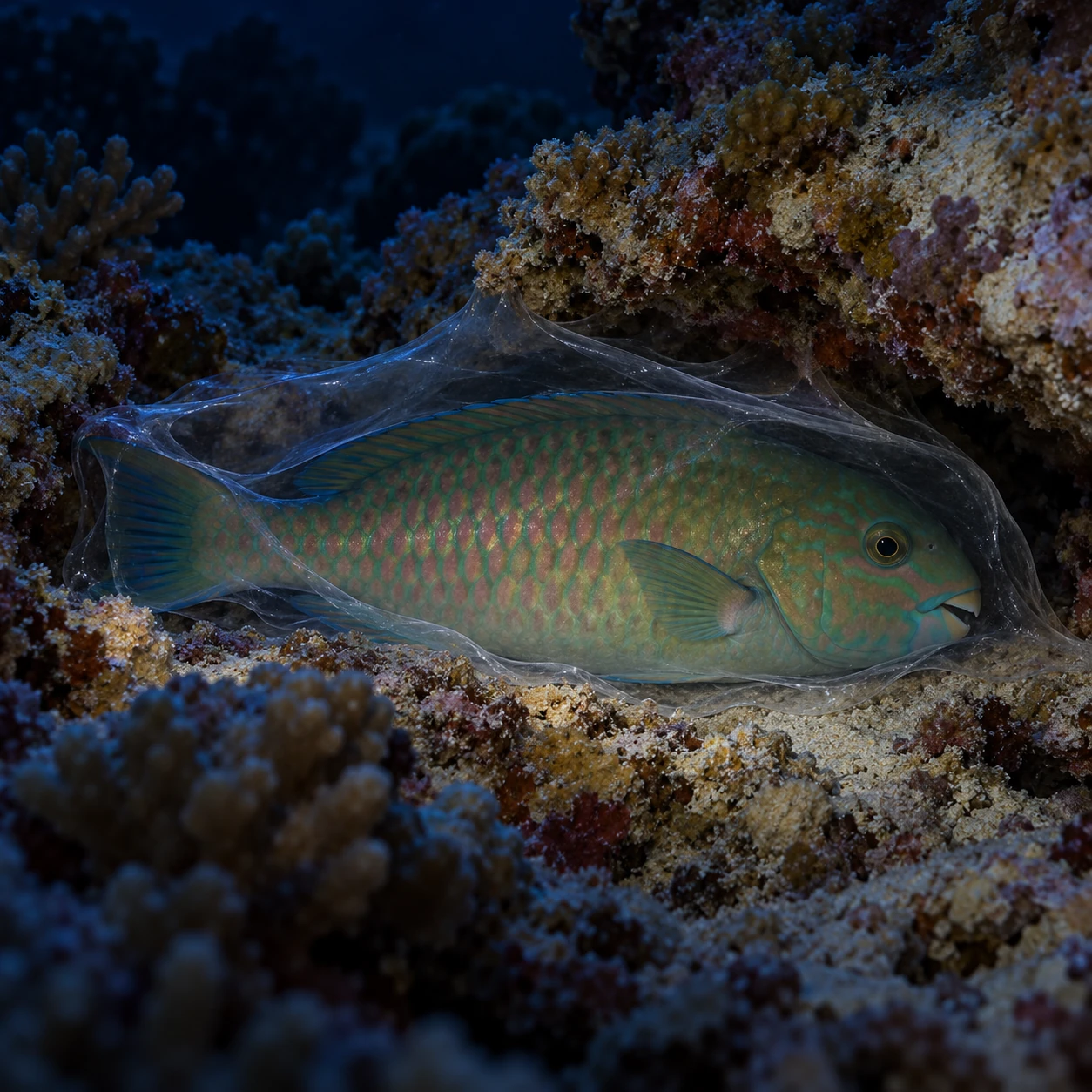
A parrotfish rests in a reef crevice within a thin nearly transparent mucus envelope.
Conceptual resting scene; the envelope is interpretive, not an experimental specimen or a measured barrier.

At night, a reef fish can settle inside a covering almost too clear to see. The cocoon is made of mucus, secreted around the resting animal. It looks vulnerable compared with a shell or a burrow, yet for some parrotfishes it can provide a useful barrier against small blood-feeding parasites.

The comparison often used is a mosquito net. Like any analogy, it identifies a function without establishing an identical mechanism or construction. The fish does not weave cloth. It produces a physiological covering whose value can be tested by asking what happens when the covering is absent.

The experiment behind the familiar image

A study published online in 2010 and in a 2011 issue of Biology Letters investigated mucous cocoons in Chlorurus sordidus. Researchers compared fish that retained their cocoons with fish from which the cocoon had been removed, and examined attack by gnathiid isopods. These small crustaceans feed on fish blood during part of their life cycle.

In the reported experimental comparison, 94.4 percent of fish without their cocoon were attacked, compared with 10 percent of fish that retained it. This was a defined test with particular fish, parasites, timing, and conditions. It supports protection against those attacks; it does not establish that a cocoon makes a fish invulnerable to everything in the reef.

The Smithsonian's photograph and caption provide a visual reference for the covering. The genuine cocoon is a delicate envelope, not a rigid transparent sphere. Seeing its thinness makes the experimental question more interesting: the barrier does not need to look like armor to alter access for a tiny parasite.

Why removal is more informative than a photograph

A fish in a cocoon demonstrates an association between a behavior and a material structure. To establish a protective function, researchers need a relevant comparison. Removing the structure while preserving other conditions as well as possible changes the proposed cause and lets the outcome be measured.

Even then, the design deserves inspection. Handling could change the fish's state. Some fish might abandon or damage a cocoon or make another. The published methods specify how such cases were treated. Those details determine which animals the final numbers describe.

This is a useful reading habit for any natural-history experiment. Ask what changed intentionally, what else might have changed with it, and which observations were excluded. A clear result becomes more convincing when its construction is visible, not when the procedure is omitted for a cleaner story.

A parasite count is the balance of several movements

The number of parasites on a fish at one instant is not the same as the number that tried to feed during the night. New arrivals, successful attachment, departure after feeding and removal can all change the count. A protective covering can alter one part of that traffic.

Enlarged interpretive gnathiid larva on reef sand with a distant fish
A small parasite’s arrival, feeding and departure belong to different stages. The illustration is not microscopy or an identification key.

A 1999 study of the wrasse Hemigymnus melapterus compared gnathiid abundance and feeding state through the day. More parasites were present at dawn than at sunset, but the evidence also indicated new infestations during daylight. This concerned a different host from the parrotfish cocoon experiment. It shows why time of sampling belongs in the biological explanation.

2002 work on cleaning interactions then combined observations with a model of parasite arrival, departure and removal. The clients' cleaning behavior did not simply track every daily change in parasite abundance. A count could vary while the frequency and duration of inspections remained comparatively steady.

Try a balance sheet with a missing history

Begin with ten fictional parasites on a fish. In Scenario A, five arrive and five leave during an interval. In Scenario B, none arrives and none leaves. Both finish at ten. The same final count describes very different exposure histories.

What if a barrier prevents four arrivals?

Under the invented A schedule, one arrives and five leave, so six remain. Under B, there were no arrivals to prevent and ten remain. The difference does not make the barrier intrinsically better in one fish; its observed effect depends on the traffic occurring during the interval.

These fictional cases omit feeding success, parasite identity and possible host responses. They isolate one measurement issue: a standing burden is an outcome of rates through time. The arithmetic is not a reconstruction of the cocoon study.

Return to the removal experiment with that distinction in mind. Ask when exposure began, when attacks were counted and how the intact and removed treatments shared the interval. The result becomes a precise test of protection under specified circumstances, rather than a timeless claim that a fish is either parasitized or protected.

A delicate covering can matter because it changes access during a vulnerable period. The small animals outside it are part of a moving system, not a fixed set of dots waiting on the skin for the observer's next photograph.

Making the covering has a cost

The same cocoon study estimated energetic investment using the material's energy content and a daily assimilation estimate from another parrotfish species as a proxy. Its often repeated figure of roughly 2.5 percent is therefore an estimate with a cross-species assumption, not a complete direct measurement of every cost in the study fish.

That qualification is biologically interesting. A protective behavior can be worthwhile when its benefits exceed its costs, but identifying those costs accurately is difficult. Material energy, secretion, time, and alternative activities are not automatically captured by one number. The calculation offers a starting comparison, not the final accounting.

Some fish also produced a second cocoon after removal. That shows a capacity to respond within the night under the study conditions. It does not mean repeated removal would be harmless, or that a diver should touch a resting fish to see the response. Observation should leave the covering intact.

A barrier against one parasite is not a universal parasite shield

A 2020 study of trematode infections in Okinawan parrotfishes considered a different group of parasites. Cocoon use did not straightforwardly explain prevalence across the species examined. That does not contradict the gnathiid experiment: different parasites reach hosts in different ways, and comparisons across species introduce additional differences.

The two studies illustrate why a general statement such as “mucus prevents parasites” is too broad. A useful account identifies the parasite, how it encounters the host, which host species is involved, and what was measured. A mechanism can work well within one interaction and be irrelevant in another.

The night reef also differs from the daytime reef familiar to snorkelers. Rest changes what a fish is doing, and a covering can help alter exposure during that vulnerable interval. The seemingly quiet scene contains ongoing interactions among a resting vertebrate, secreted material, and small organisms searching for a meal.

The generated painting here suggests the envelope without pretending to reproduce an experimental specimen. The linked Smithsonian image is the better visual evidence for the real covering. Taken together with the experiment, it changes what a bedtime scene can mean: a fish has made a temporary boundary between its skin and a particular kind of hungry neighbor.

Follow the evidence: Grutter and colleagues: fish mucous cocoons and parasite attack; Smithsonian Ocean: parrotfish in a mucus cocoon; Parrotfish trematode prevalence in Okinawa: a different parasite question.

More curious connections, art and independent projects at Incoprea.
Wednesday, October 14, 2026

Peacock Spider Courtship Has a Soundtrack You May Miss

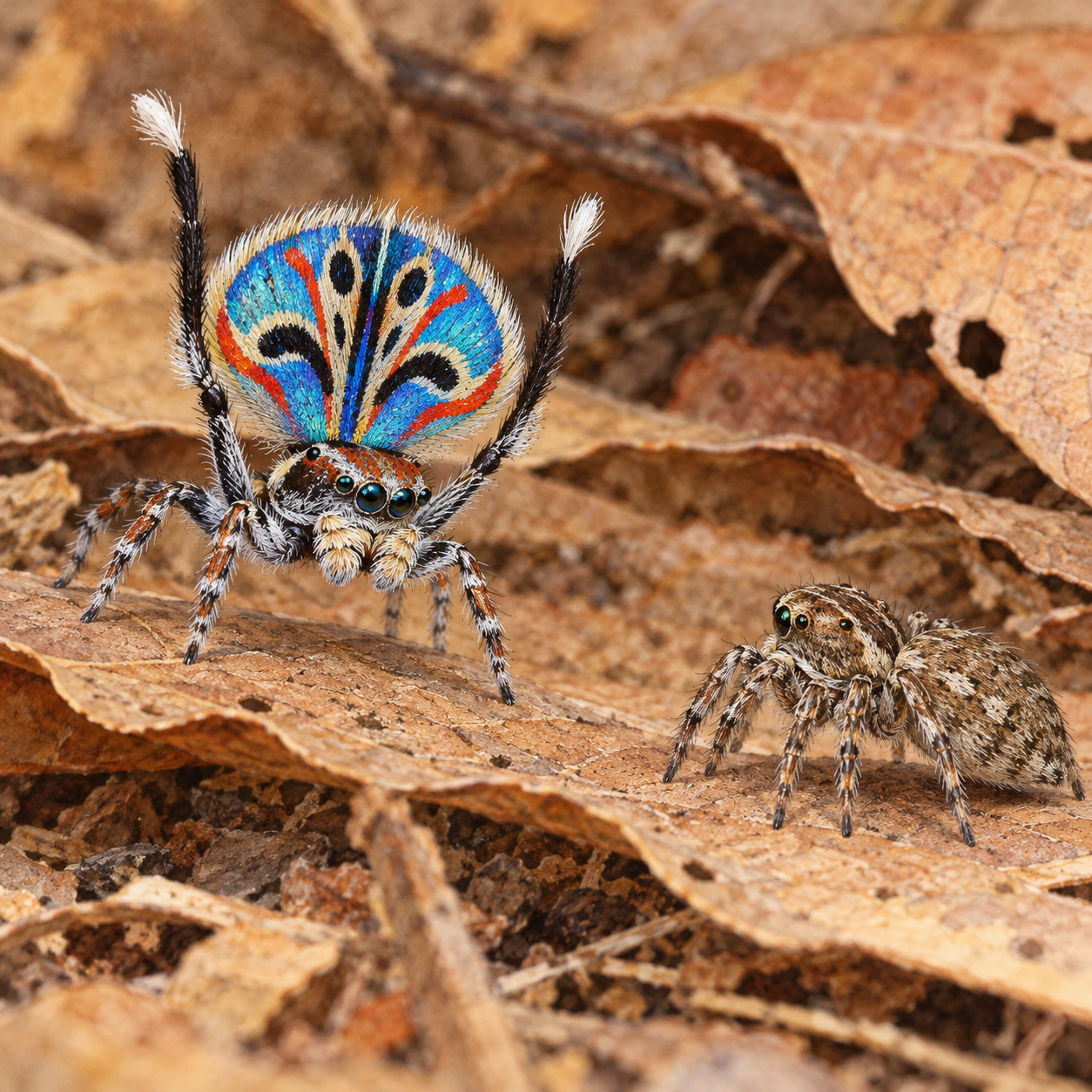
A male peacock spider raises a colorful fan and legs toward a smaller plain female on leaf litter.
A conceptual peacock-spider courtship scene at enlarged scale, with an artistic pattern rather than an identified specimen.

A male peacock spider raises a colorful abdominal fan, waves his legs, and shuffles in front of a female. Magnified video makes the display look like a miniature stage performance. Much of the exchange, however, happens through a channel that a silent clip can leave out.

In Maratus volans, researchers have measured vibrations accompanying the visible display. The animal's performance is multimodal: movement and color work alongside signals transmitted through the surface beneath it.

The fan is an abdomen, rather than feathers

Peacock spiders are small Australian jumping spiders. In displaying males, folded flaps associated with the abdomen open into a fan-like shape. A raised third pair of legs helps frame and accompany the movement.

The resemblance to a peacock gives the spiders their common name, but their apparatus is an arachnid's body. Their colors, proportions, and display details vary among species. A striking male in one photograph should not stand in for every member of the group.

Museums Victoria's account of peacock-spider research emphasizes how much observers have learned by paying close attention to these tiny animals. A spectacle can be common at its own scale and still remain easy for a much larger viewer to overlook.

Vibrations add another channel

In a 2011 study, scientists combined ordinary and high-speed video with laser vibrometry, a method for measuring tiny movements. They documented vibrational signals as well as visual behavior during courtship in M. volans.

A vibration through a leaf or other substrate is different from airborne sound recorded by a nearby microphone. To understand what the female receives, researchers need measurements suited to the medium carrying the signal.

The study also distinguishes describing a signal from demonstrating its exact function. Several ideas can explain multimodal communication: different components might convey different information, reinforce one another, or become useful under different conditions. Identifying the display's parts is a foundation for testing those alternatives.

Follow one display through three channels

The study's supporting movies are a better place to begin than an edited compilation with music. On the first viewing, watch the abdominal fan and the raised legs. Record the sequence of changes you can actually see. On the second, watch the female rather than the male: her position and responses are part of the interaction, even when the male occupies most of the frame.

For the vibration record, check how the researchers measured and presented the signal. Laser vibrometry detects motion of the substrate. If that measurement is made audible for a recording, the speaker is rendering a measured vibration for human listening. It does not mean a tiny airborne song would sound equally loud to a person standing beside the spider.

Keep the recording's timescale in mind as well. High-speed footage can reveal movements hidden in ordinary video, but slowing it changes the experience of timing. The scientific question concerns how components occur relative to one another during a real display. A slow-motion flourish is useful evidence about motion, not a new normal pace for the animal.

A simple observation sheet can have three columns: visible action, substrate vibration and receiver response. Leave a cell empty when the clip or measurement does not show that channel. The exercise makes the missing information visible instead of unconsciously supplying it from a human idea of dancing.

A performance for the intended audience

Human viewers tend to notice saturated colors and movements that resemble dancing. A female spider may attend to combinations of timing, motion, and vibration that our first impression does not capture.

The same caution applies when we call a performance successful. A conspicuous display is an attempt to communicate, not a guarantee of mating. Studying the receiver's behavior is as important as admiring the sender's ornaments.

See or hear more: Explore the study's supporting courtship videos.

Describing a signal is different from proving its job

Suppose a vibration and a fan movement repeatedly occur together. That establishes a relationship worth investigating. To find what the vibration contributes, researchers need comparisons that alter access to the signal while preserving other relevant parts of the display. The receiver's response then helps test a proposed function.

Different components could reinforce a common message, convey partly different information or remain useful under different viewing conditions. A description of a complex sequence is a foundation for those alternatives, not evidence that one must already be correct. The 2011 paper explicitly treats its detailed account as a basis for investigating multimodal communication.

The species label matters because the striking family resemblance can hide diversity. A film of one Maratus species cannot establish an identical choreography or vibration repertoire in another. Museums and taxonomic researchers combine close observation with the work of distinguishing species, making a spectacle legible as biology.

This changes the question a viewer brings to the performance. Instead of asking whether the spider dances well by human standards, ask what information reaches the intended receiver, through which medium and at what moment. The fan remains beautiful, but the behavior becomes richer when the female and the vibrating stage receive as much attention as the ornamented male.

Sources and further reading: Girard and colleagues: Multi-Modal Courtship in Maratus volans · Museums Victoria: Peacock-spider research · Australian Museum: Peacock-spider natural history

publications

New this week Two novels in six stories each, from The Night Shift . New — a novel in six documents Small Print A Novel in Six Do...