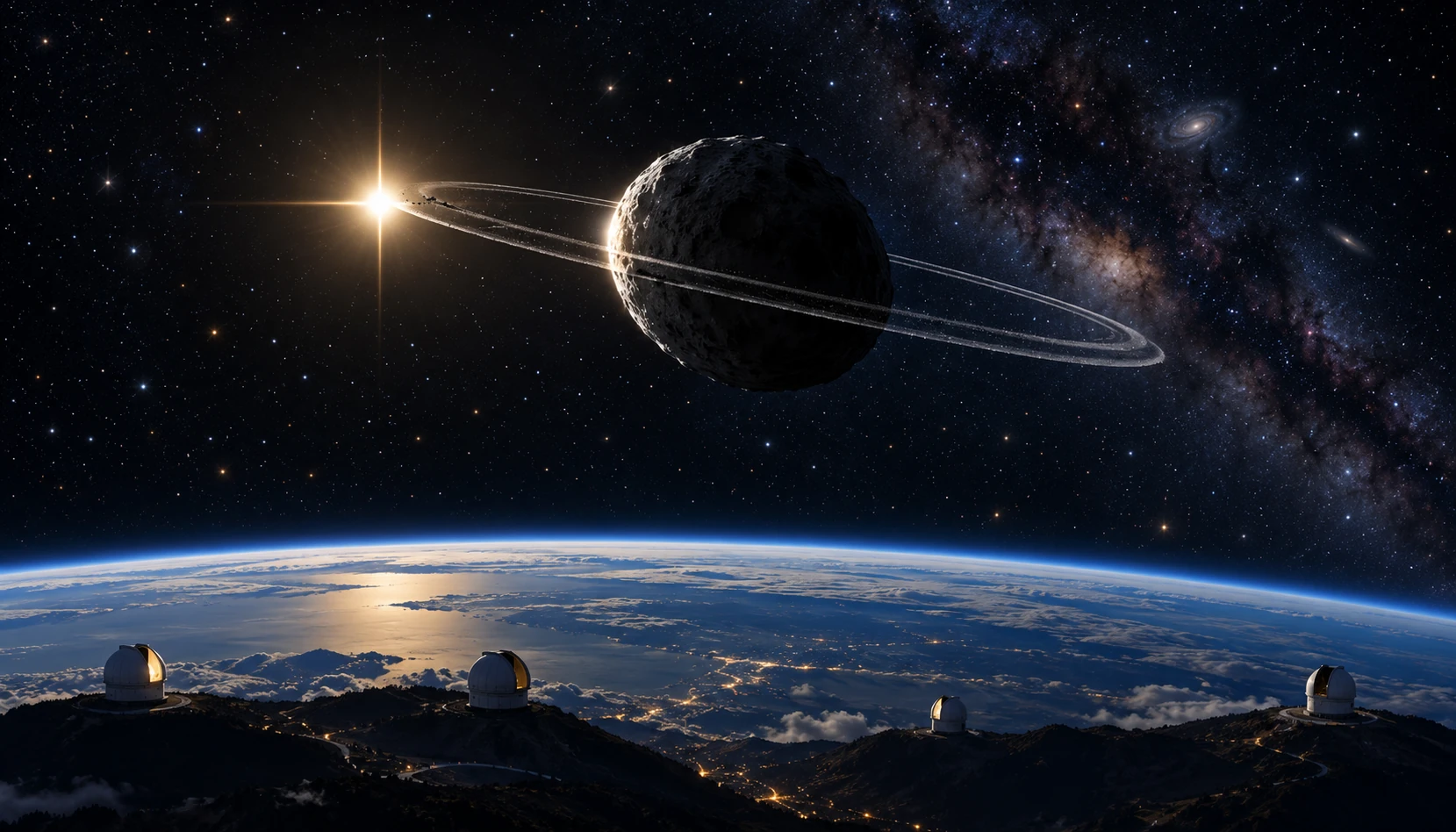
A star disappears for a few seconds. To most viewers, that sounds like a failed observation. To an occultation team, the timing of the darkness can be the measurement they planned for months.
When a Solar System body crosses the line of sight to a distant star, it casts a moving shadow across the observer’s location. Measuring the star’s changing brightness can reveal the foreground object’s size, shape, atmosphere, or rings at a level of detail difficult to obtain from a direct image.
The star supplies the backlight
The distant star acts approximately as a small light source, while the nearer body and any surrounding material block or refract some of its light. The observation becomes a light curve: brightness measured repeatedly through the event.
An airless solid edge can produce a relatively abrupt disappearance. A tenuous atmosphere can alter the light more gradually through refraction and extinction. Rings can produce additional dips before and after the main body’s passage. The actual curve also includes finite exposure time, diffraction, the star’s apparent size, and instrument behavior.
ESO’s account of Chariklo’s ring discovery shows how unexpected secondary dips led to a striking result. Telescopes at several sites watched the 2013 event, allowing the pattern to be tested across different paths through the shadow.
One site measures a chord
A telescope’s disappearance and reappearance times define a path across the object’s projected silhouette when combined with the shadow’s velocity. This path is called a chord. A short chord can pass near an edge; it need not imply that the whole body is small.
Several stations provide several chords. Together they constrain the silhouette more strongly than one site can. A station with no occultation can also be useful, setting a limit on where the shadow did not pass, provided its timing and sensitivity are adequate.
Imagine drawing a circle and laying three parallel strings across it. Each string has a different length, though all belong to the same circle. Now replace the circle with an ellipse. The exercise makes clear why one duration is insufficient to establish a unique shape.
A simple duration calculation
Suppose a hypothetical shadow moves at 20 kilometers per second and a solid-body occultation lasts 8 seconds. Ignoring other complications, the corresponding chord length is 160 kilometers. If the observing cadence is one frame per second, the timing resolution becomes a substantial fraction of the event.
These invented numbers do not describe Chariklo’s actual measurements. They show why accurate clocks and rapid photometry matter. A tenth of a second at that speed corresponds to 2 kilometers of chord distance before including other uncertainties.
For narrow rings, finite exposure can smear a dip. A shallow feature may be genuinely low opacity, partly unresolved, diluted by background light, or affected by other observational factors. The model has to account for the instrument as well as the object.
The ring announcement was not a direct close-up
The Chariklo discovery paper presents the multi-chord evidence for two narrow rings. The ring geometry emerged from light losses and their timing, not from a spacecraft visiting the object and photographing the particles.
That distinction is easy to lose when an artist’s impression accompanies a news story. The impression helps readers picture the inferred system. The measured light curves and geometric fit are the evidence.
ESO’s observation video offers a useful next step: watch the actual stellar brightness change before looking again at the polished ring illustration. The small dip becomes more impressive when you know what information it carries.
Webb changed the observing location
A space telescope follows its own trajectory, so predicting an occultation requires the star position, the foreground object’s orbit, and the observatory’s location. A ground-based shadow track alone is not enough.
NASA’s 2023 Chariklo report describes Webb observations and explicitly labels the report as science in progress at the time. That qualification belongs with the original announcement rather than being silently removed in retelling.
The more general lesson is that precise astrometry—the measurement of positions—makes the dramatic event possible. The eventual few-second curve rests on years of orbit and star-position work, scheduling, and accurate timekeeping.
Changing opacity has more than one interpretation
Santos-Sanz and colleagues’ subsequent analysis of the Webb occultation reports an inner-ring signature stronger than in earlier observations and a weaker near-infrared signature for the outer ring. The authors discuss temporal change and wavelength-dependent opacity as possibilities that are not mutually exclusive.
A weaker dip in a different wavelength does not automatically mean that a ring lost the same fraction of its mass. Particle size, composition, viewing geometry, and optical properties affect the relation between brightness loss and material. New observations at matched wavelengths can help separate those explanations.
This is where the subject moves beyond a simple discovery story. A ring system can be well established while its origin, stability, and evolving particle population remain active research questions.
Try adding a timing uncertainty to the hypothetical eight-second event. If each edge is uncertain, the chord length should carry uncertainty too, and an uncertain shadow velocity adds another contribution. The resulting silhouette is a fitted region rather than an infinitely thin outline. This does not diminish the method’s precision; it explains what precision means. A reader can then compare two inferred shapes without pretending that either was measured with a physical ruler placed beside the object.
Read a light curve in three passes
- First identify the baseline, noise, and any comparison-star correction.
- Then mark the main disappearance and additional dips without deciding what they mean.
- Finally compare the model, observing cadence, and other stations’ chords.
Keep a distinction between an observed feature and the object inferred to explain it. An isolated dip might be instrumental; matching features across independent sites offer stronger evidence. A model that explains timing, geometry, and repeated observations is more persuasive than a resemblance in one curve.
Occultations turn absence into a ruler. The star’s brief disappearance is useful because the darkness has a location, a duration, and a carefully measured context.
Sources and a next step
- ESO: discovery of Chariklo’s rings
- Braga-Ribas et al.: Chariklo discovery paper
- ESO: actual occultation observations
- NASA Webb 2023: occultation technique and preliminary observations
- Santos-Sanz et al.: Webb ring-system analysis
Continue exploring art, ideas, and unexpected connections at Incoprea.