In a textile, a pattern can begin before the cloth exists. A weaver may arrange threads, bind selected sections against dye, color the exposed lengths, and only then weave them together. The picture is distributed across separate strands before it becomes a surface.
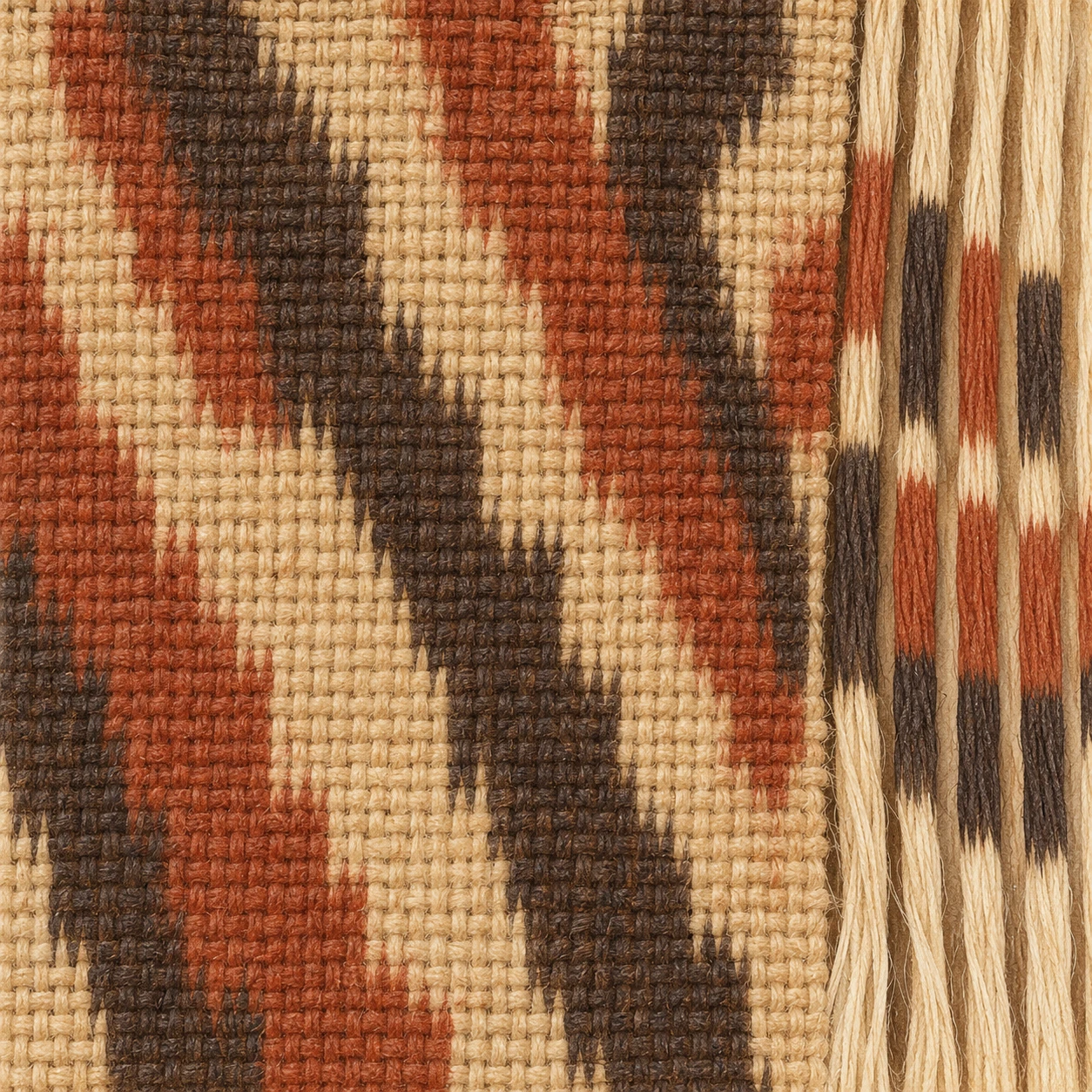
The Banton cloth, held by the National Museum of the Philippines, offers a rare surviving encounter with that kind of planning in the precolonial past. Its fragility is part of its importance. Many historical textiles disappeared while more durable pottery and metal survived. A surviving cloth changes what an archaeological collection allows us to notice.
A burial context, not a complete biography
The Cultural Center of the Philippines’ encyclopedia entry identifies the Banton burial cloth as abaca warp ikat, associated with wooden coffins in a cave on Banton Island in Romblon. “Burial cloth” describes that association. It does not by itself establish every purpose the textile served before burial, the name of its maker, or the exact place it was woven.
The National Museum’s Hibla textile catalog (entry 153, page 109; the link gives its current library record) places it among finds from a disturbed cave complex, including coffins, imported ceramics, beads, and other objects. The catalog estimates the associated assemblage to the thirteenth to early fourteenth century. The encyclopedia uses a fourteenth–fifteenth-century date. Those published ranges should not be silently turned into a single precise year.
A 2021 textile-research conference abstract likewise notes that the cloth’s origins remain under study and that the presence of an ikat textile on Banton does not establish a documented local ikat-weaving tradition. The careful story is already compelling: the object survives in a particular archaeological setting, while questions about its manufacture remain open.
How warp ikat stores an image in thread
“Warp” refers to the lengthwise system of threads held under tension during weaving. “Weft” crosses through it. In warp ikat, resist-dyed portions of the warp contribute the visible pattern. The dyeing therefore precedes the weaving, rather than being a design painted onto a finished cloth.
Imagine a row of parallel paths with colored stretches at different positions. Move one path a little forward and its colored section shifts relative to its neighbors. A planned motif depends on keeping those relationships sufficiently aligned as the work proceeds. Slightly soft edges can be part of this material result, rather than a failed attempt at a printed outline.
This is a simplified explanation of the principle, not instructions for reproducing the Banton cloth. A named community’s technical vocabulary, materials, and designs deserve more precision than a universal “ancient weaving secret” story.
A paper model of a pre-woven pattern
You can explore the planning problem with paper and colored pencils. No dye, sharp tool, or borrowed traditional motif is needed.
- Draw six parallel vertical lines on a sheet. Across their middle, draw your own simple diagonal band.
- Copy each line onto a separate narrow strip, preserving where the colored band crosses it.
- Arrange the strips together again. The diagonal reappears only if their positions agree.
- Slide one strip upward and another downward. Watch the outline break into displaced segments.
The model leaves out fiber preparation, tying, dye chemistry, tension, and the labor of actual weaving. Its purpose is narrower: to let you feel the difficulty of distributing a design across independent lengths. After trying it, return to a museum photograph and look for the relationship between a large motif and the threads that carry it.
Material skill belongs to people
The Hibla gallery presents the Banton fragments alongside looms, fibers, dyes, and textiles from different Philippine communities. That context discourages two easy mistakes: seeing only an isolated “oldest” object, and treating all Philippine weaving as one interchangeable tradition.
For a named example of more recent knowledge and teaching, the museum’s account of Tagabawa Bagobo master weaver Salinta Monon describes her expertise in inabal, an ikat-dyed abaca textile, and her work teaching younger generations. It also records her ability to recognize designs and individual makers. This is evidence of her particular community and practice, not proof that she inherited the Banton cloth’s exact lineage.
The distinction matters. A contemporary or recent textile tradition can help a visitor understand that weaving involves expert decisions. It should not be used to fill every gap in an archaeological artifact’s story. Continuity is a historical proposition that needs evidence, not a compliment we can safely invent.
Look past the race to be first
The museum calls the Banton fragments its oldest textile collection and a National Cultural Treasure. “Oldest surviving” is a statement about preservation and present knowledge. It is not the same as the first cloth ever woven in a region, and it is not a measure of the sophistication of all earlier work that happened to decay.
Three questions make a better looking guide than a superlative. What can you actually see in the fibers? What does the find context support? What remains unknown about the maker and the route to the burial place? Keep these questions separate and the fragment becomes both more human and more intellectually interesting.
A tiny surviving textile does not have to answer everything. It gives us a rare material point of contact with someone who understood how to arrange color in threads—and with the larger human world that valued the finished work enough to keep it close to the dead.
If you are looking with a child, let the first question be about work rather than age: how many separate decisions would be needed to turn loose fiber into this surface? Invite guesses about arranging, coloring, tightening, and keeping track. Then distinguish the guesses from what the museum actually documents. The exercise gives the maker attention without inventing a biography.
For an adult reader, a useful follow-up is to compare two museum labels for the same artifact. Note differences in date, measurements, and terminology. Those differences may reflect fragments, catalog histories, or changing scholarship. Keep them visible until a documented explanation resolves them.
Sources and a closer look
Cultural Center of the Philippines: Banton Burial Cloth; National Museum: Hibla textile catalog (entry 153, page 109; the link gives its current library record); Centre for Textile Research: 2021 conference abstracts; National Museum: Hibla gallery; National Museum: Salinta Monon and inabal.
Find more art, ideas, and unexpected connections at Incoprea.