Showing posts with label Microscopic Life. Show all posts

Wednesday, October 14, 2026

Bdelloid Rotifers: Tiny Animals With Large Survival Mysteries

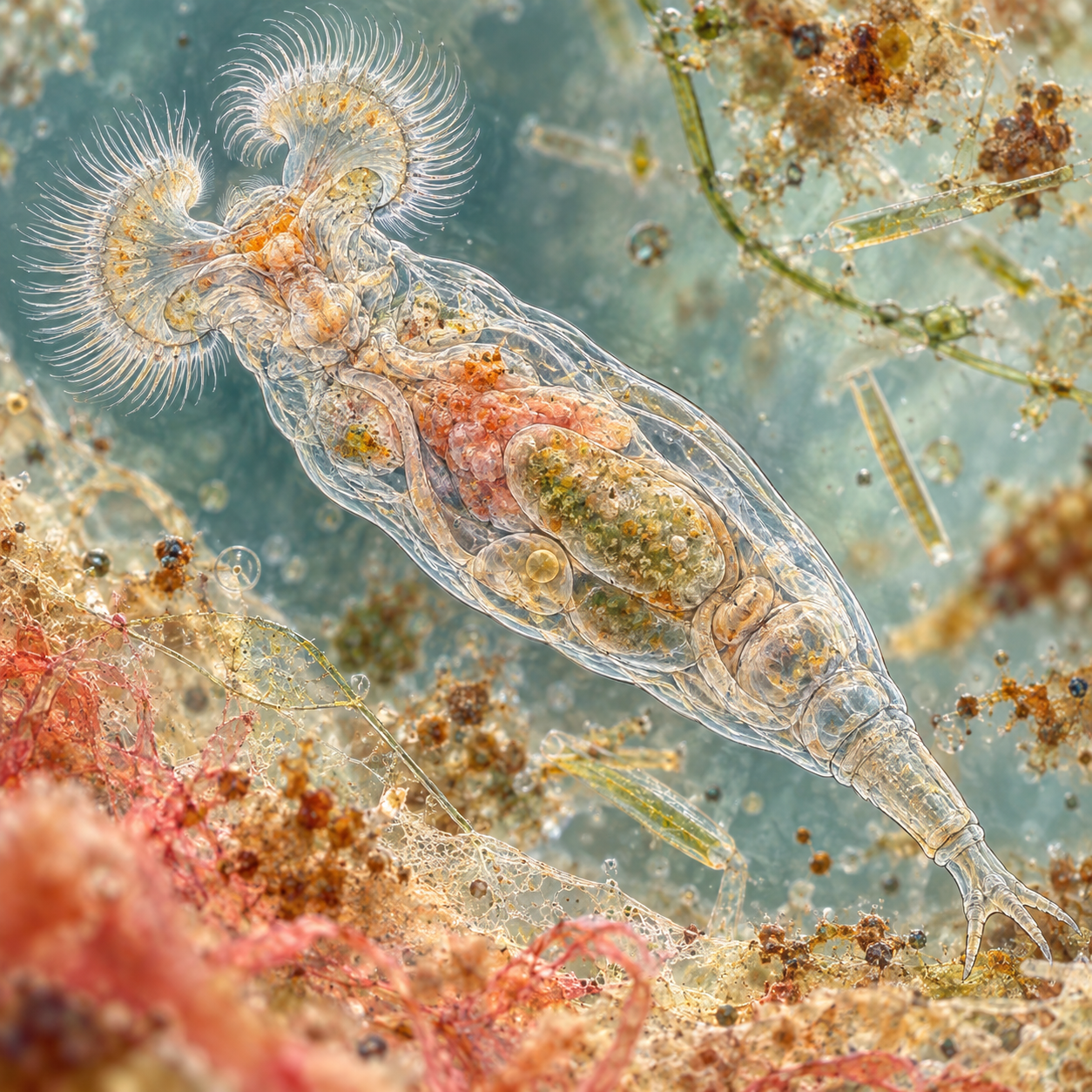
A translucent bdelloid rotifer with ciliated feeding lobes appears among microscopic freshwater material.
Microscopy-inspired illustration of a bdelloid rotifer; colors and internal details are interpretive, not a specimen micrograph.

A bdelloid rotifer is easiest to appreciate when it is busy. Under a microscope, its body stretches, contracts, and bends. At the feeding end, beating cilia create the impression of tiny turning wheels. This is a multicellular animal carrying out an ordinary day in a film of water, even when its entire world is smaller than a familiar speck.

Then imagine that the water film disappears. For many bdelloids, that change need not end the story. Their ability to endure drying, and sometimes other severe stresses, has drawn researchers into questions about recovery, the history of frozen samples, and the movement of genes. Each question needs its own evidence.

Start with the living animal

The “wheels” are not rotating parts. They are arrays of cilia whose coordinated beating helps bring food toward the mouth. Looking for that movement gives a much richer impression than an outline showing only an elongated transparent body. Watch how the feeding end differs from the narrower end used during attachment and movement.

In the Marine Biological Laboratory’s research footage or a live educational display, try following three actions separately: feeding, extension, and contraction. A single still image cannot show all three. It may also conceal how the same animal changes shape, making a contracted individual seem unlike an extended one.

That ordinary activity matters to the survival story. A dormant rotifer is not continuously feeding, growing, and reproducing through a dry interval. The remarkable event is a return to those functions when suitable conditions return. Persistence and continuous activity are different claims.

Drying and freezing ask different questions

Many bdelloids occupy habitats where the availability of liquid water changes, including films around moss and soil. Some can become inactive during drying and later recover on rehydration. The success of that transition depends on the organism and conditions, rather than a universal ability shared without limits by every species.

Freezing introduces additional problems. Ice formation and the changing chemistry of the remaining liquid can damage cells. A species surviving one freezing treatment has answered a specific experimental question. It has not established an unlimited ability to withstand any temperature, cooling rate, or duration.

Imagine comparing two studies in which both authors report survival. One may measure movement shortly after rehydration; another may require later reproduction. Those endpoints tell us different amounts about recovery. A careful comparison asks what returned, when it returned, and how many individuals did so.
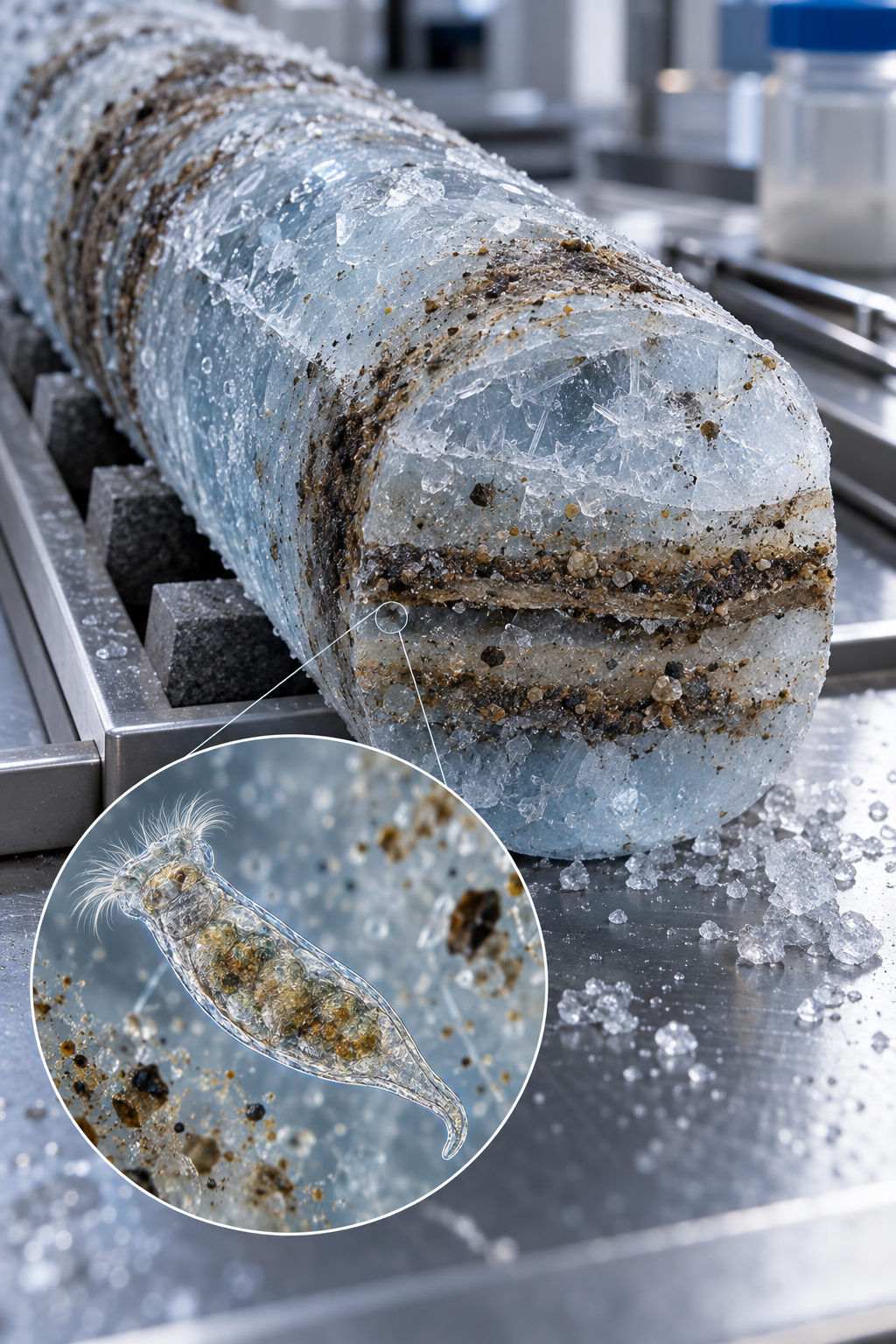
An illustrated layered frozen sediment core includes a magnified conceptual rotifer inset.
Conceptual illustration of permafrost research. It does not depict the actual 2021 core or recovered specimen, and the inset is not to scale.

The 24,000-year report is a chain of evidence

In 2021, Lyubov Shmakova and colleagues reported a bdelloid recovered from northeastern Siberian permafrost. The surrounding material was radiocarbon-dated to approximately 24,000 years before present. After thawing, the animal reproduced, allowing a culture to be established. The researchers also detected rotifer genetic sequences in material from the same sample.

The date belongs to the sediment context, not to a directly measured birth certificate for the animal. That distinction does not make the finding uninteresting. It tells us how the authors connected the living recovery with a geological history. Handling, sampling, dating, identification, and reproduction all contribute to the claim.

What supports which part of the story?
ObservationWhat it helps establish
Dated frozen materialThe age of the sampled context.
A moving recovered animalReturn of visible biological activity.
Subsequent reproductionRecovery extending beyond a brief movement.
Genetic identificationThe biological identity associated with the sample.

A headline usually compresses those steps into an age and the word “alive.” Restoring the steps makes the result easier to assess. It also prevents an unusual preserved specimen from becoming a claim that active rotifers routinely live for tens of thousands of years.

Reproduction brings a second mystery

Bdelloid females reproduce by parthenogenesis, with offspring developing without fertilization, and males have not been conclusively observed. This made the group famous as an apparent challenge to ideas about why sexual reproduction is widespread.

But absence of observed males does not establish absence of every form of genetic exchange. A 2020 study compared genomes from 11 wild-caught Adineta vaga individuals. Several patterns were inconsistent with strict clonality and supported exchange and recombination. The precise biological process producing those patterns remained an important question.

This is a good example of evidence changing the wording of a story. We can describe observed reproduction and genomic patterns without pretending we have watched every relevant event. The mystery becomes more specific rather than disappearing.

Borrowed genes can become active in a new setting

A 2024 study added another connection. Researchers examining a fungal challenge found increased activity of horizontally acquired genes, including genes associated with biosynthetic functions. Such findings investigate how DNA acquired from other kinds of organisms may contribute to the biology of a tiny animal.

Gene activation, production of a particular compound, and protection against disease are separate levels of evidence. Recognizing that distinction keeps an intriguing genetic result from becoming an unsupported claim about a ready-made antibiotic or treatment. The biological role needs investigation through appropriate comparisons.

Keep two kinds of exchange separate here. Recombination between individuals of a rotifer species concerns the reshuffling of their inherited information. Horizontal acquisition concerns DNA whose history includes a different kind of organism. One finding does not explain every example of the other. Both can influence evolution, but they raise different questions about origin, mechanism, and function. Connecting them carefully is more interesting than using the broad word “exchange” to imply that the same event accounts for both.

Bdelloids therefore offer more than a list of endurance records. They connect visible feeding behaviour with recovery from environmental interruption and open questions about heredity. The next time you see the ciliary “wheels” working, the most interesting thought may be how much history and biology can fit inside that small, active body.

Explore more creative curiosity at Incoprea.

Tardigrades Are Tough, but Their Survival Has Fine Print

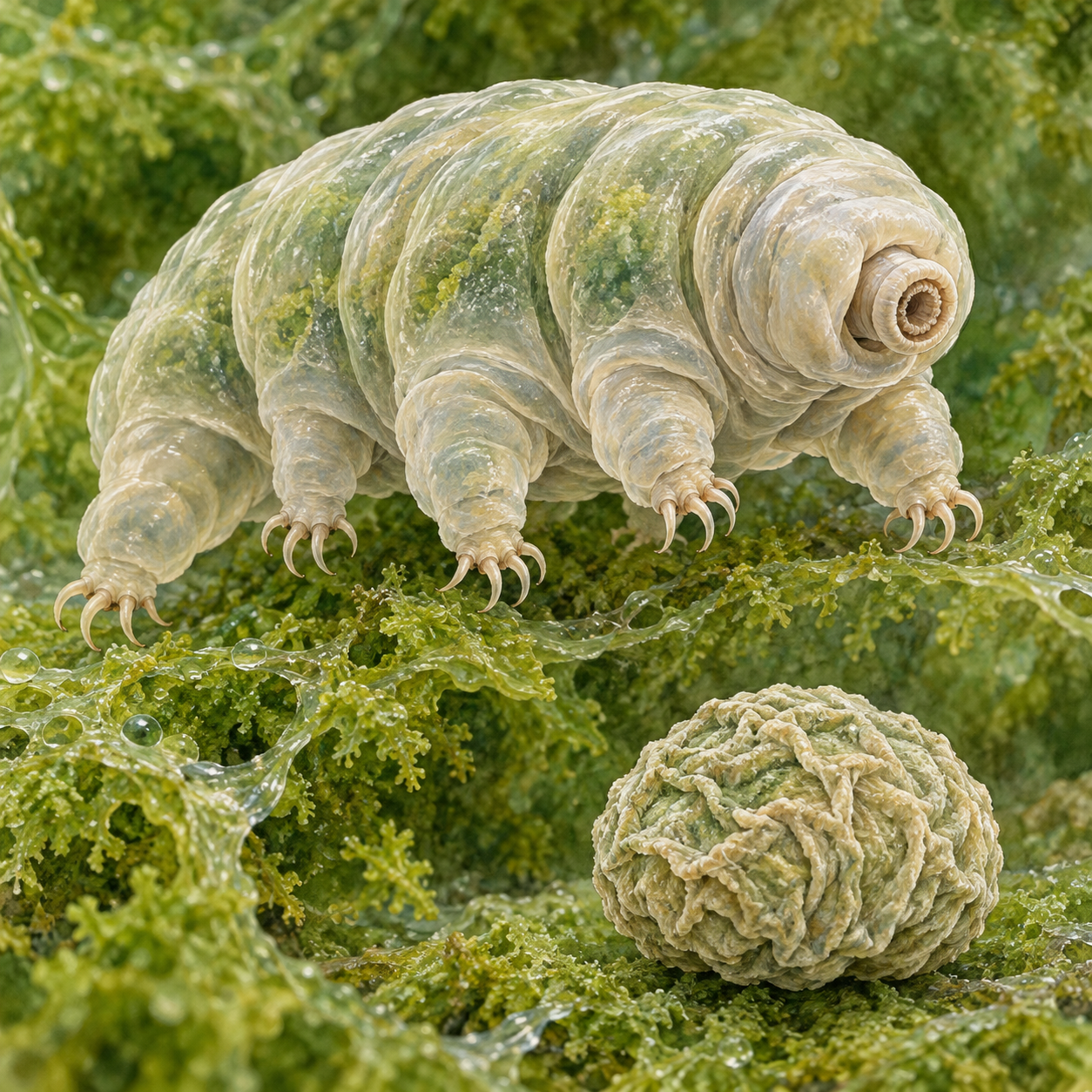
An enlarged active tardigrade above a compact wrinkled tun form against a moss-green background.
An artistic comparison of an active tardigrade and a contracted tun; the sizes and setting are illustrative.

A tardigrade looks like a tiny padded animal wearing too many feet. Under a microscope, its slow walk explains the nickname “water bear.” Its other reputation, as an almost indestructible creature, needs a more careful explanation.

Tardigrades are microscopic animals, not one single species with one set of powers. They occupy aquatic environments and the small wet spaces of places such as moss. Their dramatic survival feats often involve a dormant state, rather than an animal continuing to eat and walk through extreme conditions.

The tun is a survival state

In species capable of surviving severe drying, the animal contracts and withdraws its legs, forming a compact shape called a tun. It loses most of its body water, and its metabolism becomes extremely low. This form of drying tolerance is called anhydrobiosis.

The protective state raises a materials question

Drying removes much of the medium in which ordinary cellular processes occur. Molecules and structures must remain in a condition from which useful activity can return. A 2017 study found that tardigrade-specific disordered proteins contributed to drying tolerance and could stabilize material in a glass-like state under the conditions studied.

“Intrinsically disordered” does not mean defective or useless. It describes proteins that do not possess one fixed folded structure under the relevant ordinary conditions. Their behavior can change with their surroundings. A protein's usefulness cannot be judged only by whether it resembles the tidy folded shape often shown in an introductory biology diagram.

“Glass-like” concerns restricted molecular motion in a dried protective setting, not an animal becoming ordinary window glass. The interpretation should stay attached to the experimental evidence and conditions. Different protective molecules and species can require different explanations; surviving desiccation does not automatically establish resistance to every kind of radiation, heat or mechanical damage.

Duration changes the headline

A 2020 study tested the heat tolerance of Ramazzottius varieornatus. Desiccated animals were far more resistant than active animals, but a longer exposure sharply reduced that resistance.

At 70 degrees Celsius, roughly 94 percent of tuns exposed for one hour were active after rehydration and a 48-hour recovery period. In the corresponding 24-hour exposure, none were active. A sentence saying the species “survives 70 degrees” would hide the most important detail.

The same study found active animals much more sensitive to heat. Its results belong to a named species, specific preparation, defined exposure times, and a particular way of measuring recovery. They are not a universal operating manual for every water bear.

Turn the headline into a small experiment table

Write four headings: species, starting state, exposure and recovery test. Under the 2020 experiment, put Ramazzottius varieornatus, dried tun, the stated temperature and duration, then activity after rehydration. The resulting sentence is less compact than “a tardigrade survives heat,” but it preserves the conditions that make the number meaningful.

Now change only duration from one hour to 24 hours while keeping the reported 70-degree temperature comparison. The outcome changes sharply. The number on the thermometer is therefore not a stand-alone survival rating. Heat exposure is an event that unfolds over time, and the animal's state when it begins matters too.

Finally, compare the response criterion. The study assessed clear movement or a response to a gentle tactile stimulus after recovery. Being scored active at that point establishes something different from completing a normal lifespan and reproducing successfully afterward. Conversely, inactivity at one observation can be difficult to interpret without a recovery interval. The researchers' endpoint belongs in the description of the result.

This is a paper-reading activity, not a home heat challenge. Tardigrades have no universal operating temperature, and a species that tolerates a particular treatment does not supply a preparation method for another specimen. The controlled study is valuable because it identifies limits rather than simply seeking the largest dramatic number.

Surviving a test is different from living there

Another useful distinction separates tolerating an extreme condition from flourishing in it. A dormant tardigrade cannot feed, grow, or reproduce normally while dried into a tun. Returning to suitable conditions is part of the survival story.

Long-term anhydrobiosis research also finds variation among species and experimental conditions. Humidity, the duration of storage, and the animal's state can matter. The compact form is an extraordinary adaptation with limits, rather than a guarantee.

Try comparing the active animal and the tun in the illustration as two answers to different questions. The active form can gather food and reproduce in a suitable habitat. The tun helps preserve the possibility of future activity through an unfavorable interval. The distinction turns the water bear's reputation into a more precise puzzle: what must remain organized during dormancy so that an animal can function again when water returns?

Sources and further reading: Neves and colleagues: Tardigrade thermotolerance experiments · Boothby and colleagues: Disordered proteins and desiccation · How long can tardigrades survive in the anhydrobiotic state?

Famous Last Meals is now in paperback — stories, history and 25 recipes

Famous Last Meals: Stories, History, and Recipes is now available in paperback on Amazon. The illustrated collection brings together 23 his...
