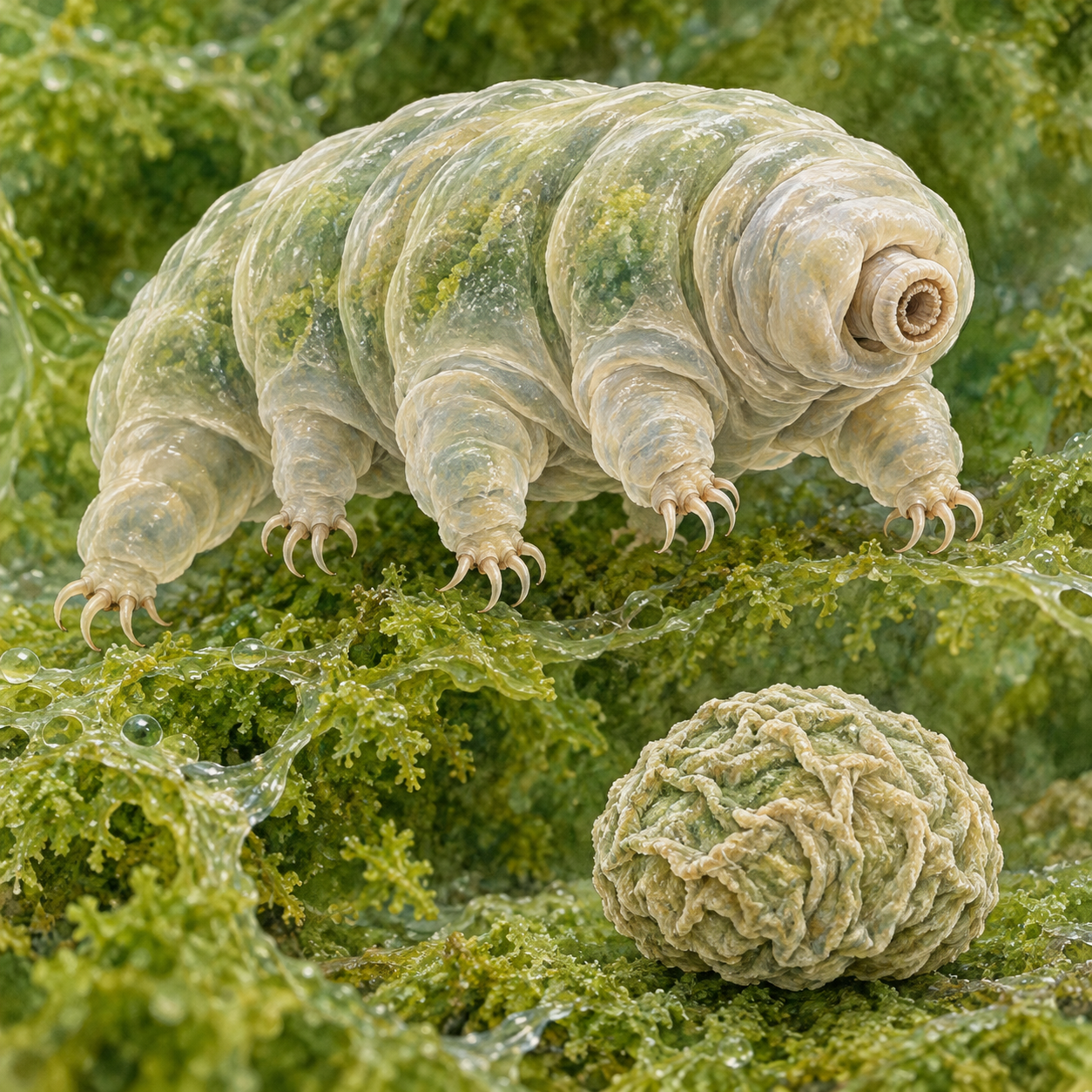
A tardigrade looks like a tiny padded animal wearing too many feet. Under a microscope, its slow walk explains the nickname “water bear.” Its other reputation, as an almost indestructible creature, needs a more careful explanation.
Tardigrades are microscopic animals, not one single species with one set of powers. They occupy aquatic environments and the small wet spaces of places such as moss. Their dramatic survival feats often involve a dormant state, rather than an animal continuing to eat and walk through extreme conditions.
The tun is a survival state
In species capable of surviving severe drying, the animal contracts and withdraws its legs, forming a compact shape called a tun. It loses most of its body water, and its metabolism becomes extremely low. This form of drying tolerance is called anhydrobiosis.
Survival requires protecting structures that normally depend on water. Research has identified unusual tardigrade proteins involved in this process. A 2017 study found that intrinsically disordered proteins contributed to drying tolerance and could help stabilize material in a glass-like state under the conditions studied.
“Glass-like” describes a physical state of protective biological material. It does not mean the whole animal becomes an ordinary piece of window glass. Researchers continue to examine how different protective molecules work, including differences among tardigrade species.
Duration changes the headline
A 2020 study tested the heat tolerance of Ramazzottius varieornatus. Desiccated animals were far more resistant than active animals, but a longer exposure sharply reduced that resistance.
At 70 degrees Celsius, roughly 94 percent of tuns exposed for one hour were active after rehydration and a 48-hour recovery period. In the corresponding 24-hour exposure, none were active. A sentence saying the species “survives 70 degrees” would hide the most important detail.
The same study found active animals much more sensitive to heat. Its results belong to a named species, specific preparation, defined exposure times, and a particular way of measuring recovery. They are not a universal operating manual for every water bear.
Surviving a test is different from living there
Another useful distinction separates tolerating an extreme condition from flourishing in it. A dormant tardigrade cannot feed, grow, or reproduce normally while dried into a tun. Returning to suitable conditions is part of the survival story.
Long-term anhydrobiosis research also finds variation among species and experimental conditions. Humidity, the duration of storage, and the animal's state can matter. The compact form is an extraordinary adaptation with limits, rather than a guarantee.
Those limits make tardigrades more interesting, not less. Their biology asks a precise question: how can a living system preserve itself when water, the medium of its ordinary activity, disappears? The answer involves preparation and molecular protection. The myth gives us an invincible mascot; the research gives us a small animal with remarkable and measurable solutions.
Sources and further reading: Neves and colleagues: Tardigrade thermotolerance experiments; Boothby and colleagues: Disordered proteins and desiccation; How long can tardigrades survive in the anhydrobiotic state?.
Explore more creative work at Incoprea.