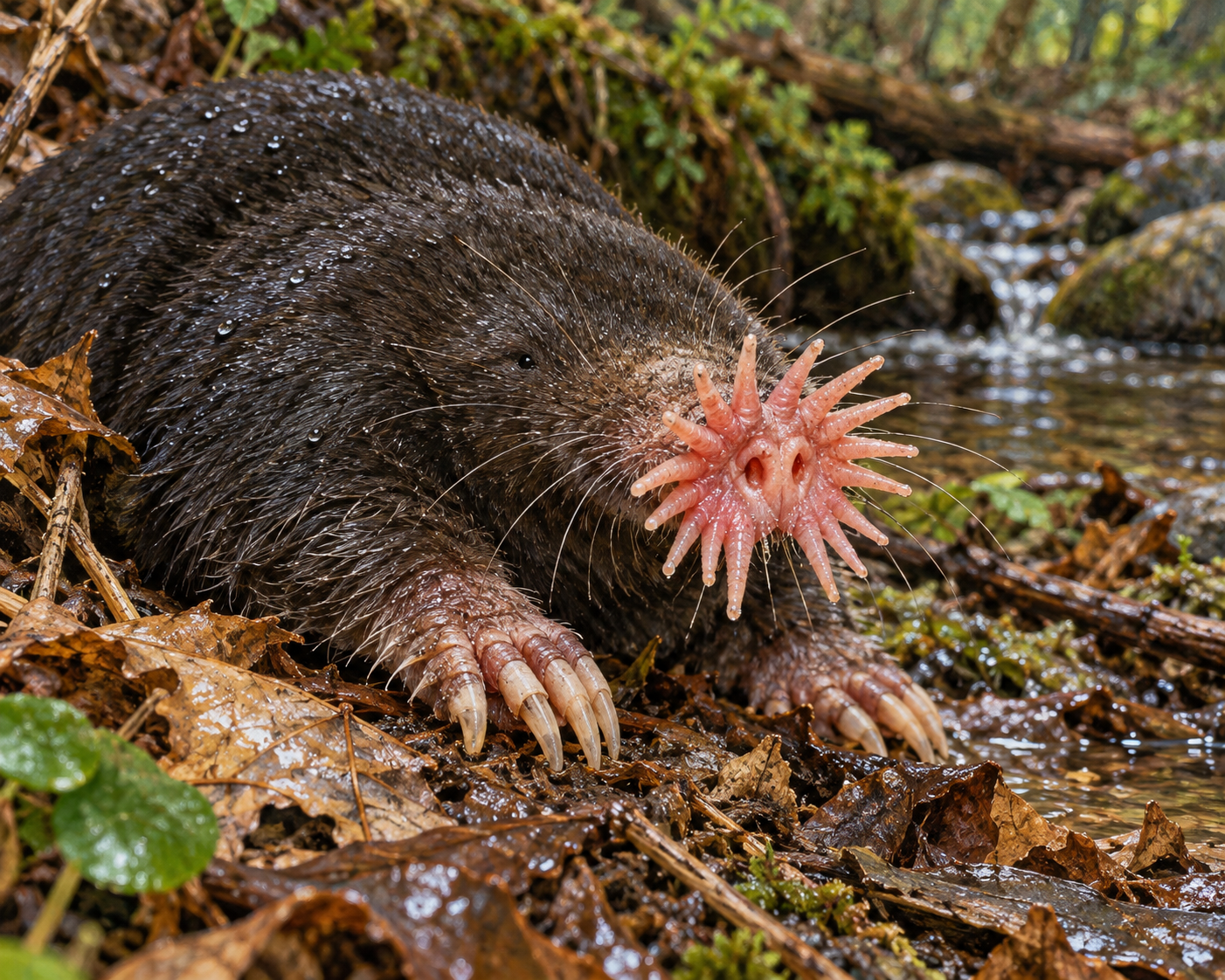
The star-nosed mole has one of the most immediately recognizable faces in the animal world. Twenty-two pink, fleshy rays surround its nostrils. They look extravagant, but they are practical equipment for finding food in a world where vision is often of little use.
The star is principally a touch organ. Calling it a strange-looking nose is accurate as a location, but incomplete as an explanation. Its specialized surface and the brain circuits connected to it form an exceptionally fast system for examining nearby objects.
Thousands of tiny touch points
Each ray carries microscopic domed structures called Eimer's organs. A whole star has roughly 25,000 of these touch organs, supplied by a dense network of nerve fibers. As the mole moves its nose across a surface, that array samples the shape and texture of what it encounters.
The rays are not twenty-two little hands with the same job. The central pair, known as the eleventh rays, has a special role. When another part of the star detects something of interest, the mole brings this central region onto the object for closer investigation.
Researchers call that region a tactile fovea. The comparison is with the fovea of an eye: a specialized area used for fine discrimination. The analogy describes how the system is organized, rather than claiming that the nose literally sees.
The brain follows the important surface
The Catania Laboratory reports roughly 100,000 myelinated nerve fibers serving the star. That is a count of nerve fibers associated with the sensory surface, not a count of all neurons in the mole’s brain. The anatomical investment makes the tiny contact surface a substantial source of information.
This arrangement helps explain the animal's speed. In laboratory studies, star-nosed moles could identify and consume small prey in as little as about 120 milliseconds. That is a minimum observed handling time under experimental conditions, not a claim that every meal or every decision takes exactly that long.
A tiny prey item contains relatively little energy. Handling it quickly can make it worth eating. The remarkable sensory system therefore connects with an everyday economic problem: how much time should an animal spend obtaining a small reward?
Watch the switch from discovery to inspection
The laboratory's high-speed behavior film lets you ask a specific question: where does the first contact occur, and which part of the star examines the object next? The central tactile fovea matters because sensing is organized into a sequence. Broad contact can find something worth investigating, followed by directed contact with a specialized region.
A useful comparison is your own fingertip finding a seam while your hand explores fabric. The analogy captures directing a more sensitive surface toward a point of interest. It does not imply that a mole's rays have human fingerprints or that your processing speed matches the reported prey-handling minimum.
The brain map adds another scale. The representation of the central rays occupies more cortical territory than their small surface area might suggest. Counting rays alone would miss the unequal investment in processing. The same number of physical parts does not mean that each part supplies the same resolution or behavioral importance.
For the reported 120-millisecond minimum, keep the whole task in view. It includes identifying and consuming a small prey item in a laboratory setting. It is not a universal duration for every decision the animal makes, and a slowed film should not be used to estimate ordinary speed without checking its presentation.
A face shaped by a particular world
Star-nosed moles live around wet habitats and also forage in water. Their touch system is suited to close encounters with small objects in dark, cluttered surroundings. A face that seems bizarre in a portrait makes more sense at the boundary between damp soil, roots, and shallow water.
Touch and underwater smell are separate achievements
The second film on the laboratory page shows underwater sniffing. The mole exhales small air bubbles that contact an object and draws them back toward its nostrils. The bubbles provide a way to collect odorants for a sense usually associated with air. This behavior complements the star's touch function rather than replacing it.
While viewing, separate visible bubble movement from the inferred sensory information. A film can show how the animal samples; experiments following scent trails help establish what the sampling achieves. The touch maps and the olfactory behavior therefore belong to related but distinct investigations.
The distinction changes how we read a portrait of this unusual face. The star is striking because its rays are visible at once. The sequence of contacts, the unequal neural representation and the handling of tiny bubbles are harder to see in one still image. They explain why the shape is useful to a living animal in wet, cluttered surroundings.
An informative question for any unusual sensory organ is what problem it solves during an ordinary day. Here, quickly locating small food items and checking them at close range connects anatomy with energy gained from foraging. The apparent extravagance becomes an economical arrangement when considered at the animal's scale.
Sources and further reading: Vanderbilt Catania Lab: Star-Nosed Mole · Catania and Remple: Foraging speed limit · Catania: A nose that looks like a hand and acts like an eye