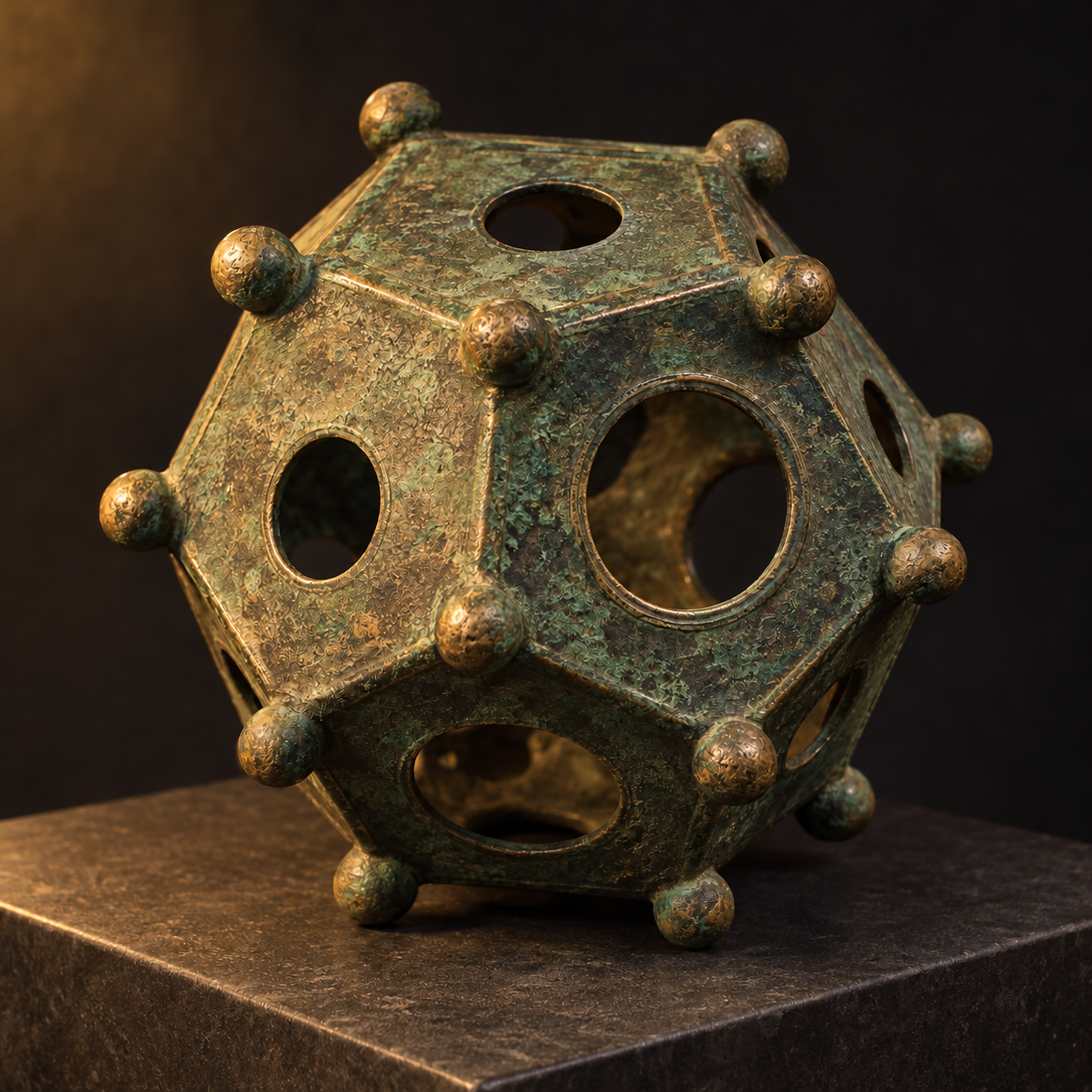
Imagine finding a small bronze object that feels deliberately designed, yet arrives without instructions. It has twelve pentagonal faces, circular openings and little knobs at its corners. It looks useful. It looks ceremonial. It also looks like something a modern designer might invent. That is the predicament presented by the Roman dodecahedron.
A very real object with a missing job
These hollow copper-alloy artifacts belong to the Roman world, especially its northern provinces. Their distinctive shape makes them easy to recognize, but recognition has not supplied an agreed explanation. There is no surviving Roman description that securely tells us what this particular class of object did.
A remarkably complete example was excavated at Norton Disney in Lincolnshire in 2023. Lincoln Museum's account places it in the third or fourth century and describes an object around eight centimeters tall, weighing 245 grams. The discovery near a Roman settlement matters because a carefully recorded excavation can supply information that an attractive object found on its own cannot.
Why a working replica is not the final answer
Suggested explanations range from measuring devices to craft tools and objects with religious significance. A replica may be made to perform a proposed task. That is an interesting experiment, but it establishes possibility rather than ancient intent. You could use a modern drinking glass as a paperweight; a successful demonstration would not reveal why the glass was manufactured.
A stronger explanation must also fit the artifacts' material, shapes, geographical distribution and excavated surroundings. It should explain why the holes and corner knobs are there, rather than selecting only the convenient features. An interpretation becomes more persuasive when several independent pieces of evidence point toward the same use.
At Norton Disney, investigators considered whether the object's placement in a former pit could have been deliberate. The museum account discusses ritual or religious associations, while acknowledging that the exact purpose remains uncertain. That is a hypothesis attached to evidence, not a license to invent an elaborate ceremony.
The discovery includes the questions
The dodecahedron's appeal is partly visual: its repeated geometry practically demands an explanation. Our minds want the neat solution that turns every hole into a clue. Archaeology sometimes offers a slower reward. The important advance may be learning where an object was deposited, which other materials surrounded it, or how its manufacture compares with another example.
An unanswered purpose does not make the object meaningless. It means the people who understood it have left us the object without enough of its surrounding knowledge. The honest mystery is already interesting: someone shaped, valued and handled this small piece of bronze, and we can still see the care in it.
Sources and further reading: Lincoln Museum's account of the Norton Disney discovery; University of Nottingham Museum exhibition; British Museum collection record.
Explore more creative curiosity at Incoprea.