Showing posts with label Bioluminescence. Show all posts

Wednesday, October 14, 2026

Milky Seas: When the Ocean Shines Like a Field of Snow

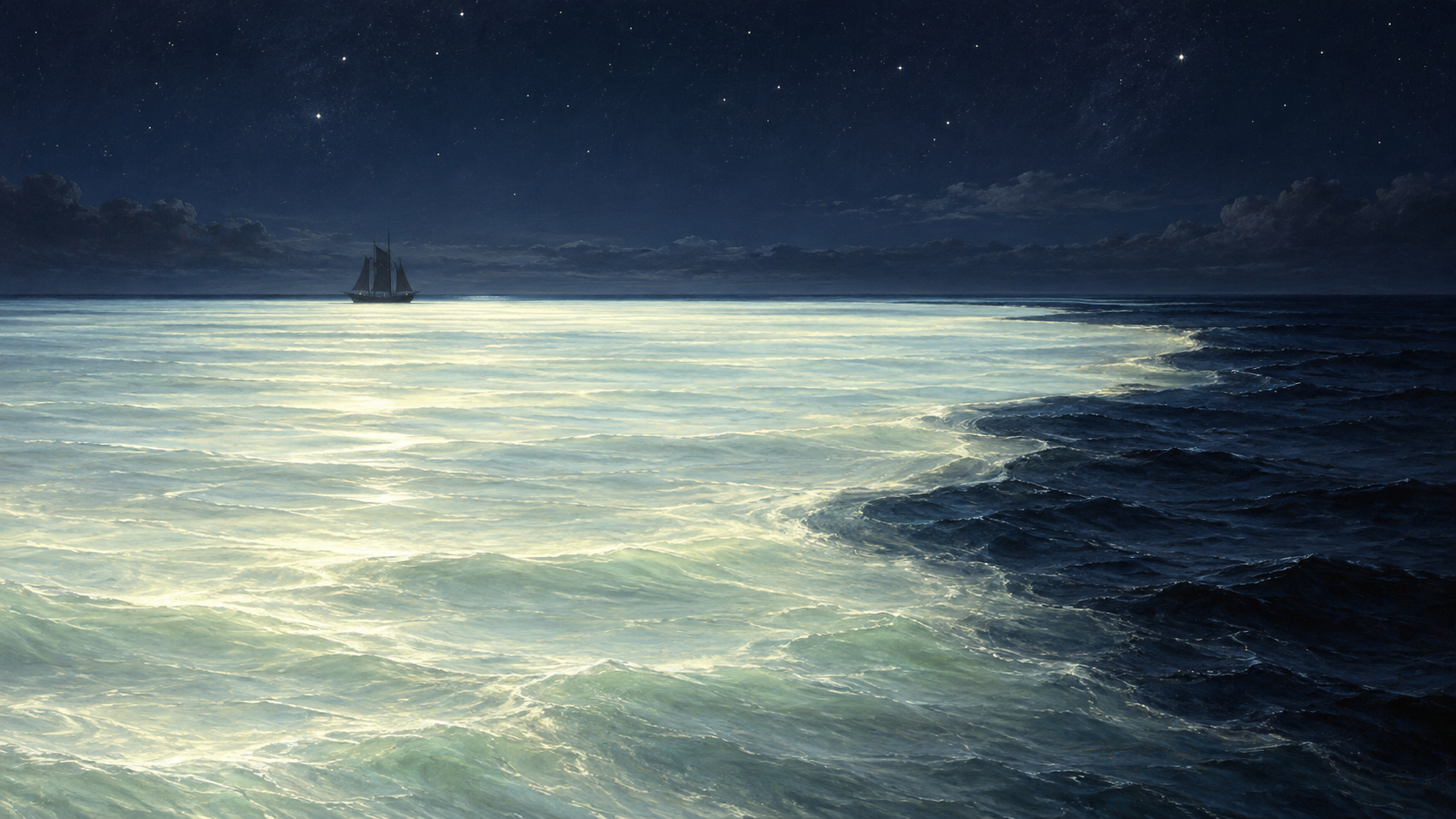
Illustration of a broad pale glowing ocean surface beneath a dark night sky.
An imagined milky-sea encounter showing steady pale illumination, not a particular reported event.

A sailor expects darkness beyond a ship's lights. Occasionally, the sea supplies its own illumination: a vast, pale surface glowing steadily toward the horizon. These rare displays are called milky seas. They can make the ocean appear white or softly greenish, as though an enormous light were hidden beneath it.

The effect differs from the brief blue flashes stirred up in many bioluminescent waves. A milky sea is reported as broad and comparatively uniform, persisting without needing every patch of water to be disturbed. That difference suggests a different biological mechanism.

A bacterial explanation with open questions

Luminous bacteria are the leading explanation. Unlike dinoflagellates that commonly flash in response to motion, some bacteria can produce a sustained glow. Their light production can depend on population density and chemical signaling, a process known as quorum sensing.

Researchers have proposed that bacteria associated with concentrated organic material, including algal blooms, could supply enough light collectively to create a milky sea. Limited historical sampling supports the bacterial idea. But the exact organisms, structure and conditions of most events remain uncertain.
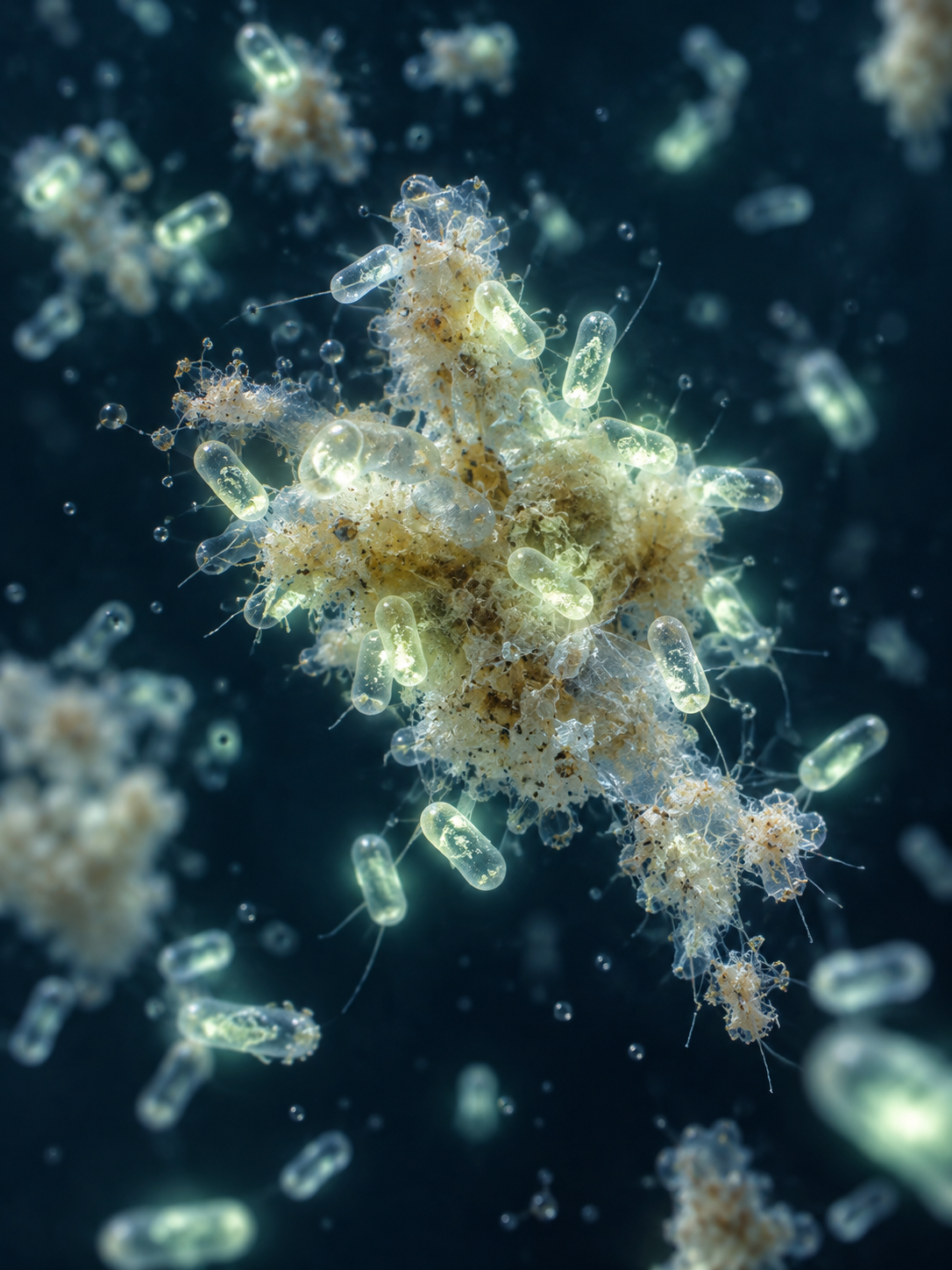
Conceptual enlarged luminous marine bacteria cluster around pale organic particles in dark seawater.
A conceptual view of luminous bacteria around organic material, illustrating a proposed explanation for milky seas. This is not a microscope sample from a documented event; cell shapes and scales are illustrative.

A steady glow is a clue about time

Imagine watching the same small patch of water for a minute. Does it brighten only after a ripple or splash, then fade? Or does the background remain luminous between disturbances? Both observations concern marine light, but their timing gives investigators a way to distinguish processes that a single photograph may make look similar.

The bacterial explanation involves coordinated biological activity, rather than millions of cells receiving a simultaneous command from a ship. Chemical signals can accumulate within dense bacterial populations and affect light production. Scaling that process from a colonized particle to a large, persistent ocean region is the unresolved ecological problem. Knowing how a cell can glow is not enough to explain why a whole water mass does so.

The researchers' proposed “natural flask” offers a useful image. Relatively isolated water with suitable conditions might maintain a luminous community, as a vessel maintains a laboratory culture. It remains a hypothesis about organization in the sea, not a literal membrane surrounding the observed patch. Currents, nutrients and the vertical structure of the water all become relevant to testing it.

A sailor's story meets a satellite

Specialized low-light satellite instruments have changed the investigation. A 2021 study used a sensor known as the Day/Night Band to locate twelve candidate events between 2012 and 2021. The observations let researchers follow bright regions across successive nights and compare them with currents and other environmental information.

One striking event south of Java in 2019 covered more than 100,000 square kilometers in satellite observations. Researchers later learned that the yacht Ganesha had crossed the glowing water. Its crew supplied recollections, navigation information and photographs that could be compared with the satellite record.

Their report described a mostly steady glow and a dark bow wave, rather than a brighter splash at the bow. That contrast helped distinguish the encounter from the familiar disturbance-triggered light of many dinoflagellate displays.

Build the case from three records

Start with the yacht's reported course. A vessel encounters one route through an event, with a time, position and limited horizon. Satellite images add the broader luminous shape on nights when the sensor and viewing conditions permit it. Comparing the two can establish whether the crew's experience and the remote signal belong to the same region.

Then add photographs carefully. A camera's exposure and processing affect how strongly a soft glow appears. The images can preserve valuable features and provide corroboration without being a direct copy of the crew's night vision. Reports that the bow wave appeared darker than the surrounding water are especially interesting because they concern a relationship within the scene, rather than a single claimed brightness.

The third record would be a deliberately collected biological sample. Which organisms are present? Does a sample glow steadily when left undisturbed? How does its behavior change with depth, time or position near the region's edge? These questions connect the luminous pattern to the living system producing it. The satellite cannot answer them simply by resolving the shape more sharply.

Use those three records as a checklist while reading the linked studies. Identify what was actually available for each event and which conclusions rely on an explanation transferred from earlier sampling. The investigation is strongest when a missing observation remains visibly missing. That gap is also the reason improved detection from space matters: locating an event while it persists could make the much harder work of sampling it possible.

The missing laboratory is the ocean

Matching a vessel's experience to a satellite signal is a valuable step. It gives investigators greater confidence that they are recognizing the same phenomenon across very different scales. The next challenge is to connect that recognition with timely sampling of living communities.

Milky seas are hard to study because research ships cannot simply summon one. A satellite can help identify where to look, but a detailed biological explanation still requires measurements in the water, with attention to how conditions change.

Sources and further reading: Miller et al.: Honing in on milky seas from space · Miller: The 2019 Java boat encounter · Colorado State University: Satellite investigation of milky seas · Miller and colleagues: Full open text of the satellite investigation

The Plankton That Turns a Ripple Into Blue Light

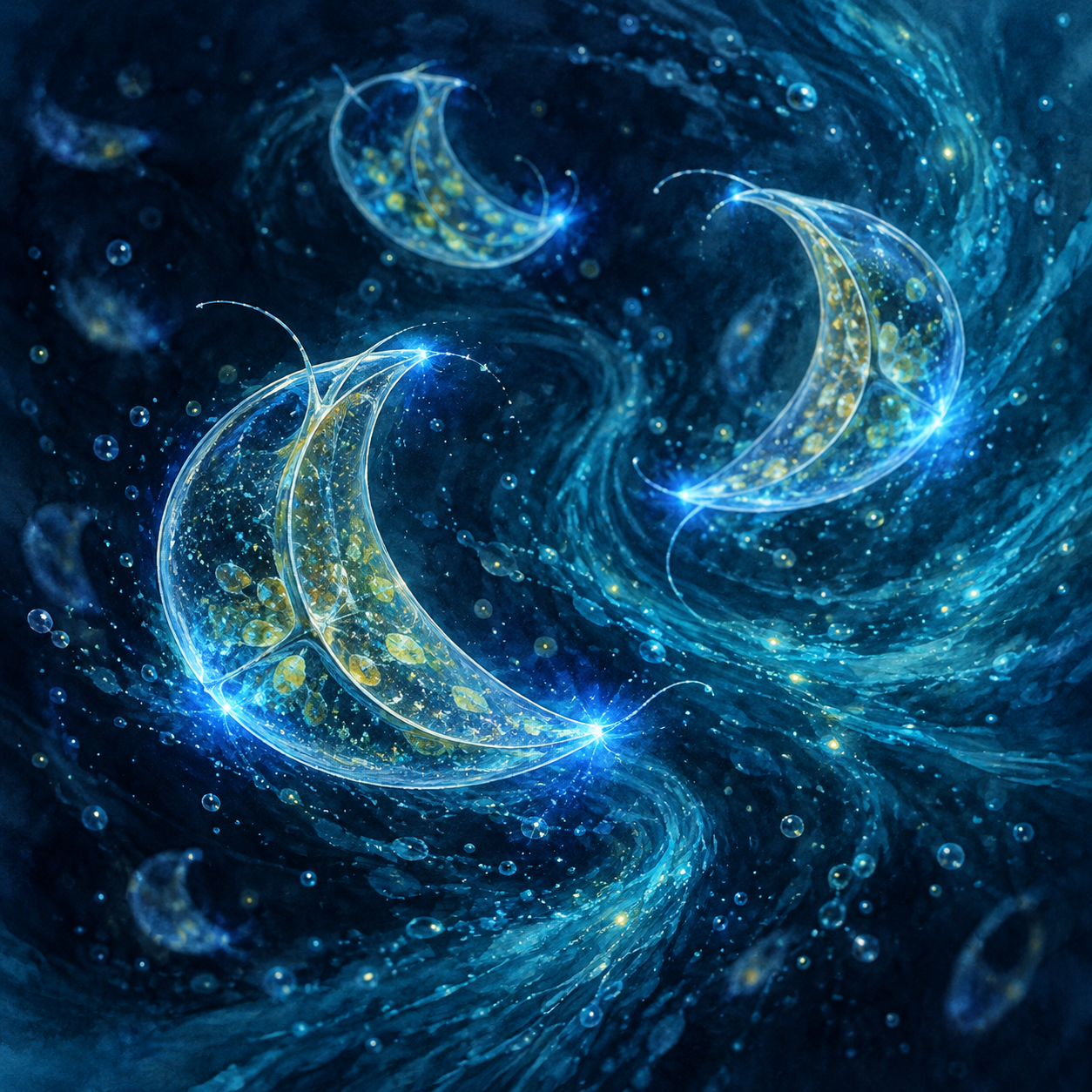
Three crescent-shaped dinoflagellate cells glow blue among swirling dark seawater.
Crescent-shaped dinoflagellates and blue flashes, shown at an artistic enlarged scale.

A paddle enters dark seawater, and blue sparks trace its edge. A wave breaks, and the foam briefly shines. The light can look like a special effect, yet the performers are living cells: certain marine dinoflagellates, a diverse group of microscopic organisms.

If you have heard about a tiny creature that “glows blue when it gets nervous,” this is probably the phenomenon you have in mind. Nervousness is a useful image, but not the biological explanation. These organisms respond to mechanical disturbance. A moving animal, a breaking wave, or a stirring current can deform a cell and trigger a flash.

A cell with a pressure-sensitive light switch

Researchers at Cambridge studied Pyrocystis lunula, a crescent-shaped dinoflagellate, by applying carefully controlled forces to individual cells. They found that the light response depended on both how much a cell was deformed and how quickly that deformation happened. The same amount of squeezing, delivered differently, did not necessarily produce the same flash.

The proposed connection between movement and light involves mechanically sensitive ion channels in the membrane. When deformation opens those channels, changes in calcium help begin a biochemical chain of events. Ultimately, a chemical light-producing reaction releases energy as visible light. It is not stored sunshine simply leaking out of a damaged cell.

The speed of a disturbance belongs in the experiment

Imagine applying the same total deformation slowly and then more quickly. The cell's material can respond differently because it has time to relax in one case and less time in the other. A force-sensitive light response therefore needs more description than “the cell was squeezed.” The timing of the applied disturbance is part of the stimulus.

In the Scripps work, a calibrated microscopic lever supplied controlled forces to individual cells. This approach let researchers compare responses under conditions that would be difficult to separate in a breaking wave. The accompanying research film makes the change of scale particularly useful: a broad shoreline glow can begin with an event investigated one cell at a time.

Keep three stages separate. First comes the mechanical deformation. Then come cellular signals linking that disturbance to the light-producing machinery. Finally comes the emitted light. Observing a flash establishes a response, while identifying every step between force and chemistry requires further measurements and models.

That distinction also prevents a misleading image of a cell full of blue light waiting to spill out. The glow is generated through a biochemical reaction. A spectacular display is an active conversion of chemical energy into light, triggered under suitable conditions, rather than fluorescence caused by a lamp or an ocean permanently charged like luminous paint.

A possible alarm in the food web

Why spend energy flashing? Scientists have investigated defensive explanations. A sudden flash might startle a small grazer. It might also make that grazer visible to a larger predator: the idea often called a “burglar alarm.” These are ecological hypotheses supported to different degrees in different experiments, rather than one universal purpose proved for every luminous species.

Not every bloom is a light show

The crescent-shaped Pyrocystis used in a laboratory is not the organism behind every glowing beach. Scripps has documented coastal displays involving Lingulodinium polyedra, among other dinoflagellates. There are many species, and only some produce this sort of light.

Likewise, a red tide is not a promise of blue surf. Bloom color, species composition, abundance, darkness, and water movement all affect what someone sees. Scripps notes that not all red tides are bioluminescent. A photograph of a luminous shoreline does not establish which organism was there.

Read a glowing wave as a map with missing information

Watch which parts of a filmed wave brighten and when. Does the light follow the breaking crest, a paddle's edge or the wake of a moving animal? A disturbance-sensitive organism can reveal where the fluid experienced the relevant mechanical conditions. The luminous pattern is therefore related to the flow, rather than only to the positions of cells before the wave arrived.

A dark patch remains ambiguous. It might contain fewer luminous organisms, or the motion might not trigger the same response there. The cells' physiological state and the recording conditions matter too. Researchers using bioluminescence to investigate flow need calibrated relationships between stimulus and light, rather than assuming that brightness measures water speed directly.

For a shore observation, record the event's date, location and pattern before attaching a species name. The crescent-shaped organism used in the controlled study is a particular example. A bright coastal bloom can involve different organisms, and a daytime reddish patch alone does not establish that it will flash after dark.

Compare this display with the broad steady illumination of a milky sea. Both involve living light, yet timing and response to disturbance point toward different mechanisms. A still image can make them look more alike than they behave. Following a few seconds of change is often the most useful step toward understanding what the ocean is showing.

Sources and further reading: Cambridge: Flashes bright when squeezed tight · Scripps: The Force behind Nature's Light · Scripps: Red Tide Brings Bioluminescence to San Diego Beaches

Famous Last Meals is now in paperback — stories, history and 25 recipes

Famous Last Meals: Stories, History, and Recipes is now available in paperback on Amazon. The illustrated collection brings together 23 his...
