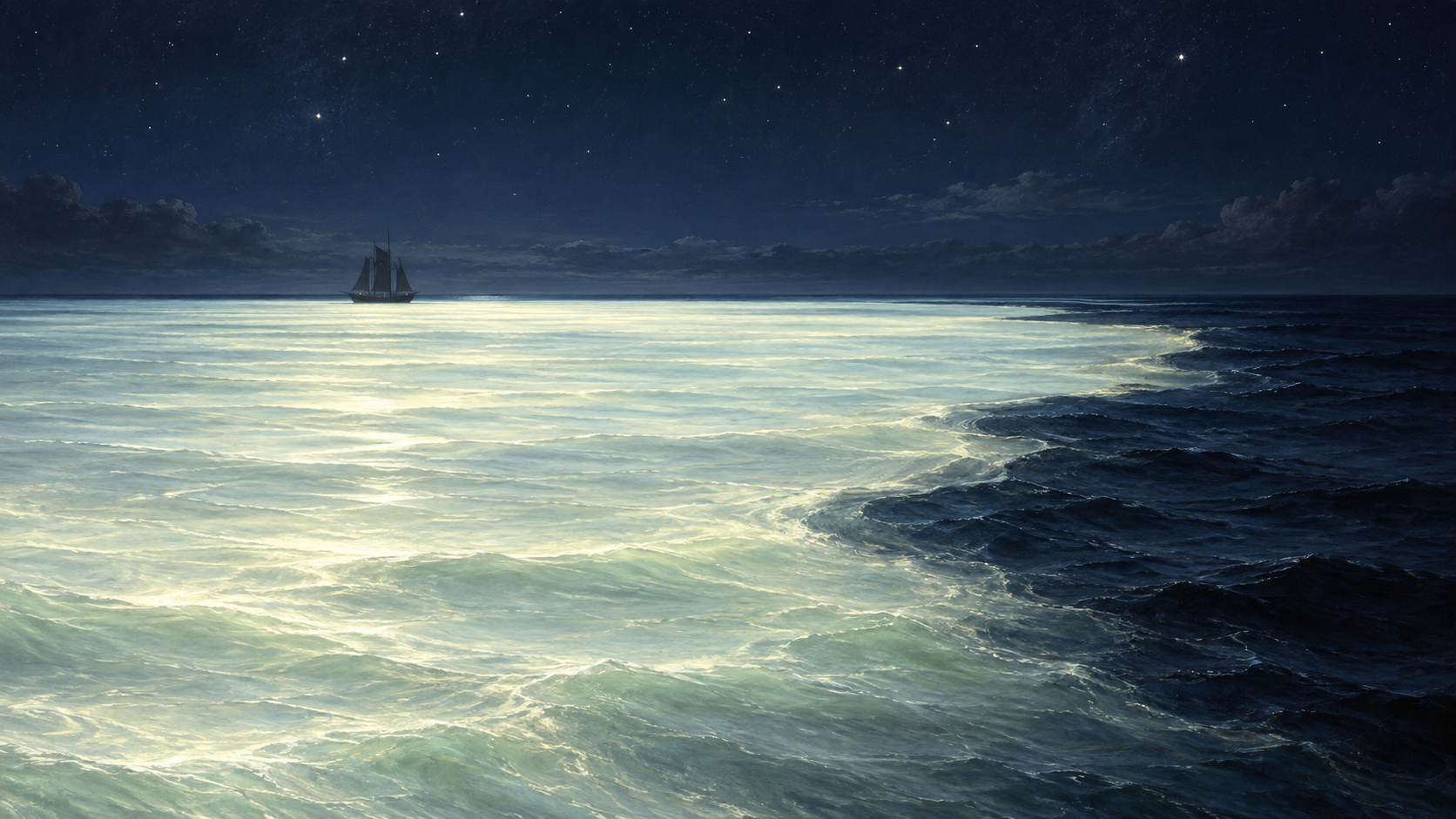
A sailor expects darkness beyond a ship's lights. Occasionally, the sea supplies its own illumination: a vast, pale surface glowing steadily toward the horizon. These rare displays are called milky seas. They can make the ocean appear white or softly greenish, as though an enormous light were hidden beneath it.
The effect differs from the brief blue flashes stirred up in many bioluminescent waves. A milky sea is reported as broad and comparatively uniform, persisting without needing every patch of water to be disturbed. That difference suggests a different biological mechanism.
A bacterial explanation with open questions
Luminous bacteria are the leading explanation. Unlike dinoflagellates that commonly flash in response to motion, some bacteria can produce a sustained glow. Their light production can depend on population density and chemical signaling, a process known as quorum sensing.
Researchers have proposed that bacteria associated with concentrated organic material, including algal blooms, could supply enough light collectively to create a milky sea. Limited historical sampling supports the bacterial idea. But the exact organisms, structure and conditions of most events remain uncertain.
That caution matters. Seeing a glowing region from space does not identify the microbes inside it. Nor does a laboratory explanation of bacterial light establish how an enormous ocean patch develops, persists and eventually disappears.

A sailor's story meets a satellite
Specialized low-light satellite instruments have changed the investigation. A 2021 study used a sensor known as the Day/Night Band to locate twelve candidate events between 2012 and 2021. The observations let researchers follow bright regions across successive nights and compare them with currents and other environmental information.
One striking event south of Java in 2019 covered more than 100,000 square kilometers in satellite observations. Researchers later learned that the yacht Ganesha had crossed the glowing water. Its crew supplied recollections, navigation information and photographs that could be compared with the satellite record.
Their report described a mostly steady glow and a dark bow wave, rather than a brighter splash at the bow. That contrast helped distinguish the encounter from the familiar disturbance-triggered light of many dinoflagellate displays.
The missing laboratory is the ocean
Matching a vessel's experience to a satellite signal is a valuable step. It gives investigators greater confidence that they are recognizing the same phenomenon across very different scales. The next challenge is to connect that recognition with timely sampling of living communities.
Milky seas are hard to study because research ships cannot simply summon one. A satellite can help identify where to look, but a detailed biological explanation still requires measurements in the water, with attention to how conditions change.
The appeal lies in that meeting of perspectives. A sailor sees an uncanny horizon; an orbiting sensor sees a luminous shape; a microbiologist asks about tiny cells. The most convincing explanation will connect all three without allowing the impressive scale of the glow to outrun the evidence.
Sources and further reading: Miller et al.: Honing in on milky seas from space; Miller: The 2019 Java boat encounter; Colorado State University: Satellite investigation of milky seas.
Explore more creative curiosity at Incoprea.