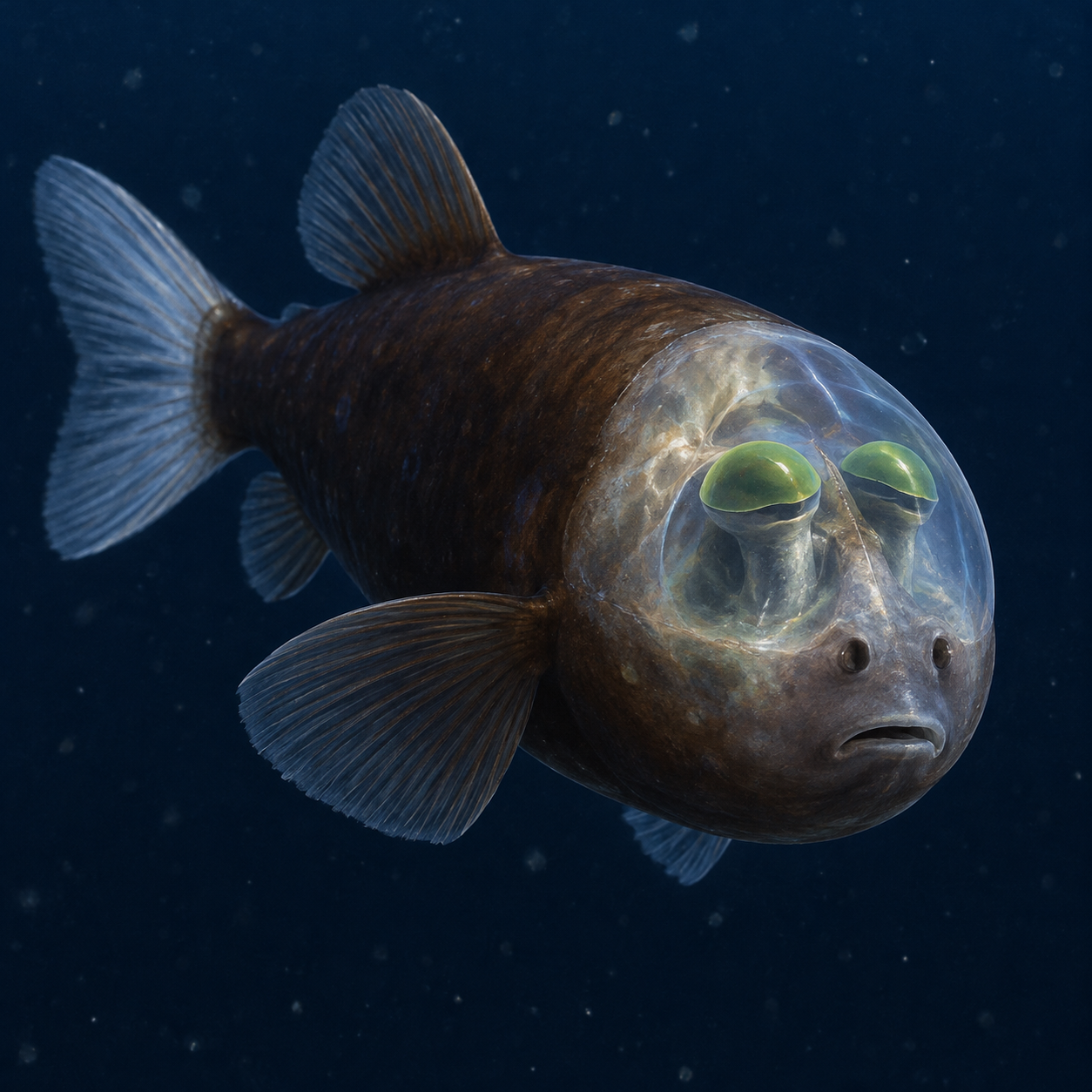
At first glance, a barreleye fish seems to have eyes in the usual place: two dark spots above a small mouth. Look again. Those spots are smell organs. The real eyes are the green-capped structures farther back, visible through a transparent shield covering the top of its head.
Macropinna microstoma is a small deep-water fish with an arrangement that looks invented. Its unusual anatomy solves a practical problem: gathering scarce light and finding food in the ocean's twilight zone.
A telescope that needs to turn
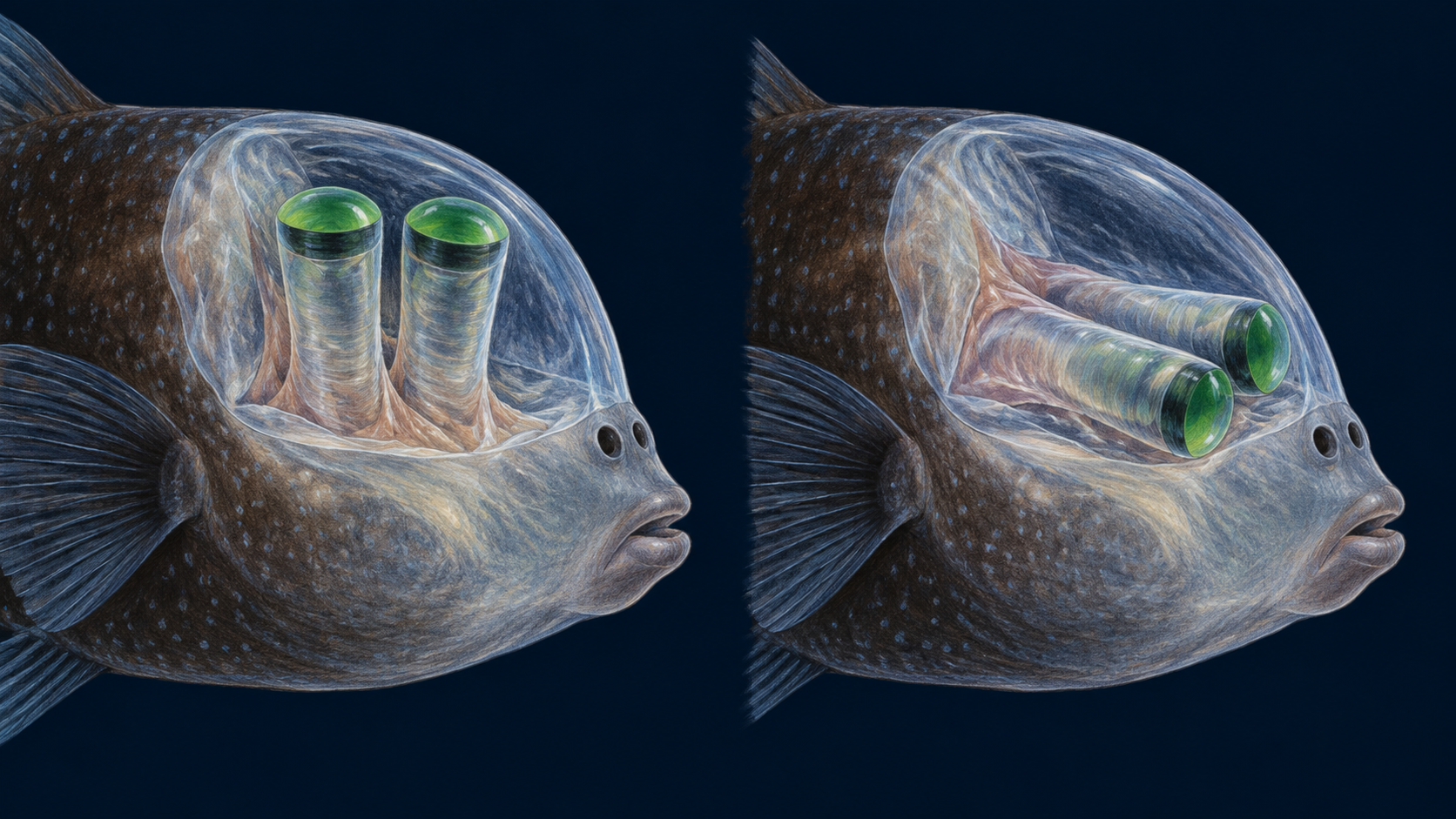
The fish's eyes are tubular. Their shape helps collect faint light, but it limits the field of view. When directed upward, the eyes can detect silhouettes against the weak illumination filtering down from the surface.
For years, researchers thought those eyes stayed fixed in position. That created an apparent puzzle. An upward-looking fish with a forward-pointing mouth would have trouble visually following food into its mouth.
Observations by MBARI researchers Bruce Robison and Kim Reisenbichler showed that the eyes can rotate. The fish can look above itself while searching, then direct its eyes forward during feeding. The strange design becomes more understandable when its movement is included.
The fragile feature nets could miss
A transparent, fluid-filled shield surrounds the eyes and covers the upper head. It is living tissue, not a glass helmet or a completely transparent skull. The distinction is worth preserving because photographs can invite the wrong mental picture.
That delicate shield was probably damaged in many specimens collected by nets, helping explain why older descriptions and illustrations omitted it. Remotely operated vehicles allowed researchers to observe intact fish where they live, hundreds of meters beneath the surface.
MBARI recorded these fish in Monterey Bay waters around 600–800 meters deep. Broad, flat fins help them hold position and maneuver precisely. Remaining almost motionless can be useful when searching for small food items overhead.
A remarkable face, an unfinished life story
Stomach contents and observations inform ideas about the diet. Scientists believe the fish may take small crustaceans caught in siphonophore tentacles. They have also proposed that the head shield helps protect its eyes during such encounters. That possible protective role is an interpretation, rather than an explanation established for every aspect of the tissue.
The green eye caps are distinctive, but their appearance under research-vehicle illumination should not be mistaken for a pair of biological headlights. An illuminated view reveals structures that would be much harder for a human observer to see in the animal's dim environment.
Despite its internet fame, much about the barreleye's life remains poorly known. A striking portrait does not provide a complete account of reproduction, behavior or abundance.
The fish illustrates a useful lesson in natural history: an organ's position alone may not reveal its job. Add motion, habitat and intact tissue, and an apparently impossible face becomes an elegant working system.
See the fish in motion: Watch MBARI’s remotely operated vehicle encounter to see an intact fish moving in its deep-water habitat.
Sources and further reading: MBARI: Tubular eyes and the transparent head; Monterey Bay Aquarium: Barreleye natural history; Robison and Reisenbichler: The paradox of tubular eyes.
Explore more creative curiosity at Incoprea.