Showing posts with label Glass. Show all posts

Thursday, October 22, 2026

A Glass Bowl in Nara: Following Connections Without Inventing a Journey

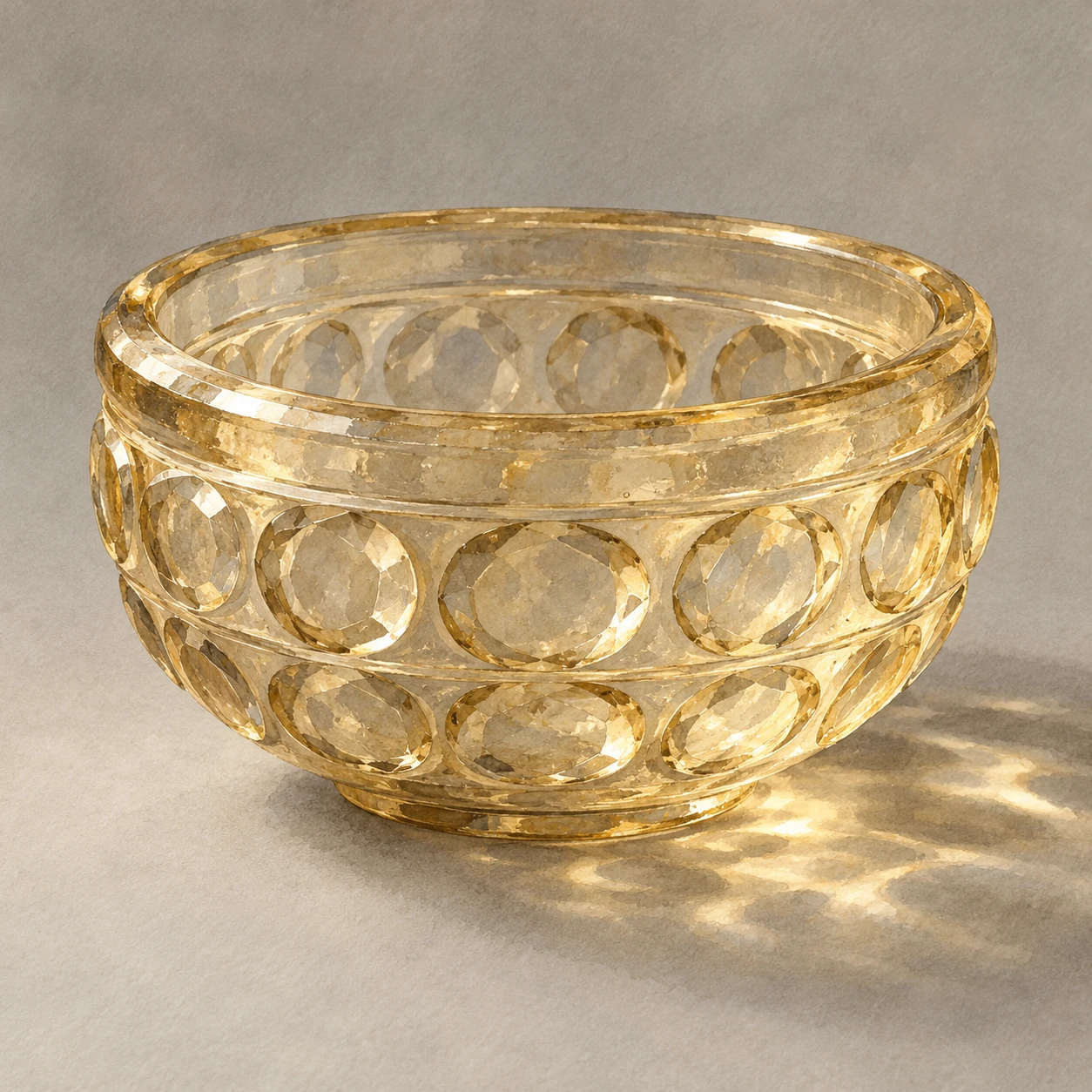
A pale amber glass bowl with repeating shallow circular facets casts a soft shadow on a neutral surface.
Conceptual cut-glass study, not a facsimile or photograph of the Shōsōin White Glass Bowl.

A small glass bowl can make a continent feel connected. Its shallow circular facets catch the light, repeating around a surface that has survived for centuries in Japan. It is easy to imagine a single adventurous traveler carrying it all the way from a western workshop to Nara. The bowl does not tell us that story so neatly.

The White Glass Bowl in the Shōsōin collection is more rewarding when we resist inventing its itinerary. Its material, shape, decorative technique, and custodial history provide different kinds of evidence. Together they reveal wide connections. They do not necessarily reveal every hand through which the vessel passed.

Start with the object that is actually cataloged

The Imperial Household Agency’s object entry describes a nearly colorless alkali-lime glass bowl with a faint brown tint, its exterior covered in circular cut facets. It gives a mouth diameter of 12 centimetres and height of 8.5 centimetres. The entry attributes its manufacture to Sasanian Persia as a received scholarly identification, rather than supplying the name of a particular maker.

Those modest dimensions matter. This is an intimate object, not a monumental vessel. To picture the scale, mark a 12-centimetre circle on ordinary paper. Then compare that small opening with the geographic breadth of the connections people discuss around it. The contrast is part of the bowl’s power.

A circular facet is a change in the glass surface. It can alter reflected and transmitted light without requiring a painted design. Look at a good museum photograph for the relationship between repeated cuts, the uninterrupted rim, and the thickness of the wall. The decoration depends on material being removed, while enough glass remains to preserve the vessel.

Why this treasury is an unusual archive

The Agency’s history of the Shōsōin explains that much of the collection derives from Emperor Shōmu’s belongings donated by Empress Kōmyō to Tōdaiji in 756. Dedicatory records, inscriptions, and controlled access help scholars understand objects passed down in custody rather than recovered from the ground. The treasures are now housed in modern repositories; the famous timber storehouse is not simply an unchanged room full of exposed artifacts.

This is a different preservation history from a burial find. A treasury may retain surfaces and materials that soil would have altered. It can also favor objects that powerful institutions chose to keep. “Well preserved” and “representative of everybody’s life” are separate judgments.

The collection includes goods and designs connected with multiple regions. That does not make it a bag of foreign curiosities. An imported thing acquires new uses and meanings where it is received, displayed, donated, or preserved. Its life in Japan is part of its history, rather than an epilogue to the place of manufacture.

Similar is useful; identical needs proof

The Nara National Museum catalogs another cut-glass bowl, dated to the fifth–sixth century, as comparable to the Shōsōin example. Its label links the cutting technique with Sasanian Persia and describes its weathered yellowish-white surface following burial. This is a separate object, with a different preservation history. Comparing them is useful precisely because comparison does not require pretending they are the same bowl.

A further comparison comes from the Metropolitan Museum’s Sasanian glass bowl, cataloged broadly to the third–seventh century and associated with Ctesiphon in Mesopotamia. A museum’s period and geographic labels help place an object within a scholarly framework. They are not a passport listing all of its movements.

What chemistry can add—and what it cannot

A SPring-8 research report discusses scientific analysis of fragments believed to come from different glassware excavated at Niizawa Senzuka Tumulus 126 in Nara Prefecture. The analyzed facet-cut bowl fragment had a composition matching a Sasanian glass group. That research concerns the tumulus material, not a direct analysis of the White Glass Bowl discussed here.

The distinction is essential. An analytical result from a comparable artifact can strengthen a wider picture of connections. It should not be silently transferred to another object. Even when a glass composition points toward a production region, it does not automatically name the person who carried the finished vessel, the route taken, or the occasion of its arrival.

Consider two possible journeys for the same vessel: one long passage with a single owner, or several shorter exchanges among people who never met its maker. Both can connect the same endpoints on a map. The surviving object needs additional evidence to distinguish them. Distance alone cannot choose the more dramatic story.

Build an evidence map with three kinds of line

Try making a simple sketch rather than a confident trade-route graphic. Put the bowl at one end and the proposed production region at the other. Use a solid line only for a documented relationship, a dashed line for a reasoned attribution, and a question mark for a missing part of the journey.

  • Documented custody: what does the treasury’s history establish about preservation and records?
  • Material and stylistic comparison: what features connect the bowl with other vessels?
  • Unrecorded movement: which carriers, ports, exchanges, or gifts have not been demonstrated for this particular object?

You may end with fewer arrows than an exhibition’s sweeping map. That is a useful outcome. The exercise reveals which claims come directly from the object and which are interpretations of a network around it.

For a second pass, write two captions: one saying only what a photograph shows, and another adding the catalog’s historical attribution. Notice how much invisible knowledge the second caption introduces. Good interpretation makes that knowledge available while allowing the reader to see where it comes from.

The bowl remains extraordinary with its gaps intact. Someone formed the glass, someone cut the facets, and a succession of people kept the vessel from disappearing. We do not need to supply their missing conversations to recognize how much human work a little surviving surface contains.

Sources and a closer look

Shōsōin: White Glass Bowl object record; Imperial Household Agency: Shōsōin repository history; Nara National Museum: comparable cut-glass bowl; The Met: Sasanian bowl 32.150.244; SPring-8: Ancient glassware that traveled the Silk Road.

Find more art, ideas, and unexpected connections at Incoprea.

Flowers Inside Glass: How Ancient Mosaic Vessels Were Put Together

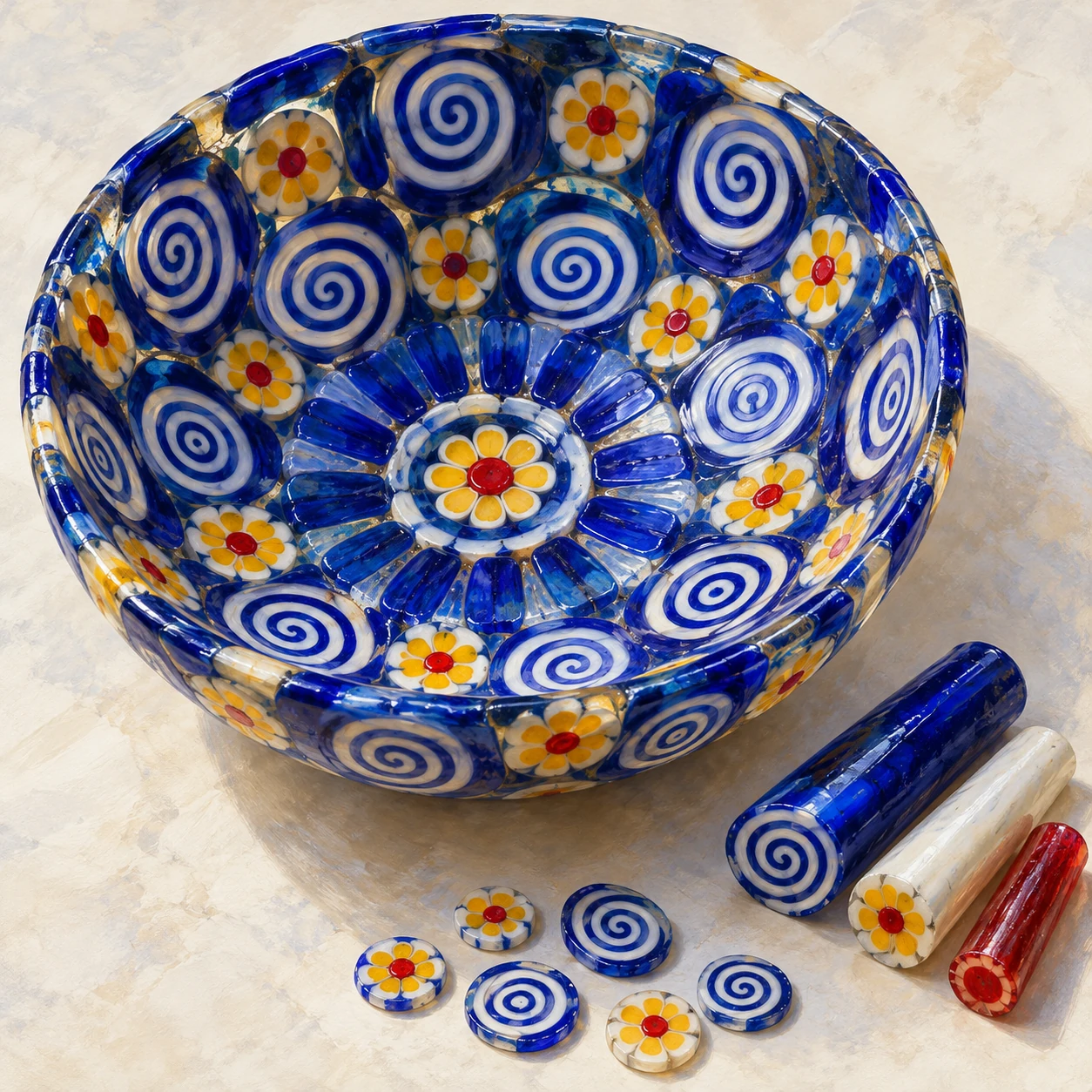
An original blue mosaic-glass bowl with white spirals and flower-like cane patterns beside short cane pieces and slices.
Conceptual glassmaking study with an original pattern. It is not a museum artifact or a measured process diagram.

A flower seems to repeat inside the wall of a glass bowl. It is not painted on the surface. The pattern can run through a slice of a colored cane, and many slices can be fused into the vessel. The image begins along a rod, becomes a cross-section, and finally enters a curved surface.

Ancient mosaic glass turns that sequence into something you can still read. Its delight is not only the color. It is the way a small pattern can survive being assembled, heated, stretched, cut, rearranged, and shaped.

A pattern has a length before it has a surface

The Corning Museum of Glass’s account of early techniques describes mosaic glass made by arranging small cut pieces or lengths of canes and fusing them into vessels or inlays. This belongs to a range of ancient approaches, rather than a single unchanging recipe for every patterned object.

Corning’s explanation of mosaic glass and glass mosaic offers a helpful distinction. Bundled colored rods can be fused and drawn out so that their internal pattern becomes smaller. Cross-sections then carry that pattern. In a glass mosaic made with separate pieces set in a binder, by contrast, the pieces need not become one fused glass body.

The terminology can be confusing because both results look like collections of small colored units. Ask how the units are joined. Heat-fused glass and pieces held by cement are different constructions even when both involve a mosaic-like visual logic.

One museum bowl makes the process concrete

The Walters Art Museum’s small patella, object 47.185, is dated to the first century BCE–first century CE. Its description identifies red, blue, and white glass discs fused and shaped over a form. Instead of imagining a painter placing each colored dot on a finished bowl, imagine pattern-bearing material being assembled before the final curved shape emerges.

The Smithsonian’s mosaic glass bowl is likewise cataloged through its making terms: slumped, polished, and applied mosaic glass. Technical vocabulary becomes useful when it prompts a question about the surface. Which parts of the appearance belong to fused units, which to shaping, and which to finishing?

A whole vessel can conceal the work particularly well. In a photograph of a fragment, an exposed edge may help show that color occupies the material, rather than merely sitting on top. The inference should still be checked against the catalog. A colorful broken edge alone is not a complete laboratory identification.

Why drawing out a pattern is such a clever move

Consider the design problem in ordinary paper. If you need a hundred tiny identical flowers, drawing each at final size is demanding. If you can make one larger cross-sectional pattern that continues along a length, every slice inherits a version of it. The practical glass process involves heat and the behavior of different glasses; the conceptual economy is repetition through a structured material.

This does not make the final bowl automatic. The arrangement of slices, control of heat, shaping, and surface finishing introduce further decisions and possible failures. “It is just sliced rods” is as incomplete as saying a woven picture is just threads.

Corning’s Roman glass gallery places mosaic vessels alongside the later possibilities of glassblowing. New techniques changed production and forms, while older approaches could continue. A technological history need not be a simple race in which one method instantly replaces everything before it.

A cold model you can safely make

Use soft modeling material in three colors, or rolled strips of paper if that is what you have. Keep the design your own: a dot inside a ring, a simple spiral, or a few stripes.

  1. Build a thick short bundle with a visible pattern at its end.
  2. If using soft material, gently lengthen it while trying to keep the internal arrangement. Observe where the pattern distorts. With paper, simply make a second smaller bundle to compare scale.
  3. Use the repeated ends or drawn copies to arrange a circular “bowl surface” on paper.
  4. Rotate several units. Notice when repetition becomes a new larger pattern.

This is a room-temperature model, not a glassmaking procedure. No heating or cutting glass is involved. It shows only the relationship between a cross-sectional pattern and a surface assembled from repeated units.

To make the exercise more revealing, impose a limit of three colors and six units. Fewer choices force attention onto orientation and placement. A small variation can make the overall arrangement feel orderly, flowing, or deliberately uneven.

There is a useful difference between repeating a unit and repeating its placement. Identical slices can make a varied surface when rotated or separated by other pieces. Conversely, different units can be organized into a regular rhythm. In your paper arrangement, change only orientation, then only spacing. The two results help you see why a vessel’s larger composition cannot be explained by the cane design alone.

Read the bowl in both directions

When you return to a museum image, read from the center outward, then reverse direction. Do units keep the same scale? Are they aligned with the rim, or do they seem to move independently? Where does a pattern stretch or disappear around the curve? These questions let the vessel disclose its making without pretending that every visible variation has an obvious cause.

Also read the object’s date separately from its later collecting history. A modern label such as “millefiori” may help describe a pattern to today’s viewer, but it should not be treated as the ancient maker’s own vocabulary.

The bowl’s achievement is a chain of transformations held in one surface. Once you see the little flower as a slice of a longer structure, a decorative object becomes a compact lesson in how people design not only images, but materials capable of carrying images through the work of making.

Sources and a closer look

Corning Museum of Glass: origins of glassmaking; Corning: mosaic glass versus glass mosaic; Walters Art Museum: patella 47.185; Smithsonian: mosaic glass bowl; Corning: glass of the Romans.

Find more art, ideas, and unexpected connections at Incoprea.
The Elevator With Three Working Buttons

Case 50 · shortest-path challenge · Hard · About 10-15 minutes The archive elevator has a peculiar test mode. Its floor display works, but o...