Showing posts with label Archaeology. Show all posts

Sunday, October 25, 2026

Guédelon: A Castle Site Where the Experiment Is in the Work

A castle under construction can be more revealing than a finished castle. Before plaster hides a wall or a roof covers a joint, choices remain visible. At Guédelon in Burgundy, France, present-day craftspeople use a building project to investigate medieval construction. The castle is a result, but the questions encountered while making it are also part of the work.

Imagined modern castle-building site with stoneworkers, wooden scaffolding, visitors and a treadwheel crane.
An imagined modern castle-building site brings several trades into view.

A modern project with a historical frame

Guédelon began building in 1997. Its official account describes an experimental archaeology project concerned with the methods and organization of a construction site in the first third of the thirteenth century. This is a contemporary undertaking informed by historical evidence. The people at work are not medieval builders accidentally preserved in a French forest.

The project draws on surviving castles, building accounts and visual sources. Inspecting a wall can reveal dimensions and traces of workmanship, while a manuscript image may suggest a tool or operation. Neither necessarily gives a complete set of instructions. Guédelon creates an opportunity to test what a proposed technique demands when someone actually attempts it.

That difference is the heart of experimental archaeology. An idea that looks persuasive on a drawing may require an awkward sequence, an unavailable tool or far more material than expected. A successful experiment can show that something is possible under particular conditions. It cannot, by success alone, prove that every medieval builder used the same method.

Look for the dependency between trades

A stone wall encourages attention to the mason. But shaping stone depends on tools, moving it depends on transport, and placing it at height depends on lifting arrangements and temporary works. A building site makes these dependencies harder to overlook. One craft’s finished object becomes another craft’s starting condition.

The official construction chronology gives a concrete example in its account of the great doors completed during the 2025 season. Carpenters worked on the timber, stonemasons made pivot stones, and blacksmiths supplied metal fittings and nails. An impressive door was therefore also a negotiated meeting between materials. Its weight and movement had to be accommodated by people whose work would finally appear as one object.

For a visitor, an ordinary question such as “Where did that nail come from?” can be more productive than asking only how tall the wall has become. Follow the answer backwards. What tool made it? Who maintained that tool? What fuel and material were needed? A castle is an accumulation of these smaller chains, many of which disappear behind its final appearance.

An excavated mill becomes a testable proposal

The French archaeological institute Inrap describes its collaboration on Guédelon’s watermill in a 2014 press release. The reconstruction drew on remains of two watermills excavated at Thervay in the Jura in 2008, one Carolingian and another dating between the mid-eleventh and late-twelfth centuries. Archaeological remains supplied the starting evidence; a working reconstruction allowed further questions to be explored.

A watermill is especially useful for this kind of investigation because its parts must cooperate. A plausible-looking arrangement is not enough. Water must drive the mechanism, movement must reach the stones, and the grain must be processed. Reconstruction can expose gaps between an interpretation of remains and the requirements of operation. It can then suggest new questions to bring back to the excavation record.

The mill also prevents the castle from becoming an isolated object. Buildings require food, materials, energy and surrounding work. Considering a mill alongside walls expands the picture from monumental architecture to a functioning environment. It makes the less conspicuous infrastructures of daily life part of the inquiry.

What is being asked now?

As checked in October 2026, Guédelon’s own chronology describes the work as continuing. The 2026 season includes experiments with timber panelling for a vaulted ceiling in the aula, or great hall. Its questions concern the wood, the dimensions and splitting of boards, their attachment and their possible finish. These are current research questions, not a claim that all answers have already been recovered.

No promised completion date is needed to understand the project. A target date can become stale, and a finished exterior does not mean that every historical question has been settled. The chronology is more informative because it records which tasks and uncertainties occupy a particular season.

The experiment needs a record

The PROMESS research project at CNRS/LIRIS used Guédelon as a setting for work on multisensory recording and presentation. Its stated interests include both the physical environment and craft gestures. This acknowledges a difficult problem: a completed timber joint does not preserve every movement, sound or judgment involved in making it.

Recording cannot capture everything either. A camera angle can hide a tool edge, and a successful result can omit the failed attempt that clarified the problem. The useful record connects evidence, decisions, conditions and outcomes closely enough that another person can understand what was tested. It makes the experiment available for criticism as well as admiration.

A useful way to browse the site from home

Open the official chronology and compare two neighbouring years. Pick one object that required more than one trade. Then identify a question that was still open. If a film or interactive feature fails, the written entries provide a clear account of the work without requiring a player.

Guédelon’s strongest invitation is to see historical knowledge as something that can be questioned through making. The stones matter, but so do the decisions between them: a sequence tried, a difficulty encountered and a method revised in response to evidence.

Explore more art, ideas and independent projects at Incoprea.

Friday, October 23, 2026

The Edge of the Stone Is Part of the Writing

At first, an ogham stone may look almost undecorated. There is no broad panel of letters facing the viewer. The writing gathers around a corner, where groups of strokes meet the edge. To follow it, your attention has to move around the object.

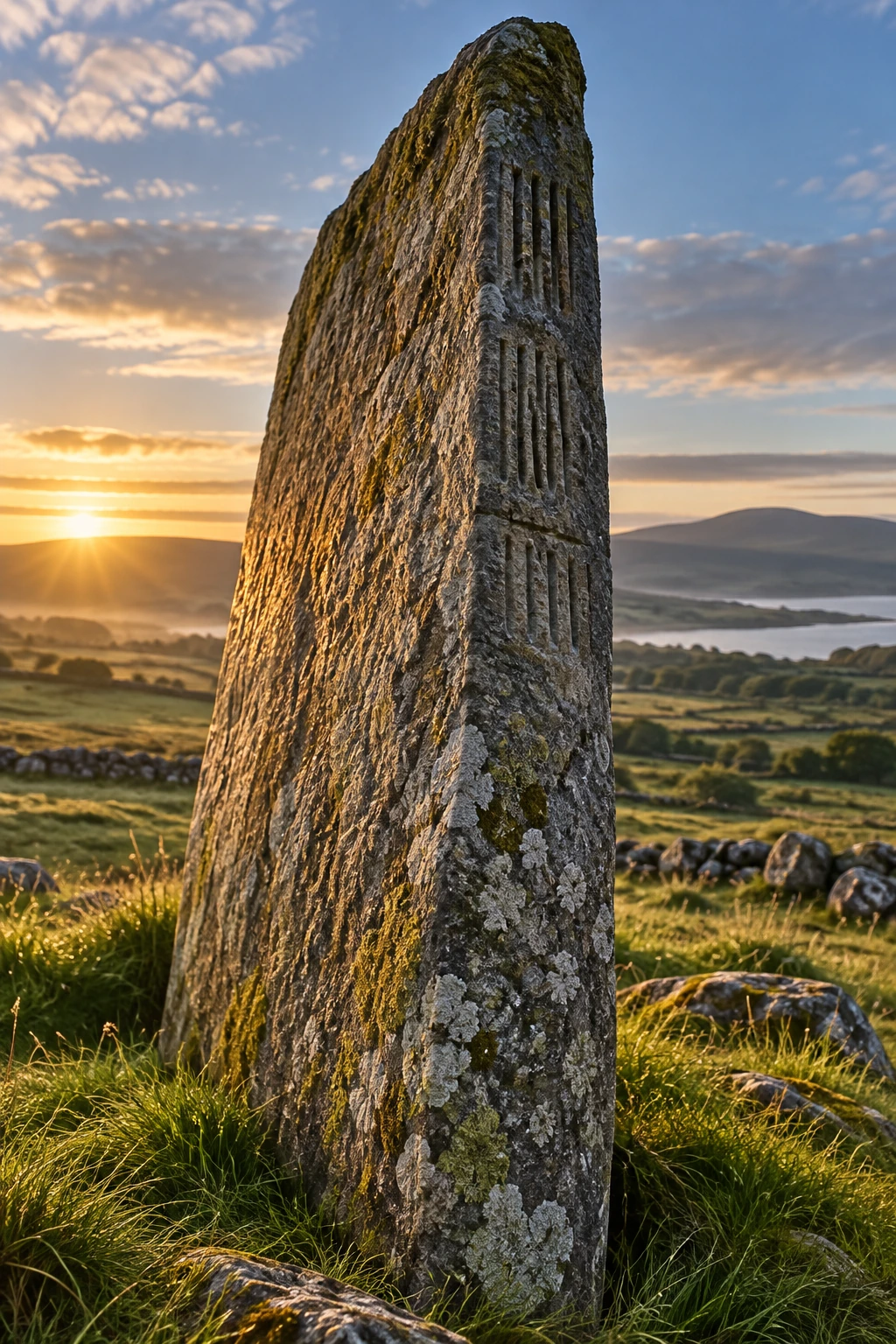
A weathered stone edge with grouped incisions stands in grass under low sunlight.
The corner offers a route for the eye. This reconstructed stone is illustrative; use the museum guide for a documented inscription.

The National Museum of Ireland's introduction shows a stone from Colbinstown, County Kildare. Its corner acts as the central line around which the signs are arranged. That makes the stone's geometry part of the writing surface rather than background scenery.

Find the line before the letters

In a printed alphabet chart, the central line is drawn on the page. On a stone, an actual edge can perform that job. Groups differ by the number and placement of strokes in relation to it. A photograph taken squarely at one face may make some of those relationships difficult to see.

Open the museum's guide and compare its pictured stone with its alphabet exercise. First identify the edge. Then identify individual groups. Only then use the key. This order prevents a common mistake: counting every visible scratch before deciding which scratches belong together.

The guide describes a usual reading route that begins low on the left, continues upward and may pass around the top. The word “usual” matters when moving from a teaching example to a real monument. Damage, reuse and individual inscriptions can make the route less straightforward.

A name can occupy a monument

Many surviving early ogham inscriptions commemorate people through personal names and relationships. The museum's short account places many stones in the fourth to sixth centuries. That is a broad historical setting, not a date obtained by measuring how old the rock is.

Consider the difference between carving “a person existed” and carving a name with a family connection. The second statement places a person among other people. Even when the inscription is short, the social information can be substantial.

For a safe paper exercise, write an invented name and “child of” followed by another invented name in your ordinary alphabet. Count how much of the inscription identifies a relationship rather than a physical feature. There is no need to translate that sentence into ogham to appreciate what the monument is doing.

Turn a digital stone slowly

The researchers behind Ogham in 3D describe their recording process: investigation of stones and sites combined with three-dimensional scanning. A model can preserve information about the corner that a single frontal image compresses.

In a linked digital model, look for a group that is clearer after rotation. Ask what changed. You did not uncover a new carving; you changed the relation between a surface, a light and a viewpoint. The distinction makes a model useful as a tool for examination rather than just an impressive object to spin.

At the same time, a scan is a record made by instruments and processed by people. It does not guarantee that every shallow groove has been identified correctly. Compare the model with the project's transcription and commentary instead of treating every small depression as a letter.

Stone evidence and later learned traditions

Jost Gippert's university-hosted introduction to ogham inscriptions brings photographs, readings and scholarly references together. It makes the difficulty of reading actual stones visible. A neat modern font cannot reproduce all the decisions an epigrapher faces.

Ogham also has later manuscript traditions and interpretations of letter names. Those are interesting subjects in their own right. They should not automatically be substituted for the reading of an early stone inscription. A tree association in a later explanation does not turn every stroke group on a monument into a message about that tree.

Try a three-pass observation

First describe only the stone: its shape, edge and visible damage. Second describe the marks without assigning letters. Third compare a published reading and note where it depends on an uncertain or missing section. Each pass asks a different question, so a difficulty in one need not erase what the others establish.

Leave real monuments untouched. Rubbing, chalking or wetting a surface can affect it, and an enthusiastic attempt to improve contrast may destroy information that a different technique could record. Public photographs and research models offer plenty of room for close looking.

The attraction of ogham is not simply that ordinary words have been disguised as strokes. It is that writing has adapted itself to an edge. Once you notice the corner, a nearly blank stone becomes a route that the reader's eyes can follow.

Sources and further exploration: National Museum of Ireland: ogham guide; Ogham in3D researchers: recording the stones; Jost Gippert: introduction to ogham inscriptions.

Explore all 50 new articles · Browse the complete illustrated collection

Explore more art, ideas, and independent projects at Incoprea.

Tyrian Purple: When a Color Carried More Than a Price

A purple thread looks like an answer: someone wanted purple. For an archaeologist, it is the beginning of several questions. Which coloring material was used? Where could it have been obtained? What part of the process happened here? Does the object's color tell us anything secure about the person who wore it?

Tyrian purple is associated with particular Mediterranean sea snails and a demanding dyeing tradition. But “purple” is also a broad visual category. The history becomes more interesting when we resist treating every purple textile, every shell heap, and every royal story as pieces of one interchangeable puzzle.

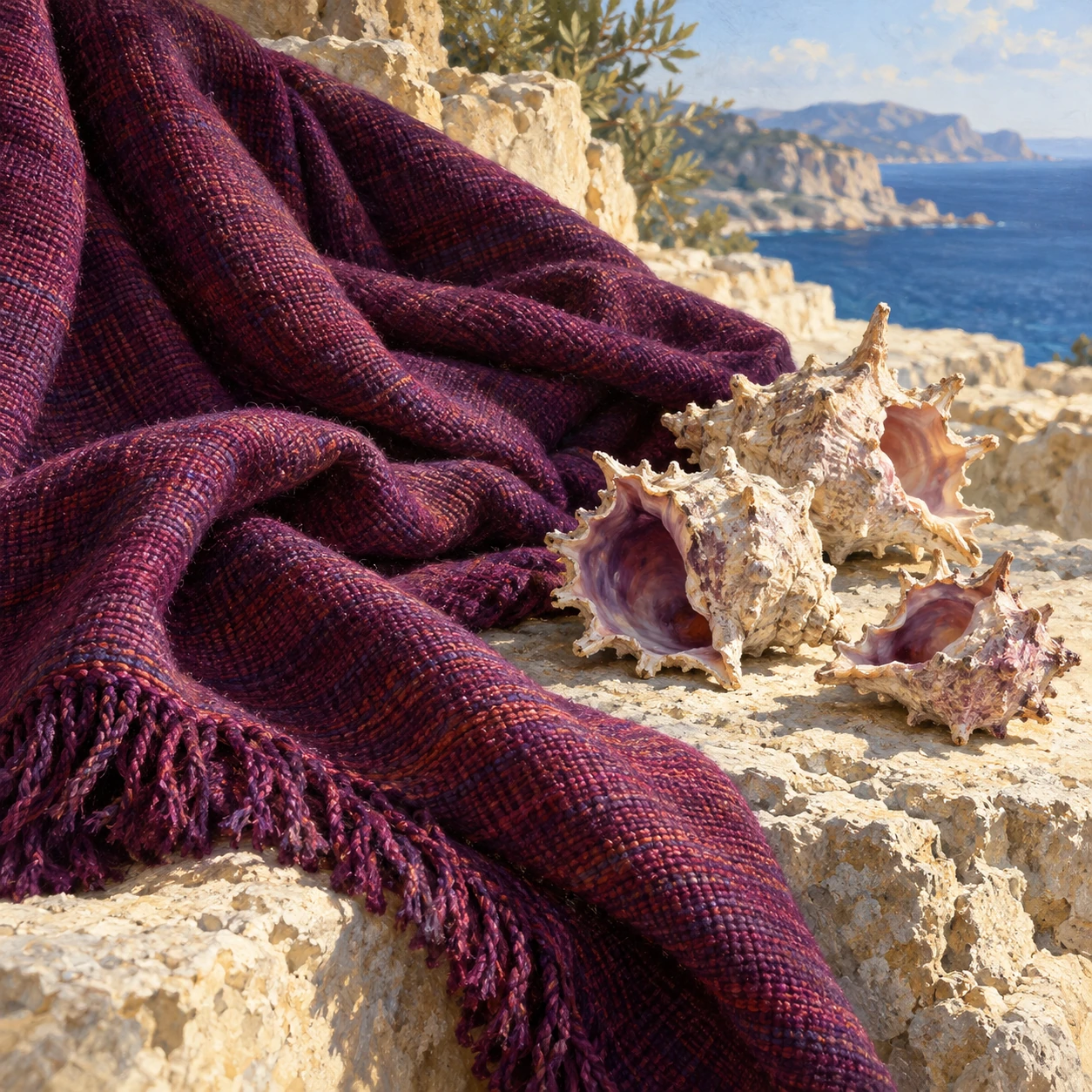
A fold of woven dark reddish-purple wool cloth beside a few empty Mediterranean murex-like shells on rough pale limestone, angled daylight reveals thread texture.
Shells and cloth evoke shellfish-purple dyeing. A purple-looking textile still needs analysis before its dye or historical status can be identified.

One color name, several kinds of evidence

The dye material comes from a gland secretion, not simply from pulverizing the shell into purple powder. Production involves transforming the extracted material and applying the color to fibers. Different conditions can produce different shades. A single bright screen swatch is therefore a poor standard for identifying an ancient dyestuff.

A useful comparison comes from a quite different place and period. The Metropolitan Museum's record of an Andean tunic, dated to the fifteenth or early sixteenth century, reports that its purple/blue areas contain cochineal. They are not evidence of Mediterranean murex dye. The example separates a visible result from the material route used to achieve it.

This does not make the tunic an imitation of Tyrian purple. It belongs to its own textile tradition. Placing the records beside each other is a comparison of how color is identified, not a claim of shared origins, direct influence, or a universal hierarchy in which one culture's purple is the authentic version of another's.

Timna: a result small enough to be precise

In a 2021 study of textiles from the Timna Valley, Naama Sukenik and colleagues identified three examples dyed with murex-derived material. Their chemical analysis detected characteristic brominated indigo compounds. The finds came from a copper-smelting site whose radiocarbon chronology places the context in the late eleventh to early tenth centuries BCE.

The researchers discuss prestige and social organization, but a dye identification is not a recovered owner's name. “Royal purple,” in the article's title, names a historically prestigious material. It does not prove that a particular king wore these fragments. The distinction allows the evidence to remain important without adding an unsupported royal wardrobe.

Think of the inference as a series of doors. Analysis can open the material door. Archaeological context helps open the place-and-date door. Identifying an individual wearer requires another kind of key. Leaving that door closed is a more accurate account than assuming that the first result opened every room.

A shell heap is a question, not a complete workshop

The Timna paper also warns that shells can be associated with uses other than dye production. A deposit needs contextual interpretation. At a different site, the team studying Alatzomouri-Pefka on Crete combined evidence for basins and vessels with chemical residues. Their account emphasizes why a painted garment alone cannot establish the dyestuff used in a real textile.

This is a good example of evidence becoming stronger through combination. A feature that looks like a basin may support several explanations. A residue helps narrow them. A pattern of related features can strengthen an interpretation further. None of that requires pretending that one attractive find speaks in a complete sentence.

The Penn account also describes two dyestuffs found in one vessel while acknowledging uncertainty about whether they were mixed or used separately. Finding substances together does not automatically reconstruct their sequence of use. An accumulated history and a single deliberate mixture can leave overlapping traces.

Make a simple inventory of the evidence before drawing a route on a map. A textile establishes a colored object at its find context. A workshop residue points toward processing at another location. A written description establishes that an author discussed a practice. Connecting those points may be a reasonable hypothesis, but the connecting line is an argument. It is not another excavated object. Labeling that line as a hypothesis keeps a useful map from becoming a misleading picture of certainty.

Pliny: expertise, complaint, and a translated voice

Turn from laboratory analysis to Book 9 of Pliny's Natural History. In the 1601 English translation hosted by the University of Chicago, the discussion distinguishes different purple products, processing choices, and prices. It also criticizes expensive display. Technical description and moral judgment occupy the same passage.

Read that mixture rather than editing the author's attitude away. A complaint about luxury is evidence that someone wanted to criticize luxury. It may also preserve information about products and practices. Those are related uses of the text, but one should not be mistaken for the other.

The translation adds another layer. Terms such as “purple,” “violet,” and “scarlet” arrive through a historical English vocabulary as well as an ancient Latin one. They should not be converted casually into precise digital color values. The text is describing materials and appearances within a particular linguistic world.

Finally, return to the image of folded cloth beside shells. It gives the subject a visual form, but it cannot certify a chemical composition or reconstruct a specific ancient garment. The research does that work through particular samples and explicit reasoning.

The fascination of Tyrian purple lies partly in the distance between appearance and process. A small area of color can connect skilled production, exchange, social ambition, and the survival of perishable things. Following those connections carefully gives us something richer than the familiar sentence that purple was expensive.

Sources and further exploration

Explore all 80 new articles · Browse the complete illustrated collection

Continue exploring art, ideas, and unexpected connections at Incoprea.

A Wall Made From Burned Stone: The Craft in Maya Lime Plaster

A pale plaster surface can look like the least interesting part of an ancient building. Stone blocks and carved figures claim attention; the coating seems merely to cover them. But plaster is made, not found. It records a sequence of material transformations and choices that helped give a building its finished surface.

At Copán in present-day Honduras, a 2023 study brought some of those choices into unusually close focus. Its most useful lesson is not that one mysterious ingredient explains every surviving Maya wall. It is that combining archaeological materials, living craft knowledge, and controlled experiments can answer a carefully bounded question.

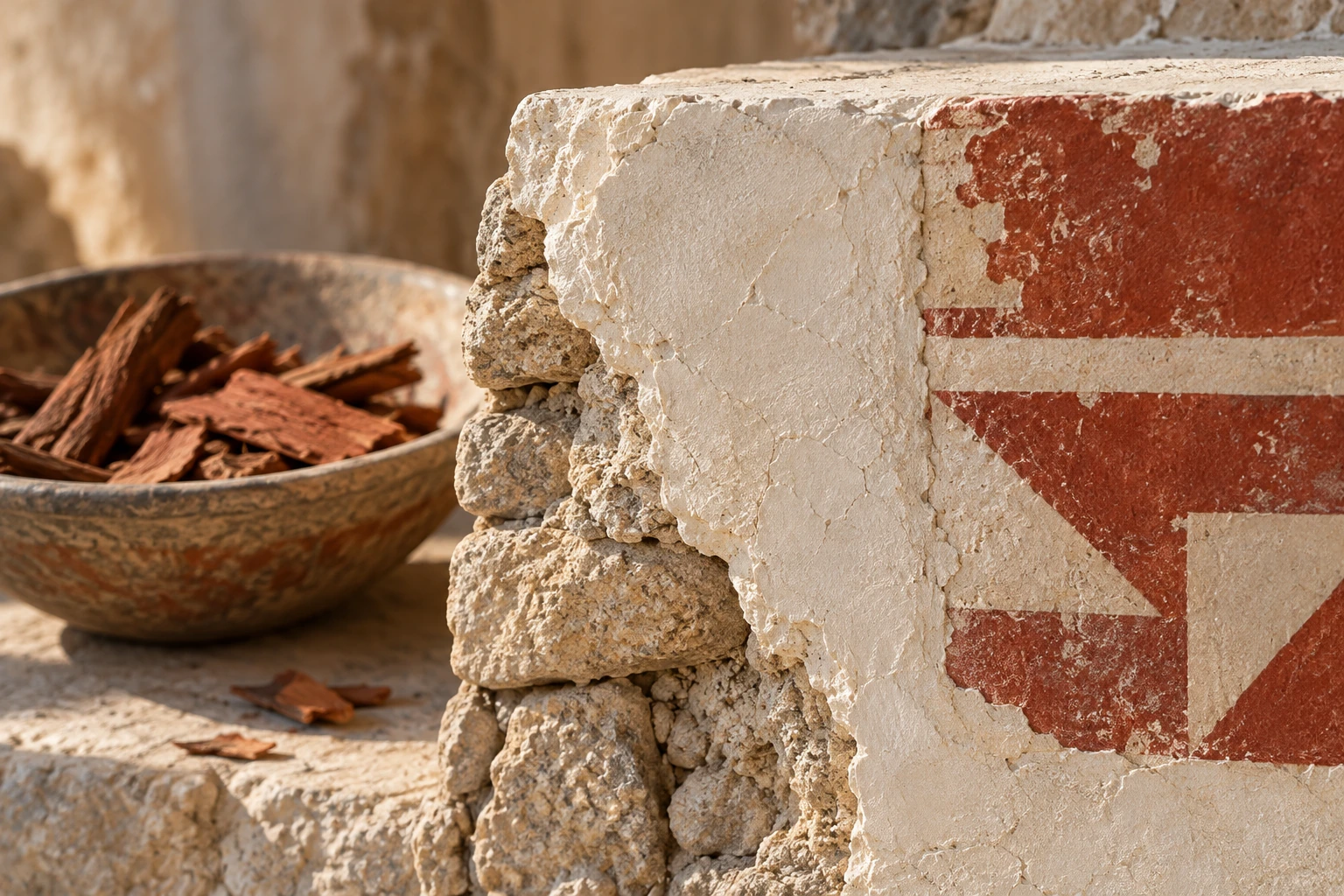
A horizontal close study of an imagined Maya lime-plaster wall edge: thick pale mineral plaster over rough masonry, a small area of muted red painted geometric surface, adjacent soft-focus bowl containing bark fragments as an explanatory separate ingredient cue.
A finished wall hides choices about lime, aggregates, water, and possible organic additions. This material study is not a sample from Copán.

First, separate the wall from its finish

UNESCO's account of Copán describes a major political, civil, and religious center with temples, terraces, plazas, and successive phases of construction. A coating belongs to this larger architectural setting. It may conceal masonry while also creating the surface people encountered, decorated, repaired, or built over.

“Made of stone” can therefore be an incomplete description. Ask which stone is structural, which material binds or covers it, and which surface was meant to be visible. A ruin presents the materials that survived and remained exposed. That is not automatically the same view its builders prepared for a finished monument.

The conceptual illustration brings a broken edge and a smooth surface together. Its bowl and decorative geometry are illustrative choices, not objects from a documented excavation. Use it to notice the difference between bulk material and finish, then turn to the study for the actual samples and their locations.

Stone changed into a binder

In the basic lime cycle, heating limestone releases carbon dioxide and produces quicklime. Reacting quicklime with water produces slaked lime. As an air-lime material hardens by carbonation, it takes up carbon dioxide and forms calcium carbonate again. These are chemical transformations, not simply grinding a white rock into smaller pieces.

The cycle is a helpful outline, but it is not a complete account of a historical plaster. A finished material also has a structure: pores, grains, interfaces, layers, and sometimes added substances. Those relationships help determine how it behaves. Knowing the names of ingredients is only a beginning.

Nor does a chemical cycle mean the final surface has returned to the original rock in every respect. A quarried stone and a newly formed binder may contain related minerals while differing in texture and arrangement. “Back to limestone” is memorable shorthand, but it can obscure the very features a materials researcher wants to examine.

The Copán experiment

Carlos Rodriguez-Navarro and colleagues analyzed plaster samples from Classic-period Copán structures. Some contained organic material within a calcite-rich binder. Following advice from Maya-descendant masons, the team prepared replicas with extracts from chukum and jiote bark. Compared with additive-free controls, the replicas helped demonstrate how incorporated organics could change crystal structures and improve toughness and weathering resistance.

The paper's author-hosted full text makes clear that the ancient samples were not all identical. That qualification matters. This is evidence for particular materials and a tested mechanism, not a license to assign one formula to every Maya city or every century.

Traditional knowledge was part of choosing what to test. Laboratory instruments did not conjure the practical use of tree extracts from nowhere. At the same time, a modern replica does not recreate every action in an ancient workshop. The relationship is strongest when both contributions are described precisely.

How to read a materials claim

A useful research question has more moving parts than “did the additive work?” What counts as working? Resistance to cracking, behavior while wet, long-term weathering, and ease of application are different properties. A material can improve in one respect without becoming universally superior.

Historic Environment Scotland's account of mortar analysis shows why complementary methods matter. A hand specimen, a microscope, and mineral identification provide different information. Observing texture is not the same operation as identifying minerals. A sample's location also matters because its function and exposure help explain its condition.

QuestionEvidence that helpsWhat it cannot do alone
What is present?Composition and mineral analysis.Reconstruct every workshop action.
How is it arranged?Microscopy and layers in a sample.Tell us every maker's intention.
Does a proposed change affect behavior?A comparison with a suitable control.Guarantee identical performance in every wall.
Where does the result apply?Sample context, test conditions, and replication.Turn a local result into a timeless universal recipe.

Keep the last column beside the first two. It does not weaken the research. It shows the boundary of each kind of evidence. The most convincing account is one in which the conclusion fits inside those boundaries.

Why a stronger material may be the wrong repair

Modern conservation introduces another question: what belongs next to an existing wall? Historic Environment Scotland's repair guidance emphasizes compatibility with existing materials, exposure, and aftercare. Strength by itself is an inadequate goal. An unsuitable repair can affect neighboring fabric and moisture movement.

This guidance concerns modern conservation practice, not a direct instruction from Copán's builders. Its relevance is the decision it forces us to articulate. Are we trying to reproduce a historical surface, protect old material, understand a mechanism, or design something new? Those aims overlap, but they are not interchangeable.

When a headline promises an ancient secret for modern buildings, try writing the missing specification. Which tested property matters? In what climate? On what substrate? For how long was it measured? You do not need to solve all those questions to see why the single word “better” is doing too much work.

The reward for this slower reading is considerable. A wall coating becomes evidence of learned practice, demanding material choices, and knowledge that can still inform research. Its endurance is interesting because it can be investigated, not because it has to remain mysterious.

Sources and further exploration

Explore all 80 new articles · Browse the complete illustrated collection

Continue exploring art, ideas, and unexpected connections at Incoprea.

Moche Portrait Vessels: A Face Is More Than a Likeness

Before looking into the eyes, look above the head. A loop rises behind it and joins a narrow spout. The face is part of a ceramic container. Forgetting that fact is easy: Moche makers gave some vessels such convincing cheeks, brows, and lips that we want to introduce ourselves to the person represented.

The attraction is valuable, but it can hurry us past the object. A recognizable face is not the same thing as a recovered identity. A vessel can resemble an individual while also communicating a role, circulating among people, and participating in practices we understand only partly.

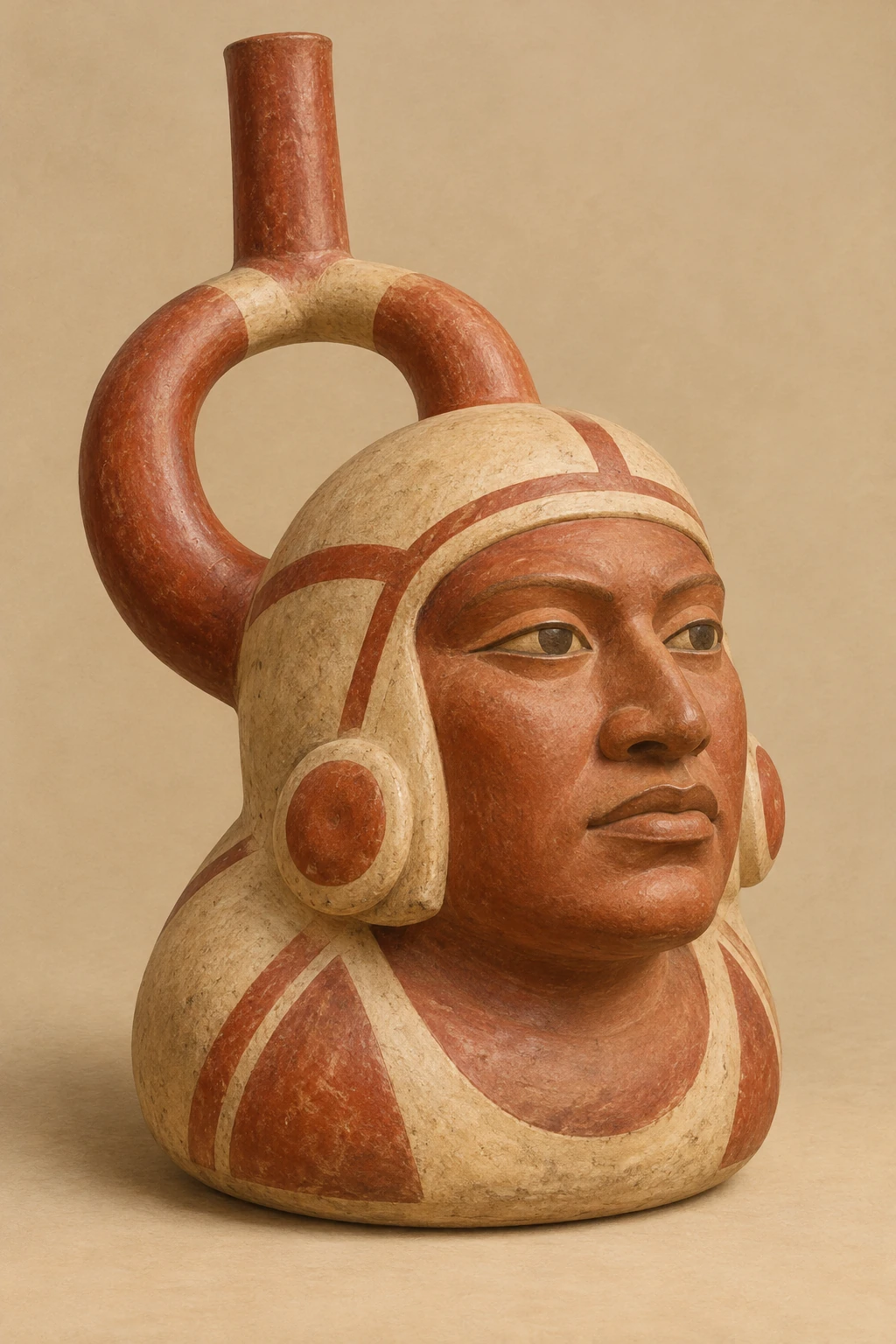
An original Moche-inspired stirrup-spout portrait vessel, seated as an object on plain sand-colored ground.
The face, hollow body, and stirrup spout must be read together. The invented form is not a portrait of an identified ancient person.

Three objects, three different questions

Use the museum records linked below as a small comparison set. The illustration above is an invented Moche-inspired vessel, so it cannot supply evidence about a specific excavated individual. The collection records provide the actual objects, measurements, and curatorial discussions.

Object to openA firm starting pointA useful question
Bottle 64.228.22Ceramic and slip;500–800 CE;27.9 cm high.How do headcloth, ear ornaments, and spout organize the head?
Bottle 67.167.22Single spout; third–sixth century;21.3 cm high.What changes when the container has a different upper form?
Human and fox heads comparedThe museum places two differently shaped head bottles together.Which assumptions did “portrait” make us bring to the human example?

Read across the table before choosing a favorite. The small set already prevents a universal claim about one spout form. It also reminds us that dimensions matter. A cropped screen image can make two vessels seem the same size even when the records tell us otherwise.

What the surface establishes

The record for 64.228.22 describes a cream-colored headcloth, red designs on a headband, and modeled earspools. A pierced septum may once have held a metal nose ornament. The distinction between a surviving hole and a proposed missing ornament is worth preserving. One is visible evidence; the other is a qualified reconstruction.

Try writing a description with no personality words. Instead of “stern,” record the line of the mouth. Instead of “proud,” describe the head's position. This is not a ban on responding emotionally. It gives you a stable description to place beside your response, so the two do not become indistinguishable.

The same discipline applies to costume. Clothing and ornaments invite questions about affiliation and status. They do not function as a modern name badge whose full meaning we can recover by recognizing a shape. A careful account asks how such features recur across objects and how they relate to archaeological contexts.

A face that could be made again

Joanne Pillsbury's survey explains that later portrait heads were often made with molds, allowing multiple vessels from a matrix. Some surviving examples appear to represent the same person at different ages. The survey also notes that contents remain uncertain and that evidence of wear and fragments suggests use before final deposition in tombs.

Molding complicates a familiar expectation. We often imagine a portrait as one artist's unique encounter with one sitter. A repeatable ceramic head makes us consider a different relationship between likeness and circulation. More than one object could carry a related face into more than one setting.

That possibility does not make the work less expressive. It changes the questions. Which details belong to the mold, which to finishing or painted treatment, and which reflect later damage? Two objects can share an underlying form without having identical histories. A repeated face and a repeated social act are not necessarily the same thing.

What “portrait” helps us see—and can hide

In From Cloth to Clay, art historian Sarahh Scher challenges approaches that treat Moche ceramic representations as straightforward records of lived identity. The durable object makes selected features of bodies and clothing permanent. It cannot preserve everything about the contingent, changing life of a person.

This is a productive warning for any viewer. A headcloth fixed in clay cannot be rearranged. A face fixed at one moment cannot answer a question. The vessel may preserve a remarkable representation while withholding the lived circumstances that would let us interpret it confidently.

Compare the human and fox-head bottles in the museum's discussion of faces. The pairing interrupts an easy division between literal human likeness and everything else. It asks us to examine the representational choices shared by objects that a modern viewer might place in separate categories.

There is another practical check: read the provenance separately from the date of manufacture. “Gifted in 1964” describes an event in a museum object's later history; it does not describe an ancient findspot. A modern accession record can preserve an object's collecting history while leaving important archaeological context unknown. Keep those two histories on separate lines, and resist treating the completeness of one as a substitute for the other.

Likewise, a broad date range is a statement about current knowledge. It does not mean the object took three centuries to make. When comparing two vessels, overlapping date ranges permit questions about relationships, but they do not establish that both came from the same workshop or were used together.

A label you can improve

Here is an intentionally inadequate imaginary label: “A powerful man, shown exactly as he looked, used this bottle for maize beer.” It turns four different propositions into certainty. How would you repair it using the sources?

  1. Keep the object type, place, and date range supplied by its record.
  2. Describe the modeled and painted features before interpreting them.
  3. Qualify any claim that the face represents a particular person.
  4. State that contents are uncertain unless evidence for this object establishes them.

A better label may feel less like a complete biography. It is more useful because a reader can see which parts are secure and which remain questions. You can still feel the force of the face without pretending to know its owner's name, mood, occupation, or last thought.

Finish by looking again at the whole container. The opening, hollow body, surface, and represented head belong together. The vessel's strangeness is part of its interest: a face we can almost recognize, made repeatable in clay, participating in a world that exceeds what likeness alone can explain.

Sources and further exploration

Explore all 80 new articles · Browse the complete illustrated collection

Continue exploring art, ideas, and unexpected connections at Incoprea.

The Sweet Track: A Neolithic Route Built Across Wet Ground

The most arresting fact about the Sweet Track is not simply its age. It is the unusual precision with which part of its making can be dated. Timbers from a route across the Somerset wetlands preserve a calendar written before the tree was cut. Yet that calendar cannot tell us the names of the people who walked there.

This is a useful place to separate three questions: what survives, what can be dated, and what the route meant. The answers do not have equal precision. A date can be extraordinarily specific while a purpose remains open to interpretation.

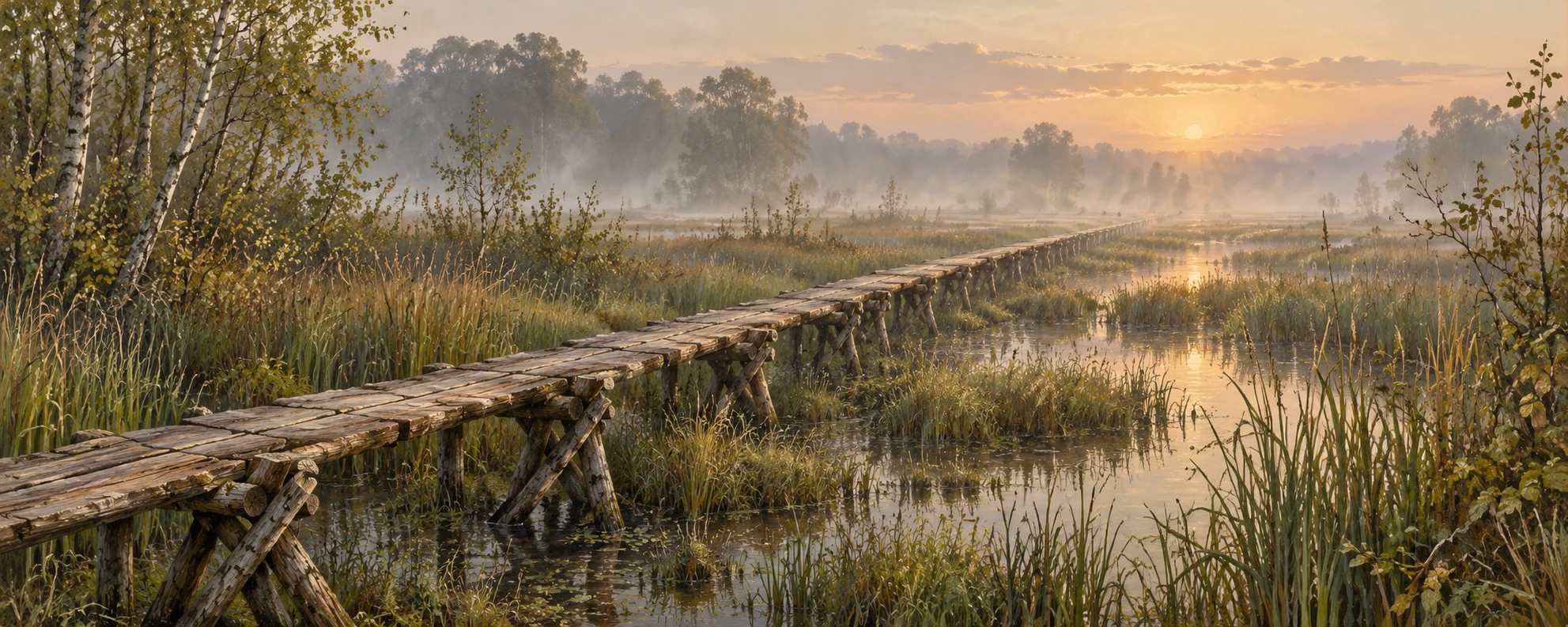
An interpretive Neolithic timber walkway across an English reed wetland: narrow straight planks elevated modestly above wet ground on simple crossed timber supports, birch and hazel-like marsh-edge vegetation, dawn mist and subdued ochre greens.
The narrow wooden route is a reconstruction concept. The excavated Sweet Track provides the evidence for the much more specific account in the text.

Evidence file 1: a way above the wet ground

The Sweet Track ran for almost two kilometers through wetland between the Polden Hills area and Westhay. Its surviving construction shows a raised wooden route rather than a strip of permanently dry ground. The Somerset Historic Environment Record describes longitudinal rails, supporting pegs, and walking planks. Crossed pegs and other supports helped hold the upper surface above the lower timbers.

That is a more interesting object than the vague phrase “prehistoric boardwalk” suggests. A board resting directly on mud and a board carried by a support system solve different problems. Construction details reveal how the makers dealt with the ground. They also give archaeologists features that can be compared between stretches of the route.

The illustration evokes a wooden crossing, but it is not a measured reconstruction. In particular, a scenic depiction can simplify plank orientation, joints, spacing, and the supporting structure. Use the archaeological description, rather than the picture's attractive regularity, to understand the excavated design.

Also notice that “wood” is not one uniform material. A support, a peg, and a walking surface ask different things of a piece of timber. The record's distinctions between components are therefore worth retaining in your notes. A reconstruction that turns every part into the same regular lumber makes the route easier to picture while discarding some of the choices preserved in the remains.

Evidence file 2: the last ring

According to Historic England's research account, tree-ring evidence places felling for the Sweet Track in the winter of 3807–3806 BCE or early spring 3806 BCE. Repairs indicate use for at least several years afterward. This is a date for trees being felled, tied to construction through the archaeological context. It is not a diary entry announcing an opening ceremony.

Think about what must survive for such precision to be possible. An isolated piece of wood does not automatically produce a year. Archaeologists need a recognizable pattern of rings that can be compared with a dated sequence. The relationship between the final surviving ring and the tree's outer edge affects how closely felling can be estimated.

This distinction is especially helpful when encountering headlines. “A 3806 BCE trackway” is a useful shorthand. “Everyone crossed it on a known day in 3806 BCE” adds information the evidence does not supply. Precision in one measurement should never spread automatically to every sentence around it.

Evidence file 3: a route with a predecessor

The scheduled monument record includes both the Sweet Track and the earlier Post Track. The latter has a felling date of 3838 BCE. So even here, the neat story of one extraordinary invention is too simple. People had already been building routes through this wet landscape.

Compare the questions an earlier route raises with the questions it answers. It establishes that the landscape had an earlier episode of route construction. It does not tell us, by itself, whether the later route replaced exactly the same kind of journey, served the same users, or had the same social importance.

A crossing could help movement between places. That functional statement leaves room for different reasons to move: tasks, exchanges, visits, ceremonies, or combinations. Objects found near a route may inform those possibilities, but a striking object is not a caption explaining the whole site.

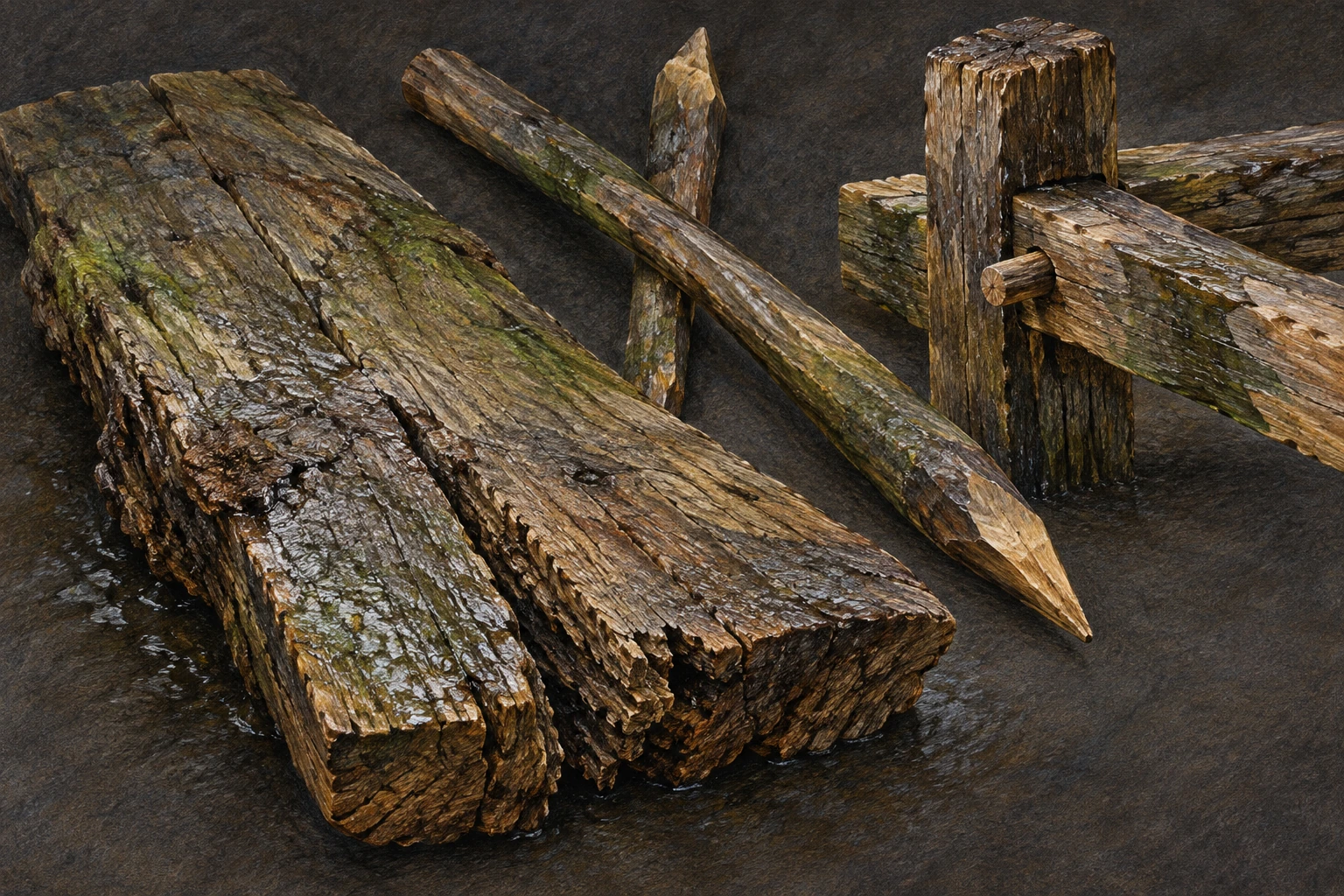
A close arranged study of waterlogged wooden walkway components on neutral dark ground: one broad split oak-like plank, two slender crossed stakes and a pegged simple timber joint nearby.
The invented timber study draws attention to planks, stakes, and working marks. It is not a measured Sweet Track joint or an excavated assemblage.

Evidence file 4: preservation is an ongoing experiment

Wet conditions helped the timbers survive. Changing those conditions can change what remains for future study. A 2022 research report describes trials using four trenches and monitoring from March 2017 to November 2019. During that interval, the monitored conditions did not indicate a significant desiccation threat. A trial membrane offered little observable benefit under those conditions.

Read the time boundaries carefully. A result from a monitored interval is evidence about that interval and that setting. It is neither proof of permanent safety nor proof that a proposed intervention must always fail. Conservation research is useful precisely because it tests assumptions against the place being protected.

The buried timber and the public reconstruction also have different needs. A reconstruction can help visitors picture movement. The original deposits preserve information that no reconstruction can replace. Making the former more visible should not mean treating the latter as expendable once the main story has been told.

Open the observation sheet

The printable sheet below asks you to classify six statements as observation, dating result, interpretation, or unsupported embellishment. It includes an answer guide. You can use it without visiting the site or handling any archaeological material.

Sweet Track evidence sheet

Printable six-statement evidence classification worksheet with answer guide.

Open sweet track evidence sheet in its own window.

For a second visual account, the South West Heritage Trust's archaeology films page includes a Sweet Track digital reconstruction. Watch for the decisions every reconstruction has to make: water level, vegetation, completeness, and the spacing of structural parts. Which are being illustrated, and which could you verify from the excavation record?

Here is a useful test afterward. Write two short descriptions of the site. In the first, include only claims directly established by the surviving materials and their analysis. In the second, add a plausible account of a journey. Underline every addition in the second description. This shows how rapidly a modest set of facts can become a vivid narrative.

There is nothing wrong with imagining that journey as long as the boundary remains visible. The timbers deserve both kinds of attention: curiosity about the lives around them, and care with what their survival allows us to know. A route made for movement has become a remarkably precise, incomplete record of human decisions.

Sources and further exploration

Explore all 80 new articles · Browse the complete illustrated collection

Continue exploring art, ideas, and unexpected connections at Incoprea.

The Runes Inside Maeshowe: A Monument With More Than One Lifetime

A person enters a monument that is already ancient and leaves a mark on its wall. Centuries later, another visitor tries to read that mark. At Maeshowe in Orkney, the walls do not belong to one historical moment. They hold evidence of a Neolithic tomb, later Norse visitors, and modern efforts to investigate and protect both.

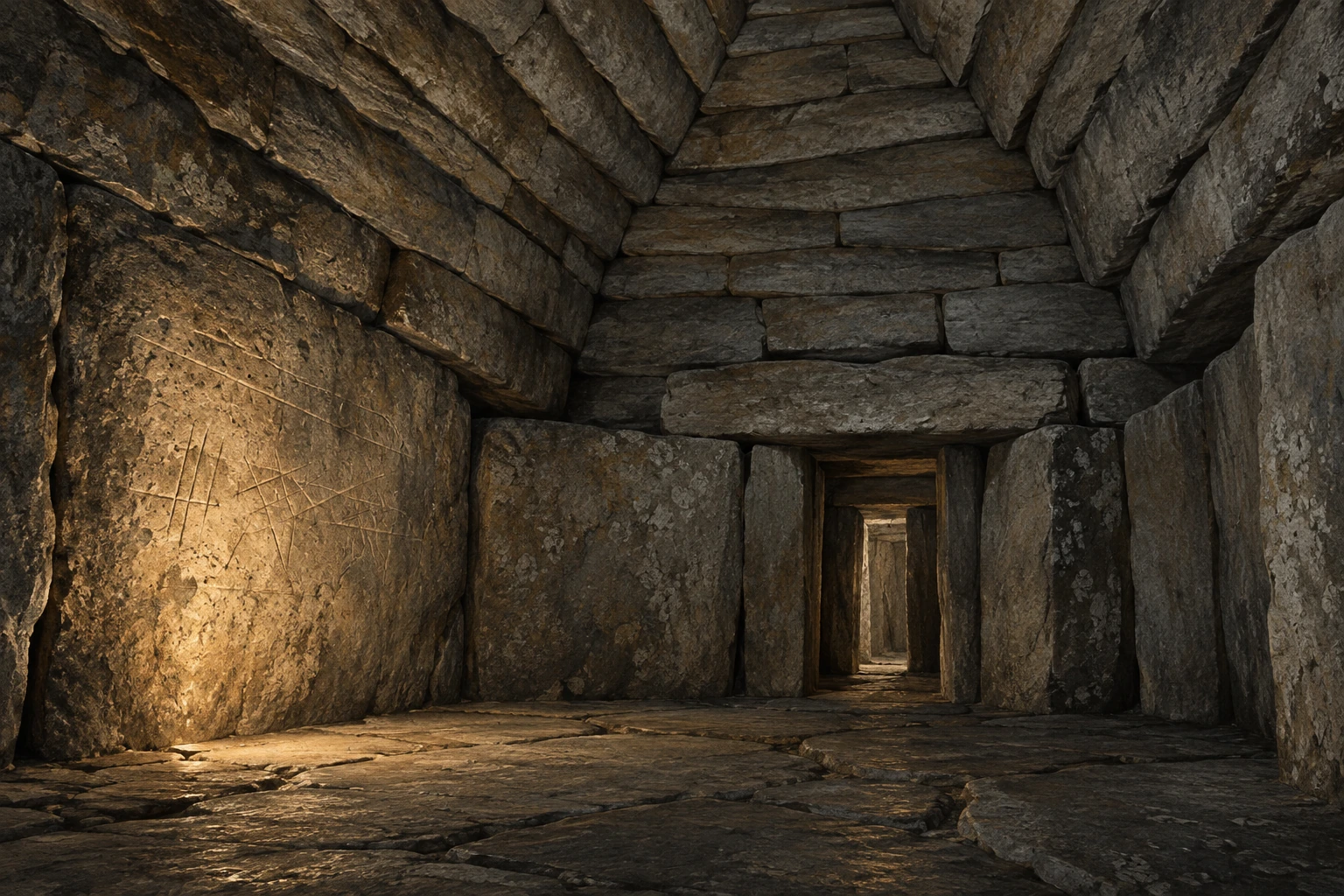
The inside of a generic Neolithic corbelled stone chamber inspired by Maeshowe, with a small patch of indistinct incised strokes on one side wall lit from an unseen low lamp.
A chamber can outlive its first purpose. The invented incisions stand for later visitors rather than a transcribed Maeshowe inscription.

The temptation is to let the liveliest writing take over the whole story. Runic graffiti can seem more conversational than a monumental stone chamber. Yet the runes are late arrivals in a much older building. Keeping those timelines separate makes the place more remarkable.

A tomb before the inscriptions

Historic Environment Scotland describes Maeshowe as a Neolithic chambered tomb, later entered by Norse visitors after a long interval. The inscriptions belong to that later phase. Their presence does not mean Norse builders constructed the chamber, or that the original builders used runic writing.

This sounds obvious when stated plainly. It becomes less obvious in a cropped photograph that shows a rune beside a carefully dressed stone. Images place things next to one another; historical argument has to establish whether they were made together. Physical proximity is evidence of a relationship, but not necessarily of shared date or purpose.

The tomb's construction also deserves attention on its own terms. A low passage leads into a central chamber with side cells. Stone size, positioning, and the transition from passage to room organize an experience that the later writers inherited rather than invented.

Where a line is matters as well as what it says

The World Heritage nomination dossier discusses the Norse inscriptions and the history of recording them. It includes the position of a high inscription as well as its reading. Placement can become evidence: a mark's height raises questions about the state of the chamber when somebody carved it.

A translation gives a modern reader access to language. A measured location gives access to an action in space. Together they can suggest more than either alone, but they still need careful limits. An inscription that boasts about a feat is evidence that someone made that claim. It does not automatically verify every event being described.

Names, declarations, joking, and claims about other visitors can all invite a very modern sense of recognition. That recognition is enjoyable. It should not turn every line into a reliable diary entry, or every modern translation into a direct recording of a speaker's voice.

Three histories in one chamber
Layer of historyA useful question
Neolithic construction and useWhat do the architecture and archaeological context show?
Later Norse entry and inscriptionsWhat was carved, where, and how is it dated and read?
Modern excavation and conservationWhat has been exposed, altered, recorded, or supported?

The monument you see also has a conservation history

The 2008–13 World Heritage management plan records an 11-meter passage and describes a concrete cap installed in 1910–13 above the chamber. It notes that the present upper height is probably lower than the original apex. A modern protective intervention is therefore part of the structure's present condition.

That is not a reason to dismiss the monument as inauthentic. It is a reason to ask better questions about which parts of a visible condition are ancient, which are reconstructed, and which support survival. Conservation choices can preserve access to evidence while also changing what a visitor experiences.

Try reading a monument photograph in two times

Choose a photograph in the official site account or nomination dossier. First describe only visible relationships: passage, chamber, wall, incision, light. Then add dates from the record. Mark any part for which you do not have a date. The exercise tests how quickly the eye turns several periods into one apparently continuous scene.

There is no need to flatten Maeshowe into either a solemn prehistoric mystery or a collection of amusing Viking messages. The building's long life includes both, alongside many gaps. Its depth comes from the coexistence of histories that remain distinct.

The next time you encounter writing on an old wall, begin with two questions: how old is the wall, and how old is the writing? The distance between those answers may be where the most interesting story starts.

Sources and further exploration

Explore all 80 new articles · Browse the complete illustrated collection

Continue exploring art, ideas, and unexpected connections at Incoprea.

Faces Wrapped for Another World: Looking Carefully at Roman Egyptian Portraits

Start with the edge. A face may draw you in, but the narrow wooden panel tells you that this was never simply a painting floating free of a body, a burial, or a community. Roman Egyptian portraits can seem startlingly close to us. Their original purpose makes that closeness more complicated.

The label “Fayum portrait” is familiar, yet it can encourage the misleading idea of one place, one technique, or one population captured in a single style. The Met's Ancient Faces account describes a broader funerary painting tradition in Roman Egypt, especially from the first through third centuries CE. Wood panels, linen paintings, masks, and other coverings belong to that larger picture.

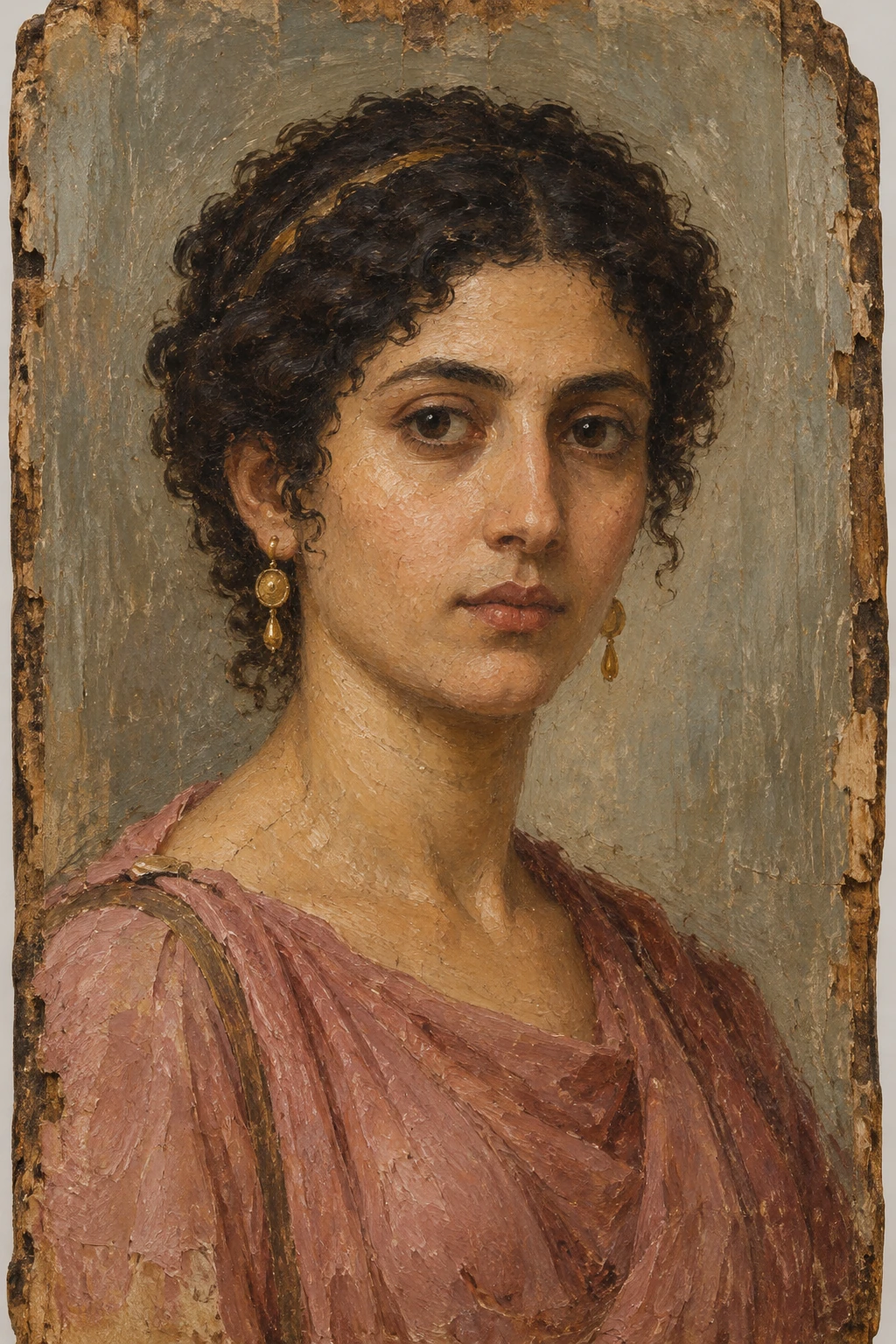
An invented Roman Egyptian portrait panel of an adult woman, chest and head only, dark curly hair, plain muted rose tunic, restrained gold earrings, waxy broad brush marks on weathered wood.
An original portrait study evokes the layered paint and wooden support of Roman Egyptian funerary panels; it is not a copy of an ancient individual.

Follow the paint, then the support

Encaustic is painting in a wax-based medium. Tempera is a different broad category, and a label using that word should not automatically be translated as the egg tempera familiar from later European painting. The useful first step is to read the actual medium description for the object in front of you. A brush mark is evidence of handling, not a complete recipe.

The Ashmolean identifies one male portrait as encaustic on limewood, dated 138–161 CE. That is a specific support and date range for a specific panel. It does not mean every portrait used the same wood, binder, or production sequence. Differences are part of what make comparison worthwhile.

Look at a highlight on a cheek, a dark curl, and a pale background. Ask whether the painter built the effect through broad strokes, small touches, a sharp boundary, or a transition. You can describe those visible choices without assigning the sitter a temperament. “The eyes are large and directly addressed” is an observation; “this person was anxious” is an imaginative interpretation.

A portrait still in its setting changes the question

The Met's object 11.139 preserves a portrait panel still positioned over the face of a wrapped person. The museum dates it to 80–100 CE and records its excavation at Hawara. Its sitter's name is unknown. Those facts provide a stronger anchor than guessing an identity from the painted features.

The full object restores a relationship that a cropped reproduction removes. Panel, wrapping, and body were arranged together. A portrait in this setting participated in a funerary practice; it was not only an exercise in resemblance. Looking at the complete record also asks us to remember that the subject is a deceased person, not an anonymous design resource.

Clothing, hairstyle, jewelry, painterly modeling, and Egyptian burial practices can coexist. They do not divide neatly into one “Greek” half and one “Egyptian” half of a person. Style is not a genetic test, and a hairstyle is not a passport. The more convincing historical question concerns how people used several cultural resources in the world they actually inhabited.

What technical images add

Getty's APPEAR project brings together research on materials, construction, provenance, and workshop practices. Its example of macro-X-ray fluorescence imaging maps the distribution of lead-based pigments across a portrait. A colored analytical map is a different kind of image from a visible-light photograph: its colors are a key for data, not the ancient painting's original appearance.

This distinction helps you read conservation stories with more confidence. A map can suggest where a material occurs. Identifying a workshop, a painter, or a sequence of decisions usually requires several kinds of evidence. The strongest result is not necessarily the most dramatic hidden picture. Sometimes it is a better account of an ordinary preparation layer.

Try a portrait comparison without guessing a personality

Open the Ashmolean gallery record and the Met's complete portrait mummy. Make two short lists. Under “visible,” record support shape, color boundaries, surface marks, and the relationship to wrapping. Under “documented,” record dates, excavation information, and materials. Leave a third space for questions you cannot answer. Do not move an appealing guess into the documented column just because it feels plausible.

A useful final check is to change the scale. First view the face large enough to see the paint. Then view the whole panel. Finally, if the record allows it, view the complete funerary object. Each view makes a different set of facts easy to notice. None is a replacement for the others.

The portraits' power does not depend on pretending they are photographs. Their surfaces preserve acts of selection, skilled painting, and remembrance. Taking the material and funerary setting seriously allows the face to remain vivid while keeping the person beyond our easy claims.

Sources and further exploration

Explore all 80 new articles · Browse the complete illustrated collection

Continue exploring art, ideas, and unexpected connections at Incoprea.

An Invitation on a Sliver of Wood: The Everyday Voices of Vindolanda

A birthday invitation survives because somebody once wrote on something that looks almost too slight to be an object: a thin leaf of wood. Its endurance is extraordinary. Its purpose is wonderfully ordinary. Claudia Severa wanted Sulpicia Lepidina to come and make a celebration more enjoyable.

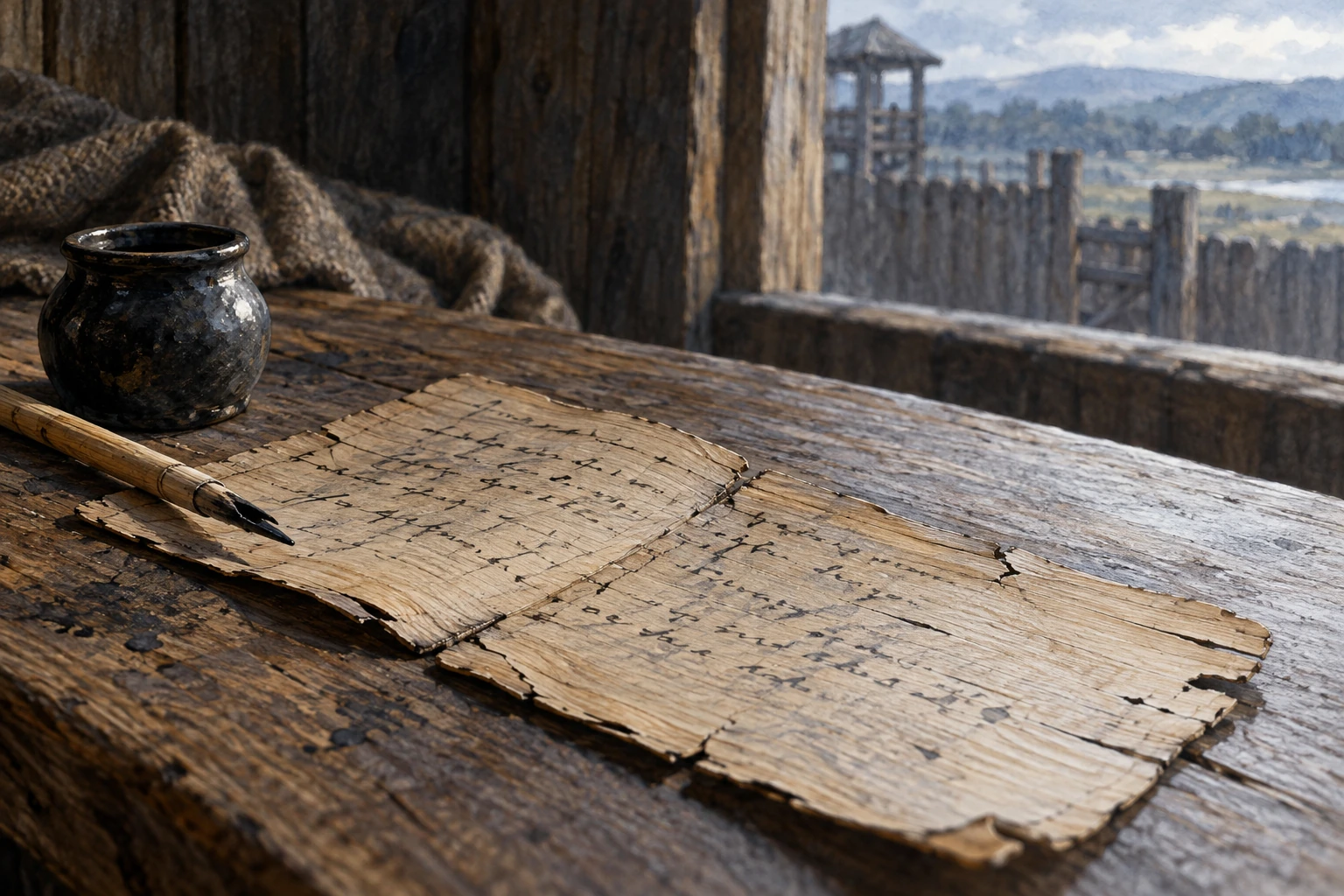
A thin wooden writing leaf with indistinct ink marks beside a reed pen and small ink pot in a northern Roman timber room.
A thin wooden leaf could carry a personal letter. The imagined marks here are not a transcription of a Vindolanda tablet.

The invitation is Vindolanda tablet 291, dated by its archaeological context to 97–105 CE. It belongs to a Roman military settlement in northern Britain, but it does not read like an imperial proclamation. Family greetings share space with the invitation. The surviving text gives the occasion as 11 September.

First, put the writing surface back into the story

A Roman writing tablet is not automatically a little wooden blackboard filled with wax. The editors of the Vindolanda corpus distinguish wooden leaves intended for ink from recessed tablets designed for a stylus and wax. Some objects complicate that division by carrying more than one kind of writing. Material categories are useful starting points, not a substitute for examining the particular object.

The leaf format matters. Thin wood offered a smooth writing surface that could be folded. Layout had to accommodate that physical arrangement, just as the outside of an envelope has a different job from the letter inside. Notches on some letters may have anchored binding cords. The editors present that as an interpretation of the evidence rather than an intact ancient postal procedure we can watch from beginning to end.

Try picturing the difference between a letter laid flat in a publication and the same object handled, closed, carried, and opened. Reading the words answers what was said. Looking for a fold, an address, or an edge answers how the communication worked. Those are related questions, but they need different kinds of observation.

Two hands are more interesting than one famous sentence

The British Museum identifies two hands in the invitation. The scholarly edition attributes the short personal closing to Severa herself, while the main text has a different hand. That shift gives the letter an additional texture: a message could be prepared by someone else and still end with the sender's own written greeting.

This is stronger evidence for a particular writing practice than for the literacy rate of an entire society. It would be a leap to turn one woman's autograph into proof that every woman could write. It would also be a mistake to treat the use of a scribe as proof that a sender could not. A document records an action under particular circumstances; it rarely supplies every reason behind that action.

The invitation's warmth can feel immediately familiar. That feeling is a useful entrance, provided it does not erase differences in status, household organization, and military life. We can recognize a wish for company without pretending that the rest of Severa's world was our own.

How a fragment becomes a readable document

The first tablets were recognized in 1973. The discovery account describes thin fragments resembling oily shavings and writing that began to fade after exposure. Preservation and decipherment therefore belong to the same story. Recovering an object is not the end of the work needed to make it legible.

A modern edition separates what survives from what has been supplied or remains doubtful. On tablet 291's page, compare the diplomatic text, edited text, and translation. Brackets and dotted letters are not ornamental scholarly clutter. They tell you where an editor has crossed from visible traces to a reasoned reading.

What changes a fragment reading?

An invented fragment separates useful letter evidence from context that does not decide a missing word.

Open what changes a fragment reading? in its own window.

The small exercise above uses an invented English fragment, not an ancient tablet. Two words initially fit the missing letters. Recovering a date supplies context but does not settle the missing word. Recovering a distinguishing letter does. That is the point: additional information helps only when it bears on the uncertainty you are trying to resolve.

A three-minute route through the real edition
  1. Read the translation once for the human situation.
  2. Find one uncertain or restored place in the edited text.
  3. Check the support record for material, dimensions, find date, and archaeological dating.
  4. Return to the translation and name one thing it tells you firmly, and one thing you still cannot know.

This way of reading works beyond Roman letters. It keeps the pleasure of meeting an individual voice while making room for the object, its survival, and the labor of interpretation. The little invitation becomes more compelling when its gaps remain visible.

Sources and further exploration

Explore all 80 new articles · Browse the complete illustrated collection

Continue exploring art, ideas, and unexpected connections at Incoprea.

Thursday, October 22, 2026

The Comb-Maker’s Waste: How Antler Offcuts Rebuild a Viking Town

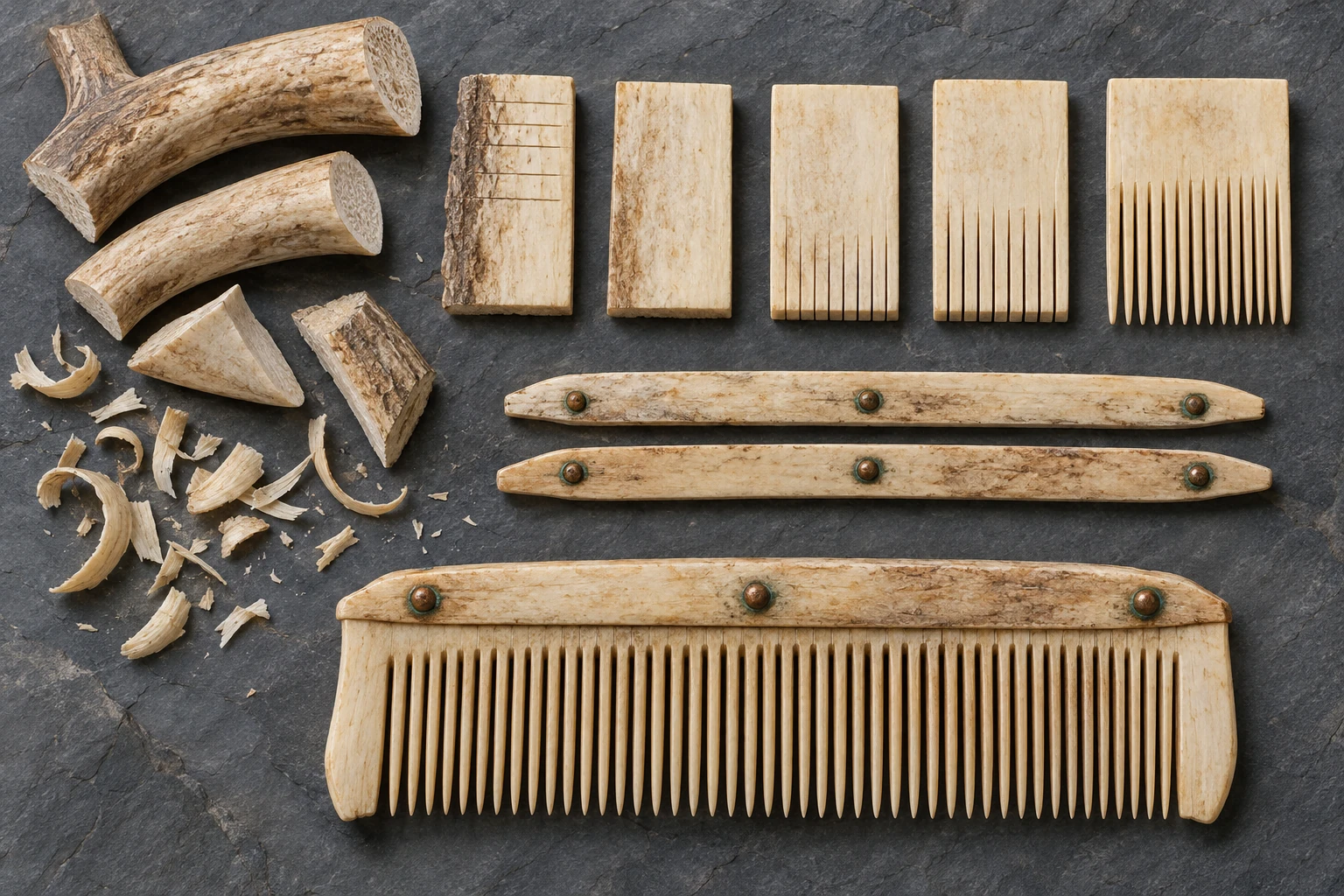
Antler fragments, stages of comb production, connecting plates, and a completed composite comb arranged on a dark surface.
Conceptual craft illustration. The arranged stages are not excavated Ribe finds or a measured production diagram.

A finished comb is a personal object. The scraps left beside a comb-maker’s bench can describe an entire trading world. At Ribe in Denmark, fragments of antler, unfinished pieces, and discarded manufacturing waste help archaeologists separate two journeys that can look identical in a display case: a finished object arriving from elsewhere, and raw material arriving to be worked locally.

That distinction makes the waste unusually valuable. An imported comb proves that a comb moved. A scatter of antler offcuts can show that a material moved and was transformed at its destination. The scraps put a workshop back into the story.

Why a comb is not simply a carved outline

Early medieval composite antler combs were assembled objects. The 2015 study by Steven Ashby, Ashley Coutu, and Søren Sindbæk investigated combs, manufacturing waste, and raw antler from Ribe, Aarhus, and Aggersborg. The research concerned the supply networks behind a specialized urban craft, rather than treating attractive finished objects in isolation.

A useful way to look at a composite comb is to follow its joins. Where are the tooth plates? What holds them together? Do the cuts and rivets suggest a sequence of work? The answers depend on the actual object, but the questions draw your attention away from decoration alone. A comb embodies decisions about material thickness, assembly, and the danger of breaking a small tooth during manufacture or use.

The University of York’s Combs and Communities project places production and consumption together. That pairing matters: a craft object belongs both to the person making it and to the people who chose, carried, maintained, and eventually discarded it. Neither side of that relationship is fully recoverable from a pretty silhouette.

When a fragment stops looking like an animal

Once antler has been cut, smoothed, and worn, identifying its source animal by eye can become difficult. The 2015 investigation used ZooMS, a method of species identification through peptide mass fingerprinting. In accessible terms, surviving protein information offers another route to identifying material after its recognizable anatomical shape has been removed.

The study documented reindeer antler in Danish town assemblages by the 780s at the latest. Reindeer material connects those workshops with a supply area beyond Denmark. The Aarhus UrbNet research report stresses the implication: the activities sustaining an urban workshop need not all occur within the town. A resource landscape far away can be part of the town’s practical life.

It is tempting to draw one confident arrow on a map and label it “the route.” The identification itself does not supply that complete itinerary. Material could pass through several hands. A species identification is evidence about the substance, while a reconstructed journey requires additional reasoning about habitats, dates, other finds, and transport.

A later study makes the sequence sharper

A 2023 study of Ribe material dated 720–900 CE combined biomolecular approaches with archaeological context. Early combs made from non-local reindeer and moose antler could be distinguished from evidence for later local working of imported material. Reindeer appeared among workshop debris from the middle of the eighth century in the studied sequence. The authors also reported limits: insufficient preserved DNA prevented a finer geographic attribution of one reindeer comb.

That result is more interesting than a claim that “science proved where the Vikings came from.” It describes changes in the movement of objects and resources. It also shows different methods doing different jobs: an archaeological layer places a find in a sequence; protein or DNA helps identify material; the distribution of working debris helps identify an activity.

Three finds, three different claims

What you findWhat it can supportWhat it cannot establish alone
A finished comb of non-local antlerMovement of the object or its materialThe exact workshop or every stop on its journey
Offcuts from the same animal speciesWorking of that material near the deposit, subject to contextThe identity or origin of the craftworker
Finds in carefully recorded successive layersA changing local sequenceEvery event between the surviving deposits

This table is a reading aid, not a catalog of specific Ribe specimens. Use it to test the wording of an archaeology headline. Does the evidence concern raw material, manufacture, a finished object, or the movement of a person? Those are not automatically the same story.

Count the joins before counting the teeth

Two Coppergate records offer a useful close comparison with the Ribe evidence. York Archaeology catalog 7557 describes an incomplete single-sided antler comb with six surviving tooth plates, two side plates, two surviving iron rivets, and detached components. Catalog 7583 records eight surviving tooth plates and five surviving rivets in another incomplete comb. The objects are dated differently in the catalog. Neither is a Ribe find, and neither should be inserted into Ribe’s stratigraphic sequence.

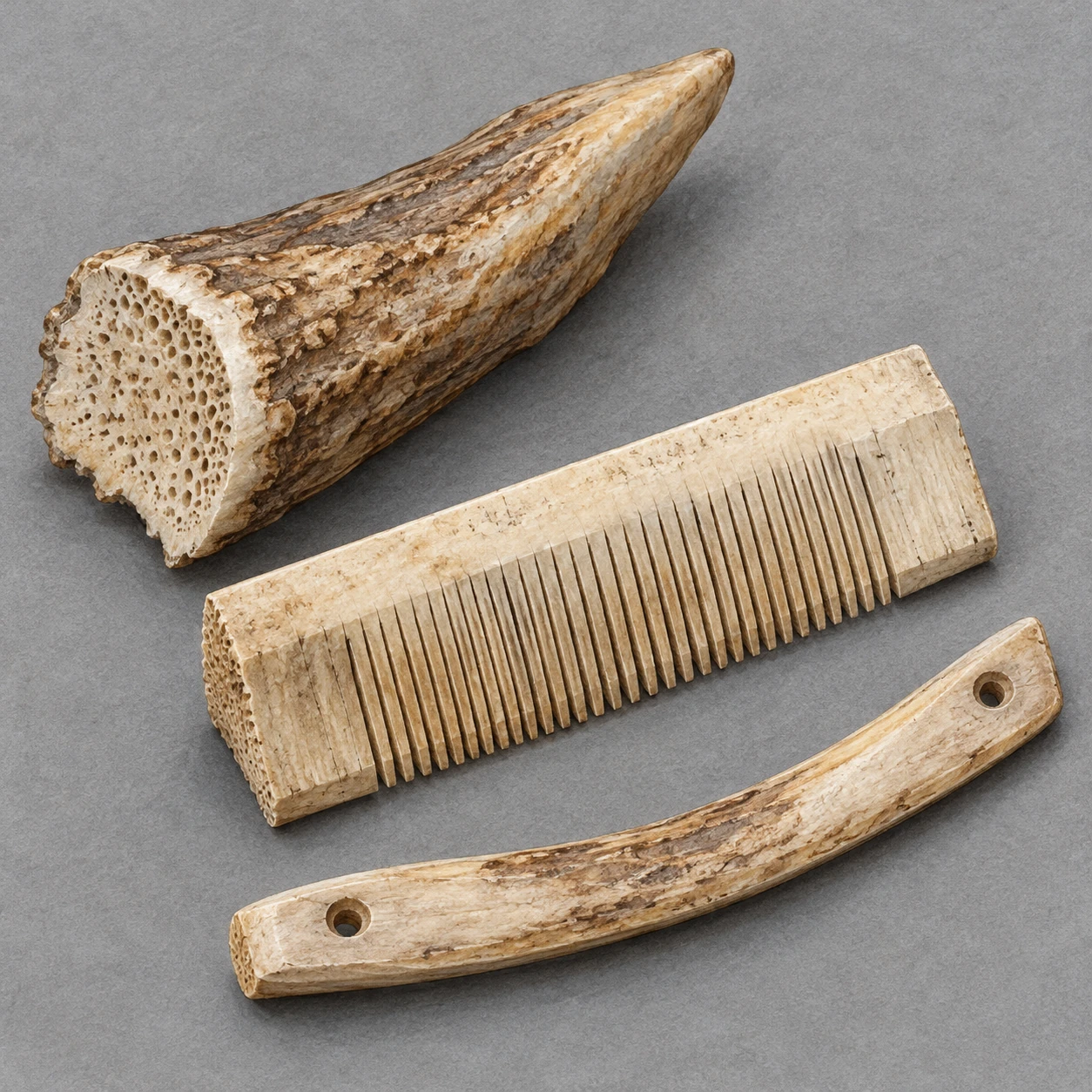
Antler offcut, tooth-plate blank, and drilled backing strip arranged as a craft material study.
Interpretive component study, not excavated Ribe or Coppergate finds.

The value of the comparison lies in the word “surviving.” Six plates are six that can be counted now. They are not automatically the original total. The same applies to rivets. An inventory of what remains and a reconstruction of what once existed answer different questions, even when the numbers appear in adjacent sentences.

Open the first record and find the side plates in the photograph. These longer pieces gather shorter tooth plates into one object. Instead of following the comb’s decorative outline, follow the interfaces: plate against plate, antler against iron, tooth against gap. The finished implement distributes a repeated task across an assembly. Damage can make that assembly easier to notice than a complete, polished example does.

Here is a small evidence task with an answer you can test. Suppose a fragment has regularly spaced tooth cuts and a broken end. A second fragment has a smooth curved face and a rivet hole, but no teeth. Can the two fragments come from one category of composite object? Yes: different components perform different jobs. Can they be assigned to the same individual comb from that description alone? No. Shape, fit, dimensions, context, and perhaps material analysis would be needed to argue for a specific connection.

Now inspect the catalog’s detached rivet and teeth. Give each a sentence beginning “This can show…” and another beginning “This cannot establish alone…”. A loose tooth may help describe manufacture or damage. It cannot supply the owner’s name. A rivet documents fastening material; its existence does not date every nearby scrap to the moment it was installed.

This way of looking brings the workshop and the consumer closer without giving them invented biographies. A comb is both a designed assembly and an object with a later history of wear, breakage, loss, excavation, and cataloging. Every join belongs to the first story; every missing component raises a question about the second.

The floor is another kind of archive

The Northern Emporium project’s geoarchaeological work studied undisturbed soil blocks in thin section and chemical variation across occupation deposits. These approaches examine how a floor or layer formed and what activities may have contributed to it. A concentration of objects becomes more useful when the deposit around it is understood.

For your next museum visit, try spending two minutes with the least glamorous material in the case. Look for a broken mould, a sawn end, a failed casting, or a rough blank. Ask what stage of work it represents and which missing stages it implies. A polished artifact may show an achievement. A discarded fragment can reveal the system that made repeated achievement possible.

There is another productive question: what has not survived? A comb-maker’s work involved more than antler. Time, teaching, exchange, maintenance, and the gestures of a practiced hand are largely absent from the scraps. Even the distribution of debris can change when a floor is swept or a deposit disturbed. A careful interpretation therefore asks how material entered the ground, not simply what object category it resembles.

Try rewriting one confident headline as three sentences: the observation, the inference, and the remaining question. “Reindeer material occurs here” is an observation supported by identification. “It arrived through a supply network” is an interpretation of movement. “Who organized that supply?” is a question the material may help investigate without settling on its own. The rewritten version loses a little drama and gains a great deal of usable history.

Sources and a closer look

Ashby, Coutu and Sindbæk, 2015 research record; University of York: Combs and Communities; UrbNet 2015–2016 report: biomolecules and urban networks; Rey-Iglesia and colleagues, 2023: Antlers far and wide; UrbNet: microscopic research on Ribe deposits.

Find more art, ideas, and unexpected connections at Incoprea.

Famous Last Meals is now in paperback — stories, history and 25 recipes

Famous Last Meals: Stories, History, and Recipes is now available in paperback on Amazon. The illustrated collection brings together 23 his...