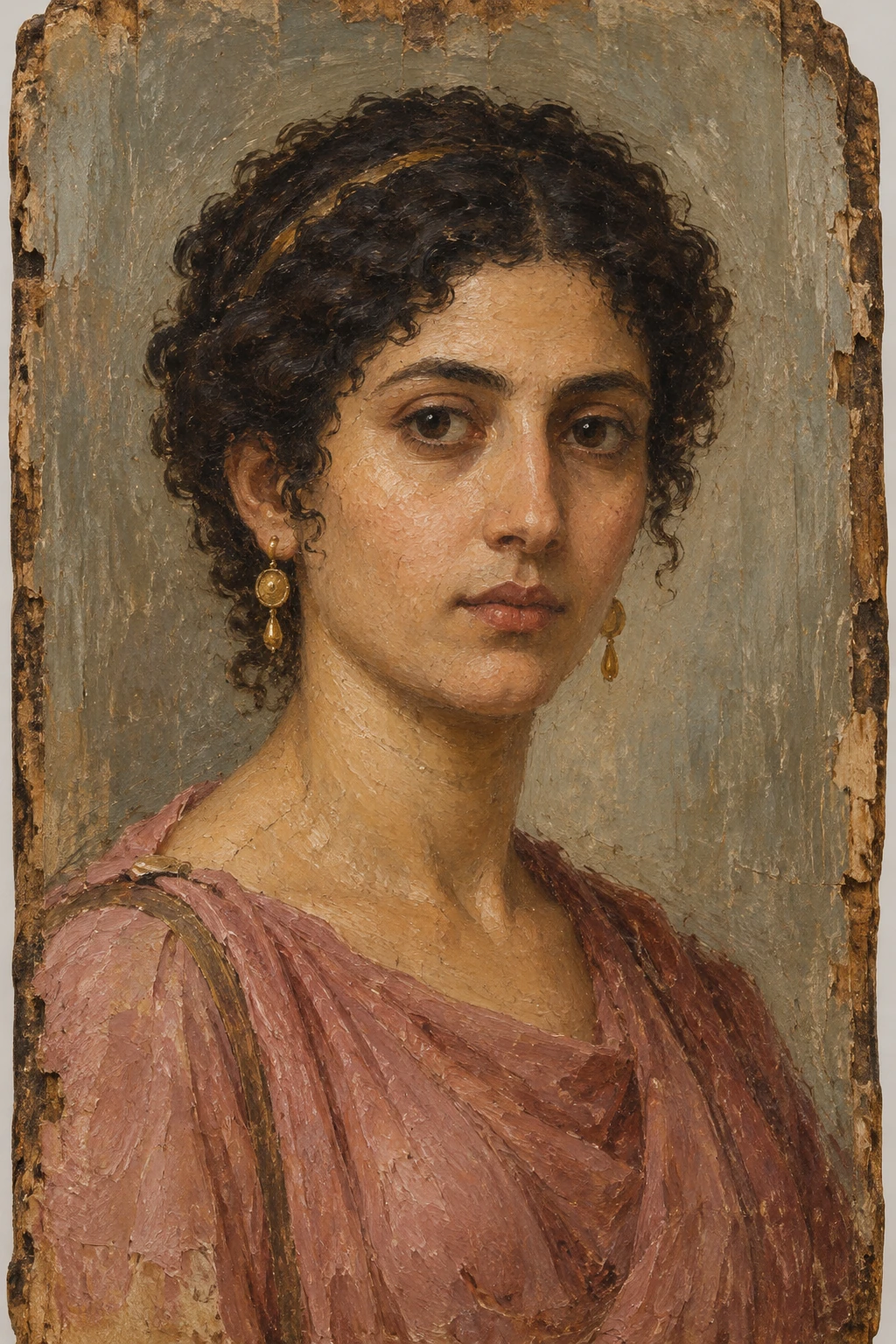
Start with the edge. A face may draw you in, but the narrow wooden panel tells you that this was never simply a painting floating free of a body, a burial, or a community. Roman Egyptian portraits can seem startlingly close to us. Their original purpose makes that closeness more complicated.
The label “Fayum portrait” is familiar, yet it can encourage the misleading idea of one place, one technique, or one population captured in a single style. The Met's Ancient Faces account describes a broader funerary painting tradition in Roman Egypt, especially from the first through third centuries CE. Wood panels, linen paintings, masks, and other coverings belong to that larger picture.
Follow the paint, then the support
Encaustic is painting in a wax-based medium. Tempera is a different broad category, and a label using that word should not automatically be translated as the egg tempera familiar from later European painting. The useful first step is to read the actual medium description for the object in front of you. A brush mark is evidence of handling, not a complete recipe.
The Ashmolean identifies one male portrait as encaustic on limewood, dated 138–161 CE. That is a specific support and date range for a specific panel. It does not mean every portrait used the same wood, binder, or production sequence. Differences are part of what make comparison worthwhile.
Look at a highlight on a cheek, a dark curl, and a pale background. Ask whether the painter built the effect through broad strokes, small touches, a sharp boundary, or a transition. You can describe those visible choices without assigning the sitter a temperament. “The eyes are large and directly addressed” is an observation; “this person was anxious” is an imaginative interpretation.
A portrait still in its setting changes the question
The Met's object 11.139 preserves a portrait panel still positioned over the face of a wrapped person. The museum dates it to 80–100 CE and records its excavation at Hawara. Its sitter's name is unknown. Those facts provide a stronger anchor than guessing an identity from the painted features.
The full object restores a relationship that a cropped reproduction removes. Panel, wrapping, and body were arranged together. A portrait in this setting participated in a funerary practice; it was not only an exercise in resemblance. Looking at the complete record also asks us to remember that the subject is a deceased person, not an anonymous design resource.
Clothing, hairstyle, jewelry, painterly modeling, and Egyptian burial practices can coexist. They do not divide neatly into one “Greek” half and one “Egyptian” half of a person. Style is not a genetic test, and a hairstyle is not a passport. The more convincing historical question concerns how people used several cultural resources in the world they actually inhabited.
What technical images add
Getty's APPEAR project brings together research on materials, construction, provenance, and workshop practices. Its example of macro-X-ray fluorescence imaging maps the distribution of lead-based pigments across a portrait. A colored analytical map is a different kind of image from a visible-light photograph: its colors are a key for data, not the ancient painting's original appearance.
This distinction helps you read conservation stories with more confidence. A map can suggest where a material occurs. Identifying a workshop, a painter, or a sequence of decisions usually requires several kinds of evidence. The strongest result is not necessarily the most dramatic hidden picture. Sometimes it is a better account of an ordinary preparation layer.
Try a portrait comparison without guessing a personality
Open the Ashmolean gallery record and the Met's complete portrait mummy. Make two short lists. Under “visible,” record support shape, color boundaries, surface marks, and the relationship to wrapping. Under “documented,” record dates, excavation information, and materials. Leave a third space for questions you cannot answer. Do not move an appealing guess into the documented column just because it feels plausible.
A useful final check is to change the scale. First view the face large enough to see the paint. Then view the whole panel. Finally, if the record allows it, view the complete funerary object. Each view makes a different set of facts easy to notice. None is a replacement for the others.
The portraits' power does not depend on pretending they are photographs. Their surfaces preserve acts of selection, skilled painting, and remembrance. Taking the material and funerary setting seriously allows the face to remain vivid while keeping the person beyond our easy claims.
Sources and further exploration
- Ancient Faces: Mummy Portraits from Roman Egypt
- Ashmolean: Egypt meets Greece and Rome
- Getty APPEAR Project
- The Met: Mummy with an Inserted Panel Portrait of a Youth
- Getty: technical studies of mummy portraits
Explore all 80 new articles · Browse the complete illustrated collection
Continue exploring art, ideas, and unexpected connections at Incoprea.