A cast metal object can preserve a shape whose first version no longer exists. In lost-wax casting, wax gives the maker a workable surface. Heat removes it. Metal takes its place. The mold then has to be broken so that the object inside can emerge.
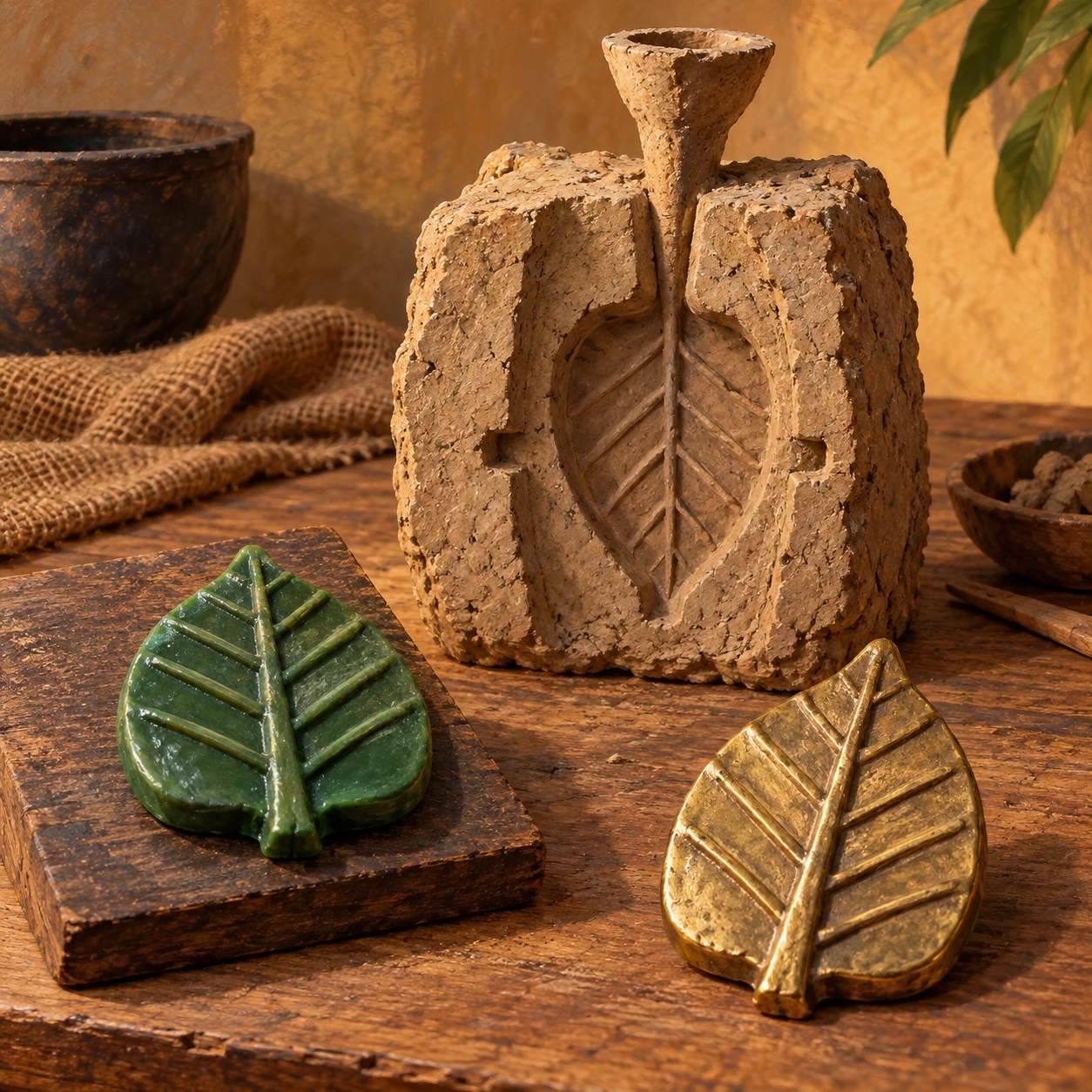
That sequence is easy to summarize and difficult to carry out well. In Benin City, in present-day Nigeria, brass casting belongs to a living tradition of skilled makers, court institutions, and inherited knowledge. Treating it as a mysterious ancient trick misses the people who understand the work.
Watch the changes of material
The Art Institute of Chicago's museum archive presents a film of casting in Benin City, documented in 2003 and 2006. Its explanation follows a wax model built over a clay core, an enclosing clay investment, heating to remove the wax, and the introduction of molten metal. Breaking away the cooled mold reveals the cast form.
As you follow the sequence, notice the reversals. A positive wax surface becomes the boundary of a negative space. That space then shapes metal. The outer mold must withstand a process that is meant to destroy its usefulness as a mold. A successful casting depends on coordinating these temporary roles, not simply on pouring a liquid into a hole.
A concise description cannot supply the judgment involved in preparing materials, arranging channels, or responding to local working conditions. The museum film is valuable because it returns the explanation to makers and movements. It also gives a date and place: it documents a particular instance of practice, rather than providing an unchanging picture of every Benin workshop across centuries.
The surface can retain part of the process
Conservation research sometimes changes what a viewer thinks the surface is. In Ellen G. Howe's account of the Horn Player at the Met, reddish material in recesses proved more interesting than loose dirt. Analysis identified iron-rich clay with evidence of heating, supporting the interpretation that it was surviving investment from casting.
That does not settle every question about why the material remained. Howe distinguishes the material evidence from possible reasons for retaining it. A technological identification is not automatically an explanation of intention. The possibility that a residue contributed to appearance or significance deserves attention without being promoted into a proven rule for all objects.
This is a good habit to bring to any museum surface. Ask whether you are seeing the original material, a working trace, corrosion, a later repair, a coating, or a mixture. “Clean metal” is not a neutral goal if removing something would erase historical information. Surface treatment can change the questions an object remains able to answer.
Technique does not explain the whole object
A cast head, a palace plaque, and a figure need not have the same role because they share a manufacturing method. The Met's record for a head of an oba connects that form with royal ancestral commemoration and palace altars. The depicted head is therefore more than an opportunity to admire casting skill. Its meaning belongs to an institution and a relationship between rulers and ancestors.
Likewise, the familiar collective term “Benin Bronzes” should not make us careless about materials. Museum records often identify particular objects as brass or use the broader term copper alloy. Read the actual material field. A conventional group name is not a laboratory result.
A close-reading route for one object record
- Identify the named maker or guild, where recorded.
- Separate the object's date from the date it entered a collection.
- Find the material description rather than relying on the title.
- Look for an account of use, not only an account of appearance.
- Read the provenance as part of the object's history.
Follow the later journey too
The British colonial military attack of 1897 resulted in extensive looting of Benin City and its palace. Digital Benin connects dispersed objects with provenance records, including military participants, dealers, collectors, and institutions. Those records help reconstruct how objects were separated from the settings in which they mattered.
An account that ends at the moment of casting stops too early. So does an account that begins when a museum acquired the work. Looking at both histories lets us appreciate technical accomplishment without detaching it from authority, violence, continuity, and the knowledge of living makers.
Sources and further exploration
- Art Institute of Chicago: Lost Wax Brass Casting, Benin City
- The Met: Recovering the Brilliance of a Benin Bronze
- Digital Benin: Provenance
- The Met: head of an oba
Explore all 80 new articles · Browse the complete illustrated collection
Continue exploring art, ideas, and unexpected connections at Incoprea.