A face in a Roman Egyptian portrait can contain blue even where it looks like warm flesh. A marble sculpture can retain pigment too faint to notice in ordinary light. Egyptian blue makes these discoveries possible because its material identity has a second, invisible signature.
When illuminated appropriately, the pigment emits near-infrared light that suitable imaging equipment can record. The resulting image is more than a spectacular effect. It helps researchers move from “this surface once had colour” to questions about where paint was placed and how an artist used it.
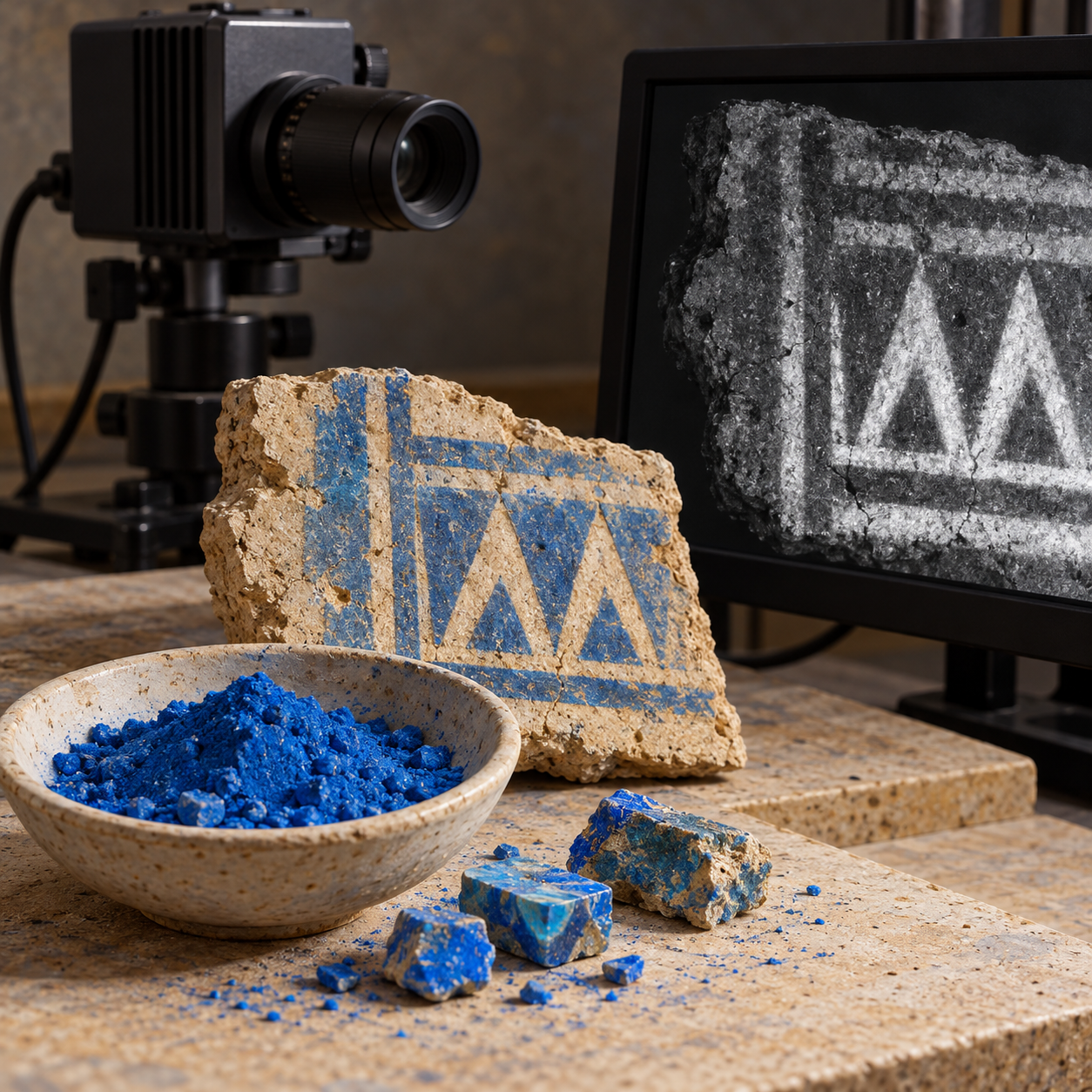
Blue is an appearance; pigment is a material
Egyptian blue is a manufactured calcium copper silicate pigment, associated with the crystalline compound cuprorivaite. Its preparation required heat and controlled material processing. It is widely described as the earliest known synthetic pigment.
The name does not limit its use to Egypt. It circulated within a wider ancient world, and a modern catalogue can identify it in works from different locations and periods. Nor does finding the material guarantee that the surface looked bright blue. Small particles can be mixed into other colours.
This distinction changes the question a reader asks of an artwork. “Where is the blue?” searches for a visible hue. “Where is Egyptian blue?” asks where a particular material occurs, including places whose overall colour is something else. Scientific imaging can make the second question practical.
How the invisible signal becomes a picture
Visible-induced infrared luminescence imaging, commonly abbreviated VIL, uses illumination to provoke an emission outside ordinary human vision. A camera sensitive to the relevant near-infrared wavelengths records it while filters distinguish that emission from other light.
The resulting bright areas are a way of displaying recorded information. The ancient paint is not glowing blue to the naked eye, and the displayed brightness should not be mistaken for the original appearance of the artwork. It is an analytical view with a particular purpose.
Getty's discussion of the APPEAR portrait project also notes that images made by different teams are not necessarily directly comparable in brightness. Equipment, conditions and processing matter. The useful interpretation begins with the image's method and legend, rather than assuming every pale pixel means the same quantity of pigment.
A blue contribution to a woman's face
Stephanie Spence and John Twilley's study of a portrait at the Nelson-Atkins Museum of Art provides an especially engaging example. Their investigation combined luminescence imaging, elemental mapping and microscopy. The portrait depicts a woman with carefully modelled highlights and shadows.
Egyptian blue was identified in an underdrawing role and in mixtures used to modulate flesh tones. The face does not present obvious blue patches in those areas. Microscopic particles and corresponding analytical responses reveal the material's subtle contribution.
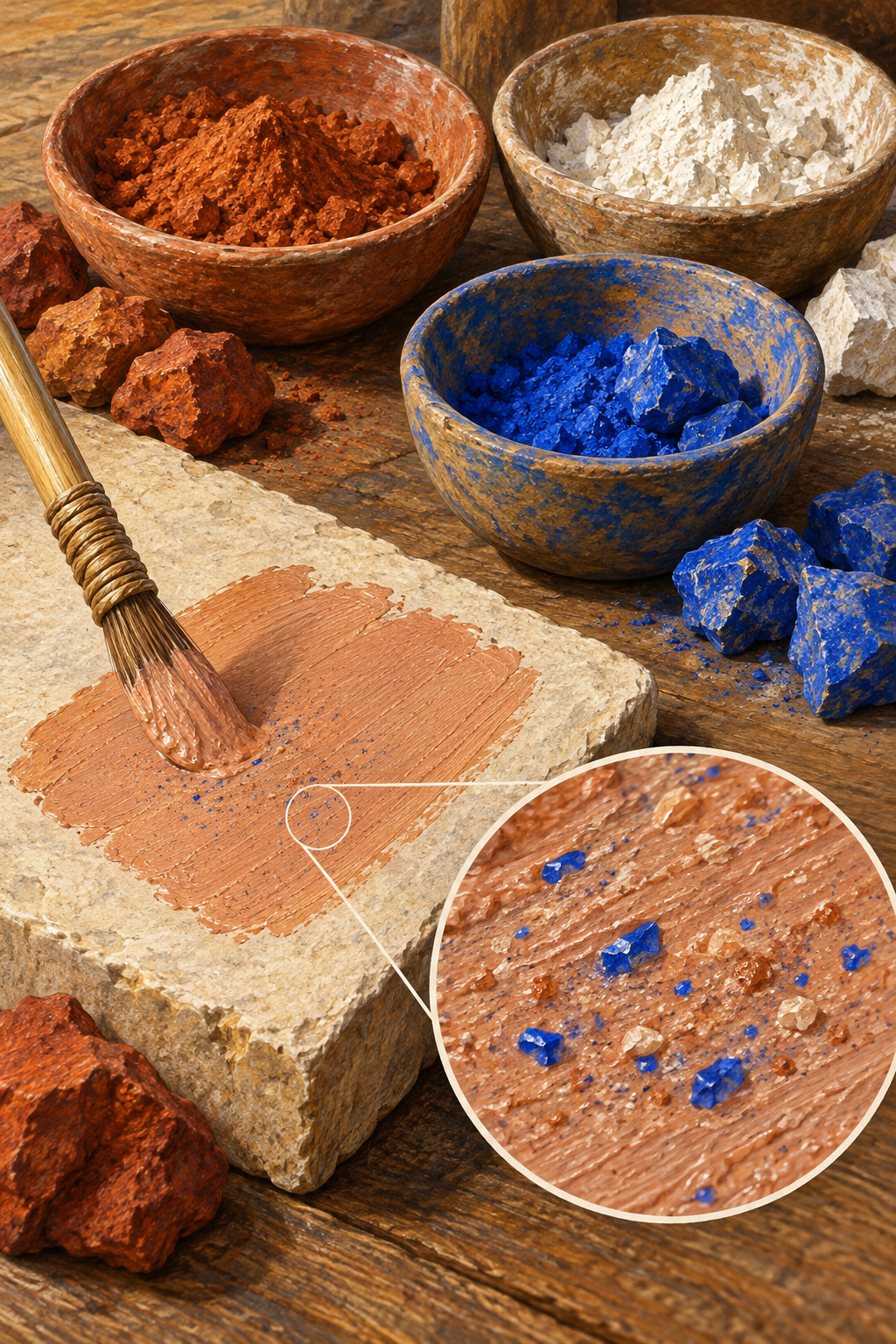
The conceptual particle illustration encourages a change of scale. In the Getty study, compare the ordinary portrait, the VIL image and the photomicrograph in figure 14.5. The real evidence lies in the relationship among those views, rather than in the explanatory inset here.
For an artist, a pigment can help a mixture achieve an effect without advertising itself as a separate colour. The research therefore recovers a decision about painting, not just an entry in a chemical inventory. A small amount can matter because of where and how it is used.
The surviving trace on marble
Research on the Parthenon sculptures provides a different scale of evidence. A 2023 primary study by Giovanni Verri and colleagues combines close examination of carving with analysis of colour traces, including Egyptian blue. It investigates the relationship between sculpted textiles and painted designs.
That is more specific than simply repainting every marble surface in the imagination. A detected trace can establish the presence of a material at a location. Reconstructing a whole garment's original design requires additional evidence about the distribution, surviving forms and comparison with other works.
Surface texture matters too. The study describes carving that differentiated materials such as skin and fabric. Painting and sculpting were parts of the finished effect. Modern white marble is therefore not a neutral window onto every aspect of the ancient object's appearance.
A three-view investigation
Open the Nelson-Atkins portrait study. Choose one small area, such as the region beneath an eye or part of the neck, and follow it across the published views.
- In visible light, describe the colour and modelling without using the material name.
- In the VIL image, identify the corresponding location and inspect the response shown there.
- Read the microscopy and elemental-map discussion. Which additional observations support the pigment identification?
The sequence keeps observation ahead of conclusion. It also explains why several techniques can be more informative together. An elemental map indicates the distribution of an element; a luminescence response concerns a material's optical behaviour; a microscope can reveal particles and their context.
Now reverse the journey. Return to the visible portrait and look at the same area again. Its appearance may not change, but your account of the artist's choices has. You know that a seemingly straightforward skin tone can contain a carefully judged mixture.
More than hidden colour
Egyptian blue connects making and examining. Ancient craftspeople controlled materials to produce a useful pigment; modern researchers use its properties to find evidence that ordinary viewing misses. Neither achievement requires turning the material into a magical secret.
The most rewarding discovery is often a relationship: blue within flesh, a pigment trace on carved cloth, a particle linked to a brush decision. The signal beyond sight matters because it returns us to the visible work with better questions about the person who made it.




