Two photographs can make the Lycurgus Cup look like two different objects. In one, the glass is green and difficult to see through. In another, it is a translucent red. Before looking for a second cup, follow the light. Has it returned toward the camera from the vessel, or traveled through the glass on its way there?
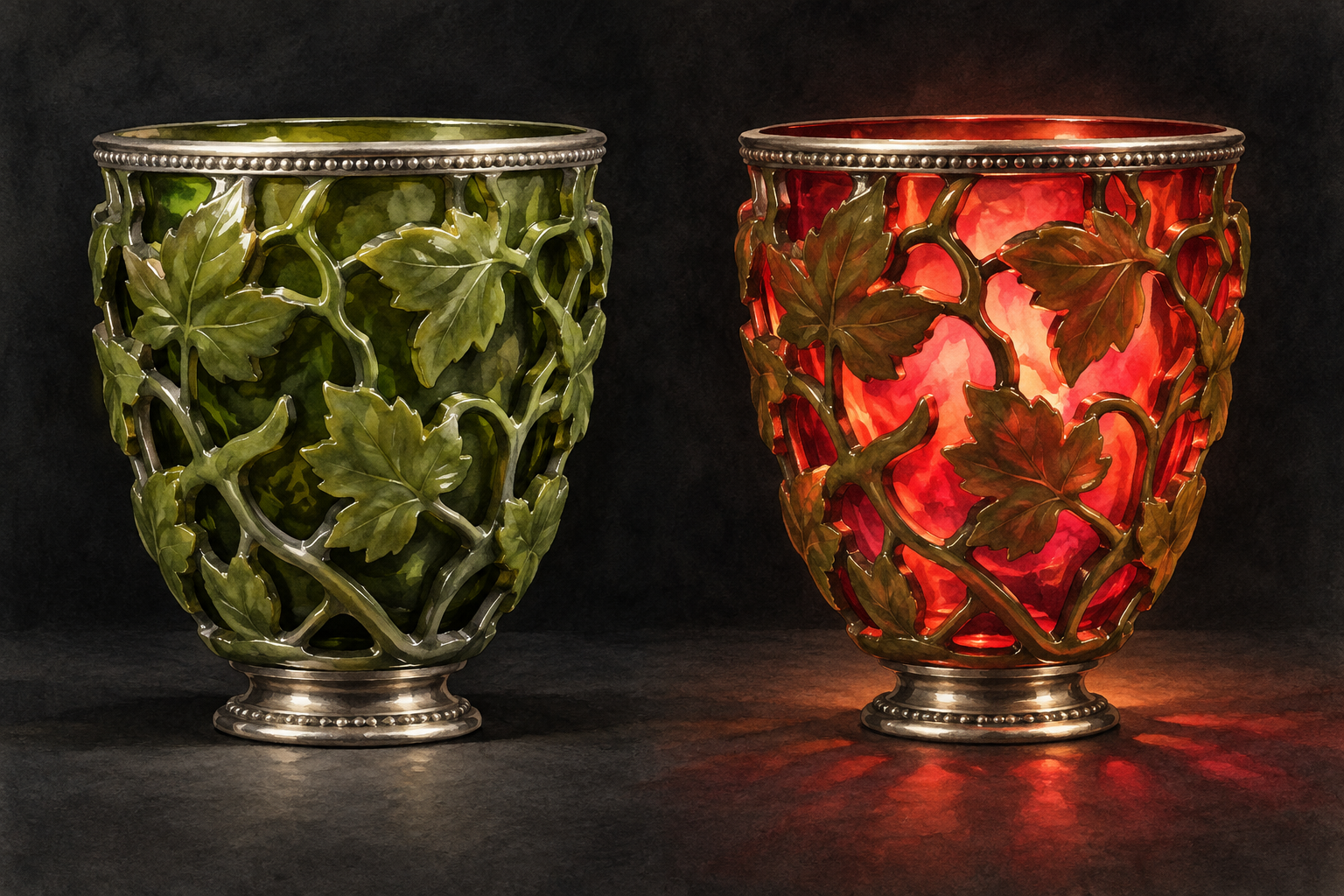
The fourth-century Roman cup makes color feel less like a possession and more like an event. Glass, illumination, and viewing position work together. Its optical effect is remarkable, but the carved object deserves equal attention: an outer world of figures and vines stands around a fragile vessel.
The light takes two different journeys
The British Museum’s record identifies the Lycurgus Cup as a Late Roman drinking vessel. Its glass appears green in reflected light and red when light passes through it. This behavior is called dichroism.
In a reflected-light view, much of what reaches your eye has been returned from the object. In a transmitted-light view, illumination reaches you after passing through the glass. Those are different selections from the light interacting with the material. Moving a lamp can change the appearance without the object changing its chemical composition on command.
The cup is not producing light by itself. Nor does every colored glass object show this particular green-to-red effect. The useful first question is more concrete: where are the light source, the object, and the observer in this view?
Small particles, large consequences
In their 2007 scientific study, Ian Freestone, Nigel Meeks, Margaret Sax, and Catherine Higgitt discuss the investigation of the glass and its manufacture. Electron microscopy revealed minute metal particles, typically about 50–100 nanometres across. Analysis identified particles containing a silver–gold alloy, with copper also present.
The particles’ interaction with light helps explain the different appearances in reflected and transmitted illumination. Their size and composition matter; the optical behavior is not the same as placing a small lump of ordinary gold behind clear glass. A material’s arrangement can change the way we encounter its ingredients.
This is also a lesson in how explanations develop. Identifying elements in a sample is one kind of evidence. Showing how those elements are distributed, including whether they form tiny particles, answers another question. A list of ingredients does not completely specify a glass’s structure or appearance.
Two kinds of knowledge belong to different histories
The scientific description uses modern concepts and instruments. The surviving cup demonstrates an ancient material and an extraordinary level of working skill. Those facts do not establish that its makers held a modern theory of nanoparticles.
A craftsperson can learn what conditions produce a useful result before a later investigator explains every physical process. Repeated practice, comparison, material judgment, and a successful working sequence are forms of knowledge. Their value does not depend on whether the maker would recognize a modern scientific term.
Smithsonian’s Museum Conservation Institute indexes Robert Brill’s earlier research on the chemistry of the cup, including the relationship between its colors and reproducing that behavior. The record is a reminder that the scientific account has its own history of questions and experiments. Explaining an ancient achievement is continuing work, not a single moment when the object stopped being interesting.
Follow a vine as carefully as a color
The museum-authored account accompanying the cup’s digital image describes a thick glass blank worked by cutting and grinding. Much of the surrounding material was removed until figures stood in high relief, some joined to the vessel through small bridges. This openwork construction gives the object another kind of complexity.
Imagine working backward from the finished surface. The open space around a figure was once occupied by glass. Removing it had to preserve the vessel and the connections supporting the decoration. Looking for those connections makes patient craft visible where a quick glance might register only an elaborate silhouette.
The museum’s gallery guide relates the scene to the myth of Lycurgus, who attacks Dionysus and his followers. Ambrosia becomes a vine that traps him. The figure entangled in vegetation is therefore part of a narrative, not just a decorative reason to fill the surface with leaves.
Examine one connection between a figure, vine, and cup wall in the museum image. How does it serve the picture, and how does it help the fragile structure remain one object? The same detail can do visual and physical work.
Make a record of the light before describing the color
Use the museum’s digital image and the photographs in the scientific paper to explore the object. For each view, record three things: the apparent glass color, the visible direction of illumination if it is supplied, and the feature of the carving you are following.
| Question | What to notice |
|---|---|
| What reached the camera? | Does the source identify reflected or transmitted light? |
| What stays recognizable? | Follow the same figure or vine even when its color looks different. |
| What remains uncertain? | Do not infer an exact lamp position or material measurement from a photograph that does not provide it. |
The repeated feature anchors your comparison. It keeps a dramatic color difference connected to one physical object. If a caption gives the lighting arrangement, keep that information beside your observation rather than letting the image circulate as an unexplained curiosity.
You can practice the first distinction with an ordinary empty colored drinking glass near a window. Look at the glass with the bright window behind it, then with room light returning from its surface. Notice which reflections and details become easier to see. This does not reproduce the Lycurgus Cup’s special dichroism; it isolates the difference between looking through glass and looking at returned light.
A powerful object can survive its explanation
Knowing about the particles adds a scale of attention the eye cannot reach on its own. Looking at the carving adds a working history that a particle measurement cannot supply. Both enlarge the encounter rather than reducing it to a trick.
Return to the two colors with which you began. The question is no longer simply why a cup changes color. It is how one material can select different light for different viewing paths, and how people turned that material into a demanding piece of sculpture. The ancient object and the modern investigation remain remarkable for different, connected reasons.
Look at another optical material
Explore a biological reflector in A Reindeer’s Reflecting Eyes Change With the Season. For another kind of colored-light encounter, browse Stained Glass: 30 Artists to Discover.
Explore more art, ideas, and independent projects at Incoprea.




