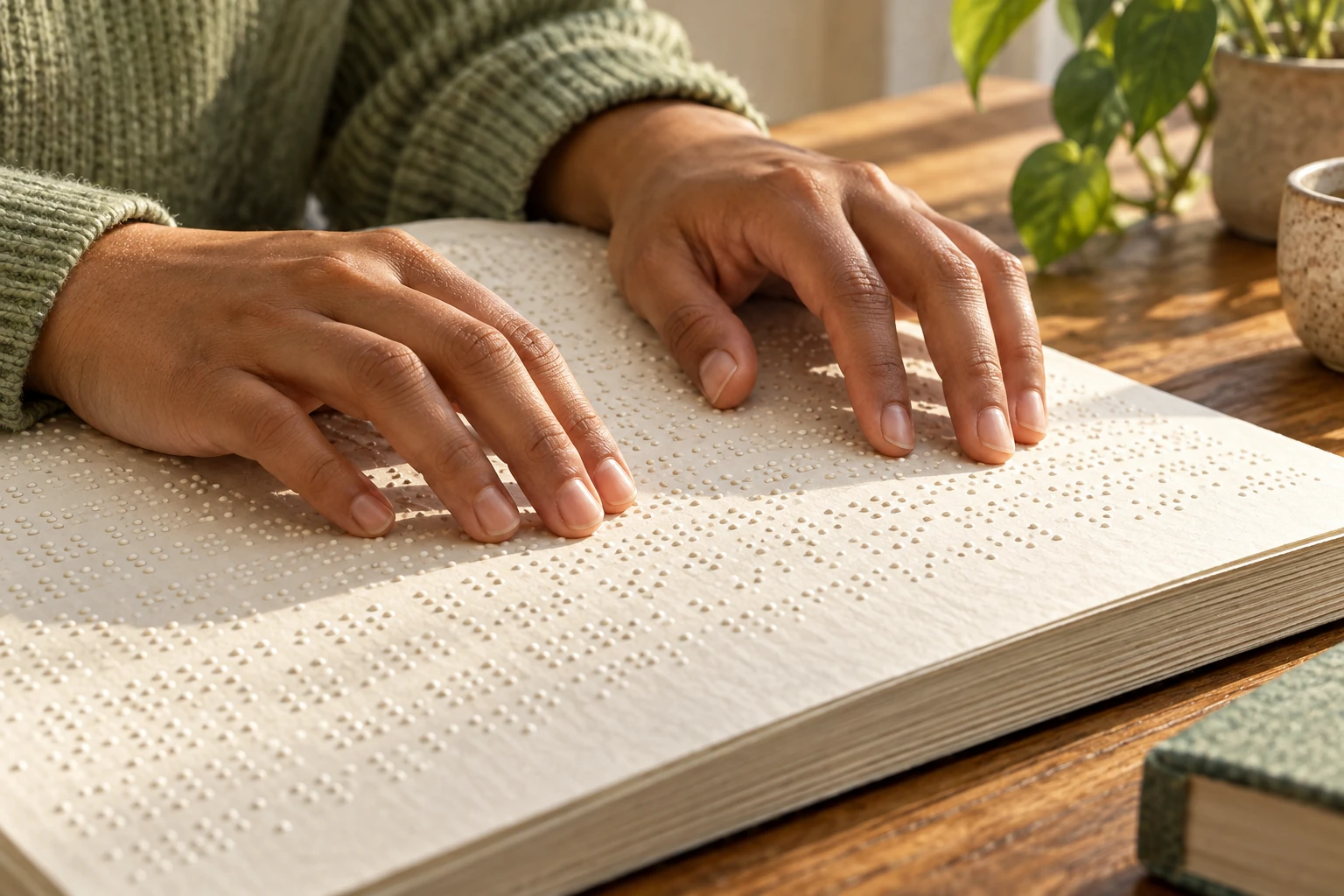
A fingertip pauses over a raised dot. Another fingertip moves through a line. Both touch the page, but only the second action begins to suggest how skilled braille reading works. The reader gathers changing tactile information through movement, while language and hand coordination give that information a useful structure.
It is easy for a sighted observer to focus on the visible dot pattern and miss the activity that makes it readable. Braille is a writing system, not a test of whether someone has unusually sensitive skin. Its use combines learned symbols, material standards, movement and comprehension.
A small cell opens a large design space
The Library of Congress exhibition shows six-dot cells arranged in two columns, along with slates, styli and braillewriters. A cell's positions are conventionally numbered 1,2,3 down the left and 4,5,6 down the right. Patterns of present and absent dots can carry different meanings within a braille code.
Six binary positions offer 2×2×2×2×2×2=64 possible patterns, including the blank. That arithmetic is a design-space count, not a promise that all 64 patterns simply equal 64 letters. Context, indicators and contractions can extend what a system expresses. Different language and technical codes use the available patterns according to their own rules.
A visual drawing can help a newcomer understand the arrangement. It cannot reproduce the tactile experience of properly embossed material. A printed imitation made from dark circles is still ink on a page. Even handmade raised dots need appropriate dimensions and consistency to function as reliable reading material.
Reading changes the signal reaching the skin
In a 2021 longitudinal study, Tetsushi Nonaka, Kiyohide Ito and Thomas Stoffregen recorded the reading-finger movements of eight congenitally or early blind children over twelve months. They related features of movement variability and finger orientation to reading performance. The findings concern an active process, not just a stationary fingertip's resolution.
The sample is small and the relationships do not establish one ideal motion that every reader should copy. They do show why treating movement as incidental would miss measurable aspects of performance. Which part of the fingerpad contacts the dots, how that contact changes, and how the reader advances all belong in the question.
Think of a ridged surface under a moving fingertip. Its spatial pattern becomes a sequence of changing skin deformation. Vary the movement and the temporal input changes too. This is an explanatory analogy, not a substitute for a braille lesson: skilled reading adds learned linguistic structure and practiced strategies that an unfamiliar texture lacks.
Sensitivity is only one part of the account
Van Boven and colleagues' study of tactile spatial resolution measured fingertip acuity in braille readers and comparison participants. It reported enhanced spatial acuity in the tested blind braille readers and discussed experience-related adaptation. That is useful evidence about a measured tactile task, but it does not reduce reading ability to a single acuity score.
Reading a sentence involves recognizing symbols, preserving order, interpreting contractions and understanding language. A fingertip could distinguish a small pattern without its owner knowing what it means. Conversely, a reader's expertise includes managing uncertainty and using context rather than treating every character as an isolated object.
Research on the kinematics of the reading finger also examines language and perceptual-motor contributions together. Its framing helps avoid an unhelpful split: movement is neither a purely mechanical conveyor belt nor a direct transcript of every linguistic operation.
| Question | Kind of evidence needed |
|---|---|
| Can a fingertip distinguish nearby features? | A controlled spatial-acuity task |
| How does the reader scan? | Movement and contact measurements |
| What was understood? | A reading-comprehension task |
| Is the page usable? | Accurate material plus evaluation by braille readers |
Tools change the page, not the need for literacy
The Library of Congress collection includes the slate and stylus, a Perkins Brailler, musical material and tactile publications. These objects make a useful gallery trail: compare the action used to produce a pattern with the action used to read it. A machine's six keys do not mean its operator types a conventional printed letter with one matching key.
Contemporary refreshable displays can present changing tactile cells rather than an entire embossed page. That changes storage, navigation and interaction, but the core lesson remains: accessible output must preserve meaningful reading conditions. A visual designer cannot validate a tactile product by deciding that the dots look attractive on a screen.
The moving fingertip is doing more than receiving a sequence of bumps. It is participating in a practiced way of reading. Looking closely at that action replaces a story about extraordinary sensation with a more useful one about literacy, skilled movement and the material conditions that let a reader use a text.
Sources and a closer look: Library of Congress: braille objects and writing tools; Nonaka and colleagues: scanning movements in children; Van Boven and colleagues: tactile spatial resolution; Linguistic and perceptual-motor contributions to reading-finger motion.
Explore art, experiments and other unexpected connections at Incoprea.