The object seems almost too deliberate to remain unexplained. Twelve pentagonal faces enclose a hollow space. Circular openings pierce the faces, and small knobs project from the corners. You can picture someone holding it, turning it, and knowing exactly what to do next. The missing part is that person’s knowledge.
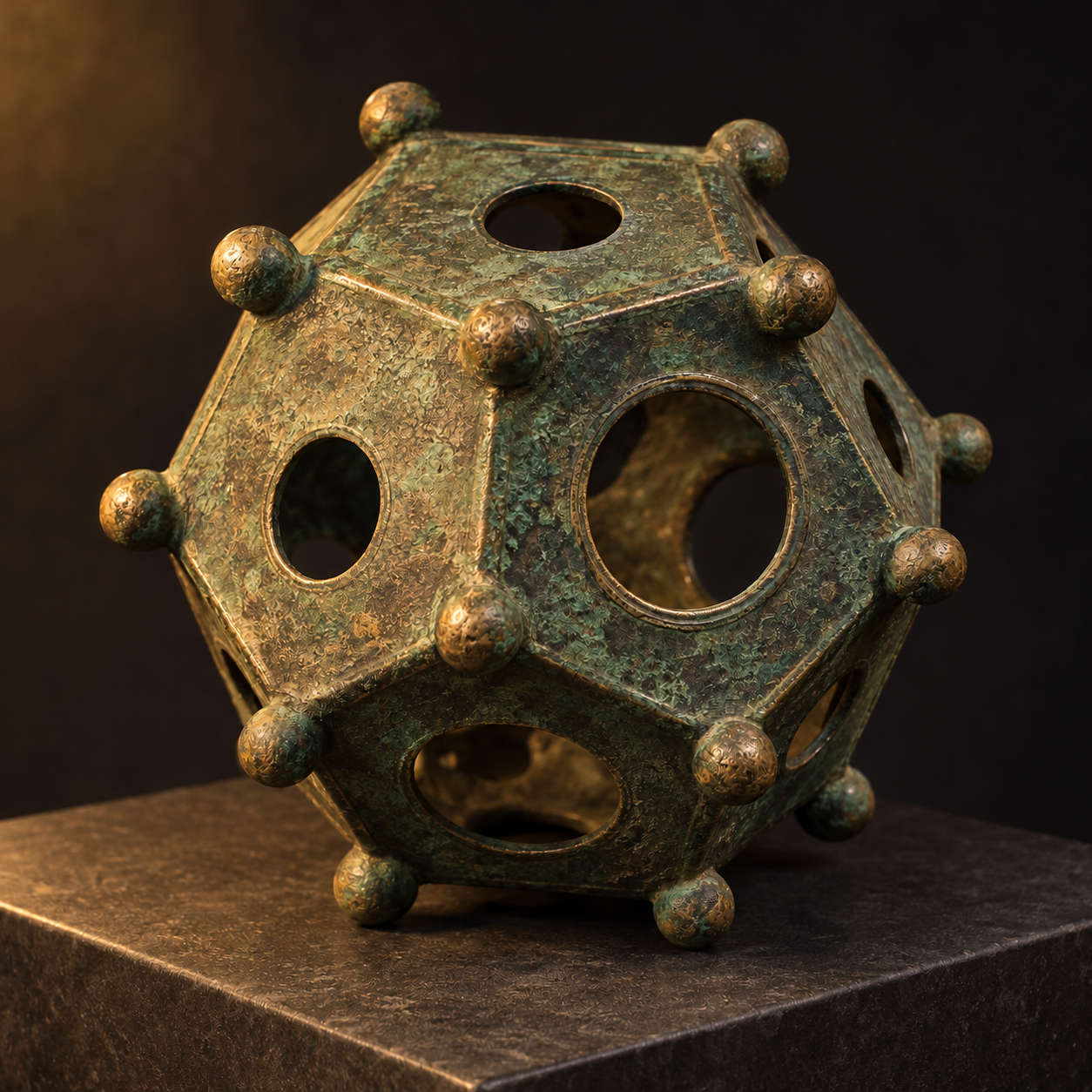
Roman dodecahedra are real copper-alloy artifacts, not a modern puzzle invented to frustrate archaeologists. Their recognizable form has outlived a securely established account of their use. That makes them a useful invitation to investigate: what can a measurement, a findspot, or a successful replica actually tell us?
One complete example comes with an excavation story
The Lincoln Museum account published in April 2024 describes a complete example found at Norton Disney in summer 2023. It places the object in the third or fourth century, gives its approximate height as eight centimetres, and records a mass of 245 grams.
The find emerged from a recorded excavation, not just an attractive object appearing without surroundings. The University of Nottingham Museum’s later exhibition account identifies the local archaeological group’s partnership with Allen Archaeology and places the site near a Roman villa and the Fosse Way. That exhibition ended in January 2026; its page remains a record of the investigation.
Location does not supply an automatic function. An object found near a road is not necessarily a road-measuring device, just as one found near a house is not necessarily a household tool. The setting gives researchers relationships to investigate, which become more informative when the deposits and associated material are carefully recorded.
Compare two actual records before choosing a theory
A second useful example is the British Museum’s Fishguard dodecahedron, registration 1924,0411.1. Its record gives an overall diameter of 127.71 millimetres and a mass of 553.20 grams. It also lists a range of aperture diameters, rather than treating every opening as identical.
| Record | Reported size | Mass |
|---|---|---|
| Norton Disney | About 8 cm tall | 245 g |
| Fishguard, British Museum | 127.71 mm diameter | 553.20 g |
Pause over the labels. Height and diameter are not automatically equivalent ways of measuring a knobbed object. The mass difference is clear, but a precise comparison of scale would require knowing how the dimensions were taken. Preserving the original labels makes the table more useful than silently placing both numbers in a column called “size.”
Now consider a proposed use. Does it depend on an object having one fixed weight, an easily held size, a particular arrangement of holes, or a consistent relationship between openings? Variation does not necessarily refute the idea. It does require the explanation to work with more than one convenient specimen.
A replica answers the question you build into it
Suppose someone makes a replica and uses it successfully for a craft task. You have learned that this replica can perform that task under those conditions. That can be a valuable experiment. It has not yet established that ancient makers designed the artifact for that purpose.
Look for the decisions the demonstration has added. Which dimensions were copied? Were worn or missing features reconstructed? What modern materials, tools, or motions were introduced? Does the proposed technique explain the inconvenient faces and knobs as well as the features the demonstrator uses?
An especially useful experiment makes a prediction before it begins. If a proposed use should create repeated contact at a particular edge, the next step is to inspect appropriate original surfaces for a matching pattern. If an interpretation depends on calibrated openings, compare their measurements across several objects. The proposal becomes more informative when it tells us what new evidence to seek.
“Ritual” also needs an argument
The Norton Disney account reports the excavators’ suggestion that the object may have been deliberately placed in a former pit. Religious or ritual significance has been considered. That is an interpretation of a deposit, not a surviving account of a ceremony.
Deliberate placement and practical use are also not simple opposites. An object can have a working life before being deposited for another reason. To understand its last setting, researchers need the relationships among the object, the pit, other finds, and the sequence in which material entered the ground.
For the same reason, calling something ritual should not mean that investigation stops. Repeated associations, distinctive placement, or comparisons with independently understood practices might strengthen a proposal. An elaborate imagined ceremony does not become evidence just because it explains the object’s strangeness.
Build a better museum label
Try writing a three-sentence label using the two records linked above. Give each sentence a different job.
- Describe: identify a feature someone can examine or a measurement supplied by the record.
- Locate: identify the particular object and what its record says about discovery or collection.
- Interpret: state one question or proposed explanation, making its status clear.
Then read your label again. Did “perhaps” quietly disappear from a theory? Did a photograph become evidence of a function you could not actually see? Did information about Norton Disney migrate into your description of Fishguard? Those small slips are how a neat story can become more certain than its source.
What would make the label more informative?
A good label lets a visitor distinguish an observed feature, a recorded fact, and an interpretation. It can be engaging without supplying a final function. A useful unanswered question also points toward evidence that could change the answer.
The care is visible even when the job is missing
The dodecahedron’s form encourages us to solve it quickly. Yet there is another pleasure in looking: someone made these repeated faces, varied openings, and projecting corners into one object. Its physical complexity survives even where its social meaning has become difficult to recover.
The mystery becomes richer when each new find adds a context and each measurement constrains an idea. A convincing answer will need to account for the surviving objects and their histories together. Until then, asking a sharper question is real progress.
Investigate two different kinds of ancient technology
Compare an object whose surviving parts constrain a working reconstruction in The Antikythera Mechanism: A Sky Made of Gears. Then test the distance between a demonstration and historical use in The Baghdad Battery: When a Name Gets Ahead of the Evidence.
Explore more art, ideas, and independent projects at Incoprea.




