Showing posts with label Textiles. Show all posts

Sunday, October 25, 2026

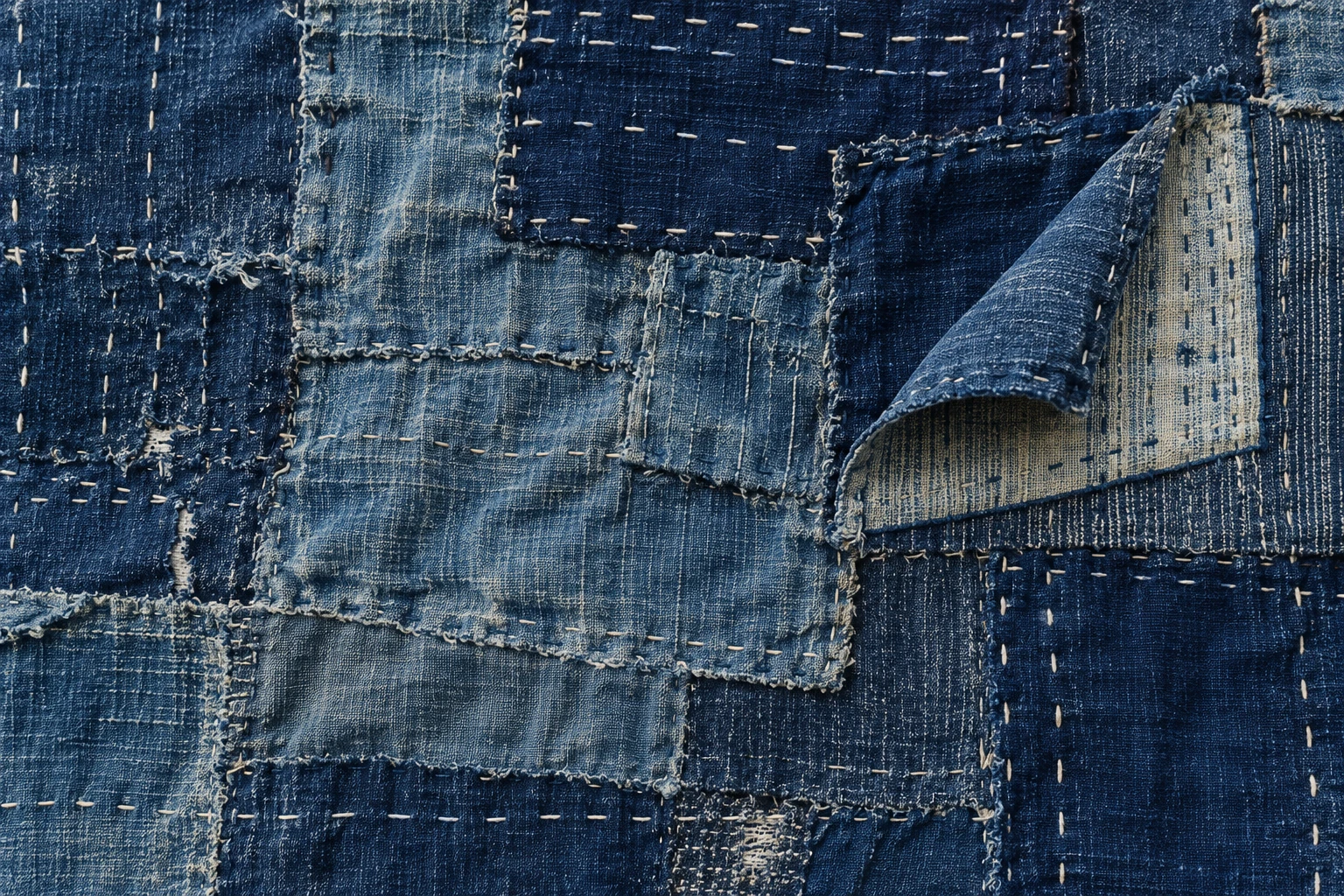
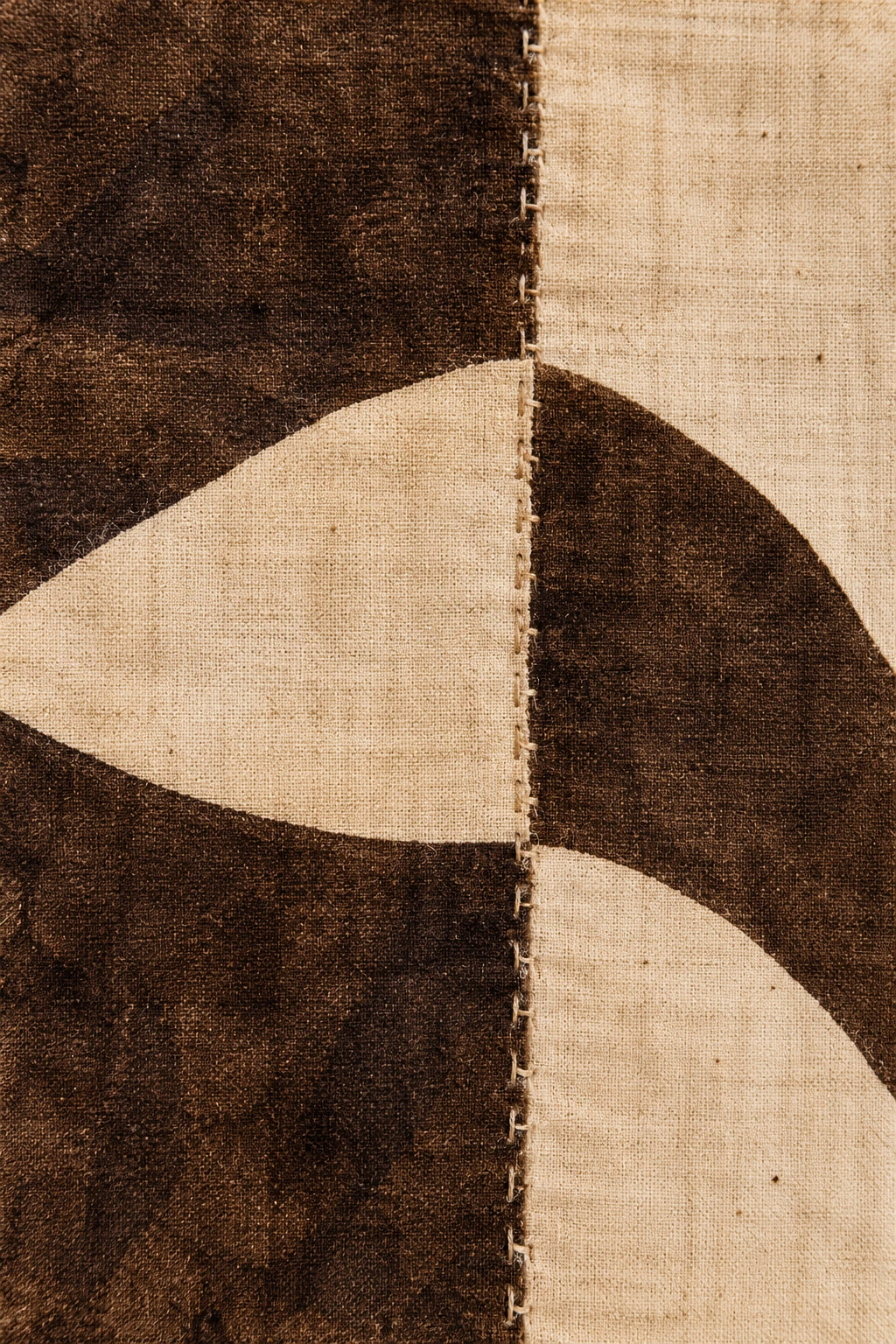
Bojagi: The Wrapping Cloth That Changes When Light Passes Through

Place a pale patchwork cloth against a wall and its seams may look like a network of lines. Lift it into window light and the same seams become darker bands. Fold it around a box and the composition changes again. A Korean bojagi can be understood through all three states: as a surface, as a translucent construction and as something designed to wrap.

Illustration of translucent Korean patchwork wrapping cloth with seams visible in window light.
Light makes the seams and layers of a wrapping cloth visible.

A family of cloths, with patchwork inside it

Bojagi is the broad name for Korean wrapping cloths. Jogakbo refers to patchwork examples assembled from smaller pieces. The distinction prevents a beautiful subtype from standing in for the entire tradition. As LACMA curator Virginia Moon explains, bojagi served many purposes, including transport, storage, protection and covering food. They could be embroidered, patterned or pieced, and made from different fibres.

Moon also separates a long history of use from the dates of surviving objects. Written records reach further back than most extant examples, which largely belong to the Joseon period. A nineteenth-century cloth can therefore participate in an older practice without itself being ancient. This is a useful distinction whenever a museum label places an everyday object within a long cultural history.

The V&A’s account of jogakbo describes cloth remnants joined into larger squares or rectangles. It names silk, cotton, ramie, hemp and even paper among possible materials. Individual examples are often organized around one type of fabric. Patchwork could make use of pieces left after other sewing, but the finished cloth still required many decisions about arrangement, scale and joining.

Why the seams become part of the picture

In the V&A’s examples, a careful enclosed seam gives the patchwork its characteristic gridded appearance. A translucent fabric makes that construction especially visible. Where fabric is folded or layered at a join, less light passes through. The seam can become a dark outline even when the thread and cloth are close in colour. Construction supplies part of the visual pattern.

This suggests a way to look that does not begin with resemblance to a painting. Follow a single join. See where it meets another join, changes direction or stops. Then notice whether the adjacent pieces are equal or unequal. The maker has to produce a usable whole from parts whose shapes may not already agree. An apparent simplicity can contain a complex sequence of accommodations.

Translucency is one possibility, rather than a definition of bojagi. A heavier cotton wrapper offers another experience. The Smithsonian’s late-nineteenth-century example, collected in Seoul, has bands attached at its corners for tying. Its printed designs include characters associated with long life and blessings. This large wrapper invites attention to carrying and securing bulky belongings, not only to light passing through delicate fabric.

Wrapping can carry a relationship

The Met’s twentieth-century silk cloth has gold-leaf decoration and was probably used for a wedding gift. Its motifs include paired phoenixes, double happiness and characters expressing a wish for many sons. The museum’s cautious “likely” is important: interpretation is based on the object’s features, rather than a complete surviving account of one documented ceremony.

Those motifs also locate the cloth in a social world with particular expectations about marriage and family. We can describe those expectations without treating them as universal or endorsing them. Wrapping was not necessarily an insignificant stage before the “real” gift appeared. The chosen covering could communicate care, status and a wish for the recipient’s future.

Nor should patchwork automatically be read as evidence of poverty. Reusing pieces can reflect thrift, available material and established household practice, while fine silk and skilled labour may also be involved. The material, workmanship and intended use of a particular cloth deserve attention before a viewer assigns it a single economic story.

A continuing practice, with named makers

The Philadelphia Museum of Art’s Cover, made by Kim Hyeon-hui in 2001, introduces a named contemporary artist. Its muted colours and deliberate piecing show that bojagi is not confined to anonymous objects in a closed past. The museum describes both functional associations and the visual relationships formed by small pieces. Historical tradition and present artistic authorship can coexist.

It can be tempting to call every East Asian cloth made from remnants a version of Japanese boro. That shortcut loses distinctions. Bojagi belongs to Korean wrapping practices; jogakbo names a way of constructing some of those cloths. Boro is associated with Japanese repair and layered textiles. A shared interest in retaining useful fabric does not make the two traditions interchangeable.

Three ways to inspect one cloth
  • Flat: follow the sizes, colours and seam intersections.
  • Against light: distinguish single fabric from layered seam allowances.
  • Wrapped: notice which corners, ties and colours remain visible.

Use the V&A or Philadelphia collection photographs for the first view. If an image viewer fails, the material descriptions still let you compare a fine pieced cover with the Smithsonian’s large cotton wrapper. A photograph cannot supply the full feel of a cloth, but it can help you ask more exact questions about what it was made to do.

The most rewarding thing about bojagi may be its capacity to alter a relationship between objects. A flat cloth becomes a container; a covering becomes a gesture; a seam becomes a line of shadow. The design is not finished when the last stitch is made. It becomes legible through the changing ways the cloth is handled, used and seen.


Explore more art, ideas and independent projects at Incoprea.

Friday, October 23, 2026

The Second Thread Hidden Beneath Every Lockstitch

Look at a straight machine-sewn seam from above. It is easy to imagine a single thread being pushed repeatedly through the cloth. Turn the fabric over and there is another line to explain. In a lockstitch, the familiar visible needle works with a second thread stored below the sewing surface.

The puzzle is geometrical. A needle with its eye near the point can carry an upper thread down through the cloth and back up. How does that motion make the upper and lower threads interlock, when neither thread is simply being pulled all the way through like a hand-sewing needle?

Conceptual sewing-machine cutaway with a red upper thread loop, blue bobbin thread, and eye-pointed needle.
The two colors separate the upper and lower thread paths. The paused cutaway is conceptual, not a timing or repair guide.

The important event happens just after the descent

As the needle begins to rise, a loop of the upper thread can form below the cloth. A hook or shuttle mechanism catches and manages that loop. In a rotary-hook design, the loop is carried around the bobbin case so that it can engage with the lower thread. Take-up and tension then draw the stitch into its completed position.

A Singer patent describing a bobbin-winding arrangement also sets out the familiar lockstitch action: the hook seizes the needle-thread loop and carries it around the bobbin case. It is a useful primary description of the loop path, even though the patent's new contribution concerns another part of the mechanism.

Read the cycle as four different jobs

  1. Present the upper thread. The eye-pointed needle brings it through the cloth.
  2. Catch a loop. The lower mechanism meets the thread during the appropriate part of the needle's movement.
  3. Arrange the interlock. The loop passes around the lower-thread arrangement in the design's particular way.
  4. Take up and advance. The stitch is tightened, and the fabric moves for the next one in coordination with the needle.

This sequence names functions rather than giving service settings. The exact timing, hook motion, feed mechanism, and thread path depend on the machine. The illustration is a conceptual paused view, not a pattern for rebuilding a sewing mechanism.

What would go missing in a needle-only explanation?

The lower-thread encounter. Moving a loop through fabric is not the same as arranging that loop around another thread. A clear explanation must account for both thread supplies, the loop-taking mechanism, and the return to a tightened stitch. “The needle goes up and down” describes only the most conspicuous motion.

One stitch, more than one mechanical solution

The Smithsonian's Allen Wilson patent-model account compares shuttle and rotary-hook developments. An earlier shuttle carried a second thread through a needle-thread loop. Later arrangements changed how the loop and bobbin met. The common result did not require every machine to use the same path or shape of moving part.

That makes museum models valuable reading material. A model lets you ask which motion an inventor changed and what difficulty the change addressed. The question is more precise than asking which person “invented the sewing machine,” as if the complete modern object appeared in one indivisible step.

The Smithsonian record for Isaac Singer's 1851 model describes a straight eye-pointed needle and a reciprocating shuttle, along with specific claimed improvements involving tightening and thread control. Those details restore the invention to an actual mechanism rather than only a famous brand name.

A seam can preserve the relationship

If you have an ordinary lockstitched scrap, inspect both sides in good light. Find an existing loose end rather than cutting a garment you need. Try to follow which visible segments belong to the upper and lower thread. The completed seam offers clues about an event that took place beneath the cloth.

A classroom sample sewn with contrasting upper and lower colors makes that reading easier. The red-and-blue convention in the illustration serves this purpose; real thread colors do not have to differ. It is the interlocking relationship, not the pigment, that defines the explanation.

The machine's achievement is a carefully repeated meeting. An upper thread becomes a loop; the lower mechanism gives that loop a route; the stitch is tightened before the next meeting. A straight line of stitches can look quiet because a complicated conversation has been made repeatable.

Follow the evidence: Smithsonian: Allen Wilson sewing-machine model; Smithsonian: Singer 1851 patent model; Singer patent US4259914A.

Explore all 80 new articles · Browse the complete illustrated collection

Explore more art, ideas, experiments, and independent projects at Incoprea.

Tyrian Purple: When a Color Carried More Than a Price

A purple thread looks like an answer: someone wanted purple. For an archaeologist, it is the beginning of several questions. Which coloring material was used? Where could it have been obtained? What part of the process happened here? Does the object's color tell us anything secure about the person who wore it?

Tyrian purple is associated with particular Mediterranean sea snails and a demanding dyeing tradition. But “purple” is also a broad visual category. The history becomes more interesting when we resist treating every purple textile, every shell heap, and every royal story as pieces of one interchangeable puzzle.

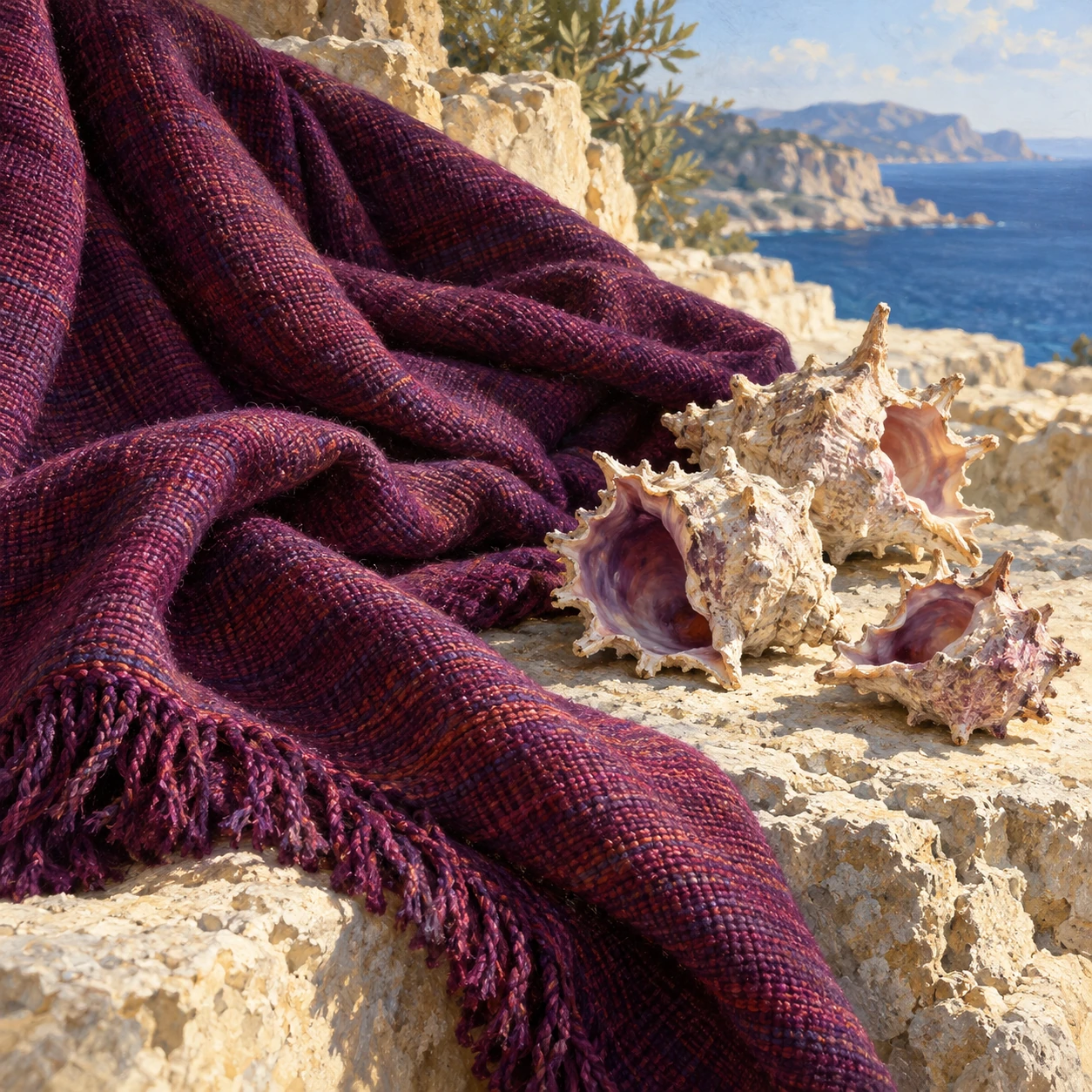
A fold of woven dark reddish-purple wool cloth beside a few empty Mediterranean murex-like shells on rough pale limestone, angled daylight reveals thread texture.
Shells and cloth evoke shellfish-purple dyeing. A purple-looking textile still needs analysis before its dye or historical status can be identified.

One color name, several kinds of evidence

The dye material comes from a gland secretion, not simply from pulverizing the shell into purple powder. Production involves transforming the extracted material and applying the color to fibers. Different conditions can produce different shades. A single bright screen swatch is therefore a poor standard for identifying an ancient dyestuff.

A useful comparison comes from a quite different place and period. The Metropolitan Museum's record of an Andean tunic, dated to the fifteenth or early sixteenth century, reports that its purple/blue areas contain cochineal. They are not evidence of Mediterranean murex dye. The example separates a visible result from the material route used to achieve it.

This does not make the tunic an imitation of Tyrian purple. It belongs to its own textile tradition. Placing the records beside each other is a comparison of how color is identified, not a claim of shared origins, direct influence, or a universal hierarchy in which one culture's purple is the authentic version of another's.

Timna: a result small enough to be precise

In a 2021 study of textiles from the Timna Valley, Naama Sukenik and colleagues identified three examples dyed with murex-derived material. Their chemical analysis detected characteristic brominated indigo compounds. The finds came from a copper-smelting site whose radiocarbon chronology places the context in the late eleventh to early tenth centuries BCE.

The researchers discuss prestige and social organization, but a dye identification is not a recovered owner's name. “Royal purple,” in the article's title, names a historically prestigious material. It does not prove that a particular king wore these fragments. The distinction allows the evidence to remain important without adding an unsupported royal wardrobe.

Think of the inference as a series of doors. Analysis can open the material door. Archaeological context helps open the place-and-date door. Identifying an individual wearer requires another kind of key. Leaving that door closed is a more accurate account than assuming that the first result opened every room.

A shell heap is a question, not a complete workshop

The Timna paper also warns that shells can be associated with uses other than dye production. A deposit needs contextual interpretation. At a different site, the team studying Alatzomouri-Pefka on Crete combined evidence for basins and vessels with chemical residues. Their account emphasizes why a painted garment alone cannot establish the dyestuff used in a real textile.

This is a good example of evidence becoming stronger through combination. A feature that looks like a basin may support several explanations. A residue helps narrow them. A pattern of related features can strengthen an interpretation further. None of that requires pretending that one attractive find speaks in a complete sentence.

The Penn account also describes two dyestuffs found in one vessel while acknowledging uncertainty about whether they were mixed or used separately. Finding substances together does not automatically reconstruct their sequence of use. An accumulated history and a single deliberate mixture can leave overlapping traces.

Make a simple inventory of the evidence before drawing a route on a map. A textile establishes a colored object at its find context. A workshop residue points toward processing at another location. A written description establishes that an author discussed a practice. Connecting those points may be a reasonable hypothesis, but the connecting line is an argument. It is not another excavated object. Labeling that line as a hypothesis keeps a useful map from becoming a misleading picture of certainty.

Pliny: expertise, complaint, and a translated voice

Turn from laboratory analysis to Book 9 of Pliny's Natural History. In the 1601 English translation hosted by the University of Chicago, the discussion distinguishes different purple products, processing choices, and prices. It also criticizes expensive display. Technical description and moral judgment occupy the same passage.

Read that mixture rather than editing the author's attitude away. A complaint about luxury is evidence that someone wanted to criticize luxury. It may also preserve information about products and practices. Those are related uses of the text, but one should not be mistaken for the other.

The translation adds another layer. Terms such as “purple,” “violet,” and “scarlet” arrive through a historical English vocabulary as well as an ancient Latin one. They should not be converted casually into precise digital color values. The text is describing materials and appearances within a particular linguistic world.

Finally, return to the image of folded cloth beside shells. It gives the subject a visual form, but it cannot certify a chemical composition or reconstruct a specific ancient garment. The research does that work through particular samples and explicit reasoning.

The fascination of Tyrian purple lies partly in the distance between appearance and process. A small area of color can connect skilled production, exchange, social ambition, and the survival of perishable things. Following those connections carefully gives us something richer than the familiar sentence that purple was expensive.

Sources and further exploration

Explore all 80 new articles · Browse the complete illustrated collection

Continue exploring art, ideas, and unexpected connections at Incoprea.

Ngatu: A Cloth Built by Beating, Joining, and Working Together

A large sheet of ngatu can make the word “cloth” feel too small. It has a surface, a pattern, and a physical scale, but also a history of people working together, exchanging value, and marking occasions. Looking only at its decoration leaves most of the object unread.

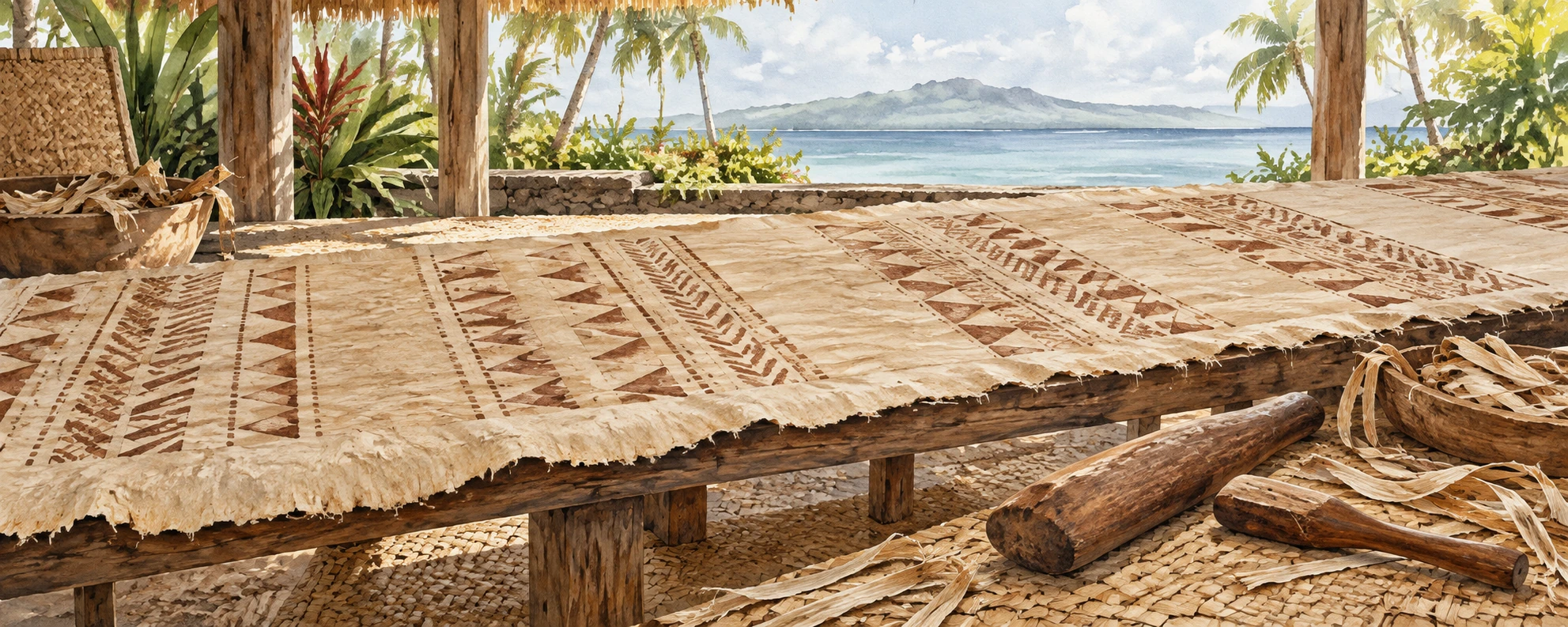
An interpretive Tongan ngatu-making space without people: a long wide cream barkcloth sheet over a low horizontal table, subtle original brown geometric rubbing marks with no named family design or coat of arms, wooden beaters and small plant-fiber strips nearby, airy open-sided setting, soft daylight.
Joined sheets, repeated marks, and working tools make barkcloth a record of skilled collective labor. The pattern is an original illustrative design.

Ngatu is the Tongan name for decorated barkcloth. It is not made by weaving threads across one another. Te Papa's account begins with hiapo, the paper mulberry tree, and follows the separation and beating of its inner bark. Strips become wider sheets, which can be joined into a much larger surface.

Begin with the joins

When looking at a photograph, try to see the cloth as assembled material before reading it as a picture. Where might smaller sheets meet? How does the larger field accommodate repeated work? What happens at an edge? These questions make the material process visible without treating every irregularity as a defect.

The difference from weaving also changes the questions you ask. A woven textile invites attention to thread direction and interlacing. Barkcloth asks you to consider transformed fibers, overlapping or joined sheets, surface working, and the relationship between pattern and the support beneath it. Calling both “fabric” is convenient, but it should not flatten their making into the same operation.

It is equally important not to turn a Tongan description into a rule for all Pacific barkcloth. Te Papa identifies distinct regional names and practices, including ngatu in Tonga, siapo in Sāmoa, masi in Fiji, and kapa in Hawai‘i. The shared broad material does not make designs, techniques, ownership, or meanings interchangeable.

A cloth can have several public lives

One remarkable ngatu in Te Papa's collection was made for Queen Elizabeth II's visit to Tonga in 1953. It was later placed beneath Queen Sālote's coffin when her body returned to Tonga in 1965. The museum's 2010 installation account records a cloth more than 22 meters long and over 4 meters wide.

Those dimensions change your interpretation. A small crop on a screen can resemble a repeat pattern suitable for a decorative background. The full object is large enough to organize a space and demand coordinated handling. Its scale is part of the work, not a neutral container for the design.

The installation account describes the effort required to support and display it. That modern museum episode is another chapter in the cloth's history, separate from its original making and ceremonial use. A collection object continues to be moved, interpreted, and encountered; the museum label does not freeze its life at the date of manufacture.

Listen to a maker before assigning meanings

Sulieti Fieme‘a Burrows speaks about her ngatu practice in a Te Papa film recorded around the 2023 Tahiti wānanga. Her account connects learning from parents, preserving knowledge of older patterns, and passing that knowledge on. It offers a voice with authority grounded in making, rather than an outsider's general claim that the cloth simply “symbolizes community.”

When you watch, notice which parts of the story concern technique and which concern memory or relationships. Those categories may overlap, but they are not substitutes for one another. Knowing the physical action of beating bark does not tell you the full significance of a particular cloth. Recognizing ceremonial importance does not remove the technical skill involved.

A careful route through a barkcloth record
  • Use the locally specific name supplied by the maker or collection.
  • Record dimensions before judging the design from a screen-sized crop.
  • Separate a documented motif name from your own visual association.
  • Look for maker, place, date, occasion, and later use.
  • If those details are absent, keep the absence visible.

A pattern can be admired without being copied into a supposedly universal vocabulary. The more useful question is what this particular object records and whom its record connects. Sometimes a collection page can answer that well. Sometimes the next necessary source is a living maker.

Ngatu rewards the effort to look at several scales at once: fiber, sheet, joined field, room, occasion, relationship. Its material presence grows richer when those scales remain connected.

Sources and further exploration

Explore all 80 new articles · Browse the complete illustrated collection

Continue exploring art, ideas, and unexpected connections at Incoprea.

Thursday, October 22, 2026

The Banton Cloth: A Fragile Textile and a Long History of Pattern

In a textile, a pattern can begin before the cloth exists. A weaver may arrange threads, bind selected sections against dye, color the exposed lengths, and only then weave them together. The picture is distributed across separate strands before it becomes a surface.

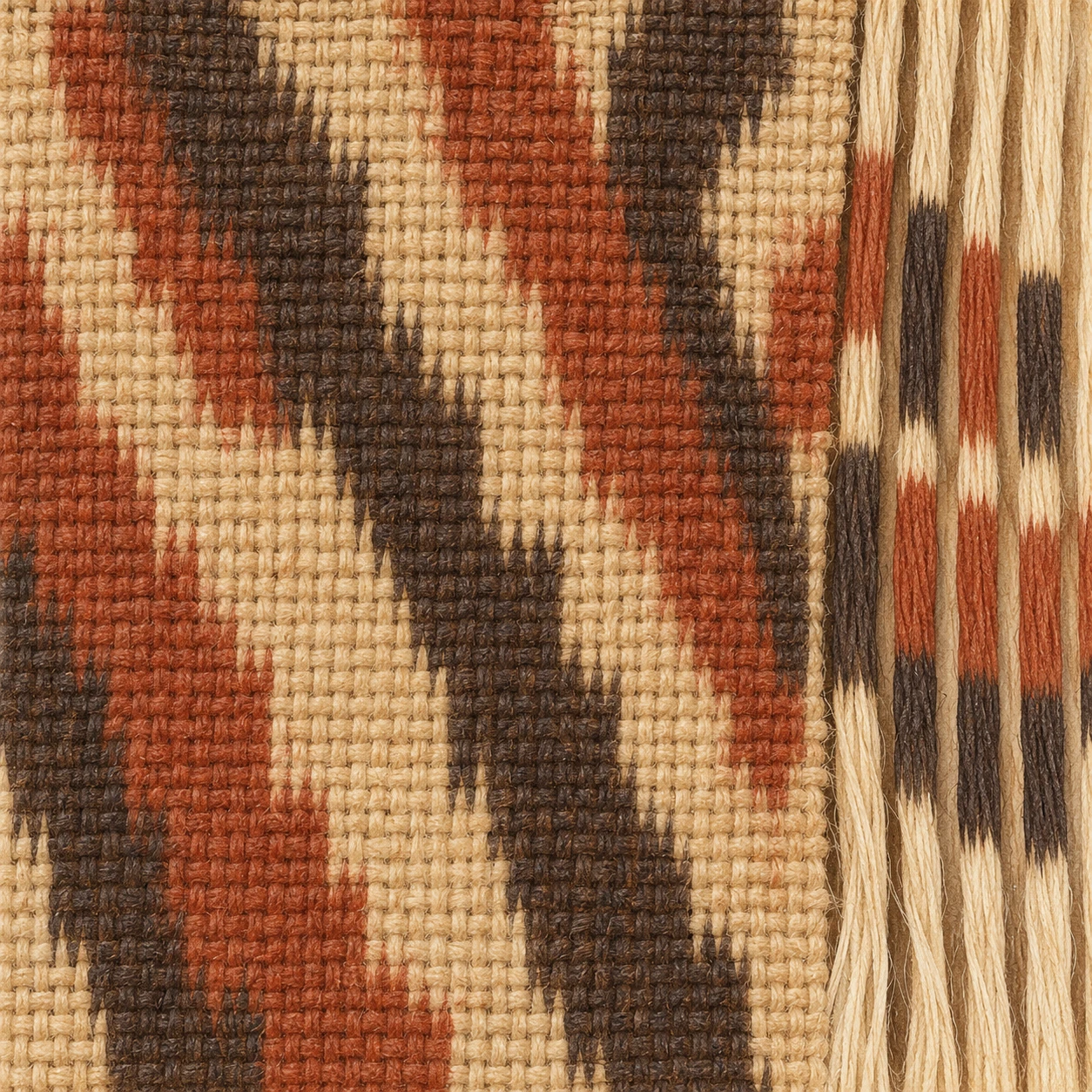
A close-up illustrative woven plant-fiber textile with colored warp segments and loose strands along one edge.
Generic warp-ikat study, not a reproduction of the Banton cloth or a named community’s design.

The Banton cloth, held by the National Museum of the Philippines, offers a rare surviving encounter with that kind of planning in the precolonial past. Its fragility is part of its importance. Many historical textiles disappeared while more durable pottery and metal survived. A surviving cloth changes what an archaeological collection allows us to notice.

A burial context, not a complete biography

The Cultural Center of the Philippines’ encyclopedia entry identifies the Banton burial cloth as abaca warp ikat, associated with wooden coffins in a cave on Banton Island in Romblon. “Burial cloth” describes that association. It does not by itself establish every purpose the textile served before burial, the name of its maker, or the exact place it was woven.

The National Museum’s Hibla textile catalog (entry 153, page 109; the link gives its current library record) places it among finds from a disturbed cave complex, including coffins, imported ceramics, beads, and other objects. The catalog estimates the associated assemblage to the thirteenth to early fourteenth century. The encyclopedia uses a fourteenth–fifteenth-century date. Those published ranges should not be silently turned into a single precise year.

A 2021 textile-research conference abstract likewise notes that the cloth’s origins remain under study and that the presence of an ikat textile on Banton does not establish a documented local ikat-weaving tradition. The careful story is already compelling: the object survives in a particular archaeological setting, while questions about its manufacture remain open.

How warp ikat stores an image in thread

“Warp” refers to the lengthwise system of threads held under tension during weaving. “Weft” crosses through it. In warp ikat, resist-dyed portions of the warp contribute the visible pattern. The dyeing therefore precedes the weaving, rather than being a design painted onto a finished cloth.

Imagine a row of parallel paths with colored stretches at different positions. Move one path a little forward and its colored section shifts relative to its neighbors. A planned motif depends on keeping those relationships sufficiently aligned as the work proceeds. Slightly soft edges can be part of this material result, rather than a failed attempt at a printed outline.

This is a simplified explanation of the principle, not instructions for reproducing the Banton cloth. A named community’s technical vocabulary, materials, and designs deserve more precision than a universal “ancient weaving secret” story.

A paper model of a pre-woven pattern

You can explore the planning problem with paper and colored pencils. No dye, sharp tool, or borrowed traditional motif is needed.

  1. Draw six parallel vertical lines on a sheet. Across their middle, draw your own simple diagonal band.
  2. Copy each line onto a separate narrow strip, preserving where the colored band crosses it.
  3. Arrange the strips together again. The diagonal reappears only if their positions agree.
  4. Slide one strip upward and another downward. Watch the outline break into displaced segments.

The model leaves out fiber preparation, tying, dye chemistry, tension, and the labor of actual weaving. Its purpose is narrower: to let you feel the difficulty of distributing a design across independent lengths. After trying it, return to a museum photograph and look for the relationship between a large motif and the threads that carry it.

From a pattern to an examination

The work of identifying a textile continues after it reaches a museum. In its 2021 annual report, page 35, the National Museum of the Philippines shows researcher and conservator Mariah Camille T. Calanno examining an abaca cloth with digital microscopy for comparison with the Banton burial cloth. This is a particularly useful image of research because the comparison object is not silently treated as the archaeological textile itself.

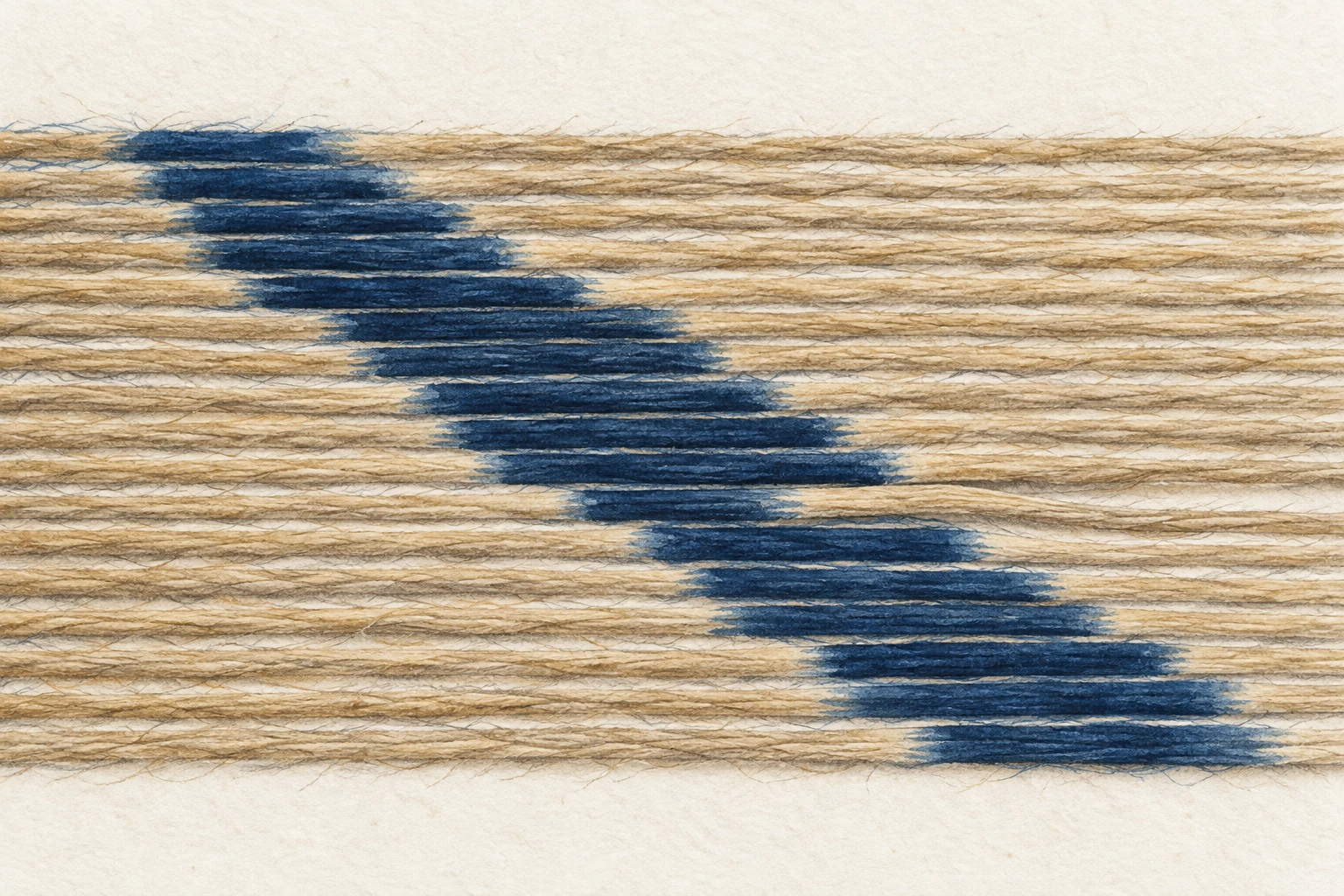
Parallel tan warp strands carry an original blue diagonal band, with one group shifted along its length.
Generic alignment study. It does not reproduce the Banton design or a named community’s motif.

The museum’s 2024 annual report, Annex E lists Calanno’s presentations about the cloth’s provenance, technique, material, design, use, manufacture, and source. A presentation title establishes that those questions were being investigated. It does not provide the results, a newly settled date, or a named production village. That difference is easy to lose when a promising research title is retold as a completed discovery.

Magnification changes which questions are accessible. At a distance, a viewer sees a motif and a color arrangement. Closer examination can ask how individual threads are organized, what crosses what, and where damage interrupts the structure. The larger pattern and the small material relationships belong to the same cloth, but they are not interchangeable observations. A resemblance between two motifs can be worth investigating while remaining weaker than a demonstrated match in technique and context.

The alignment model below lets you move eight generic warp strands independently. Their colored sections begin as an original diagonal band. Change one strand, then change all strands by the same amount. Which operation disrupts the relationship between neighbors? Which simply moves the band? The displayed numbers are model offsets, not measurements from the Banton fragments.

Move the warp, change the band

Eight independent offsets demonstrate relative alignment; values are not archaeological measurements.

Open this activity in its own window.

A useful answer is relational. Uniform movement preserves the arrangement among the strands; unequal movement changes it. That explains why looking at an individual colored thread is not enough to understand a pattern distributed across a warp. The model omits real weaving tension, dye penetration, resist ties, fiber irregularity, and the crossing weft. Its simplicity identifies one problem, rather than claiming to reproduce a weaver’s whole achievement.

After using it, return to the museum’s actual images. Ask which visible feature you would like to see enlarged, and why. A specific request—an intersection, a damaged edge, a repeated boundary—makes a more productive research question than asking a fragment to reveal its entire journey at once.

Material skill belongs to people

The Hibla gallery presents the Banton fragments alongside looms, fibers, dyes, and textiles from different Philippine communities. That context discourages two easy mistakes: seeing only an isolated “oldest” object, and treating all Philippine weaving as one interchangeable tradition.

For a named example of more recent knowledge and teaching, the museum’s account of Tagabawa Bagobo master weaver Salinta Monon describes her expertise in inabal, an ikat-dyed abaca textile, and her work teaching younger generations. It also records her ability to recognize designs and individual makers. This is evidence of her particular community and practice, not proof that she inherited the Banton cloth’s exact lineage.

The distinction matters. A contemporary or recent textile tradition can help a visitor understand that weaving involves expert decisions. It should not be used to fill every gap in an archaeological artifact’s story. Continuity is a historical proposition that needs evidence, not a compliment we can safely invent.

Look past the race to be first

The museum calls the Banton fragments its oldest textile collection and a National Cultural Treasure. “Oldest surviving” is a statement about preservation and present knowledge. It is not the same as the first cloth ever woven in a region, and it is not a measure of the sophistication of all earlier work that happened to decay.

Three questions make a better looking guide than a superlative. What can you actually see in the fibers? What does the find context support? What remains unknown about the maker and the route to the burial place? Keep these questions separate and the fragment becomes both more human and more intellectually interesting.

A tiny surviving textile does not have to answer everything. It gives us a rare material point of contact with someone who understood how to arrange color in threads—and with the larger human world that valued the finished work enough to keep it close to the dead.

If you are looking with a child, let the first question be about work rather than age: how many separate decisions would be needed to turn loose fiber into this surface? Invite guesses about arranging, coloring, tightening, and keeping track. Then distinguish the guesses from what the museum actually documents. The exercise gives the maker attention without inventing a biography.

For an adult reader, a useful follow-up is to compare two museum labels for the same artifact. Note differences in date, measurements, and terminology. Those differences may reflect fragments, catalog histories, or changing scholarship. Keep them visible until a documented explanation resolves them.

Sources and a closer look

Cultural Center of the Philippines: Banton Burial Cloth; National Museum: Hibla textile catalog (entry 153, page 109; the link gives its current library record); Centre for Textile Research: 2021 conference abstracts; National Museum: Hibla gallery; National Museum: Salinta Monon and inabal.

Find more art, ideas, and unexpected connections at Incoprea.

Boro: Reading Repair Without Romanticizing Poverty

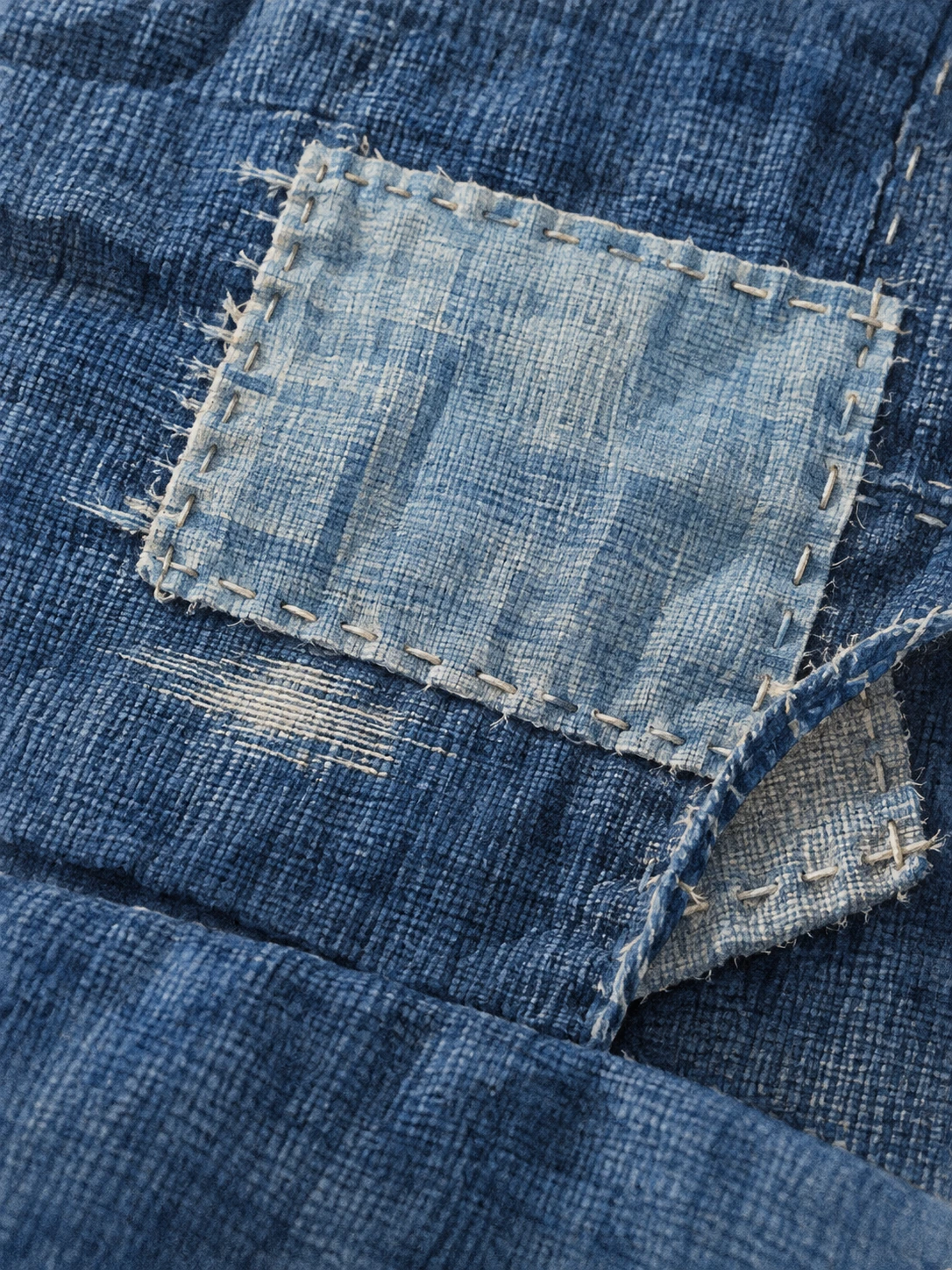
A patched cloth can be read in layers. A pale blue piece covers a darker one; a row of stitches crosses an earlier seam; a thin patch has worn through to expose something beneath. The surface is the result of repeated decisions, not necessarily a composition planned all at once.

Japanese boro textiles invite admiration for their color and texture. They also ask an uncomfortable question: what happens when work born of material necessity is celebrated mainly as a beautiful style?

Overlapping indigo cloth patches with irregular pale running stitches, worn fibers, and one turned-back edge.
Original mending study, not a historic boro textile or a documented family artifact.

A practice of continued use

The Victoria and Albert Museum’s explanation links boro with the reworking and repair of clothing and bedding through piecing, patching, and stitching. It describes garments passed through rural families, and distinguishes this practical history from today’s interest in a repaired or distressed appearance.

The International Quilt Museum’s exhibition, curated by Yoshiko Wada, similarly emphasizes cycles of use and reuse before the Second World War. Scraps covered worn areas and were held with running stitches; successive repairs produced layered, uneven surfaces. The museum places necessity alongside the later admiration of that rough beauty.

These accounts give us a better starting point than treating every blue patch as a timeless expression of a single national philosophy. An individual cloth had particular materials, uses, repairs, and people around it. Some of those details survive; others do not.

A seam is a relationship between materials

Look first at where one patch overlaps another. Which edge lies on top? Does a line of stitching secure two layers or pass through several? Is a thin area reinforced from the visible side, the reverse, or both? These questions concern construction before symbolism.

A photograph can suggest a sequence, but it may not establish it. A later stitch can cross an earlier patch, yet a repair may also have been unpicked, moved, or reinforced. Without close physical examination and documentation, a confident family story attached to every seam becomes invented intimacy.

What can still be appreciated is the practical intelligence of the result. A usable textile has to hold together under movement and wear. Its maker is solving problems of strength, coverage, available pieces, and the time required to do the work. Admiring that intelligence does not require pretending hardship was pleasant.

The modern gaze changes the object

A Cooper Hewitt discussion of boro observes that functional patching can acquire an artistic appearance through arrangements not originally intended as decoration. The museum’s account is useful because it makes the modern act of appreciation visible. We are not simply recovering exactly what every earlier user felt when looking at a worn futon cover.

Japan Society’s exhibition materials place historical textiles in conversation with contemporary art and fashion. That conversation can be productive if the categories remain clear: an old repaired garment, a contemporary artwork, and a luxury fashion piece may share visual features while belonging to very different economies.

A new distressed garment can imitate the appearance of repair without containing a long history of use. A contemporary maker can also repair a real worn object for practical reasons. Neither fact should be hidden by a label that reduces every case to one desirable look.

Four questions for looking at a repaired textile

QuestionWhat to look for
What job did this object do?A documented garment, bedding cover, wrapping, or other use
What is actually repaired?Holes, thin areas, seams, or structural stress points
Which history is documented?Maker, community, date, collection history, or acknowledged gaps
What does the display emphasize?Color, technique, labor, poverty, reuse, fashion, or some combination

Do not expect every museum label to answer all four. The point is to identify which aspect you are seeing, and which questions remain available. A cloth hung flat as art may reveal patterns beautifully while concealing how it moved on a body or folded around bedding.

There is also a difference between a repair that remains visible and one meant to disappear. A museum display can make conspicuous stitching seem like the essential virtue of mending, although a person fixing an ordinary object may value an unobtrusive result. Neither preference should be assigned retrospectively to every earlier user.

Consider your own low-stakes example: a patch on a cleaning cloth and a patch on a formal garment answer different demands. The same strength, color, or thickness might be welcome in one and unsuitable in the other. Thinking through those demands restores choice to a surface that could otherwise be admired simply as accidental abstraction. It also reminds us that the time spent maintaining an object is work, even when the resulting marks become beautiful to a later observer.

A repair is not a cultural diagnosis

The Museum of Far Eastern Antiquities in Stockholm makes a useful distinction in Stitch after stitch. Its account brings together boro, traditional workwear, and later fashion inspired by those textiles. It also discusses sashiko as running-stitch work used for repair and reinforcement. Sharing a stitch does not make every object share the same original use, economic setting, or later meaning.

Blue cotton practice cloth with a lighter patch, running stitches, and a folded edge exposing layers.
Contemporary repair study, not a historic boro textile.

A comparison outside the familiar indigo surface sharpens the point. The Smithsonian’s National Museum of Asian Art catalogs a Japanese silk brocade hanging, F1916.646, under a title noting four repairs. The record dates the textile broadly to the Edo period and gives its later collection history. A repaired silk hanging is not thereby a boro garment. “Repaired” names an intervention; assigning a textile to a particular practice requires more specific evidence.

Imagine three ordinary objects: a patched household cloth, a work jacket reinforced before it tears, and a museum textile stabilized so it can be supported safely. They may all contain added thread, but the aims differ. One restores use, another anticipates stress, and another supports preservation and study. These are invented examples for comparison, not diagnoses of the two museum objects.

Try a two-pass description of one photograph. First use only construction terms: overlapping edge, running stitch, doubled layer, seam, worn area. In the second pass, add only the history supplied by its catalog. If “a grandmother lovingly repaired it each winter” appears without documentation, remove it. The sentence may feel intimate, but it substitutes an invented person for the people whose work actually survives.

There is another question worth keeping open: which face of the textile is being shown? A hanging displayed flat can make a practical reinforcement look like a deliberate picture. Its reverse may reveal patch shapes or stitch routes that change the reading. Ask for another documented view before deciding that a visually attractive arrangement was the maker’s primary objective.

Finally, consider what happens when a museum title foregrounds repair. It directs the visitor’s attention toward the textile’s continued life, while a title such as “brocade hanging” directs attention toward its original category. Both can be useful. Reading them together helps us appreciate maintenance without allowing a later collector’s preferred vocabulary to erase the object’s other histories.

A small act of care, with honest naming

If this history makes you want to mend something, begin with your own ordinary cloth. Choose a low-stakes item such as a worn household rag or a practice scrap. Notice the thin area and consider how a patch might extend its use. A needle requires normal care and appropriate supervision for children; a paper collage can model the overlapping decisions without stitching.

Before doing anything decorative, write one sentence about the function you want to restore. Then choose the smallest intervention that serves it. Afterward, record what you used and why. You are creating a documented contemporary repair, not manufacturing an antique history or claiming membership in a traditional practice through appearance alone.

Compare the repaired area after use. Did stress move to the edge of the patch? Was the cloth too heavy or too stiff? The outcome gives you a practical respect for the skill hidden in repairs that seem casual from a distance.

Boro can be beautiful without turning necessity into romance. The strongest appreciation makes room for the people who kept things usable, the resources they had, and the labor they gave. A patch is an addition, but it is also a decision that an object’s working life can continue.

Sources and a closer look

V&A: boro, patching and reuse; International Quilt Museum: The Hidden and the Visible; Cooper Hewitt: Boro and Other Japanese Recycled Wonders; Japan Society: Boro Textiles exhibition materials.

Find more art, ideas, and unexpected connections at Incoprea.

Feathers Arranged Like Color: The Wari Panels That Change at the Edge

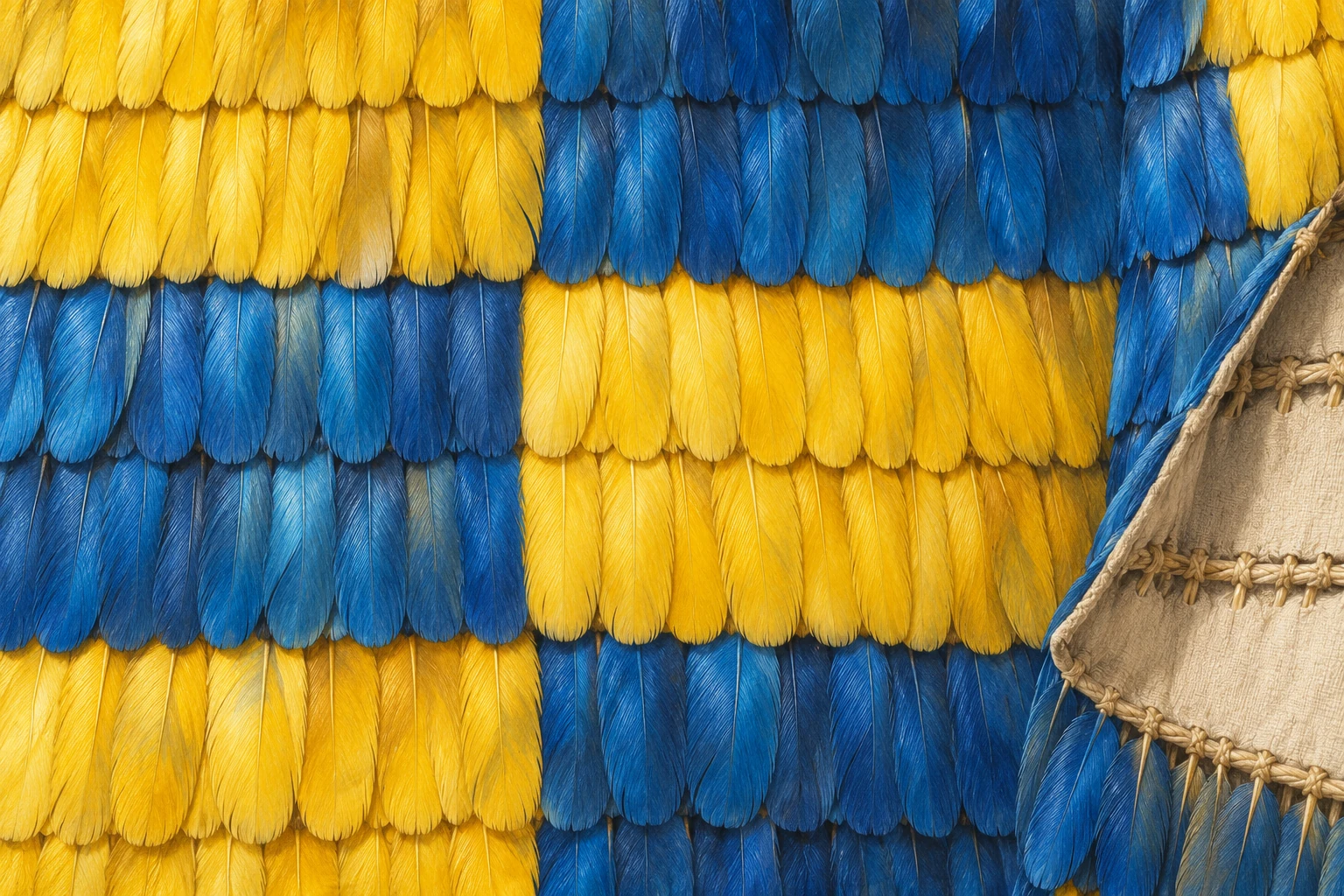
From a distance, the panel can look like a few great blocks of blue and yellow. At the edge, the image breaks into thousands of small feathers. Each one belonged to a bird; each had to be obtained, selected, arranged, and secured. A broad field of color becomes a record of extraordinary material coordination.

Rows of blue and yellow feathers form broad rectangular fields, with a turned edge suggesting a textile backing.
Conceptual featherwork study with an original arrangement, not a replica of a Wari artifact or a proposed original setting.

Wari feather panels from Peru are often described as spectacular, but scale alone does not explain their fascination. The work joins textile structure, the surfaces of feathers, long-distance connections, and a preservation history that still leaves important questions unanswered.

A dry find containing rainforest materials

The Metropolitan Museum’s Feathered Panel, 1979.206.472, is dated 600–900 CE and cataloged as feathers on cotton with camelid hair. Its account describes a cache of roughly 96 panels discovered in the Churunga Valley region in 1943. Rolled panels inside large ceramic jars survived in arid soil.

The museum identifies many feathers as those of blue-and-yellow macaws, birds of the Amazonian rainforest east of the Andes. The materials therefore connect the dry find region with a very different environment. They do not, on their own, reveal whether every exchange involved live birds, feathers, or several stages of movement.

That distinction matters because the labor begins before the visible sewing. Obtaining an enormous supply is a practical achievement in its own right. A finished rectangle makes that dispersed work look concentrated and effortless.

The pattern is built through strings and rows

The Met’s Feathered Walls exhibition explanation describes horizontal strings of feathers attached to the textile. On multicolored panels, strings were cut where colors changed along the vertical axis. The arrangement supports the conclusion that feather workers followed a predetermined design using strings of selected colors.

This is a different process from painting a blue rectangle onto a yellow ground. The colored surface has depth, direction, and overlapping components. A seam or a color boundary can reveal the sequence of assembly more clearly than the center of a broad uninterrupted field.

Look at the panel as a set of nested scales: individual feather, row, colored block, whole textile. Each scale has its own order. The large design succeeds because many small alignments cooperate.

Uniformity is evidence, but function remains a question

The Met’s Weaving Abstraction publication places the panels within the wider diversity of Andean textile construction and discusses their striking regularity. Standardized forms invite questions about organized production, shared designs, and the coordination of materials and labor.

The panels’ cords suggest attachment to some structure, but the Met’s object record explicitly leaves their actual function unresolved. “Probably hangings” is a reasoned possibility, not permission to invent the room, ceremony, owner, and arrangement in which they were used.

Heidi King’s re-examination of the Corral Redondo context also reminds us that the discovery itself required historical research. An object’s find story can become fragmented as material is dispersed and later accounts accumulate. Reconstructing that story is part of understanding the artifact.

The Wari world was larger than this one medium

The Cleveland Museum of Art’s Wari exhibition places the society broadly between 600 and 1000 and presents ceramics, ornaments, sculpture, and garments together. The feather panels belong within that wider material world. They should not become a single exotic image standing in for every aspect of Wari life.

Likewise, Wari and Inca are not interchangeable names for ancient Peru. Keeping the cultural attribution and date attached to a panel lets the reader appreciate a history that precedes the better-known Inca Empire.

A counting exercise that changes the view

Draw a modest paper rectangle and divide it into 12 rows. Put 20 short marks in each row. You have made 240 units. Now imagine that each unit requires one small decision about placement and orientation. Repeat the rectangle ten times: 2,400 decisions about individual positions, before considering how material is collected or how the backing is made.

These numbers are an illustrative exercise, not a count of feathers in a particular Wari panel. Their purpose is to make repeated labor perceptible. A great block of color can conceal an immense number of small actions.

Now change color at the same vertical line in every row. Notice the attention needed to preserve a clean boundary while building horizontally. The exercise helps explain why the museum’s observation about strings being cut at color changes is such a valuable construction clue.

Try hiding all but a small area of the institutional photograph with two sheets of paper. Study the direction of individual feathers, then uncover the whole panel. The shift reveals how local orientation contributes to a broad field of color. A catalog’s flat color description can be accurate while still missing this patterned play between many small surfaces.

How large is the block of color?

Two neighboring Met records bring the panels into human scale. Panel 1979.206.470 measures 74.3 by 212.41 centimetres. Panel 1979.206.471 measures 73.03 by 212.09 centimetres. They are separate works. Their very similar cataloged dimensions offer a comparison of format, while small measurement differences should not be made to prove different workshops or original functions.

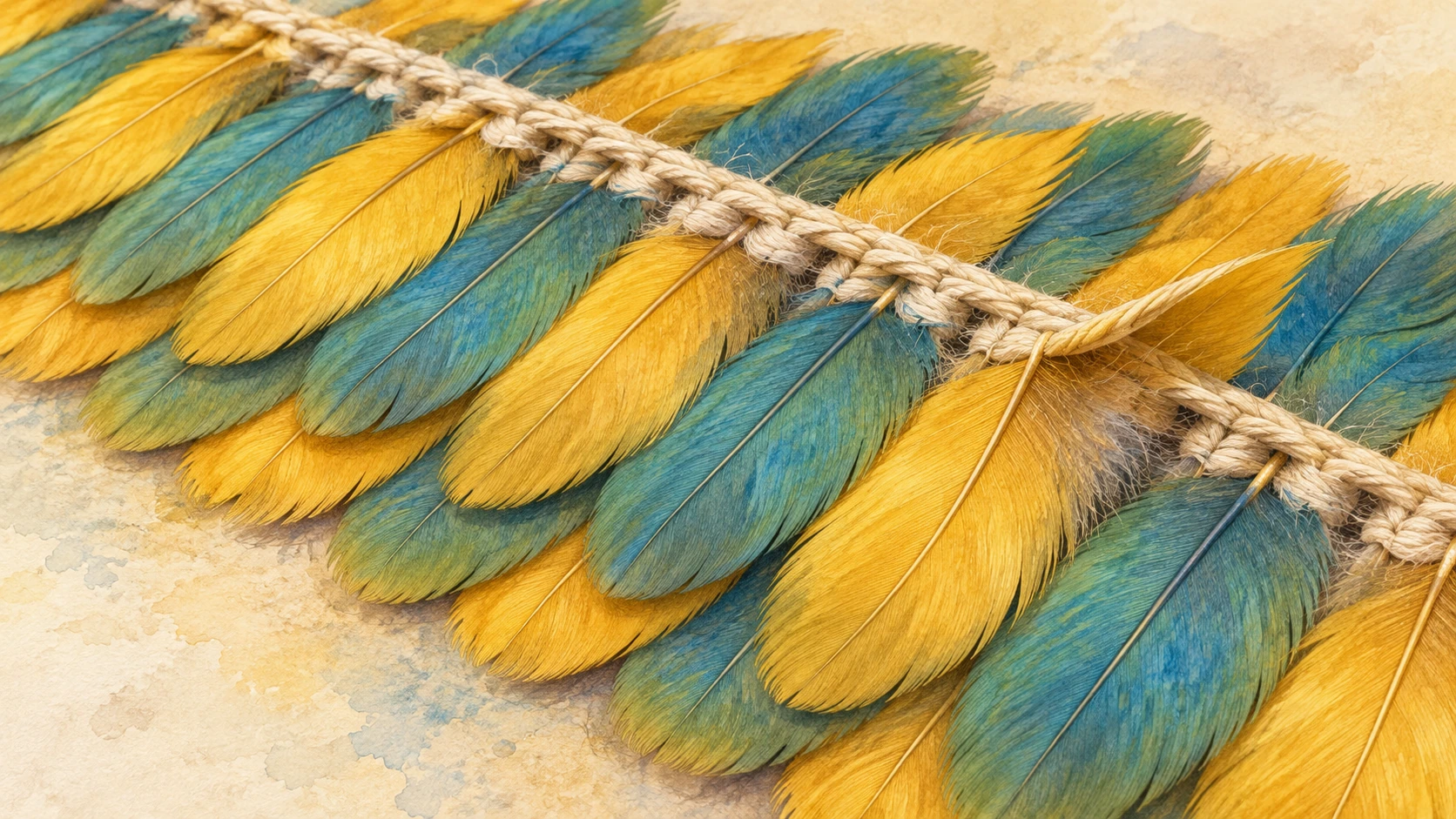
Overlapping small colored feathers reveal a cotton backing and attachment rows at an edge.
Generic attachment study, not a facsimile of a Wari panel.

A width above two metres is easy to miss when a whole panel fits inside a browser window. Mark that distance along the floor with a tape measure, leaving the tape safely out of a walking route, or compare it with a familiar wall. Then imagine a feather row crossing it. The surface’s visual simplicity depends on repetition at a scale larger than an ordinary close-up suggests.

Try a proportional exercise on paper. Draw a rectangle 21 centimetres wide and about 7.4 centimetres high. It is approximately a tenth-scale size guide for the first panel, not a tracing of its design. Now draw a 2-centimetre-wide viewing window on a separate scrap. Move it across the rectangle. The small window stands for how little of the whole a detailed photograph may show.

Ask two people to describe the panel at those two scales. One sees the institutional whole view; the other sees a close crop. The first may describe broad divisions and repetition. The second may notice feather direction, overlap, and attachment. Exchange descriptions and identify one claim that cannot be checked from each person’s view alone.

The records’ similarity creates another useful discipline: always keep the object number with the image. A caption copied from a nearby panel can look entirely plausible while assigning the wrong dimensions or photograph to a particular work. Shared cultural attribution and broadly similar appearance are not substitutes for an individual catalog identity.

Finally, resist using the long rectangle to invent its original wall. The Met’s conservation account makes attachment plausible but leaves the precise function unresolved. Dimensions can help us appreciate handling, surface organization, and repeated labor without recovering an undocumented room. The scale exercise should enlarge our attention, not the certainty of a reconstruction.

Look at the edge, then move back

In a museum image, begin with the edge where feathers meet the textile or a cord. Describe what the image allows you to see: overlap, density, row direction, the relation between the soft surface and the supporting fabric. Avoid filling invisible details with a guessed stitch pattern.

Then move back to the whole composition. The abstraction may feel almost modern, but that reaction belongs to our act of looking. It is more useful to ask how the ancient work organizes its materials than to praise it mainly for resembling a later art movement.

If viewing the panel with someone else, compare what each of you notices first. One person may see geometry; another may see the memory of a bird’s body. Both observations can lead toward the making, provided they remain separate from claims about an undocumented original meaning.

The panel’s surface is an achievement of repeated care. Its broad colors hold together because countless small elements were brought into relation. At the edge, where the apparent simplicity opens into construction, the object becomes even more astonishing.

Sources and a closer look

The Met: Feathered Panel 1979.206.472; The Met: Feathered Walls; The Met: Weaving Abstraction; Heidi King: Corral Redondo context re-examined; Cleveland Museum of Art: Wari, Lords of the Ancient Andes.

Find more art, ideas, and unexpected connections at Incoprea.

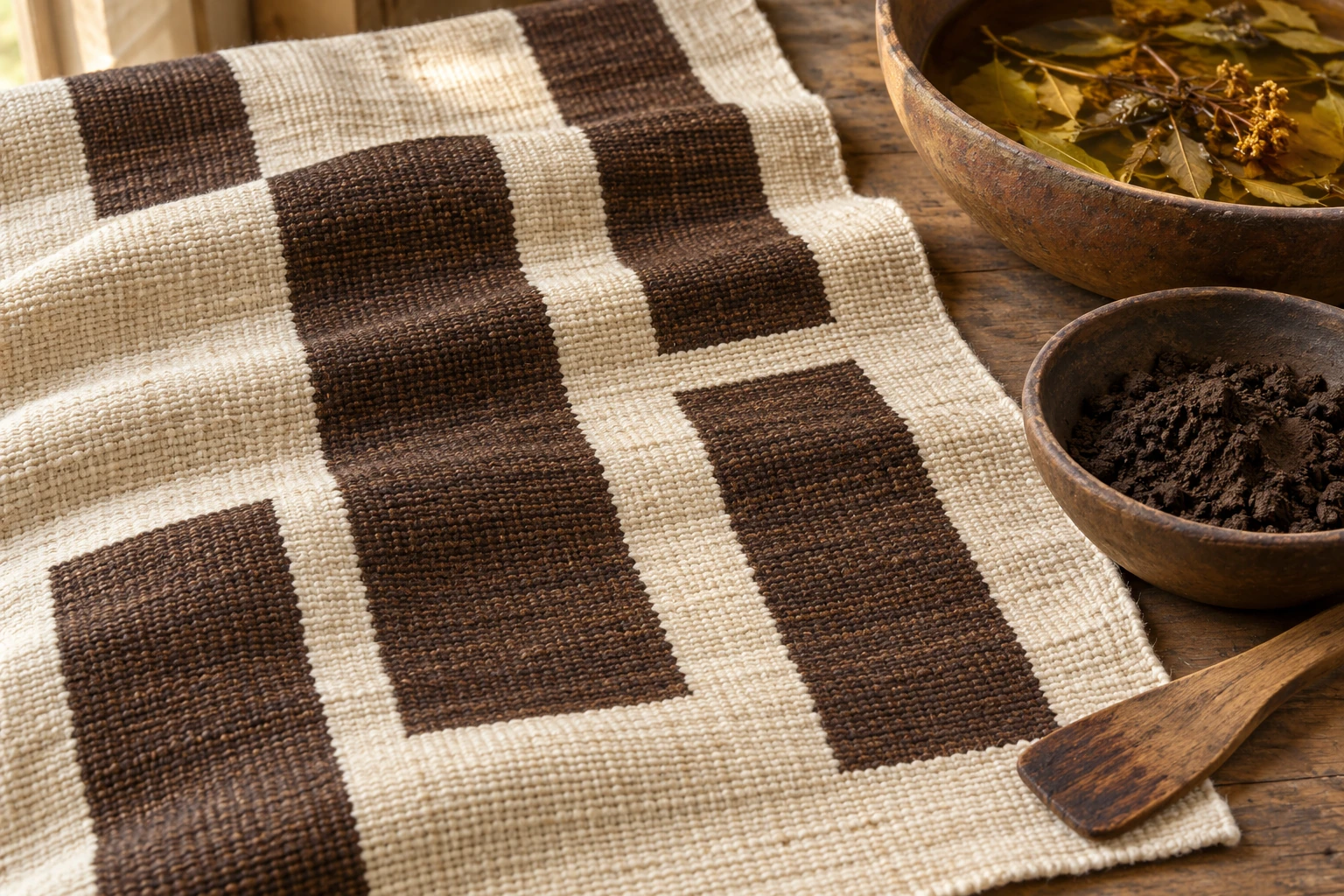
The Chemistry and Knowledge in Bogolan Cloth

Conceptual cotton strip cloth with dark geometric fields, clay bowl, and plant-dye preparation.
Material study with an original abstract pattern; it does not reproduce a documented Bamana motif.

A dark field on cotton can look like an applied surface: a color laid over an already complete cloth. In bogolan, that first impression misses an interaction. Plant preparations, iron-bearing mud, fibers, washing, and the maker’s decisions contribute to the result. The cloth holds knowledge of materials as well as a visible arrangement of shapes.

It also holds somebody’s work. Begin with a named example rather than treating every brown-and-cream textile as an interchangeable “tribal pattern.” The Metropolitan Museum preserves a 1969 cloth by Gneli Traoré, a Bamana artist in Mali. Pascal James Imperato commissioned it and documented its making and designs. Its unusually specific record lets an individual emerge from a category often marketed anonymously.

Look for the cloth before the pattern

The Met’s record describes twelve narrow cotton strips supplied for the commission. These were joined into the larger surface Traoré decorated. The seam is therefore part of the object’s construction, not damage that interrupts an otherwise seamless design.

When studying the museum photographs, first locate a strip boundary. Then follow one shape toward it. Does the painted organization acknowledge the seam, cross it, or make it difficult to notice? Write down the observation before suggesting a reason. A shape that crosses a seam does not by itself prove that the cloth was painted before or after joining; the documented sequence is what can settle that question.

The artist’s biography also resists an easy inheritance story. The catalog identifies her teacher as her father’s youngest wife. It describes Traoré developing work for new markets later in life. Skill was learned, exercised, and adapted by a particular person, rather than transmitted by an undifferentiated “tradition” acting on its own.

Why mud is an incomplete explanation

A 2010 study in Applied Clay Science examined cotton, N’galama leaf extract, and mud used in the process in Mali. It identified iron-bearing material in the clay and investigated the dark complexes formed with compounds in the plant extract. Microscopy and diffraction also detected material attached to the fiber surface. The researchers were studying interactions, not simply matching the cloth’s color to the mud’s appearance.

A 2012 investigation by Mukta V. Limaye and colleagues compared traditionally made textiles with cotton treated using tannin and iron solutions. Infrared spectroscopy, electron microscopy, and X-ray absorption analysis supported the importance of iron–tannin complexes in the black coloration. Multiple methods addressed different parts of the explanation: what was present, where it was, and how its chemistry related to color.

Those findings illuminate the process without replacing the maker’s knowledge. A laboratory can identify a class of chemical interactions. It does not automatically know which local material to choose, how a preparation should handle, or when a particular painted area has reached the desired result. Naming a mechanism and reliably making an object are different accomplishments.

Ground and figure can exchange places

The Met emphasizes that the documented technique is not simply a wax-resist process. Colorant is directly applied to prepared cloth; light shapes can emerge through areas left unpainted and subsequent treatment. Keep that distinction in mind when a label uses the convenient phrase “mud cloth.” It identifies an association with a material, not a complete recipe.

Try looking at the cloth in two ways. First let the light shapes become the figures against a dark background. Then concentrate on the dark passages as connected forms. Which interpretation makes a junction easier to follow? Does either account leave an awkward unexplained edge?

This is a visual exercise, not a decoding key. A motif’s name, historical use, or social meaning needs appropriate documentation and context. Resemblance to a familiar ladder, animal, or letter does not authorize assigning that meaning to a Bamana design. An attractive guess can become misinformation when repeated without its uncertainty.

A small paper experiment in planned space

You can investigate the figure–ground problem without copying a documented motif or attempting an uncontrolled chemical dye process. Draw three adjacent rectangles on paper. Inside them, invent a continuous pale path by coloring only the surrounding space with an ordinary pencil.

  1. Begin with a path of even width. Notice how much of the dark field must be planned before you can keep the light shape continuous.
  2. Introduce a second path that nearly meets the first. Decide whether to preserve a gap or make a junction.
  3. Add a drawn “seam” across the sheet. Consider how it changes the composition even though it has no thickness.
  4. Give the experiment a descriptive name that does not borrow a cultural identity: “two paths and a gap” is sufficient.

The task reveals something practical about leaving areas uncolored. Empty-looking space may require as much advance attention as a dark mark. That is a useful insight to bring back to a textile photograph, while remembering that pencil on paper tells us little about the feel or chemistry of Traoré’s materials.

Listen to the account of making

The Smithsonian’s Malian Bogolan online exhibition draws on documentation of artists participating in its 2003 and 2011 Folklife Festivals. It names workshop members rather than presenting a cloth as an anonymous style. Its making page includes audio of translator and moderator Haoua Cheick-Traoré explaining aspects of the process at the 2003 festival. That voice is a mediated public explanation, not the voice of Gneli Traoré describing the 1969 commission.

Cotton strip seam passes through a newly invented dark-and-light arrangement.
Material study with an original arrangement, not a named Bamana motif.

Listen once for sequence rather than terminology. Which action prepares a surface for the next? Which stage requires waiting, rinsing, or repeating? Then read the page’s account and compare the order. Do not assume that every workshop, artist, or period uses identical materials and timing simply because the English category remains the same.

If you prefer reading, choose one process photograph and identify the action described in its caption. The named workshop gives that image a particular setting. Keep the caption with your observation. A generic image search can detach a method from the people and circumstances that make it evidence.

There is a useful distinction between explaining a mechanism and giving a recipe. “Iron and plant compounds contribute to dark coloration” identifies a relationship studied in the scientific papers. It does not tell an inexperienced reader how to select, prepare, handle, or dispose of every material in a successful dye process. The workshop’s practiced judgments are not erased by a short chemical explanation.

For a small note-taking exercise, divide the process into “material,” “action,” and “decision.” Put cotton under material and rinsing under action. Under decision, write a question that requires judgment: when is the previous stage ready for the next, or which part of the planned light area must remain clear? These are prompts for listening to skilled work, not unreported answers about a particular artist.

Finally, compare the evidence for two named contexts: the Met’s documented commission and the Smithsonian’s festival workshop. Each can illuminate making. Neither should be used to overwrite the other’s biography. Keeping their dates, names, and roles distinct gives a reader more history than an all-purpose narrative of “the traditional maker.”

The seam and the chemistry are already worth close attention. Adding the recorded explanation makes another form of knowledge available: the way people publicly describe what they know how to do. The cloth becomes richer when the language around its making is treated with the same care as its surface.

Read a product description with better questions

If you encounter contemporary cloth sold as bogolan, ask who made it, where, and by what process. A seller’s answer may be specific, incomplete, or absent. A printed cotton fabric inspired by bogolan imagery and a cloth made through plant-and-mud processing have different production histories, even when a thumbnail makes them look similar.

Do not infer authenticity from imperfection or an earthy palette. Irregularity can be imitated; precision can result from expert handwork. The useful evidence is a traceable account of makers, materials, and making. Nor does “natural” establish that every preparation is harmless or that a production chain is environmentally responsible. Those are questions requiring their own evidence.

The scientific papers suggest possibilities for conservation and further dye research; they do not provide blanket environmental certification for every object bearing the name. Keeping a claim at the scale of its evidence is part of respecting the craft.

Next time a dark-and-light textile catches your eye, begin with the seam, the edge, and the maker’s name. Chemistry can help explain why color remains. A careful object record can help explain whose choices it records. Together, they make the cloth more interesting than a surface pattern alone.

Sources and a closer look

The Met: Gneli Traoré cloth, 1969; Blanchart and colleagues: Mechanism of traditional Bogolan dyeing, 2010; Limaye and colleagues: Tannins and iron in Bogolan, 2012.

Find more art, ideas, and unexpected connections at Incoprea.

Wednesday, October 14, 2026

The Jacquard Card Chain: A Textile Pattern Stored in Holes

A complicated textile can begin as a long chain of small decisions: lift this group of threads, leave that group down, pass another thread through, then change the selection. In a Jacquard mechanism, a sequence of punched cards helps make those decisions repeatable. The pattern is stored outside the weaver's memory and presented to the mechanism one step at a time.

The holes are immediately intriguing. Follow them into the rest of the system, though, and a richer story appears: the work of designing a pattern, preparing cards, keeping a sequence in order, and turning that sequence into cloth. It is a story about labour and materials as well as information.

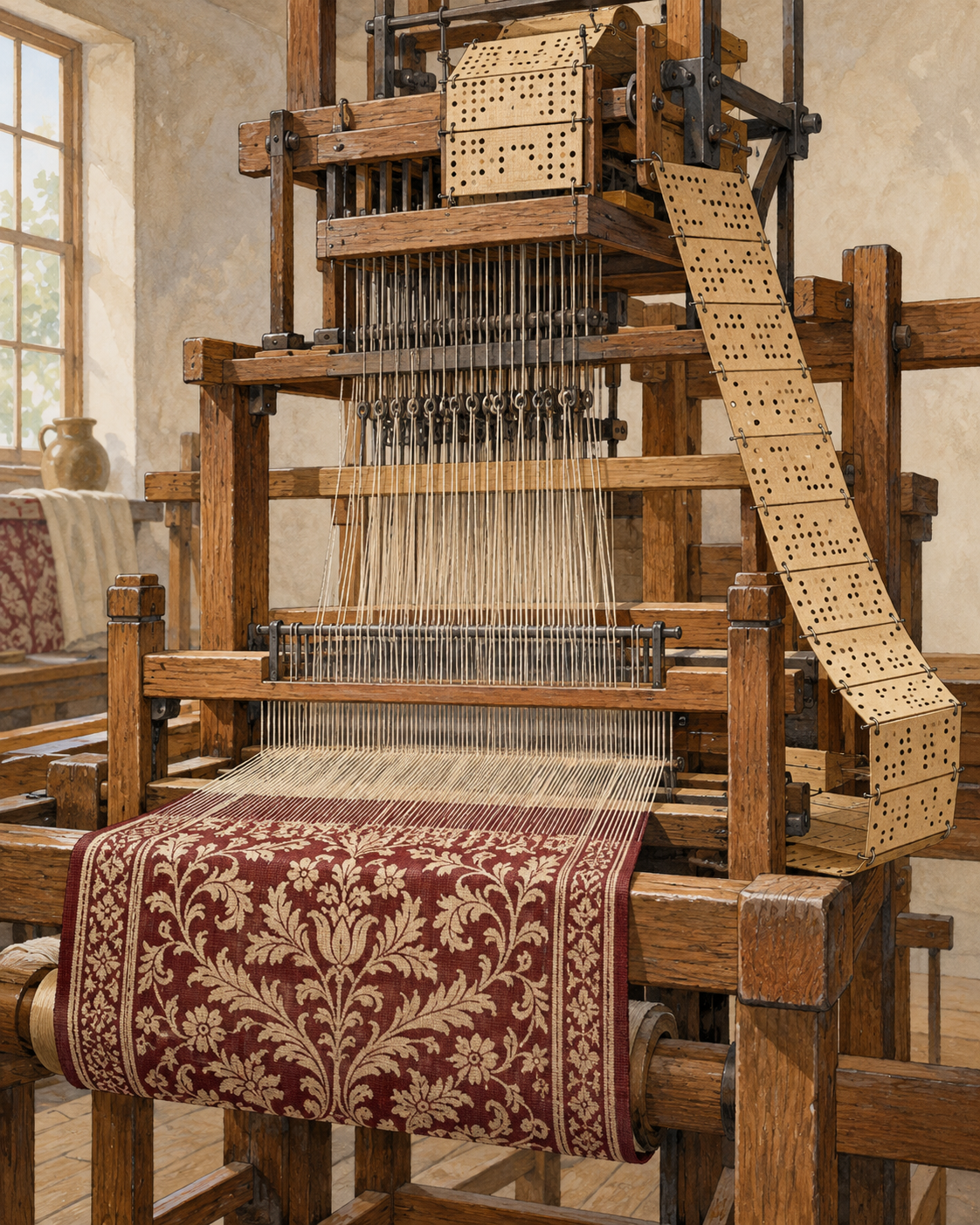
A generalized wooden loom has a hanging punched-card chain and patterned burgundy-and-cream cloth.
An invented historical weaving scene combines a Jacquard-style card chain and cloth. It is not an exact museum machine or a diagram encoding the depicted textile.

What the card controls

The warp is the set of threads held along the loom. The weft passes across them. To weave a patterned structure, selected warp threads or groups have to be raised in a particular sequence. The Jacquard attachment provides a way to control that selection using information carried on cards.

In a simplified account, a hole permits one action while the absence of a hole produces the alternative. The actual relationship between a card position, hooks and threads depends on the loom's arrangement. “One hole equals one thread” is therefore a poor universal rule. The important point is that a physical difference is read by a mechanism.

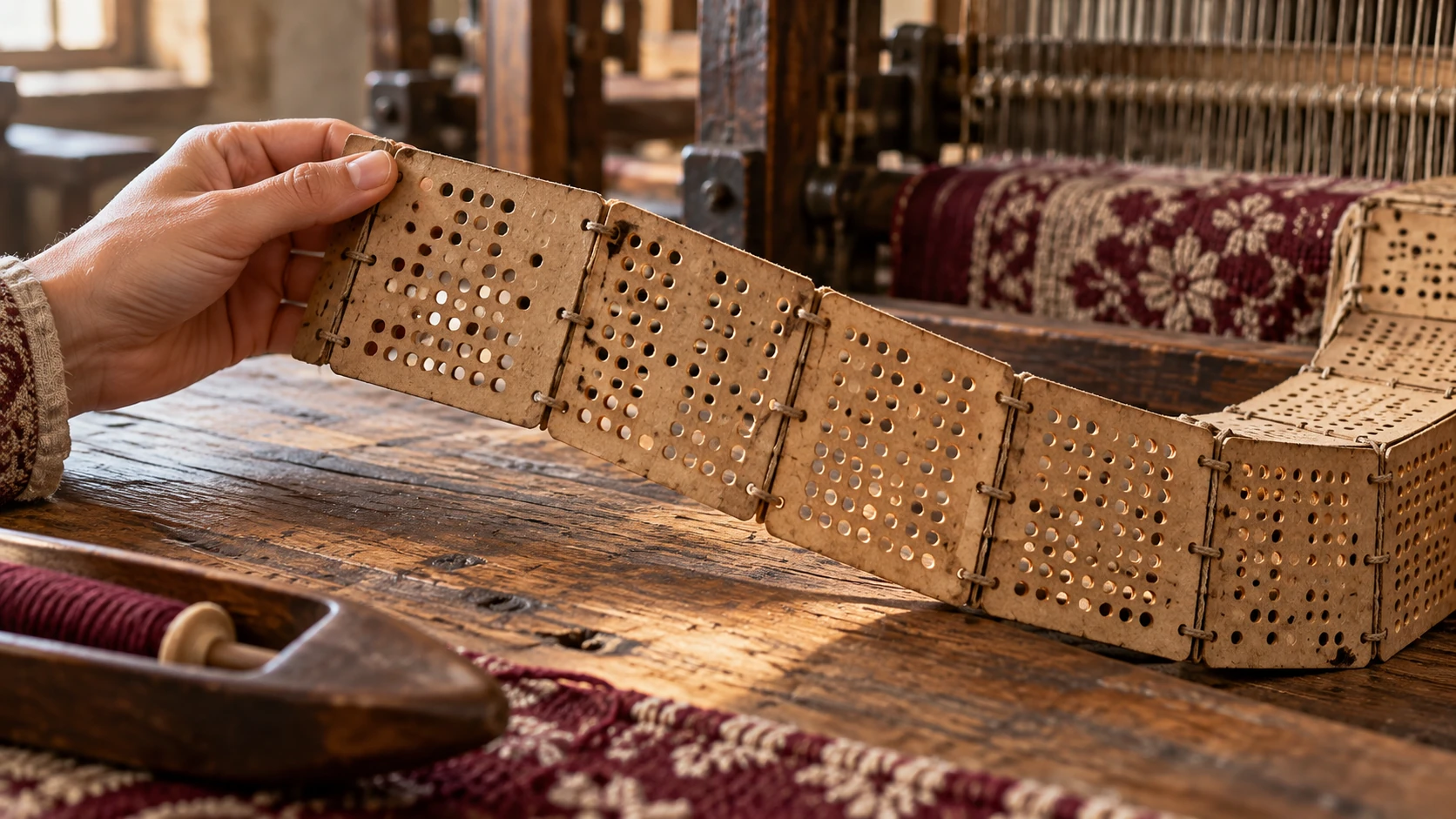
Illustrative close-up of a linked punched-card chain, showing perforations, lacing and the scale of a nearby hand.
An illustrative close-up of a card chain. Its holes do not encode a verified historical textile pattern.

Follow the joins in this close view, rather than counting the holes. Which details let separate cards travel as a sequence? Imagine turning one card around or putting it in a different position. The perforations would remain, but their relationship to the machine and the neighbouring cards would change.

A card does not contain a picture in the way a photograph contains one. Its significance depends on its position in the chain and on the apparatus that interprets it. Without those relationships, a perforated rectangle is only a perforated rectangle. Stored information needs an agreed way to become an action.

Follow a real chain through a museum object

National Museums Scotland describes a handloom used for silk weaving in Stonehouse, Lanarkshire. Its Jacquard attachment worked with cards laced together, potentially in their thousands, to produce complex designs. The museum names the brothers Robert and James Hamilton as its users and records a maker's stamp associated with Joseph Hood of Newmilns.

Those details return people and places to a machine often presented only as a milestone on the road to computing. A loom had to suit a workshop, materials, a market and workers who knew how to use it. The surviving object also carries a regional industrial history.

Look at the museum's gallery photographs in sequence. Start with the entire loom, then the hanging cards, then the cloth. Where does the stored pattern enter? Where is motion transmitted? Where does the product emerge? Moving among these views is more informative than trying to understand everything from a single dramatic photograph.

The holes had to be made

The Science Museum Group holds a card-making hole punch made in Coventry in 1870 by James Heywood, catalogued as part of a model. It directs attention to an easily missed stage: instructions have to be prepared before the loom can use them. Mechanisation redistributes work; it does not make the work of design vanish.

A pattern must become a sequence the particular machinery can read. Card positions need to correspond to intended selections, and the cards need to stay in the right order. Repeating a pattern reliably becomes possible because a great deal has been specified in advance.

This changes the nature of an error. A faulty selection may recur whenever the same card returns. A misplaced card can disrupt the sequence. A mechanical fault may produce a different kind of problem. To understand a flaw in the cloth, a worker needs to consider both the instructions and the apparatus that carries them out.

A small sequencing puzzle

Imagine a demonstration with only four controlled thread groups, named A, B, C and D. The following table gives selections in words. It is an invented teaching example, not a card design for a historical loom.

Four successive selections
StepGroups selected
1A and B
2B and C
3C and D
4D and A

First imagine that step two accidentally selects D as well as B and C. Then imagine that the cards for steps two and three have been swapped. Both faults alter the result, but they alter different things. One changes the content of an instruction; the other changes its place in the sequence.

What should you inspect first?

For an unwanted selection that appears at the same point in each repeat, inspect the relevant card and the mechanism it controls. For two otherwise plausible selections arriving in the wrong order, inspect the chain's arrangement. This is a reasoning exercise, not a diagnosis for operating machinery: real looms can have several interacting faults.

The point is to notice that order is itself information. A bag containing all the correct cards cannot do the work of a correctly arranged chain. That principle carries far beyond weaving, but it is already tangible here in the links between neighbouring cards.

Watch the textile before following the computer connection

The Science and Industry Museum's article “Weaving numbers” includes a film about the loom and early computing. On a first viewing, follow the cards and the repeated mechanical movement. On a second, focus on the threads and the emerging fabric. The two views connect an abstract sequence to a material result.

Charles Babbage proposed punched-card input for his Analytical Engine. The Science Museum's drawings show cards within a broader planned calculating system. That connection is substantial, but the textile mechanism was not itself a general-purpose computer, and a drawing of the Analytical Engine is evidence of a design rather than a completed Victorian machine.

The most useful inheritance is a way of thinking: instructions can be stored in a durable physical form, read in sequence, and used to govern repeated operations. The cards make that idea visible. The cloth reminds us why it was developed and why the people who prepared, read and worked with those instructions belong in the story.

Sources and further reading

Explore more art, stories and discoveries at Incoprea.

publications

New this week Two novels in six stories each, from The Night Shift . New — a novel in six documents Small Print A Novel in Six Do...