Boro: Reading Repair Without Romanticizing Poverty
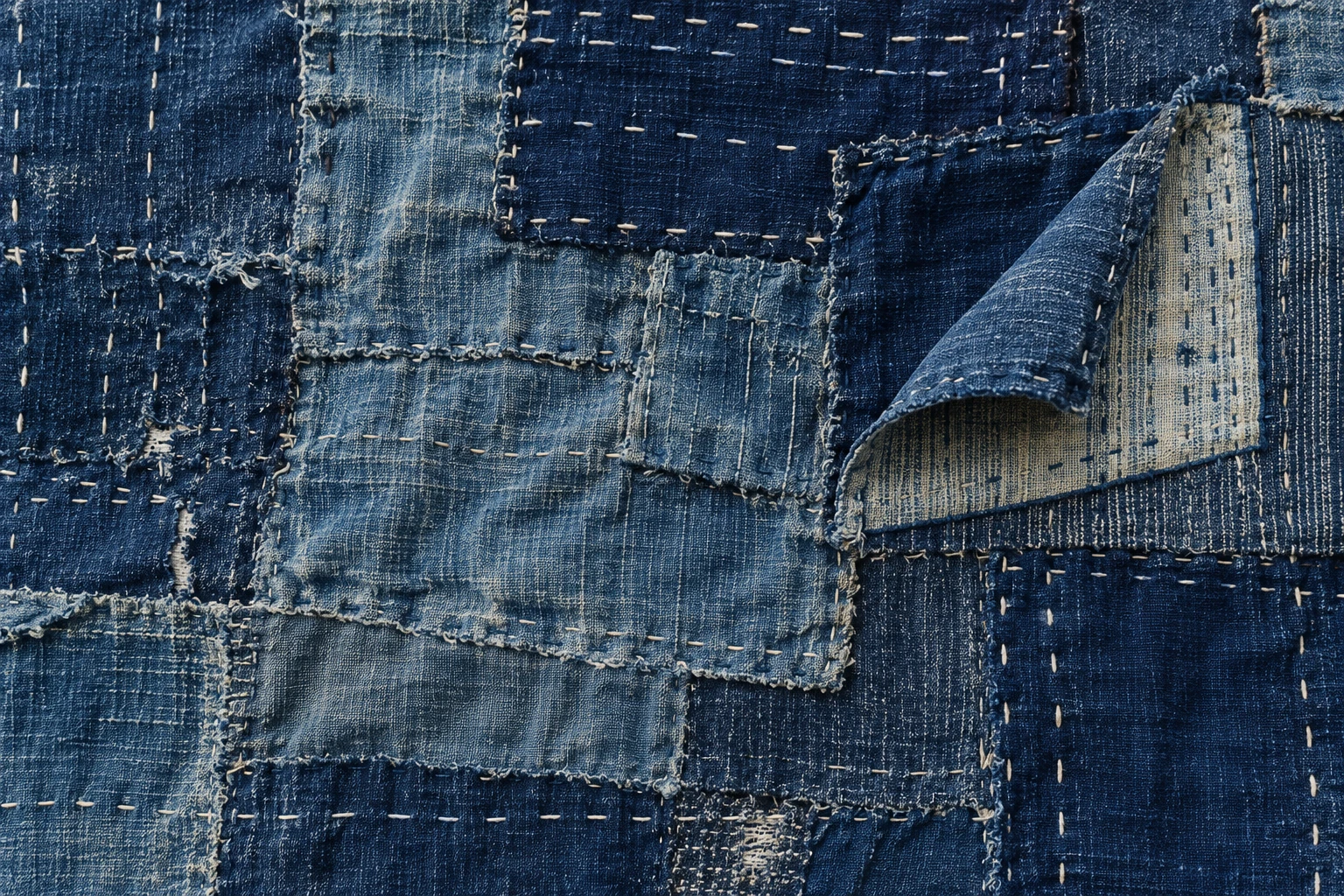
A patched cloth can be read in layers. A pale blue piece covers a darker one; a row of stitches crosses an earlier seam; a thin patch has worn through to expose something beneath. The surface is the result of repeated decisions, not necessarily a composition planned all at once.
Japanese boro textiles invite admiration for their color and texture. They also ask an uncomfortable question: what happens when work born of material necessity is celebrated mainly as a beautiful style?
Original mending study, not a historic boro textile or a documented family artifact.
A practice of continued use
The Victoria and Albert Museum’s explanation links boro with the reworking and repair of clothing and bedding through piecing, patching, and stitching. It describes garments passed through rural families, and distinguishes this practical history from today’s interest in a repaired or distressed appearance.
The International Quilt Museum’s exhibition, curated by Yoshiko Wada, similarly emphasizes cycles of use and reuse before the Second World War. Scraps covered worn areas and were held with running stitches; successive repairs produced layered, uneven surfaces. The museum places necessity alongside the later admiration of that rough beauty.
These accounts give us a better starting point than treating every blue patch as a timeless expression of a single national philosophy. An individual cloth had particular materials, uses, repairs, and people around it. Some of those details survive; others do not.
A seam is a relationship between materials
Look first at where one patch overlaps another. Which edge lies on top? Does a line of stitching secure two layers or pass through several? Is a thin area reinforced from the visible side, the reverse, or both? These questions concern construction before symbolism.
A photograph can suggest a sequence, but it may not establish it. A later stitch can cross an earlier patch, yet a repair may also have been unpicked, moved, or reinforced. Without close physical examination and documentation, a confident family story attached to every seam becomes invented intimacy.
What can still be appreciated is the practical intelligence of the result. A usable textile has to hold together under movement and wear. Its maker is solving problems of strength, coverage, available pieces, and the time required to do the work. Admiring that intelligence does not require pretending hardship was pleasant.
The modern gaze changes the object
A Cooper Hewitt discussion of boro observes that functional patching can acquire an artistic appearance through arrangements not originally intended as decoration. The museum’s account is useful because it makes the modern act of appreciation visible. We are not simply recovering exactly what every earlier user felt when looking at a worn futon cover.
Japan Society’s exhibition materials place historical textiles in conversation with contemporary art and fashion. That conversation can be productive if the categories remain clear: an old repaired garment, a contemporary artwork, and a luxury fashion piece may share visual features while belonging to very different economies.
A new distressed garment can imitate the appearance of repair without containing a long history of use. A contemporary maker can also repair a real worn object for practical reasons. Neither fact should be hidden by a label that reduces every case to one desirable look.
Four questions for looking at a repaired textile
Question
What to look for
What job did this object do?
A documented garment, bedding cover, wrapping, or other use
What is actually repaired?
Holes, thin areas, seams, or structural stress points
Which history is documented?
Maker, community, date, collection history, or acknowledged gaps
What does the display emphasize?
Color, technique, labor, poverty, reuse, fashion, or some combination
Do not expect every museum label to answer all four. The point is to identify which aspect you are seeing, and which questions remain available. A cloth hung flat as art may reveal patterns beautifully while concealing how it moved on a body or folded around bedding.
There is also a difference between a repair that remains visible and one meant to disappear. A museum display can make conspicuous stitching seem like the essential virtue of mending, although a person fixing an ordinary object may value an unobtrusive result. Neither preference should be assigned retrospectively to every earlier user.
Consider your own low-stakes example: a patch on a cleaning cloth and a patch on a formal garment answer different demands. The same strength, color, or thickness might be welcome in one and unsuitable in the other. Thinking through those demands restores choice to a surface that could otherwise be admired simply as accidental abstraction. It also reminds us that the time spent maintaining an object is work, even when the resulting marks become beautiful to a later observer.
A repair is not a cultural diagnosis
The Museum of Far Eastern Antiquities in Stockholm makes a useful distinction in Stitch after stitch. Its account brings together boro, traditional workwear, and later fashion inspired by those textiles. It also discusses sashiko as running-stitch work used for repair and reinforcement. Sharing a stitch does not make every object share the same original use, economic setting, or later meaning.
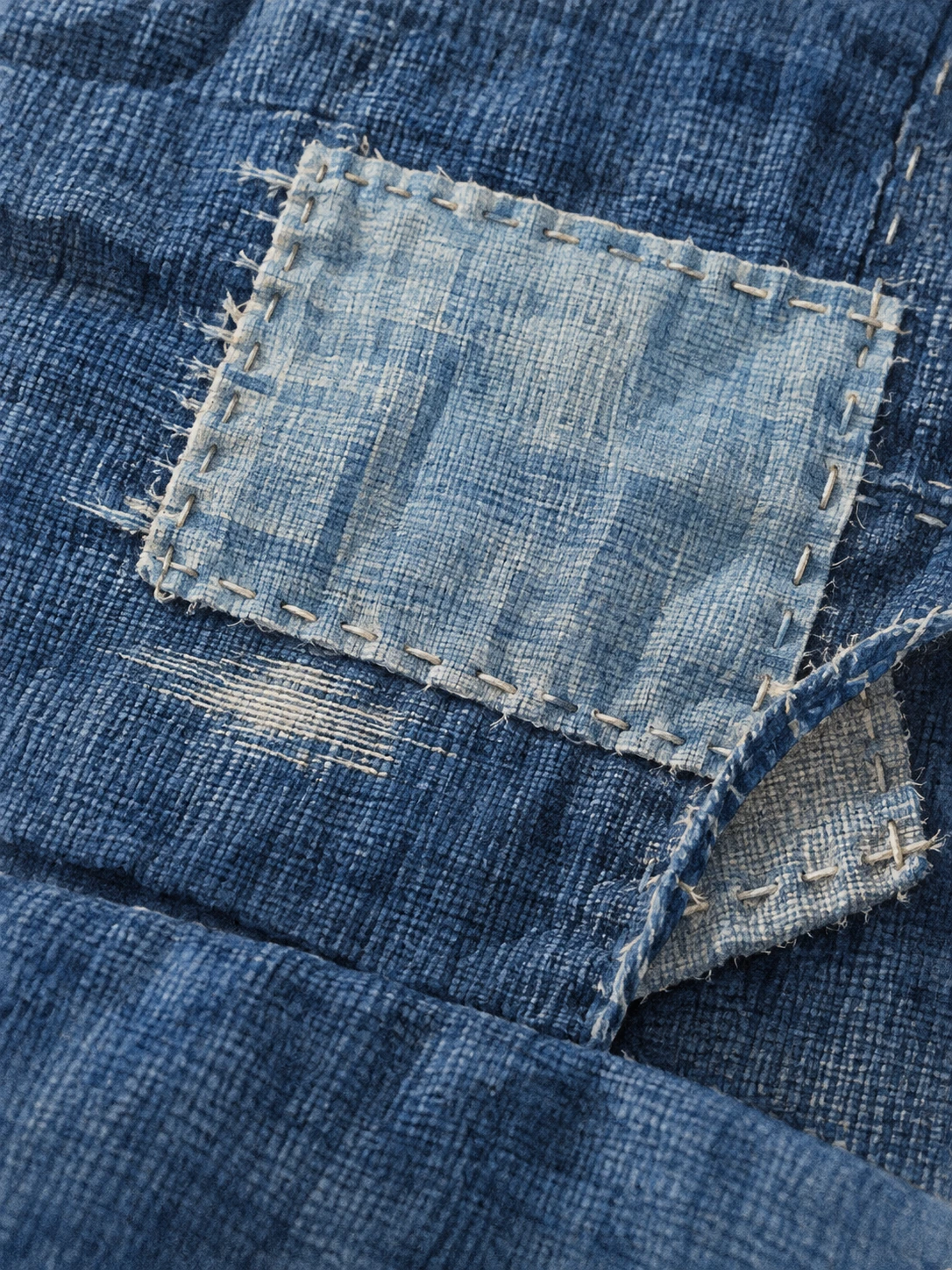
Contemporary repair study, not a historic boro textile.
A comparison outside the familiar indigo surface sharpens the point. The Smithsonian’s National Museum of Asian Art catalogs a Japanese silk brocade hanging, F1916.646, under a title noting four repairs. The record dates the textile broadly to the Edo period and gives its later collection history. A repaired silk hanging is not thereby a boro garment. “Repaired” names an intervention; assigning a textile to a particular practice requires more specific evidence.
Imagine three ordinary objects: a patched household cloth, a work jacket reinforced before it tears, and a museum textile stabilized so it can be supported safely. They may all contain added thread, but the aims differ. One restores use, another anticipates stress, and another supports preservation and study. These are invented examples for comparison, not diagnoses of the two museum objects.
Try a two-pass description of one photograph. First use only construction terms: overlapping edge, running stitch, doubled layer, seam, worn area. In the second pass, add only the history supplied by its catalog. If “a grandmother lovingly repaired it each winter” appears without documentation, remove it. The sentence may feel intimate, but it substitutes an invented person for the people whose work actually survives.
There is another question worth keeping open: which face of the textile is being shown? A hanging displayed flat can make a practical reinforcement look like a deliberate picture. Its reverse may reveal patch shapes or stitch routes that change the reading. Ask for another documented view before deciding that a visually attractive arrangement was the maker’s primary objective.
Finally, consider what happens when a museum title foregrounds repair. It directs the visitor’s attention toward the textile’s continued life, while a title such as “brocade hanging” directs attention toward its original category. Both can be useful. Reading them together helps us appreciate maintenance without allowing a later collector’s preferred vocabulary to erase the object’s other histories.
A small act of care, with honest naming
If this history makes you want to mend something, begin with your own ordinary cloth. Choose a low-stakes item such as a worn household rag or a practice scrap. Notice the thin area and consider how a patch might extend its use. A needle requires normal care and appropriate supervision for children; a paper collage can model the overlapping decisions without stitching.
Before doing anything decorative, write one sentence about the function you want to restore. Then choose the smallest intervention that serves it. Afterward, record what you used and why. You are creating a documented contemporary repair, not manufacturing an antique history or claiming membership in a traditional practice through appearance alone.
Compare the repaired area after use. Did stress move to the edge of the patch? Was the cloth too heavy or too stiff? The outcome gives you a practical respect for the skill hidden in repairs that seem casual from a distance.
Boro can be beautiful without turning necessity into romance. The strongest appreciation makes room for the people who kept things usable, the resources they had, and the labor they gave. A patch is an addition, but it is also a decision that an object’s working life can continue.