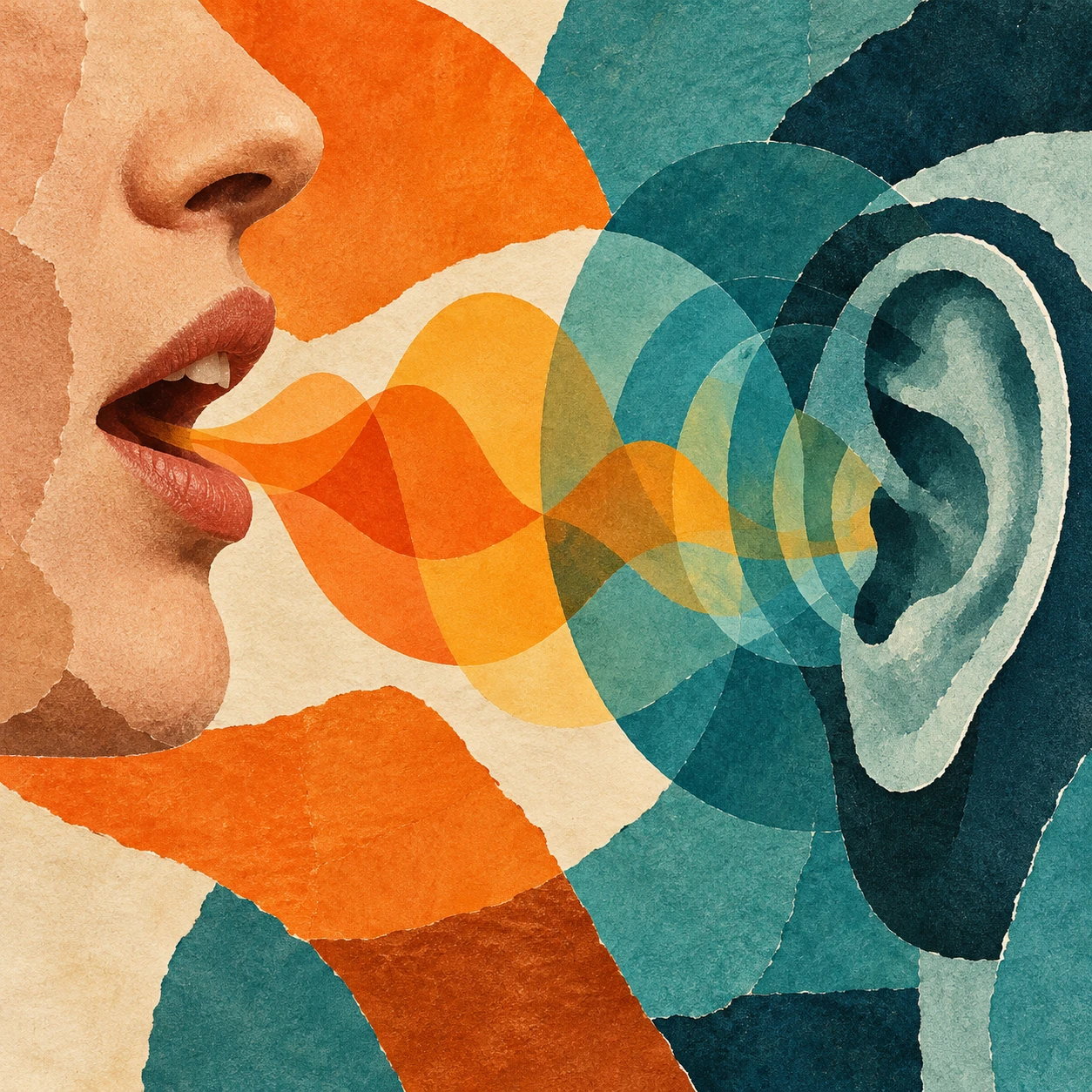
A face appears to say one syllable while the voice says another. Some listeners hear a third result, neither a simple copy of the sound nor a silent reading of the lips. The McGurk effect turns an ordinary act—watching someone speak—into a question about how the senses cooperate.
Try it before choosing an answer
The BBC's video demonstration gives a short audiovisual example. Listen once while watching the face, then once with the image covered or your eyes comfortably closed. Keep the volume unchanged. Write what you heard in your own terms before selecting among suggested syllables. Use the video only if its audio and picture are synchronized.
A classic experimental pairing combines an auditory “ba” with visual movements associated with “ga.” A listener may report a fused percept such as “da.” The exact result depends on the recording, listener and response task. It is a striking example of audiovisual speech perception, but the useful question begins where the claim “everyone hears this” ends.
The generated hero illustration cannot produce the effect: it is a visual introduction, not a speech stimulus. A proper comparison needs moving articulation and a specified sound track. Likewise, silently reading this paragraph and imagining the syllables is a different task from hearing the recording.
If your percept does not change, that is not a failed attempt to be a good audience member. The demonstration's value does not depend on persuading every reader to report the expected result. A difference among listeners is one of the things researchers have to explain.
The sensory information can stay still while the task changes
Laura Getz and Joseph Toscano's 2021 study varied response format, stimulus set and testing environment while using the same eliciting stimuli. The frequency of fusion reports varied substantially. Their experiments challenge the assumption that a standard-looking clip measures one context-free susceptibility.
Consider the difference between “What did you hear?” and “Was it ba, da or ga?” The second question supplies categories and may make a blended or uncertain impression fit a ready-made box. That does not mean all forced-choice studies are invalid. It means a study's response procedure is part of its method, not an invisible administrative detail.
For your own viewing record, preserve both stages. First write a free description; only afterward compare it with conventional labels. “Between two syllables” contains information that disappears if you force it prematurely into a single answer. Confidence is useful too: a tentative label and an unmistakable percept should not automatically be treated as identical experiences.
A person and a clip form a combination
A 2015 study of variability and stability examined 360 participants and 20 McGurk stimuli. Responses varied with participants, stimuli and response conditions. The large stimulus range makes an important point: one clip's success does not establish that a listener reacts the same way to every audiovisual mismatch.
This is where a richer account differs from calling the brain “easily fooled.” Speech perception normally has to combine changing evidence. In everyday conversation, a moving face and a voice usually belong to one person. A laboratory mismatch creates a useful conflict among cues that are ordinarily correlated. The result tells us something about that combination; it does not show that vision always defeats hearing.
Research on individual susceptibility has also tested proposed perceptual and cognitive correlates. The authors emphasize that the sources of individual differences remain incompletely explained. A home reaction to a clip is therefore not a personality test, a measure of intelligence, or a general ranking of sensory ability.
| What changes? | What the comparison can ask |
|---|---|
| The face is visible or covered | Does visual speech affect this auditory report? |
| The answer choices change | How does the response task shape the recorded result? |
| The clip changes | Does the same listener respond similarly across stimuli? |
| The synchronization changes | Are the cues still being presented as the intended event? |
What this teaches a video maker
The practical lesson is not to produce an illusion whenever a person talks on screen. It is to treat the relationship between image and sound as meaningful information. A dialogue edit that changes a visible articulation while retaining another sound can create a perceptual conflict even if both tracks seem individually plausible.
A useful production check compares the exact sound track with the visible face at normal playback speed. If a viewer reports an odd consonant, do not assume the transcript alone settles the experience. Listen without the picture, then review the combined event. Those two checks answer different questions about what the audience receives.
This is an editorial inference from the demonstration, not a quantified promise about every dubbing error. Natural speech is richer than a repeated isolated syllable, with word meaning, sentence context and many opportunities for correction. The laboratory effect opens a question; it should not swallow the whole subject of conversation.
The mouth that changes a heard syllable reveals a constructive process: perception makes sense of evidence across more than one channel. Its variability is part of the discovery. The result becomes deeper when we ask not only what someone heard, but which face, which voice, which timing and which question produced that answer.
Sources and a closer look: BBC: audiovisual McGurk demonstration; Getz and Toscano: task-dependent McGurk reports; Variability and stability across participants and stimuli; Individual differences in susceptibility.
Explore art, experiments and other unexpected connections at Incoprea.