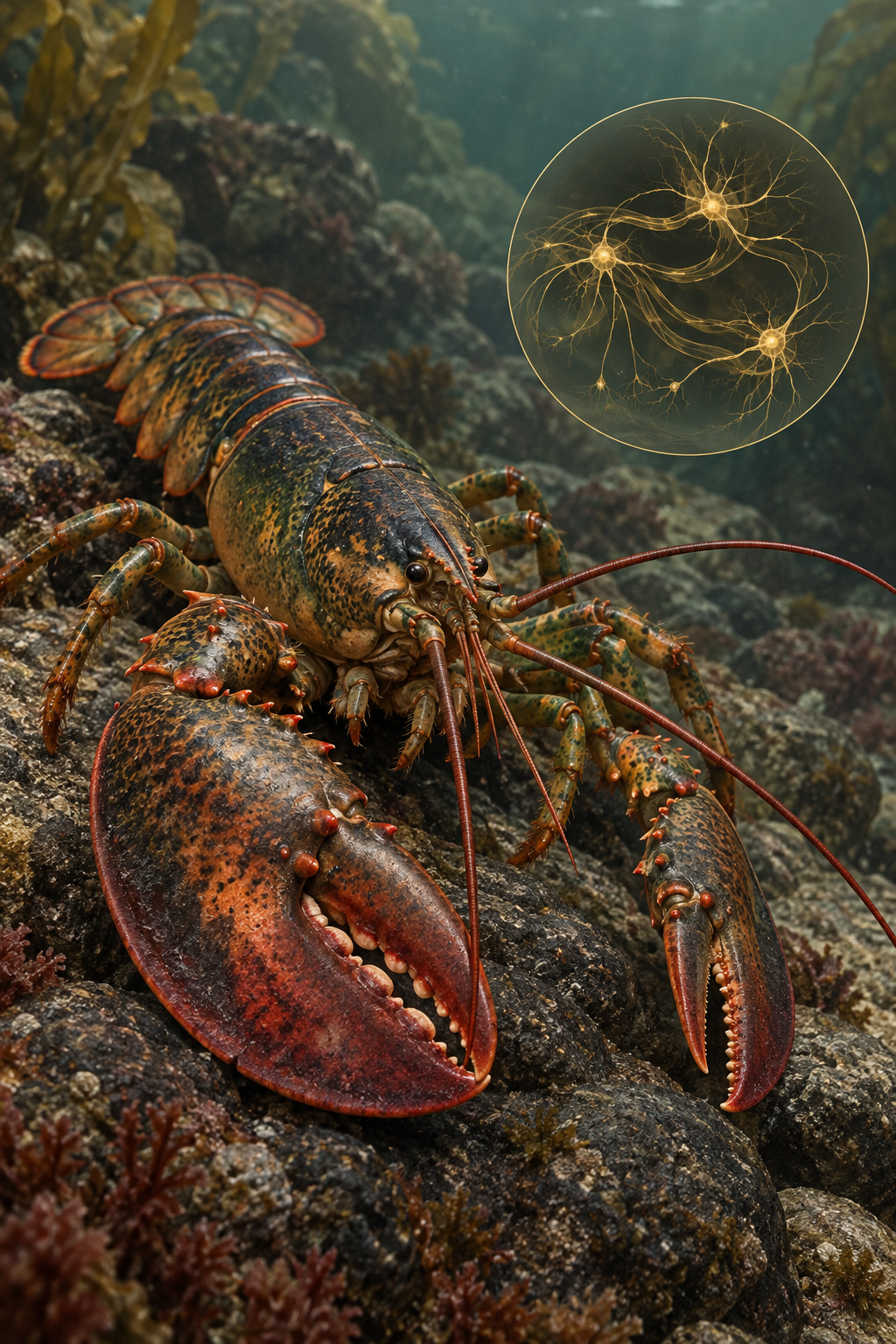
A lobster's digestion involves coordinated movements inside its body: food is chewed, filtered and moved along. Controlling those movements requires rhythmic signals. A small part of the crustacean nervous system has become one of neuroscience's most informative models precisely because researchers can study its components in detail.
The stomatogastric ganglion contains only about 30 neurons in the lobsters and crabs commonly used for this research. That is a particular ganglion, not the animal's entire nervous system. Its manageable size gives scientists a way to connect individual cells with the patterns they collectively produce.
A circuit that generates rhythms
Neural networks known as central pattern generators can produce repeated motor patterns. In the stomatogastric system, interacting circuits organize different aspects of digestive movement. The gastric mill circuit helps coordinate chewing, while the pyloric circuit organizes faster filtering and related movements.
| Studied pattern | Digestive role |
|---|---|
| Gastric mill rhythm | Coordination of chewing movements |
| Pyloric rhythm | Coordination of filtering and pumping-related movements |
Researchers can identify neurons, record electrical activity and investigate their connections. Under suitable laboratory conditions, an isolated ganglion can continue producing rhythmic activity. This makes it possible to study how a pattern arises without having to infer everything from the animal's visible behavior.
A rhythm is still influenced by the cell's properties, its connections and incoming modulatory signals. The network is not simply a tiny rigid clock that ticks identically in every circumstance.
Rhythm includes a sequence, not just a speed
Tap three fingers in a repeating order: first, second, third, then begin again. Now repeat faster while keeping the same relative spacing between the taps. The frequency has changed, but the pattern within each cycle remains similar. This limited analogy helps distinguish two properties of a rhythmic motor system.
In the pyloric rhythm, researchers can examine when different neurons become active relative to the cycle. A useful pattern is not defined only by how many bursts occur each second. The order and relative timing help organize the motor output. Two recordings with different overall speeds can therefore preserve an important relationship.
An isolated preparation gives unusual access to those relationships. Researchers record activity from identified cells and nerves instead of relying only on the visible motion of an intact animal. That does not mean the preparation contains every sensory and physiological influence found in the living lobster or crab. The experimental simplification makes some questions tractable while setting limits on others.
Keep the scale of the claim visible: about 30 neurons refers to the studied stomatogastric ganglion, not to the entire animal, and not to a universal count for every crustacean. A small accessible circuit is useful because its parts can be investigated in detail, not because the rest of the nervous system has become irrelevant.
The same result can have different ingredients
Work associated with Eve Marder's laboratory has shown why a wiring diagram is not the whole explanation of a neural circuit. Ion channels shape a neuron's electrical behavior, synapses determine interactions, and neuromodulators can alter how the system responds.
Measurements across individual animals reveal variation in these components. A 2009 study of crab pyloric circuits found substantial differences in synaptic strength, a modulator-evoked current and expression of several ion-channel genes. Relationships among the measurements helped explain how circuit output related to the differing ingredients.
This supports a broader lesson: similar useful activity need not require exactly identical values for every underlying parameter. A circuit can have multiple workable configurations. Conversely, changing one component may have different consequences depending on what else is present.
Temperature tests what “the same pattern” means
The 2020 eLife paper used computational models to investigate how pyloric activity can remain organized as temperature changes. Different channel processes have different temperature sensitivities. If every component simply sped up by exactly the same factor, compensation would be a much less interesting problem.
The models instead allowed the relative contributions of currents to change while a triphasic pattern persisted. This separates reliable output from an unchanging internal mechanism. A system can preserve a useful relationship by shifting how its parts contribute, rather than by holding every microscopic quantity fixed.
Return to the finger-tapping comparison. An observer who counts only repetitions per minute could miss a change in relative timing. An observer who checks only the sequence could miss a major change in speed. A useful circuit analysis asks both questions, then examines which measured properties support the result.
The same caution applies to perturbations. Removing or changing one current can have different consequences depending on temperature and the other available currents. A manipulation that seems essential under one condition need not have an identical effect under another. This is one reason a wiring diagram and a list of neuron names do not finish the explanation.
The research does not turn a crustacean digestive circuit into a miniature human brain. It offers a system in which rhythm, variation and compensation can be studied with enough precision to test competing explanations. The transferable insight is a way of asking how dependable function emerges from components whose properties are neither identical across animals nor constant across conditions.
Sources and further reading: Brandeis Marder Laboratory: Stomatogastric circuits · Functional consequences of animal-to-animal variation · Temperature compensation in a small rhythmic circuit




