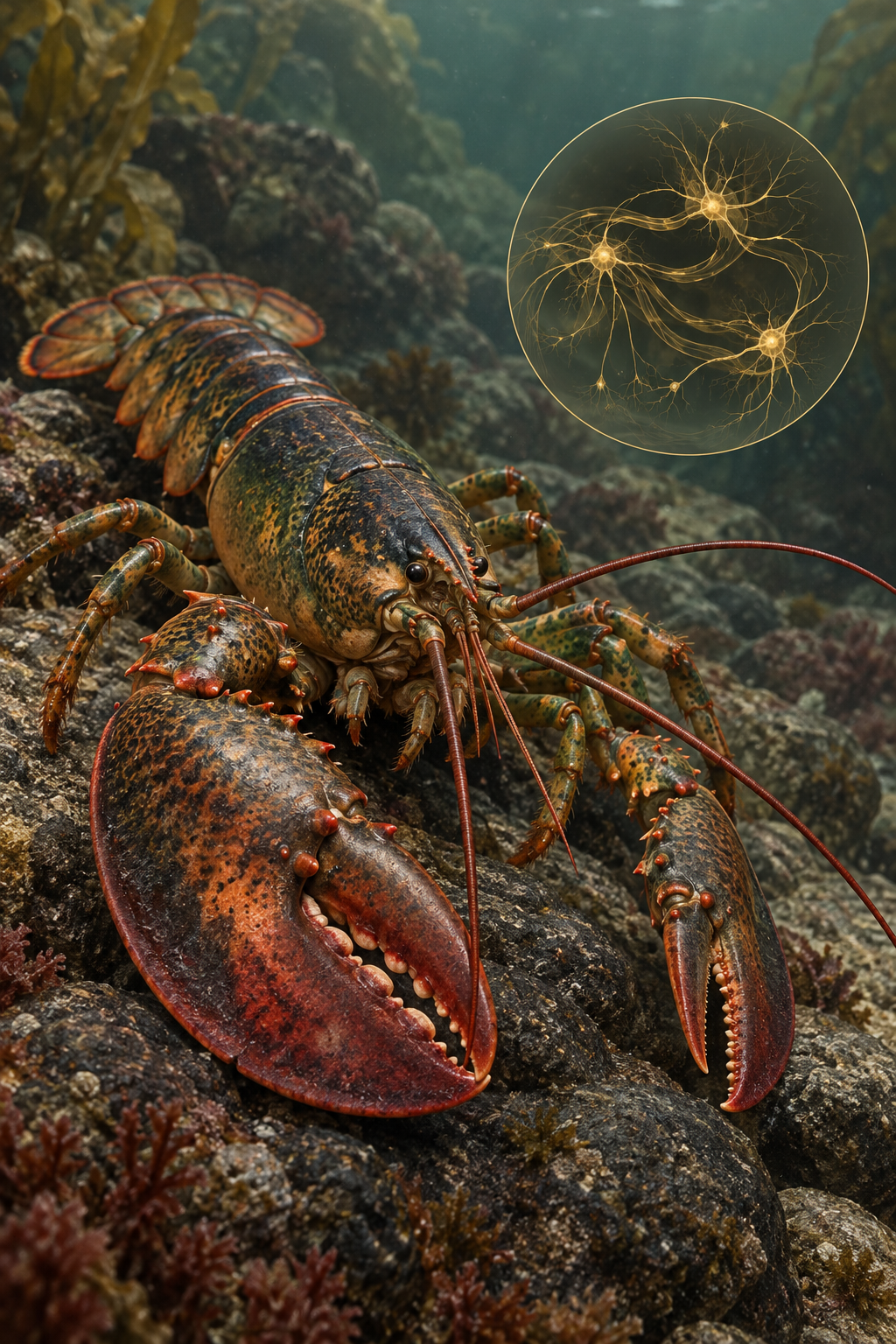
A lobster's digestion involves coordinated movements inside its body: food is chewed, filtered and moved along. Controlling those movements requires rhythmic signals. A small part of the crustacean nervous system has become one of neuroscience's most informative models precisely because researchers can study its components in detail.
The stomatogastric ganglion contains only about 30 neurons in the lobsters and crabs commonly used for this research. That is a particular ganglion, not the animal's entire nervous system. Its manageable size gives scientists a way to connect individual cells with the patterns they collectively produce.
A circuit that generates rhythms
Neural networks known as central pattern generators can produce repeated motor patterns. In the stomatogastric system, interacting circuits organize different aspects of digestive movement. The gastric mill circuit helps coordinate chewing, while the pyloric circuit organizes faster filtering and related movements.
| Studied pattern | Digestive role |
|---|---|
| Gastric mill rhythm | Coordination of chewing movements |
| Pyloric rhythm | Coordination of filtering and pumping-related movements |
Researchers can identify neurons, record electrical activity and investigate their connections. Under suitable laboratory conditions, an isolated ganglion can continue producing rhythmic activity. This makes it possible to study how a pattern arises without having to infer everything from the animal's visible behavior.
A rhythm is still influenced by the cell's properties, its connections and incoming modulatory signals. The network is not simply a tiny rigid clock that ticks identically in every circumstance.
The same result can have different ingredients
Work associated with Eve Marder's laboratory has shown why a wiring diagram is not the whole explanation of a neural circuit. Ion channels shape a neuron's electrical behavior, synapses determine interactions, and neuromodulators can alter how the system responds.
Measurements across individual animals reveal variation in these components. A 2009 study of crab pyloric circuits found substantial differences in synaptic strength, a modulator-evoked current and expression of several ion-channel genes. Relationships among the measurements helped explain how circuit output related to the differing ingredients.
This supports a broader lesson: similar useful activity need not require exactly identical values for every underlying parameter. A circuit can have multiple workable configurations. Conversely, changing one component may have different consequences depending on what else is present.
Robust does not mean unchanging
Researchers also use these circuits to investigate temperature. Electrical and chemical processes change with temperature, yet a functional rhythm can persist over a range of conditions. Models and experiments help examine how different properties contribute to that robustness and where it breaks down.
The result is not a direct explanation of every human brain function. A digestive circuit in a crustacean has its own biology. Its value is that general questions about rhythm, variability and compensation can be tested in a system whose cells are unusually accessible.
A few dozen neurons can therefore illuminate a problem faced by much larger nervous systems: how to produce dependable behavior with changing inputs and variable components. The small model makes the complexity visible rather than making it disappear.
Sources and further reading: Brandeis Marder Laboratory: Stomatogastric circuits; Functional consequences of animal-to-animal variation; Temperature compensation in a small rhythmic circuit.
Explore more creative discoveries at Incoprea.




