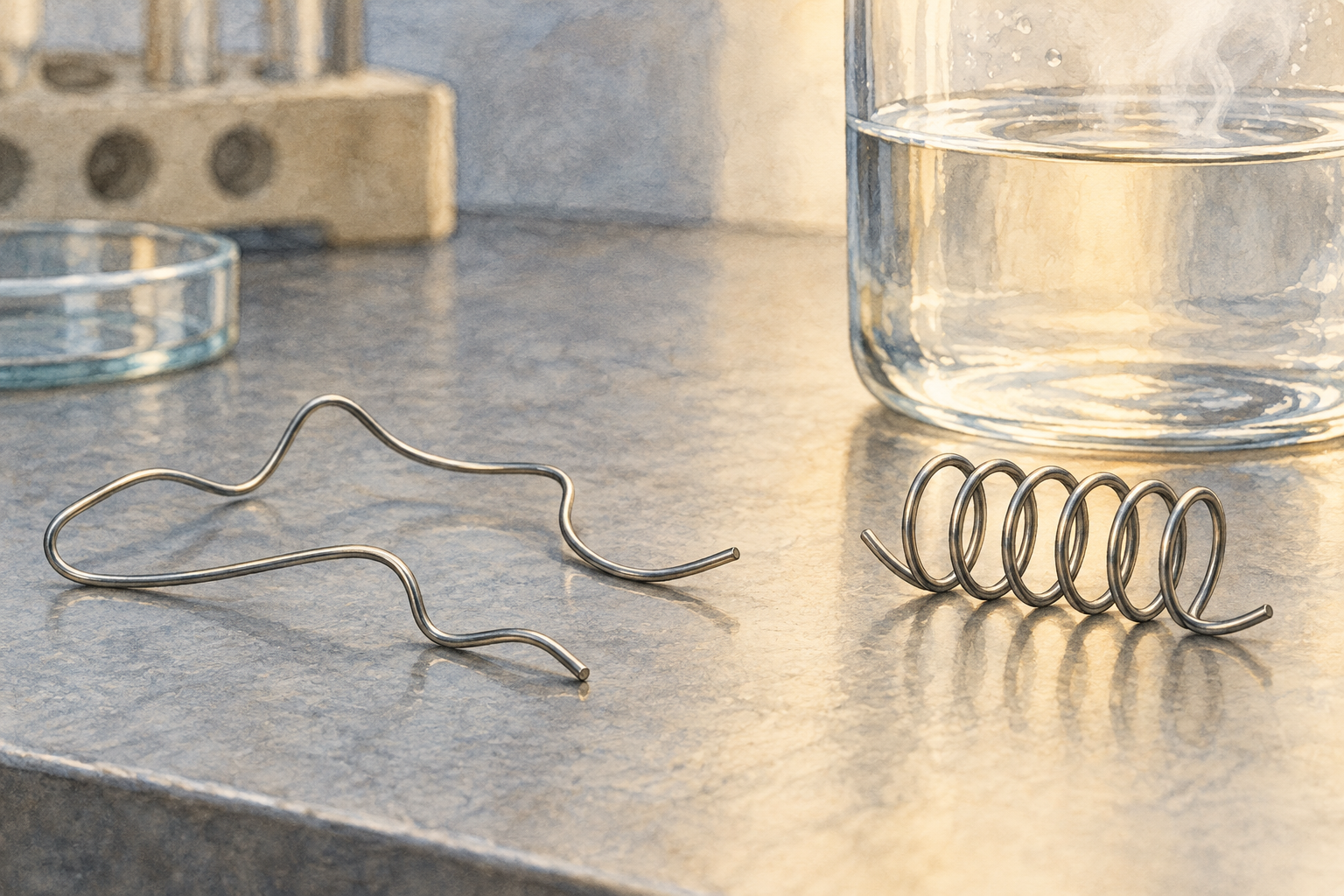
A bent wire usually stays bent. A suitably prepared piece of nitinol can behave differently: warm it through its transformation range, and it recovers a shape established earlier. Watching a crooked strand become a spring makes an ordinary metal seem unexpectedly purposeful.
Nitinol is based on nickel and titanium in roughly equal atomic proportions. Its memorable behavior comes from a change inside the solid, which engineers can use to produce useful movement.
The memory is in the structure
The alloy can adopt different crystal structures called martensite and austenite. In an appropriate lower-temperature condition, deformation can rearrange the martensitic structure. Heating through the reverse transformation restores the austenitic form and allows the previously set shape to return.
This is a solid-state transformation. The wire does not have to melt and be poured into a hidden mold. Its internal organization changes while the component remains a solid object.
Heat treatment helps establish the response, and there is a range over which transformation begins and finishes. “Memory metal” therefore describes a prepared material with particular conditions, rather than a universal promise that any bent nickel-titanium object will repair itself.
A metal can become an actuator
An actuator turns supplied energy into movement. With a shape-memory alloy, a temperature change can make a component bend or twist, transferring that movement to a mechanism.
NASA described an aircraft demonstration in 2018 using a specially developed alloy in wing-folding actuators. A small research aircraft called PTERA changed the angle of its outer wing portions during flight, reaching 70 degrees in the reported tests.
The application connected a materials response to a larger aerodynamic question: could wing geometry adapt to changing flight conditions? The alloy was part of an engineered actuator and control system, rather than the entire wing spontaneously changing shape.
The tested aviation material belongs to the broader shape-memory-alloy family. Its performance should not be assigned automatically to a classroom wire sample. Composition, preparation, loading and thermal conditions matter when a laboratory effect becomes a working component.
The response can be tuned
A second NASA account, published in 2019, described experimental vortex generators: small fins that influence airflow over an aircraft wing. Alloy rods at their hinges responded to temperature changes, moving the fins between upright and stowed positions.
For those devices, researchers tuned the material to relevant environmental temperatures. They also built a test setup that simulated the thermal changes of flight, showing how much work goes into making a response happen at the useful moment.
That is the appealing engineering idea behind the little returning wire. A material can provide both a response to its surroundings and part of the movement a device needs. The striking demonstration becomes more interesting when its apparently simple motion is connected to a deliberately designed internal transformation.
Sources and further reading: Kellogg's Research Labs: Nitinol technical FAQ; NASA: Alloy-actuated wings tested in flight; NASA: Memory metals and experimental vortex generators.
Explore more creative work at Incoprea.




