Warm a solid and its atoms move more energetically. That does not guarantee that the whole solid becomes longer. In zirconium tungstate, the geometry and collective motions of an open atomic framework can produce negative thermal expansion: contraction as temperature rises.
The effect is especially interesting because the cubic material can contract in all directions, rather than merely trading expansion along one axis for contraction along another. Understanding it means looking beyond the length of one bond to the motions available to a connected structure.
A small geometric model comes first
Imagine two rigid links of equal length meeting at a raised joint. Their end-to-end horizontal span depends on the angle they make with the horizontal. If each link has length l and the angle is θ, the span is 2l cos θ.
Keep the links the same length and increase the angle. Their projected span decreases. Each link can remain unchanged while the distance between the outer endpoints gets smaller. An original numerical example makes this concrete: two ten-centimetre links span twenty centimetres when straight, but about 19.70 centimetres when each tilts ten degrees.
This is geometry, not an exact model of zirconium tungstate. Atoms do not form a row of macroscopic hinges with one fixed angle. The example shows why “more motion” and “larger average dimensions” need not be synonyms in an open framework.
What the framework picture explains—and what it leaves open
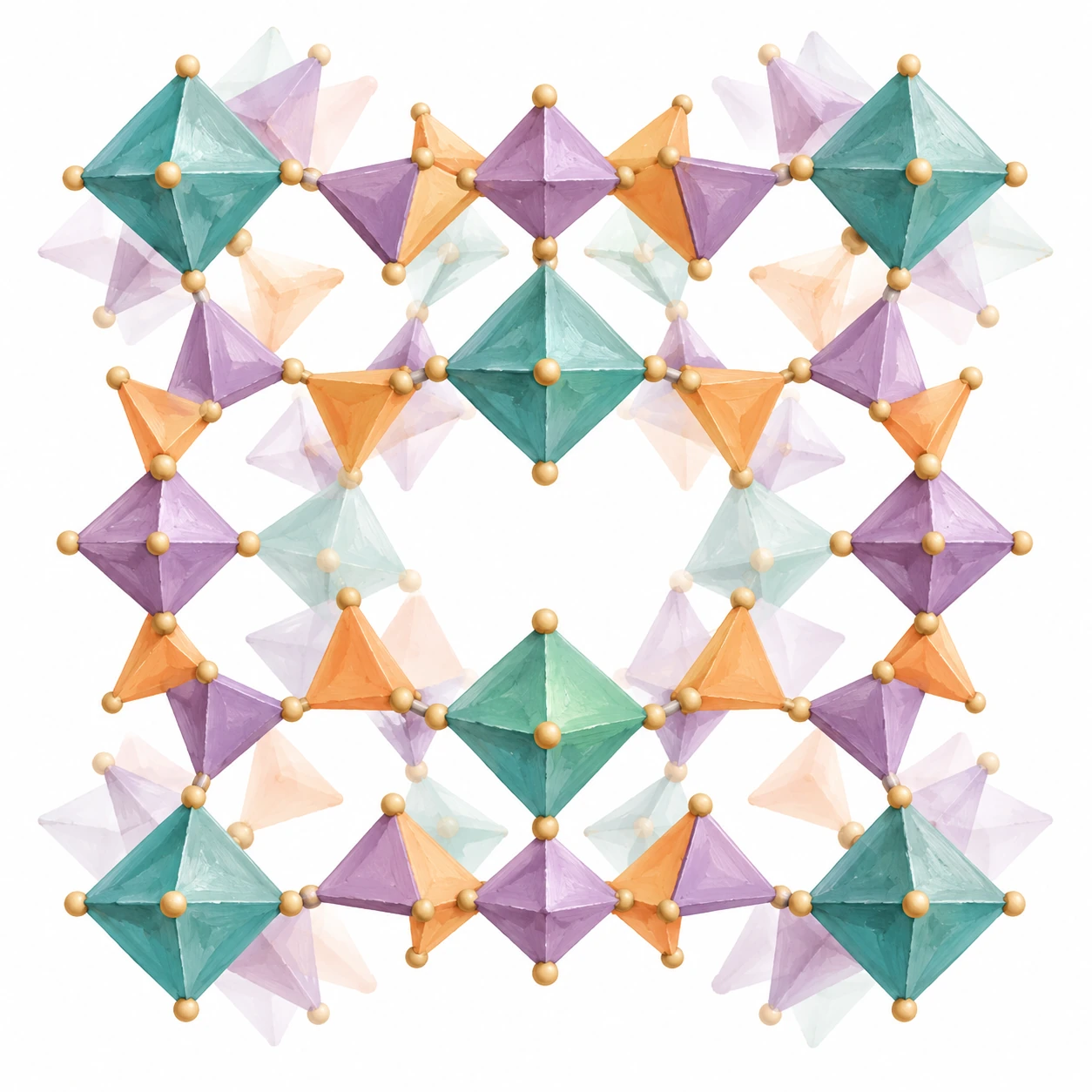
Zirconium tungstate is often represented using connected ZrO6 octahedra and WO4 tetrahedra. Those shapes organize the local oxygen environments around zirconium and tungsten. They are a compact way to discuss a complicated arrangement, rather than solid little containers packed into the material.
Rimmer, Dove and Refson’s phonon analysis, also available as an author-posted manuscript, tested how different flexibility descriptions matched calculated vibrations. The result did not reduce the contraction to one simple mechanism or one perfectly rigid polyhedron moving alone.
Broad bands of collective vibrational modes contributed. Near-rigid units and bonds were a useful low-frequency description, while angle deformation became more significant with higher-frequency modes contributing to contraction. The useful framework analogy therefore has to allow the real material more freedom than a single hinge drawing suggests.
A phonon is a way of describing a collective lattice vibration in a solid. The relevant question is how the vibration’s energy changes with volume, and how the population of vibrational modes changes as the material warms. Watching one atom oscillate in isolation would miss that collective behavior.
Pressure provides a different experimental handle
Mittal and colleagues’ inelastic-neutron-scattering experiment compared the vibrational spectrum at ambient pressure and under compression. Low-energy modes softened under pressure, an unusual response that supported the explanation of the material’s negative thermal expansion.
The study connected measured changes in vibrational energies with mode Grüneisen parameters, which describe how mode frequencies respond to volume. The technical language matters because it links a microscopic measurement with a bulk thermodynamic effect.
Different experiments answer different parts of the question. Diffraction can track the average crystal dimensions as temperature changes. Inelastic scattering supplies information about vibrations. A calculation can test which atomic motions contribute. Agreement across these methods is more informative than a visually convincing animation alone.
Calculate the size of a small contraction
For a limited temperature range, a simple linear approximation is ΔL=αLΔT. Here L is starting length, ΔT is temperature change and α is a linear expansion coefficient. A negative α gives a negative length change when the temperature increases.
Compare positive and negative length changes
A keyboard-usable linear model with explicit illustrative coefficients, unit conversion and scope limits.
Open compare positive and negative length changes in its own window.
The model begins with a 100-millimetre length warmed by fifty kelvin. Its example positive coefficient is +23 parts per million per kelvin, giving an increase of 115 micrometres. Its example negative coefficient is −9 parts per million per kelvin, giving a decrease of 45 micrometres.
Those coefficients are illustrative inputs, not certified specifications for particular batches or temperature intervals. Their purpose is to make a small fractional change readable. Forty-five micrometres is 0.045 millimetres, so the contracting example ends at 99.955 millimetres.
Try doubling the starting length and then doubling the temperature change. Each doubles the magnitude in this linear model. Next set the temperature change to zero. Both changes vanish, even though the materials retain different coefficients. These checks reveal the structure of the equation before you attach it to a real specimen.
Finally consider cooling. A negative coefficient predicts expansion when ΔT is negative. Negative thermal expansion describes the sign of a dimensional response; it does not mean the sample loses energy while being heated or possesses negative heat capacity.
The phase and temperature interval belong beside the number
A coefficient needs conditions. Hulbert and colleagues’ 2024 study examined zirconium and hafnium tungstate at their high-temperature thermodynamically stable ranges using in situ powder X-ray diffraction. Zirconium tungstate showed a linear coefficient near −5.52 parts per million per degree Celsius over the studied high-temperature interval.
The work also distinguished stable high-temperature material from lower-temperature metastable cubic phases retained by cooling. A phase can persist because transformation is slow even when it is not the equilibrium state under those conditions.
That distinction prevents a misleading extrapolation. The −9 example in the model is not a universal constant to apply from room temperature through every phase change. The actual response depends on structure, temperature, pressure and sample history.
For a real dataset, record the temperature interval and phase next to the fitted slope. Then check whether the reported coefficient is linear or volumetric. In an isotropic material with small strains, the volumetric coefficient is approximately three times the linear one. Confusing the two introduces a factor-of-three error before any comparison of mechanisms begins.
Materials that contract on warming suggest ways to manage dimensional changes, including in composites. But combining positive and negative coefficients is not automatically a simple weighted average: mechanical constraints, stiffness, bonding and geometry affect the resulting strain.
The larger lesson is physical rather than paradoxical. A material’s bulk size emerges from the motions and connections of its structure. Zirconium tungstate makes that relationship visible in a surprising sign: additional thermal motion can help pull an open framework closer together.
Sources and further exploration
- Rimmer, Dove and Refson: Phonon mechanism of zirconium-tungstate contraction
- Author manuscript of the phonon/flexibility analysis
- Mittal and colleagues: High-pressure inelastic neutron scattering
- Hulbert and colleagues: High-temperature negative thermal expansion
Explore all 80 new articles · Browse the complete illustrated collection
Keep exploring at Incoprea.