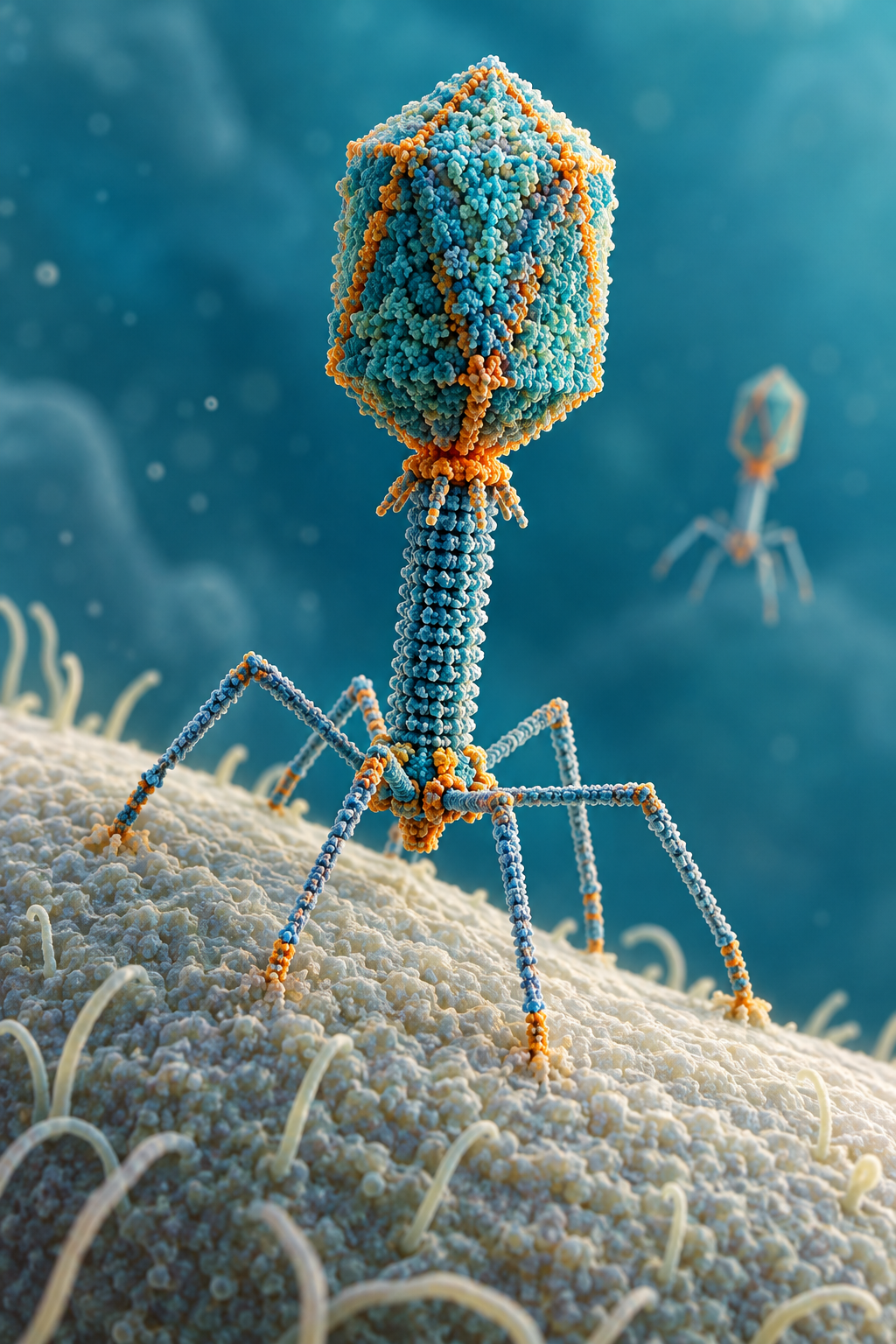
The familiar drawing of a bacteriophage looks almost mechanical: a faceted head, a tail and spindly fibers resting on a bacterial surface. It is tempting to see a miniature landing craft. In reality, those parts are molecular structures that recognize a host and help deliver viral genetic material.
A bacteriophage, usually shortened to phage, is a virus that infects bacteria. Phages occur wherever their hosts live, including seawater, soil and animal-associated microbial communities. Their interactions with bacteria help shape environments that appear quiet at human scale.
Recognition before infection
A phage must encounter a susceptible host. Molecules on the bacterial surface can serve as recognition points, and matching the host matters. A virus capable of infecting one bacterial strain may fail against another. Surface changes and bacterial defense systems help make these relationships highly specific.
Many well-studied phages have tails, but the classic shape is not universal. The small phage phiX174, for example, has a very different architecture from a long-tailed virus such as T4. Comparing structures reveals how evolution has produced different solutions to entering and exploiting a bacterial cell.
The virus relies on the host's molecular machinery to make new viral components. It is not a tiny animal feeding on a bacterium, and its visible shell is not the whole infection process. Much of the consequential activity happens after the genome has entered the cell.
Try looking at a phage as a structure
Open the RCSB PDB phage feature and compare its examples. Start with the container for the genome, then follow the structures involved in attachment and delivery. A long flexible tail, a contractile tail, and a short tail solve related problems with different arrangements. The page’s colours help distinguish parts; they are not colours the molecules would present to an ordinary eye.
Next compare those examples with phiX174. Its protein shell and projecting structures do not reproduce the familiar long-tailed outline. This is why one memorable drawing should not become the definition of a whole group. “Infects bacteria” describes the relationship shared by phages; one silhouette does not.
Choose one component and ask two questions: what is known about its structure, and what does it do? These require related but distinct evidence. A high-resolution structure can reveal an arrangement of molecules. Understanding the sequence of events during infection also needs observations and experiments about how that arrangement behaves.
The RCSB feature makes another useful distinction explicit. Some overview illustrations combine several experimentally determined structures and include unresolved features for context. Scientific illustration can explain a complete system while acknowledging where an individual structural determination stops. Reading the caption is therefore part of looking at the picture.
Two important paths
In a lytic infection, new phage particles are produced and the host cell is ultimately broken open. The released particles can encounter further hosts. Temperate phages can also establish a persistent association in which their genetic material is maintained within the bacterial lineage, often integrated into the chromosome.
| Path | Central feature |
|---|---|
| Lytic infection | Production and release of new particles with host-cell lysis |
| Lysogeny | Viral genetic material persists with the host and can later become active |
These are useful introductory distinctions, not a complete catalogue of viral lifestyles. A bacterium carrying a persistent phage genome may acquire new properties, and phages can participate in gene movement between bacterial cells. The relationship is therefore more complex than immediate destruction in every encounter.
The host is part of the outcome
Now imagine a phage reaching a bacterial cell with an altered surface receptor. Attachment may fail even though the virus is perfectly capable of infecting another strain. Alternatively, attachment may occur but intracellular defences may interrupt the next stage. Seeing viral particles near a cell does not tell us that they completed a productive infection.
This is one reason an ecological community contains relationships rather than a simple count of “viruses” and “bacteria.” Host availability, host state, and the identities of the partners influence the result. A large number of particles is not the same measurement as a large number of successful infections.
In the marine review linked below, researchers emphasize that phages can alter host metabolism during infection as well as cause mortality. The host cell is consequently a changing biological environment, not merely a bag that fills with viral copies. Following activity inside infected cells can reveal effects that a count of dead cells would miss.
An ecological influence
When infected marine bacteria lyse, their contents become available to other organisms. This redirects material through microbial food webs and affects the cycling of nutrients and carbon. Phages can also change the metabolism of infected hosts while an infection proceeds.
Specificity makes phages interesting for research into ways of targeting bacterial infections. It also creates practical challenges: choosing the right phage, understanding resistance and checking safety are essential. Their existence is not evidence that any environmental virus is an interchangeable medicine.
Where does the material go?
Consider a tiny parcel of carbon in a bacterial cell. If another organism eats the intact bacterium, that material enters one route through the food web. If a phage infection breaks the cell open, some contents become available as smaller dissolved or particulate material. Other microbes can then take up part of that supply. This is a conceptual comparison of pathways, not a claim that every lysed cell has the same fate.
The term “viral shunt” describes this redirection through microbial recycling. It does not mean carbon disappears, nor that viruses always prevent it from reaching larger organisms. The amount and eventual destination depend on the community and conditions. A food-web diagram becomes more useful when its arrows describe processes and leave room for more than one destination.
That is the real change of scale offered by a bacteriophage. Its individual machinery is molecular. Repeated across microbial communities, those encounters can influence the circulation of material through an ocean. A tiny structure can have a large ecological role without every familiar claim about its abundance or power being universal.
Sources and further exploration
RCSB PDB: Therapeutic phage structures · RCSB PDB: Bacteriophage phiX174 · Breitbart et al. (2018): Marine phage ecology · NCBI Bookshelf: Bacterial genetics




