Showing posts with label Visual. Show all posts

Thursday, October 22, 2026

The Curator’s Four Reports

Case 30 · visual · Medium · About 4–7 minutes

A worktable with a closed book, brass key, paintbrush, and feather.
The visible inventory is a clue; the reports must be evaluated using the stated rules.

The curator’s worktable originally held five objects: a book, a key, a brush, a feather, and a spoon. Exactly one has been removed. Four assistants submitted short reports before Vale arrived.

The present table is shown in the evidence picture. Determine which report is completely true and identify the missing object.

The reports

  • Nora: “The book is missing.”
  • Omar: “Both the key and the spoon are on the table.”
  • Pia: “Exactly one of the spoon and the feather is on the table.”
  • Rui: “The brush is present and the book is absent.”

The rules

Exactly one whole report is true. For an “and” or “both” statement, every named condition must hold. “Exactly one” means one is present and the other absent; it does not mean “at least one.”

The four objects left on the table are fully visible. Nothing is inside the book, concealed under another object, or outside the picture. No object was added, exchanged, or removed after this view was recorded. Presence refers only to this table, not to the museum generally.

Accessible evidence transcript

A closed book lies at upper left, a brass key at upper right, a paintbrush at lower left, and a feather at lower right. No spoon is present.

Evaluate the entire sentence in each report. Which assistant gave the true report? Do not identify the remover from the reports: the case provides no rule connecting truthful reporting with responsibility for the removal.

Hint 1 - reveal when you want a nudge

Make a present/absent list from the picture before testing the sentences.

Hint 2 - reveal when you want a nudge

Pia’s “exactly one” and Rui’s “and” impose different conditions. Check both halves of each report.

Reveal the solution and explanation

Pia’s report is true, and the spoon is missing.

Nora is false because the book is present. Omar is false because the key is present but the spoon is not; “both” fails. Pia is true because the feather is present and the spoon is absent, giving exactly one of the pair.

Rui is false. The brush is present, but the book is not absent. One correct half does not make an “and” report true.

The four evaluations are false, false, true, false. They satisfy the guarantee of exactly one true report. The full table view and original five-object inventory identify the missing spoon. They do not reveal who removed it, so assigning blame would go beyond the supplied evidence.

Solve another: The Cabinet of Fifty Mysteries · Browse all 50 cases

The Porter’s One-Swap Claim

Case 26 · visual · Medium · About 4–7 minutes

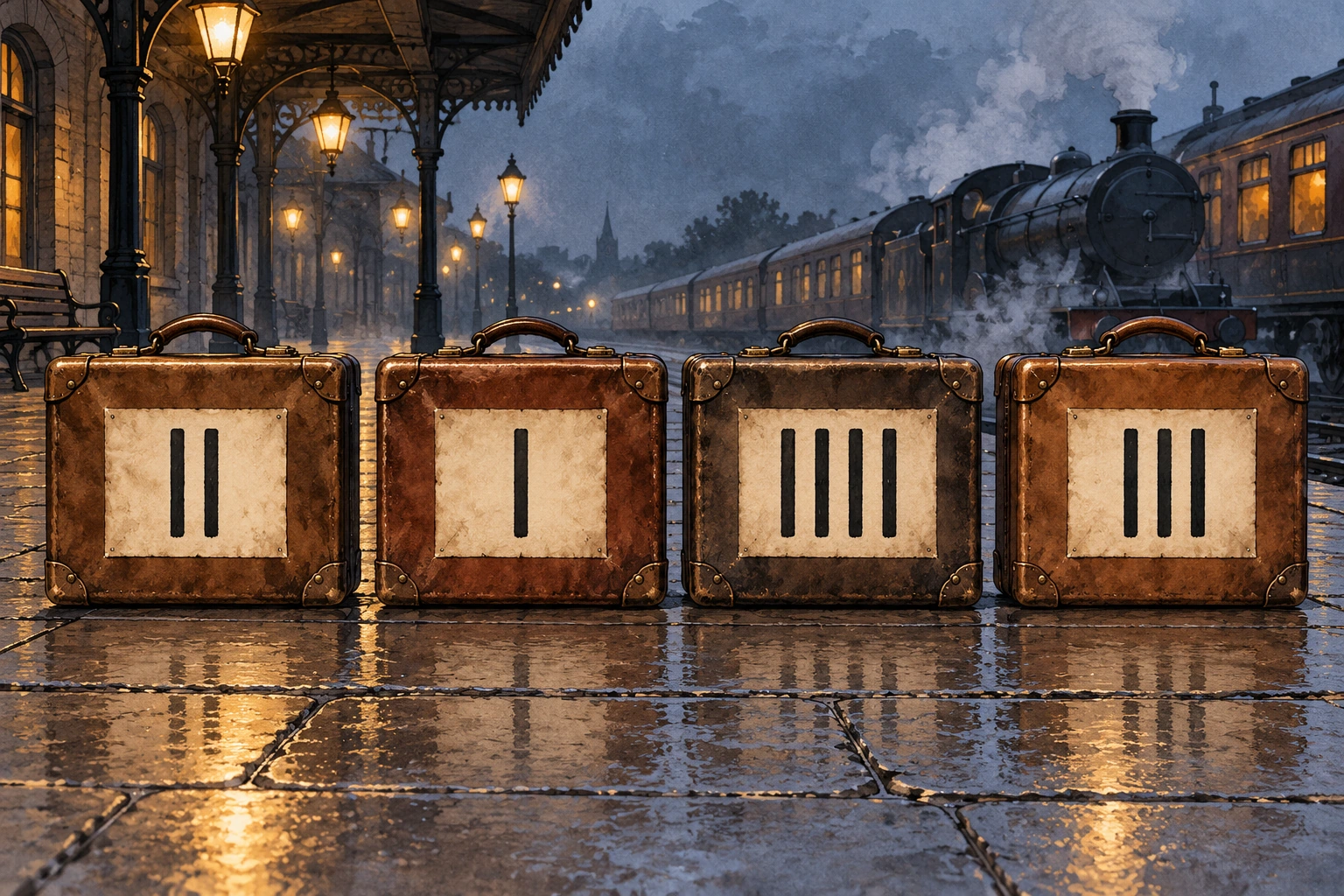
Four station suitcases with tally patches showing two, one, four, and three bars.
Tally counts and their left-to-right order are clues; the railway background is decorative.

The museum’s luggage is waiting beside the night train. Each suitcase has a tally patch indicating its place in the loading order. The correct arrangement runs from one bar to four bars, left to right.

A porter claims the pictured row can be restored with just one exchange of neighboring cases. Vale checks the claim before approving the loading log.

The movement rule

  • A move exchanges two suitcases currently next to one another.
  • Only that pair changes position in the move. You cannot lift a case over another, reverse the whole row, or exchange a separated pair.
  • All four cases must finish in increasing tally order: 1, 2, 3, 4.
  • Each tally count occurs exactly once. The patches never change.

Picture evidence

Accessible evidence transcript: The four tally patches show, from left to right, two vertical bars, one bar, four bars, and three bars. In shorthand, the row is 2–1–4–3.

Is the porter’s claim possible? Find the minimum number of legal moves and name the pair exchanged in each. If more than one shortest move order exists, acknowledge it rather than claiming that a particular sequence is unique.

Only the tally patches define order. Suitcase size, station lighting, and the train behind them are not clues. Each exchange counts as one move even though two cases move at once.

Hint 1 - reveal when you want a nudge

There are two pairs currently in the wrong relative order. Consider 2 versus 1, and 4 versus 3.

Hint 2 - reveal when you want a nudge

One adjacent exchange reverses the relative order of only the two cases exchanged.

Reveal the solution and explanation

The claim is false. The minimum is two moves. Exchange the neighboring 2 and 1, then exchange the neighboring 4 and 3. This gives 1–2–3–4.

The two moves may be performed in either order. Swapping 4 and 3 first gives 2–1–3–4, after which swapping 2 and 1 finishes the task. Thus there are two shortest move sequences, with the same required exchanges.

For the lower bound, 2 must pass 1, and 4 must pass 3. An adjacent swap changes the relative order of just its exchanged pair; other pairs retain their relative order. One move cannot correct both reversed pairs.

At least two moves are necessary, and the constructions achieve two. That proves the unique minimum value while honestly retaining both valid shortest sequences.

Solve another: The Cabinet of Fifty Mysteries · Browse all 50 cases
The Papers Beneath the Triangle

Case 23 · visual · Easy · About 4–6 minutes

Three overlapping paper cutouts: a square, a circle, and a triangle.
Overlapping edges, rather than colors, provide the visual clues.

Three museum volunteers prepared a paper display while the curator was away. Each placed one cutout, and the final arrangement appears in the evidence picture.

The curator needs to credit the volunteer who placed the triangle. The page does not show their names, but the placement rules and two register notes survive.

The placement rules

  • Eleni, Finn, and Gray entered one at a time. Each entered once and placed exactly one of the three cutouts.
  • The cutouts are one square, one circle, and one triangle.
  • A newly placed cutout lay on top of any existing cutout it overlapped.
  • No one slid a piece underneath another, lifted an earlier piece, or moved anything after placement.

The register notes

  1. Gray placed the circle.
  2. Eleni entered before Finn.

Picture evidence

Accessible evidence transcript: The circle overlaps the square and lies above it. The triangle overlaps the circle and lies above it. Enough of every cutout remains visible to identify its shape.

Who placed the triangle? Give all three volunteers’ shapes and the chronological order of their visits. Use the overlap relationships, rather than color, to recover the sequence.

The colors help distinguish the illustration’s surfaces, but the same logic works in monochrome. The size of a cutout does not indicate a volunteer’s age or importance. The case permits no hidden fourth visitor or rearrangement after the three visits.

Hint 1 - reveal when you want a nudge

A later piece must be above an earlier piece wherever they overlap.

Hint 2 - reveal when you want a nudge

The circle must be placed after the square and before the triangle. Gray therefore occupies the middle visit.

Reveal the solution and explanation

Finn placed the triangle. Eleni placed the square first, Gray placed the circle second, and Finn placed the triangle last.

Because the circle lies above the square, the square was placed first. Because the triangle lies above the circle, the triangle came afterward. Together, those relationships establish square → circle → triangle.

Gray’s circle fixes Gray in the middle. Eleni and Finn must occupy the first and last visits. The note that Eleni entered before Finn fixes Eleni first and Finn last.

There is no remaining choice of shapes or visit order. The conclusion depends on the stated rule against sliding pieces underneath one another. Without that rule, the same visible layers would not necessarily establish the history of placement.

Solve another: The Cabinet of Fifty Mysteries · Browse all 50 cases

The Gallery’s Three Commands

Case 21 · visual · Medium · About 4–7 minutes

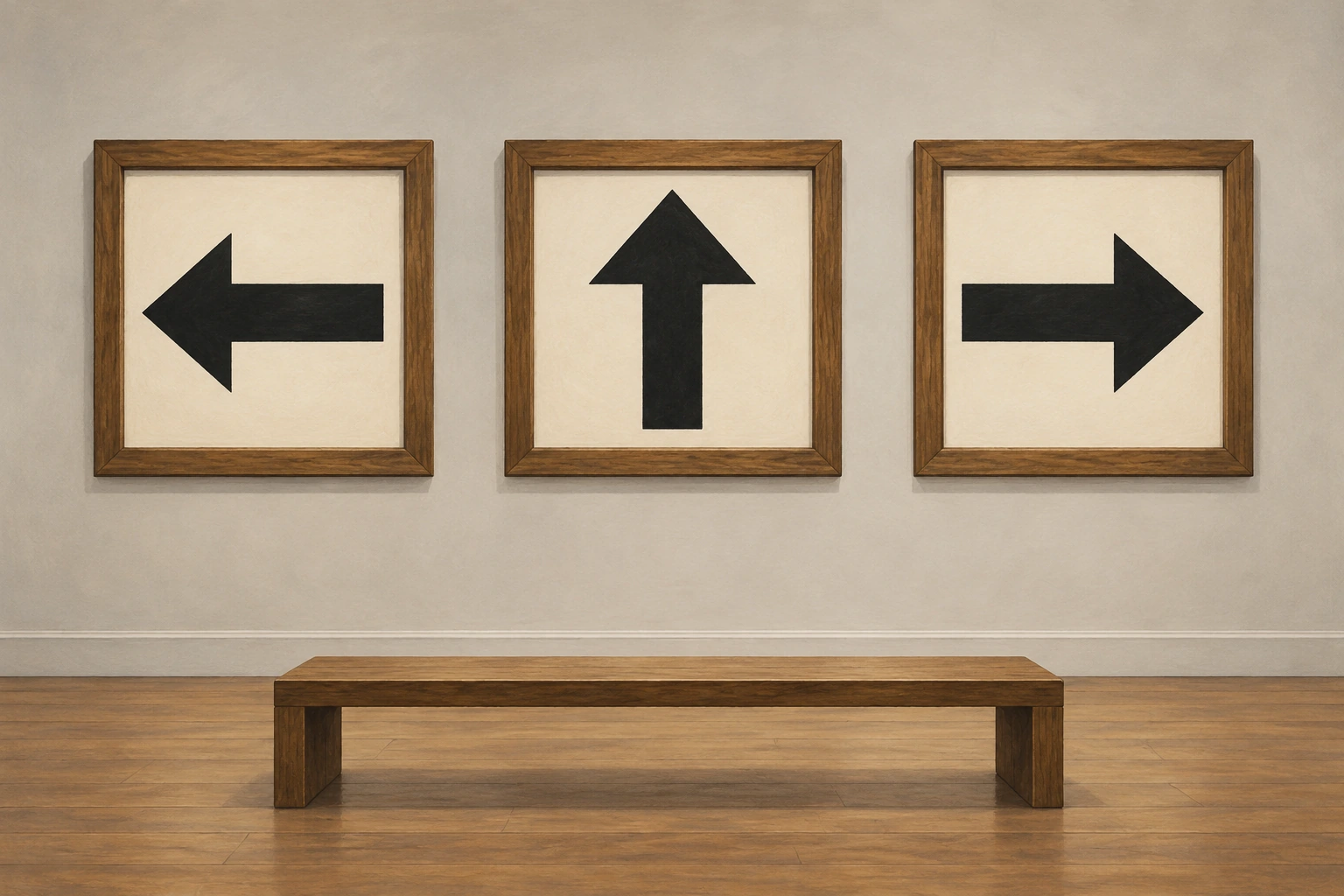
Three framed arrows in a gallery point left, up, and right.
Read the arrows using the fictional command rules. The gallery setting is decorative.

The museum’s old indexing game uses three framed arrows to transform a three-letter drawer code. A copied instruction sheet has survived, but the final code is missing.

Vale starts with the letters K M R in that order. Read the actual arrows in the gallery picture, then apply the commands carefully.

The instruction sheet

Read the frames from left to right. Apply each command once to the current row of three letters. Commands change letter positions; the arrows are not directions for walking.

  • Left-pointing arrow: move the first letter to the end. The other letters keep their order.
  • Up-pointing arrow: exchange the first and second letters. Leave the third letter alone.
  • Right-pointing arrow: move the last letter to the front. The other letters keep their order.

Begin with K M R. Never restart from that original row between commands. A final code is read from the resulting row, left to right, without spaces.

Picture evidence

Accessible evidence transcript: The left frame contains an arrow pointing left. The central frame contains an arrow pointing up. The right frame contains an arrow pointing right. No other marks inside the frames matter.

Which drawer code results? Write the row after each command so another investigator can check your reconstruction. The artwork’s bench and lighting supply no additional instructions. Nothing requires familiarity with a real museum security system.

Hint 1 - reveal when you want a nudge

After a command, keep the new row. The next command acts on that changed row.

Hint 2 - reveal when you want a nudge

The left arrow changes KMR to MRK. Now perform the exchange indicated by the middle frame.

Reveal the solution and explanation

The code is KRM. The full sequence is KMR → MRK → RMK → KRM.

The first frame points left, so K moves from the front to the end: MRK. The second points up, which exchanges the first two letters of MRK: RMK. The final frame points right, so the last letter K moves to the front: KRM.

Every command is deterministic. Once the initial row and pictured arrow sequence are fixed, there is no choice that could produce a second answer.

A tempting shortcut is to cancel the left and right commands before doing the middle one. They are separated by an exchange, so that shortcut changes the operation order. Acting on the row one step at a time avoids that mistake.

Solve another: The Cabinet of Fifty Mysteries · Browse all 50 cases
The Reading Room Exchange

Case 17 · visual · Easy · About 3–5 minutes

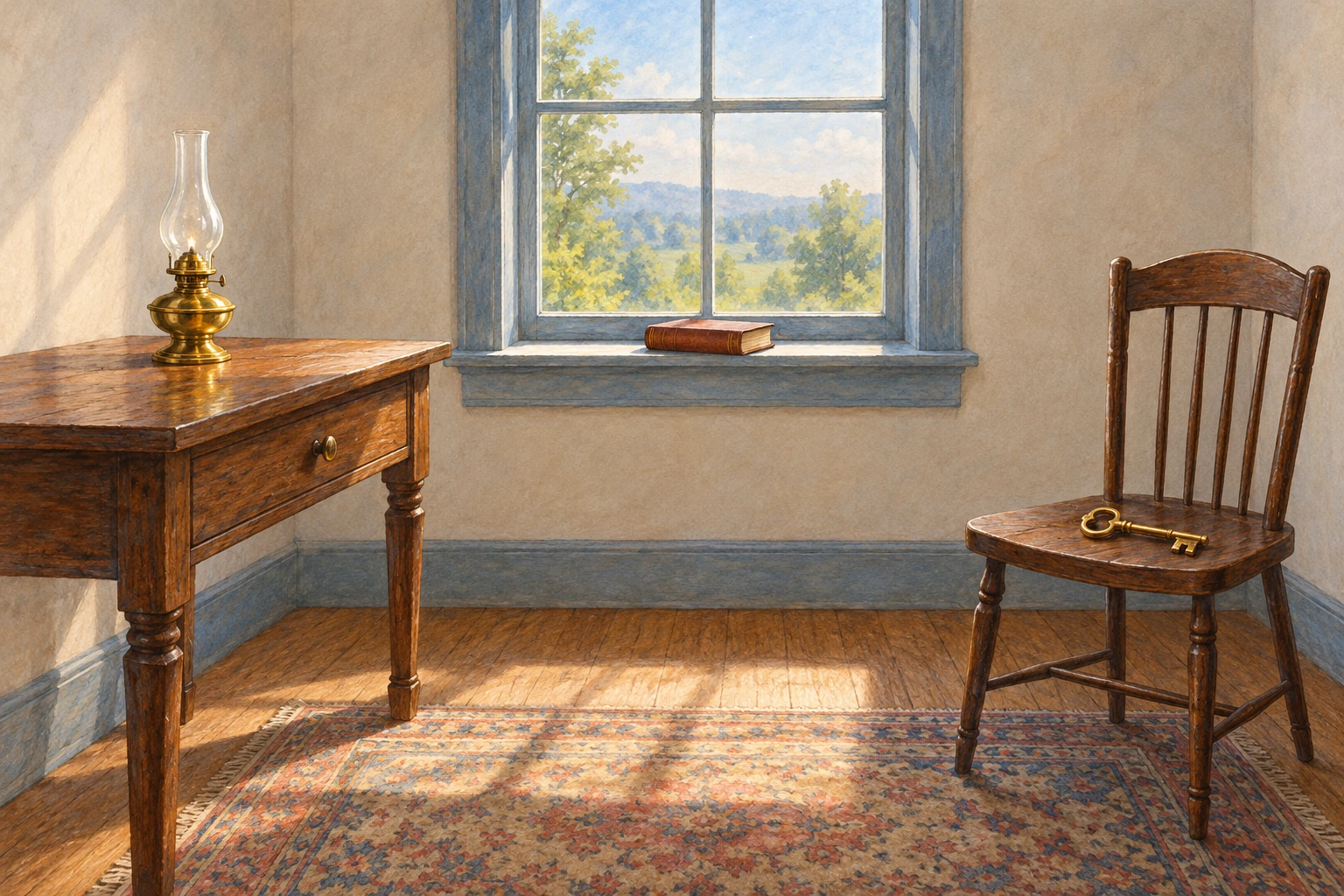
A sparse reading room with a lamp on the desk, a book on the window sill, and a key on the chair.
Only the three named object locations are clues.

The museum’s reading room has been staged incorrectly for an inspection. The caretaker says one temporary pass was used after the room’s morning inventory. Inspector Vale has the authorized inventory, the pass register, and the room as it now appears.

No knowledge about flames, sunshine, dust, or shadows is needed. This case concerns locations and one precisely defined action.

Before the visit

The signed inventory puts the closed book on the desk, the brass lamp on the window sill, and the large brass key on the chair seat.

What the register guarantees

  • Exactly one visitor entered, using exactly one of the three passes listed below.
  • The visitor performed that pass’s exchange once: the two named objects traded locations.
  • No other movable object was touched. The furniture stayed in place, and no object was added or removed.
  • Restorer’s pass: exchange the book and lamp.
  • Guide’s pass: exchange the book and key.
  • Porter’s pass: exchange the lamp and key.

Picture evidence

Accessible evidence transcript: The lamp is on the desk at left. The closed book is on the central window sill. The key is on the chair seat at right.

Which pass was used? Identify the object that stayed in its original location, then explain why neither alternative pass fits the scene. The pass identifies the authorized action, not the personal identity of whoever borrowed it.

Hint 1 - reveal when you want a nudge

Compare the key’s location before and after the visit.

Hint 2 - reveal when you want a nudge

An exchange involving the key would necessarily move it. Which registered exchange leaves it alone?

Reveal the solution and explanation

The restorer’s pass was used. The key remained on the chair. The book and lamp exchanged the desk and window sill.

The guide’s pass would leave the lamp on the window sill, put the key on the desk, and put the book on the chair. That is not the pictured arrangement.

The porter’s pass would leave the book on the desk, put the key on the window sill, and put the lamp on the chair. That also fails.

These are all three permitted actions, and only the book–lamp exchange produces the observed room. The picture cannot identify the visitor’s face or establish a motive. The deduction is exactly the pass and exchange, with the unmoved key providing the quickest route.

Solve another: The Cabinet of Fifty Mysteries · Browse all 50 cases
The Elevator With Three Working Buttons

Case 50 · shortest-path challenge · Hard · About 10-15 minutes The archive elevator has a peculiar test mode. Its floor display works, but o...