Showing posts with label Mammals. Show all posts

Thursday, October 22, 2026

Vampire Bats Build the Relationships Behind a Shared Meal

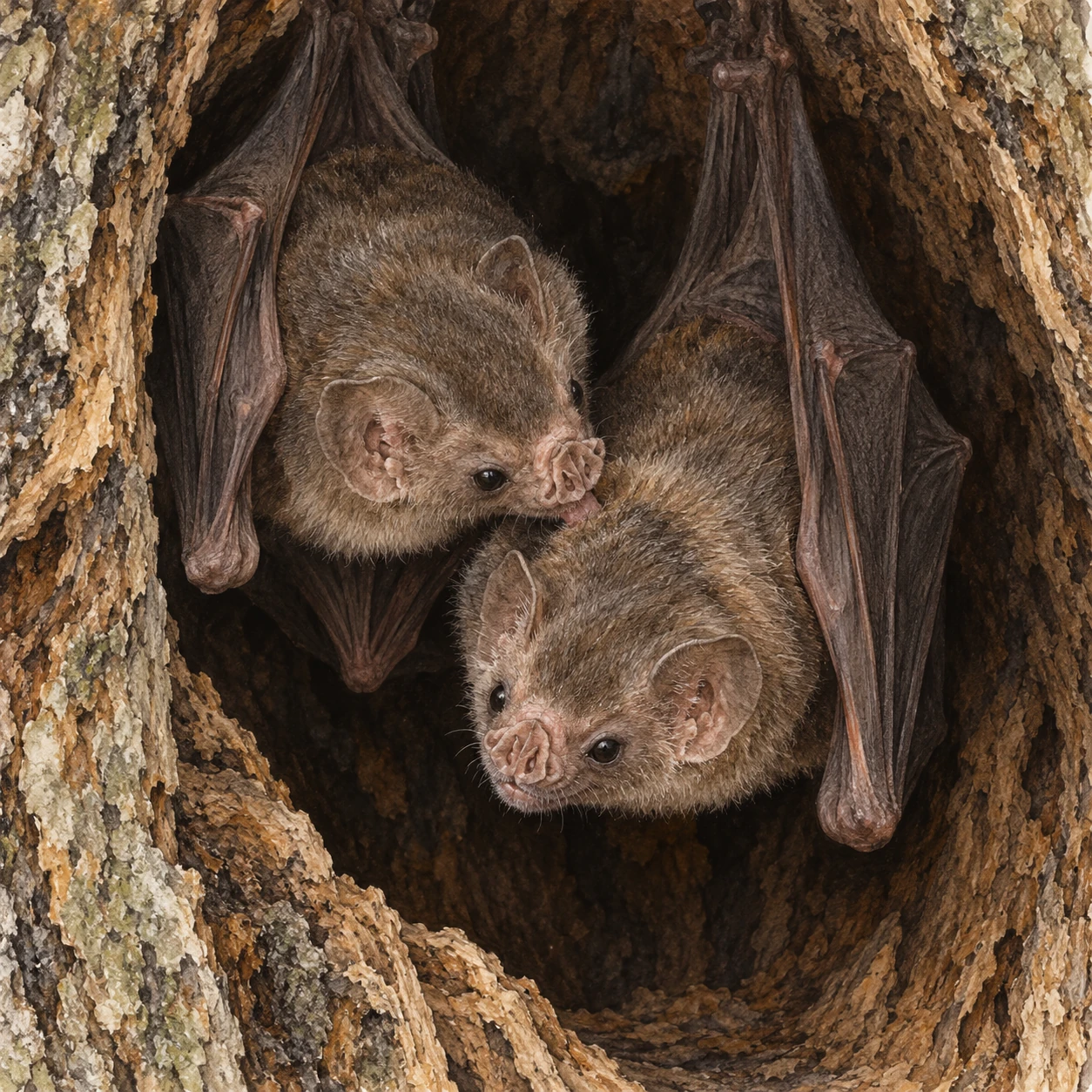
Two common vampire bats huddle in a hollow tree while one grooms the other.
Interpretive illustration of social grooming in common vampire bats; not an observation of a named study pair.

For a common vampire bat, a successful night can mean returning with a blood meal. An unsuccessful companion may receive some of that food through regurgitation. The act is small enough to happen in the dark interior of a roost, but its implications reach into one of biology's hardest questions: how can costly help persist between animals that are not simply close relatives?

The obvious human analogy is friendship. It can be useful, provided it remains an analogy rather than a claim to read a bat's private feelings. Researchers can measure who grooms whom, who shares food, how relationships develop, and whether they continue outside a laboratory. Those observations are already a rich social story. They do not require us to imagine bats keeping a written account of favors.

Reciprocity does not have to mean immediate repayment

A 2013 study by Carter and Wilkinson examined food sharing in a captive colony. Received help predicted donations more strongly than relatedness or harassment in the analysis. Sharing patterns were consistent with enduring relationships involving both food and grooming, rather than a strict sequence in which one animal pays back exactly what it received at the next opportunity.

That distinction is easy to miss. An exchange can be mutually beneficial over time without each event being matched immediately. If a bat is hungry today, its partner's ability to provide food matters now; the hungry bat may have an opportunity to help on another night. A long relationship can spread uncertainty across time.

Relatedness still matters biologically, and kinship and social history can overlap. The point is not that family relationships vanish. It is that explaining every donation as help for relatives alone leaves important patterns unexplained. Researchers compare multiple possible predictors because the same observed behavior can fit several stories.

How does a new relationship become costly?

To study the beginning rather than only the maintenance of a bond, researchers introduced unfamiliar common vampire bats and followed interactions. The 2020 study of new food-sharing relationships found selective escalation: low-cost grooming tended to build before more costly food sharing. Not every possible pair developed the same relationship.

This sequence matters because two explanations that sound alike make different predictions. If sharing simply followed indiscriminate familiarity, every familiar animal might become an equivalent partner. If animals selectively build a relationship through interaction, histories among pairs should diverge. Following the pairs through time lets researchers examine that difference.

The word “trust” is often used in accounts of this research. A cautious translation is a growing willingness to invest in a particular partner. The observations support a pattern of selective investment. Whether the animal experiences anything equivalent to a human's verbal concept of trust is a different question, and the behavior does not answer it by itself.

Nearness can be a cause as well as a consequence

Two bats found together repeatedly may be choosing one another because of an established bond. They may also be developing a bond because circumstances keep putting them together. The same association diagram can fit both directions of cause.

A 2022 experiment temporarily housed randomly assigned trios of previously unfamiliar, unrelated females in close proximity. When the bats could freely associate again, pairs that had shared that week of proximity increased their grooming more than control pairs. Repeated contact had changed a later cooperative investment.
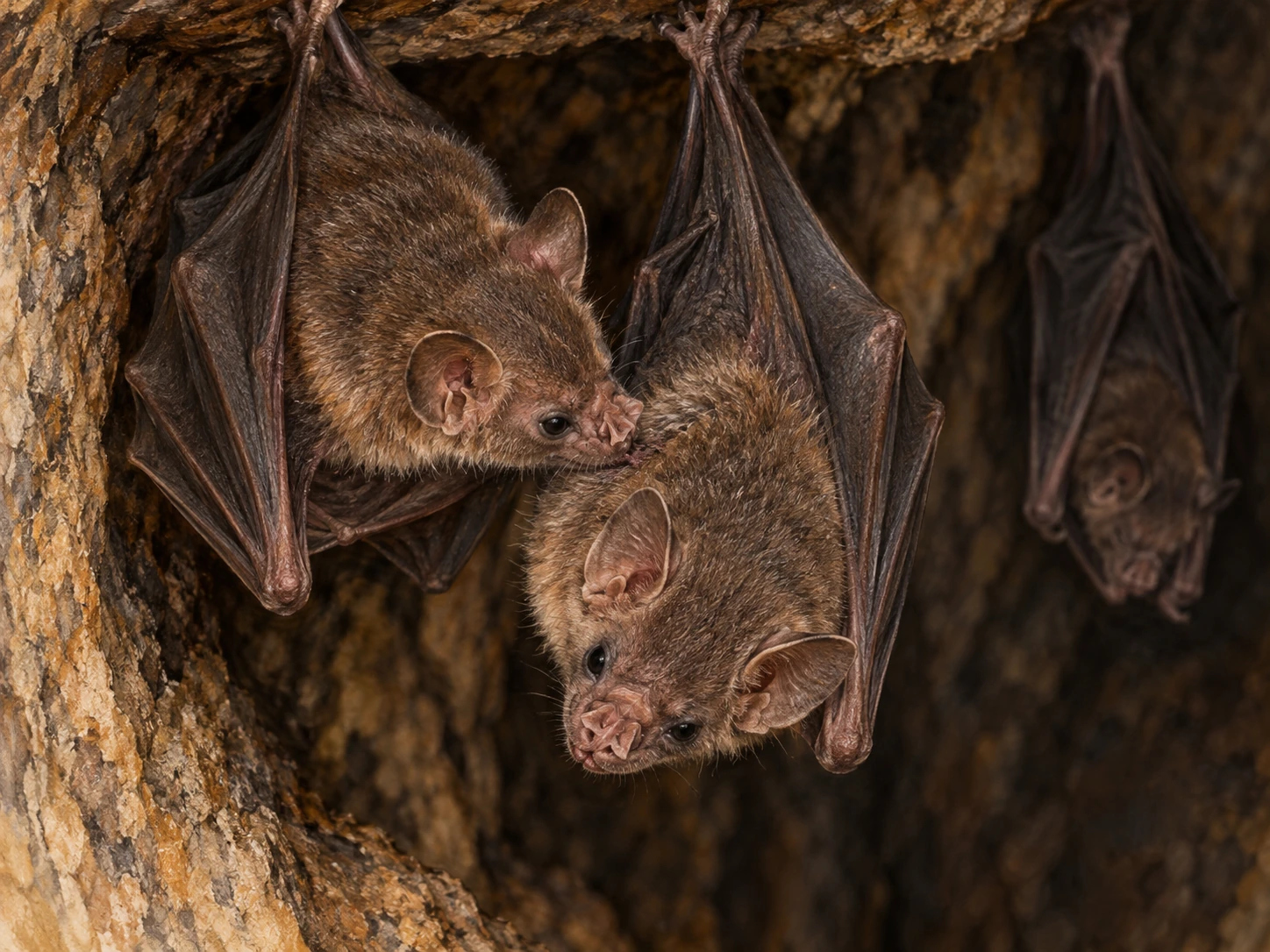
Two common vampire bats groom in a dim roost while another rests apart
Repeated proximity can shape later grooming. A visible association still needs a history and a defined behavioral measure.

The measured result was grooming, not a demonstration that every such pair developed identical food-sharing bonds. The authors also left open the relative roles of mere association and the interactions occurring during that association. An experiment can establish one causal link while identifying a more precise next question.

A strong partner is not the only useful partner

A separate partner-removal study examined a different aspect of a relationship network. When a key donor was unavailable, females that had previously fed more unrelated females suffered a smaller drop in food received. Those wider investments did not simply yield more food under ordinary conditions; their importance became clearer when a major source of help disappeared.

This is a reason to distinguish a network's ordinary return from its resilience. A relationship can contribute little to today's total yet matter when another connection is missing. The study called this social bet hedging. That functional description does not require a bat to calculate insurance premiums.

A small network puzzle

Imagine Bat A receives eight fictional units from one donor. Bat B receives six from one donor and one each from two others. Both receive eight. Remove the largest donor: A receives zero and B receives two, provided the others remain available. These invented amounts demonstrate a dependence pattern, not the study's data or a rule that more partners are always better.

Now add a cost to maintaining each relationship. The conclusion becomes less automatic: a wider network may be costly, and partners may fail together. That is why measuring interaction histories, availability and actual donations matters more than simply counting connections.

A bat society can therefore be read through two timescales. Encounters help build a particular tie. A collection of ties shapes what happens when circumstances change. The shared meal sits inside both histories.

Does the bond survive leaving the experiment?

Captivity provides control and visibility, but it can force animals together. A 2019 study addressed that limitation by releasing bats after a prolonged captive period and tracking associations in the wild with proximity sensors. Earlier grooming and food-sharing relationships predicted later associations. The relationship was not simply erased when animals regained a choice of company.

Another study, described by Ohio State in 2021, followed 50 bats during foraging. Bats generally departed separately, but established social partners encountered one another during the night. Researchers combined sensor information with additional video and sound observations. The results suggested coordination associated with social ties, while the sensors alone could not show every detail of what a meeting meant.

Those limitations are informative. Proximity is a measurable event. Cooperation over a meal is an interpretation that needs behavior and context. A strong account combines methods rather than asking a tiny radio device to reveal an entire relationship.

An evolutionary review of food sharing considers whether behavior rooted in maternal care could have been extended into mutually beneficial adult relationships. That is a hypothesis about the historical origin of the capacity, distinct from showing that two present-day bats exchange food. Present function and evolutionary origin require different evidence.

The artwork accompanying this article focuses on grooming because the quieter interaction is part of the story. A regurgitated meal is the dramatic event, but the relationship around it can develop through many less costly contacts. The bat's social world is therefore not well described by a single heroic donation.

What emerges is a form of interdependence built through repeated encounters. A small mammal with a frightening popular reputation becomes a subject for precise questions about partnership, opportunity, and time. Watching who helps whom is only the first step. Watching how a pair becomes willing to help—and whether that history continues when circumstances change—is where the deeper social life comes into view.

Follow the evidence: Carter and Wilkinson: help predicts food donations; Carter and colleagues: development of new sharing relationships; Ripperger and colleagues: captive relationships persist in the wild; Ohio State: social partners meet during foraging; Carter: co-option and the evolution of food sharing.

More curious connections, art and independent projects at Incoprea.

Meerkats Turn a Meal Into a Manageable Lesson

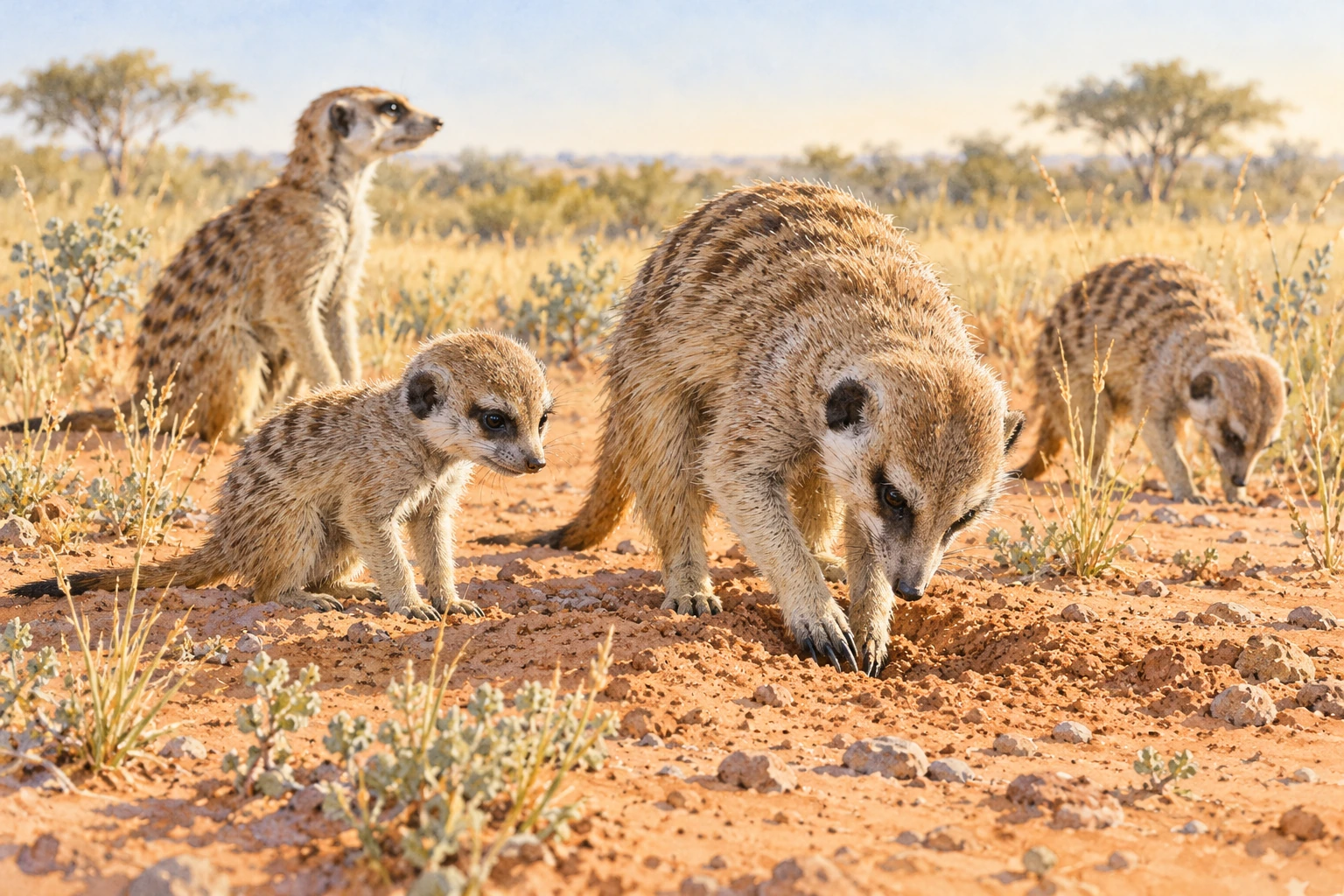
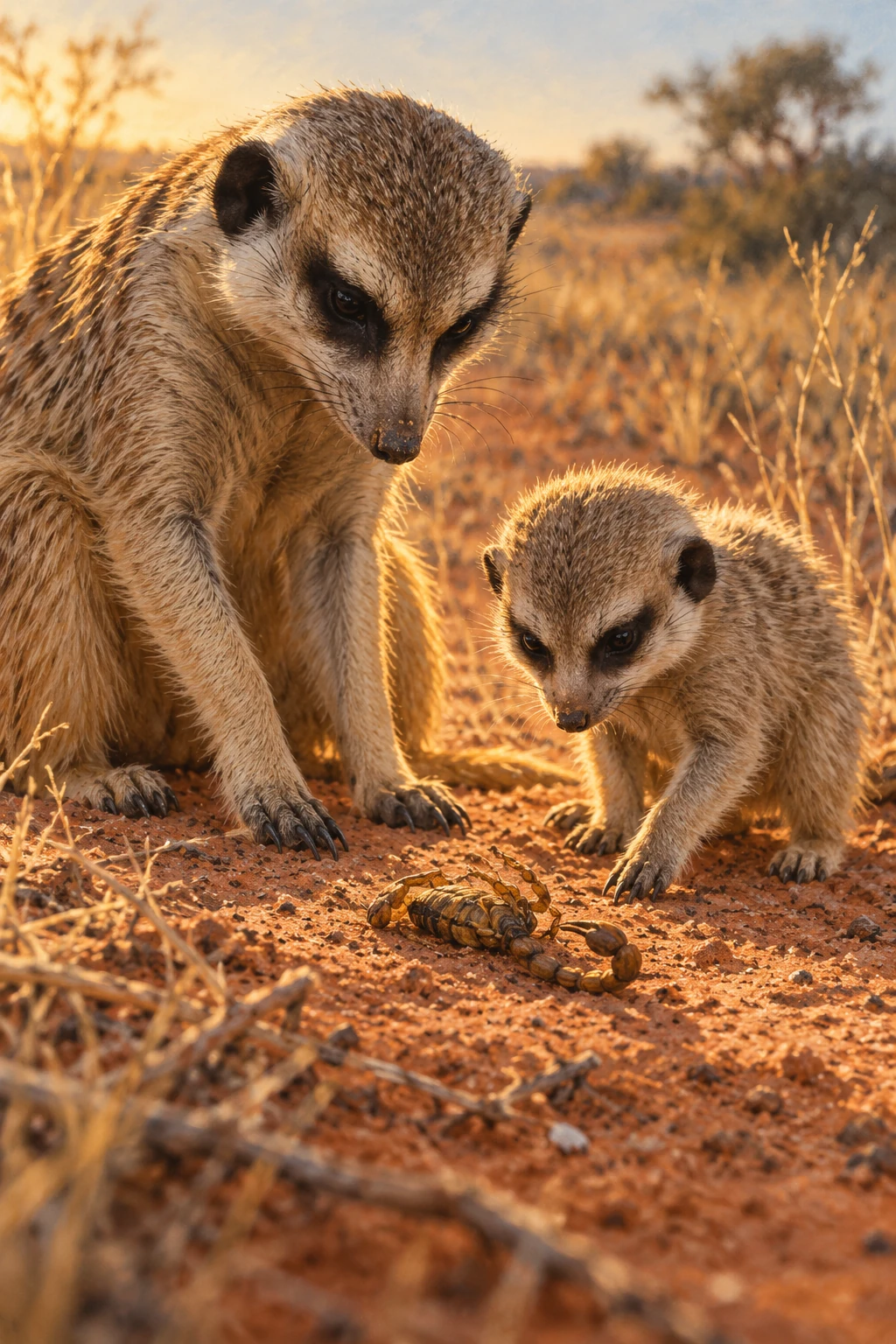
An adult meerkat and pup attend to a small disabled scorpion on sandy ground.
Conceptual scene of supervised prey handling; not a specific experimental event or a handling guide.

Learning to handle dangerous prey presents a problem for a young meerkat. Trial and error can be expensive when an error has a sting. Older group members help bridge the gap by changing what they give pups: easier prey first, then more challenging opportunities. The youngster's lesson is built into the condition of its meal.

This behavior is not merely a charming resemblance to a classroom. Researchers used observations and experiments to ask whether helpers altered their behavior in ways that accelerated learning. The case became an influential example of animal teaching defined through its consequences, without requiring an animal to explain its intentions.

The meal can contain a graduated task

A 2006 study by Alex Thornton and Katherine McAuliffe followed wild meerkats, Suricata suricatta. Helpers supplied young pups with prey that was dead or disabled, then provided more intact live prey as pups grew. This gave inexperienced animals opportunities to practice handling while reducing some of the initial difficulty.

The Cambridge account describes helpers monitoring the interaction and sometimes retrieving escaping prey or further disabling it. Food delivery therefore included more than transferring calories. It altered the learning opportunity available to the pup.

That distinction matters. Handing a pup a finished meal can nourish it without giving much handling practice. Providing a manageable live item can teach a skill while still supplying food. The same broad category, “feeding the young,” can conceal different developmental effects.

How does a helper know which challenge to offer?

The researchers investigated the role of pups' begging calls, which change with age. Playback experiments helped test whether helpers responded to the acoustic cues rather than simply judging a pup's visible size. Changing the calls available to the helper altered provisioning in the expected direction. The cue was experimentally separated from the pupil's actual developmental stage.

This is a powerful design because age changes many things together. A larger pup may move differently, beg differently, and already be more skilled. Merely observing older pups receive more intact prey cannot identify which cue drives the helper's response. Playback lets one part of that package change while others remain more nearly the same.

It also limits the mental claim. Responding to an age-related call can produce adaptive teaching without a helper explicitly representing what the pup knows. The behavior can be sophisticated in function while relying on a comparatively simple cue. Explaining that possibility does not diminish the result; it explains how teaching could evolve.

Learning needs a comparison, not just a successful pup

The study's experimental component examined whether experience handling prey improved later performance. That addresses a different question from whether helpers give age-appropriate items. An adult could alter its behavior around young animals for reasons that do not benefit their learning. Demonstrating an accelerated skill provides evidence for the teaching function.

A useful thought experiment is to compare two hypothetical pups receiving the same amount of food. One gets every item already fully processed; the other receives progressively manageable handling opportunities. If the second later handles difficult prey better, calories alone cannot explain the difference. A real experiment must also account for age, prior experience, prey type, and the opportunities each animal actually received.

The classic research paper joins such developmental outcomes with observations of helper behavior. It is that combination—not an isolated image of an adult standing over a pup—that makes the example scientifically useful.

Learning from another animal is not always teaching

The prey-handling lesson does not make every socially influenced meal an instance of teaching. A youngster can learn because it happens to be near an experienced animal, even when that animal has not changed its behavior to help the learner. The distinction becomes clearer when different experiments are placed beside one another.

A 2008 study of novel foods found that young meerkats were more likely to eat unfamiliar items after interacting with experienced companions. Yet the author found little evidence that helpers were specifically teaching pups what to eat. Learning could arise as a by-product of provisioning. That conclusion does not contradict the earlier evidence for teaching prey-handling skills; the tasks and proposed functions differ.

A juvenile meerkat watches an adult investigate a shallow sandy patch
A shared encounter can provide several learning routes. The scene alone does not establish teaching.

In a 2009 apparatus experiment, trained demonstrators used one of two techniques to obtain food. Other animals were more likely to interact with the apparatus and some adopted techniques after observing or scrounging from informed individuals. Young animals were especially likely to join those opportunities. Individual discovery also occurred, so the groups did not have to become behaviorally uniform for social transmission to matter.

Three stories can share the same photograph

Imagine a juvenile beside an adult at a food item. The adult may be deliberately altering the task in the functional sense tested by the teaching study. The juvenile may instead be gaining access through scrounging. Or both may independently investigate a profitable patch. A photograph documents their proximity but cannot choose among these histories.

Which comparison would separate the accounts?

Ask what the experienced individual does differently around a novice, whether the novice gains information or only food, and whether later performance changes. For technique transmission, compare which method was witnessed with which method was later used. For teaching, the adult's altered behavior and the learner's benefit need their own evidence.

This makes the word “lesson” more precise, not less useful. It can describe an experimentally supported function in one context while remaining an attractive but untested metaphor in another.

The group offers many developmental resources at once: food, manageable practice, access to successful foragers and chances to watch. Keeping those routes separate helps us understand how a pup becomes capable without expecting every helpful encounter to operate by the same mechanism.

The group is part of the developmental environment

Meerkats live in cooperative groups, and care is not supplied only by a pup's mother. Understanding who contributes requires following recognizable individuals and their relationships over time. Cambridge's account of the Kalahari project describes the value of a long-term field study for connecting individual behavior with survival and reproduction.

Such familiarity can make natural behavior observable without making the animal a tame performer. The research context is therefore different from a visitor trying to feed wildlife or stage an encounter for a camera. Dangerous prey should remain a subject for documented observation, not a home teaching experiment.

The scene in the generated illustration is deliberately quiet: an adult, a pup, and a small prey-handling opportunity. It is not a step-by-step guide to handling a scorpion and does not identify a particular study event. The real evidence lies in repeated behavior and controlled comparisons.

The larger insight is that teaching need not begin with a lecture. It can begin by arranging an encounter at a level a learner can manage, then changing that level as the learner develops. In meerkats, the relevant adjustment is carried in the meal itself. A social group helps shape not only whether a pup eats today, but what it becomes capable of obtaining tomorrow.

Follow the evidence: Thornton and McAuliffe: teaching in wild meerkats; Cambridge: helpers change prey provisioning as pups grow; Cambridge: the long-term Kalahari research project; Thornton and McAuliffe: research paper copy.

More curious connections, art and independent projects at Incoprea.
Wednesday, October 14, 2026

The Star-Nosed Mole's Nose Works Like a Touchscreen

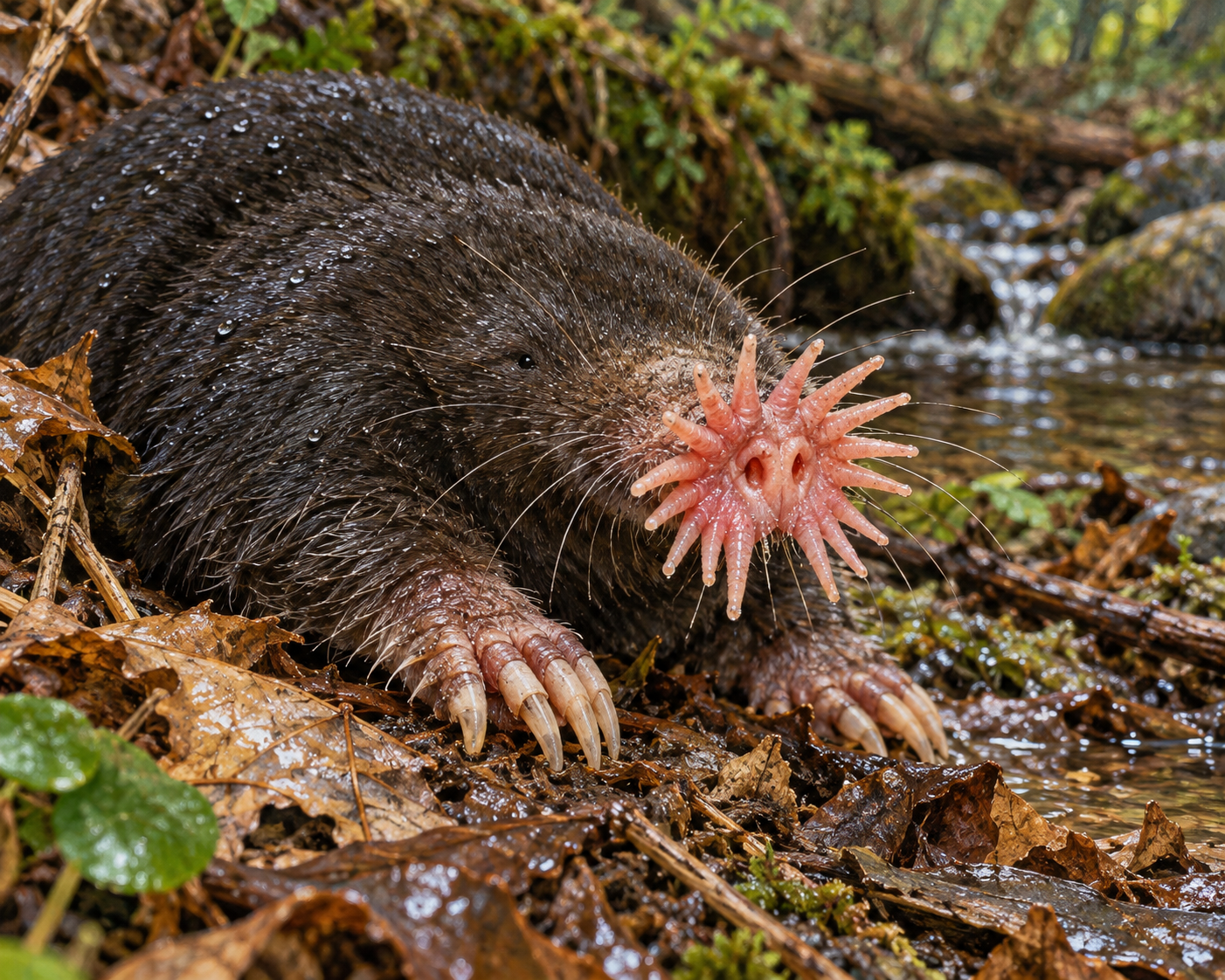
A dark-furred star-nosed mole displays its pink sensory rays beside a damp woodland stream.
The distinctive face and digging paws of a star-nosed mole, shown artistically.

The star-nosed mole has one of the most immediately recognizable faces in the animal world. Twenty-two pink, fleshy rays surround its nostrils. They look extravagant, but they are practical equipment for finding food in a world where vision is often of little use.

The star is principally a touch organ. Calling it a strange-looking nose is accurate as a location, but incomplete as an explanation. Its specialized surface and the brain circuits connected to it form an exceptionally fast system for examining nearby objects.

Thousands of tiny touch points

Each ray carries microscopic domed structures called Eimer's organs. A whole star has roughly 25,000 of these touch organs, supplied by a dense network of nerve fibers. As the mole moves its nose across a surface, that array samples the shape and texture of what it encounters.

The rays are not twenty-two little hands with the same job. The central pair, known as the eleventh rays, has a special role. When another part of the star detects something of interest, the mole brings this central region onto the object for closer investigation.

Researchers call that region a tactile fovea. The comparison is with the fovea of an eye: a specialized area used for fine discrimination. The analogy describes how the system is organized, rather than claiming that the nose literally sees.

The brain follows the important surface

The Catania Laboratory reports roughly 100,000 myelinated nerve fibers serving the star. That is a count of nerve fibers associated with the sensory surface, not a count of all neurons in the mole’s brain. The anatomical investment makes the tiny contact surface a substantial source of information.

This arrangement helps explain the animal's speed. In laboratory studies, star-nosed moles could identify and consume small prey in as little as about 120 milliseconds. That is a minimum observed handling time under experimental conditions, not a claim that every meal or every decision takes exactly that long.

A tiny prey item contains relatively little energy. Handling it quickly can make it worth eating. The remarkable sensory system therefore connects with an everyday economic problem: how much time should an animal spend obtaining a small reward?

Watch the switch from discovery to inspection

The laboratory's high-speed behavior film lets you ask a specific question: where does the first contact occur, and which part of the star examines the object next? The central tactile fovea matters because sensing is organized into a sequence. Broad contact can find something worth investigating, followed by directed contact with a specialized region.

High-speed behavior footage from Vanderbilt's Catania Laboratory. Follow contact with the star and the subsequent examination of a small prey item; the slowed sequence is a way to inspect motion that is difficult to separate by eye.

A useful comparison is your own fingertip finding a seam while your hand explores fabric. The analogy captures directing a more sensitive surface toward a point of interest. It does not imply that a mole's rays have human fingerprints or that your processing speed matches the reported prey-handling minimum.

The brain map adds another scale. The representation of the central rays occupies more cortical territory than their small surface area might suggest. Counting rays alone would miss the unequal investment in processing. The same number of physical parts does not mean that each part supplies the same resolution or behavioral importance.

For the reported 120-millisecond minimum, keep the whole task in view. It includes identifying and consuming a small prey item in a laboratory setting. It is not a universal duration for every decision the animal makes, and a slowed film should not be used to estimate ordinary speed without checking its presentation.

A face shaped by a particular world

Star-nosed moles live around wet habitats and also forage in water. Their touch system is suited to close encounters with small objects in dark, cluttered surroundings. A face that seems bizarre in a portrait makes more sense at the boundary between damp soil, roots, and shallow water.

Touch and underwater smell are separate achievements

The second film on the laboratory page shows underwater sniffing. The mole exhales small air bubbles that contact an object and draws them back toward its nostrils. The bubbles provide a way to collect odorants for a sense usually associated with air. This behavior complements the star's touch function rather than replacing it.

While viewing, separate visible bubble movement from the inferred sensory information. A film can show how the animal samples; experiments following scent trails help establish what the sampling achieves. The touch maps and the olfactory behavior therefore belong to related but distinct investigations.

The distinction changes how we read a portrait of this unusual face. The star is striking because its rays are visible at once. The sequence of contacts, the unequal neural representation and the handling of tiny bubbles are harder to see in one still image. They explain why the shape is useful to a living animal in wet, cluttered surroundings.

An informative question for any unusual sensory organ is what problem it solves during an ordinary day. Here, quickly locating small food items and checking them at close range connects anatomy with energy gained from foraging. The apparent extravagance becomes an economical arrangement when considered at the animal's scale.

Sources and further reading: Vanderbilt Catania Lab: Star-Nosed Mole · Catania and Remple: Foraging speed limit · Catania: A nose that looks like a hand and acts like an eye

publications

New this week Two novels in six stories each, from The Night Shift . New — a novel in six documents Small Print A Novel in Six Do...