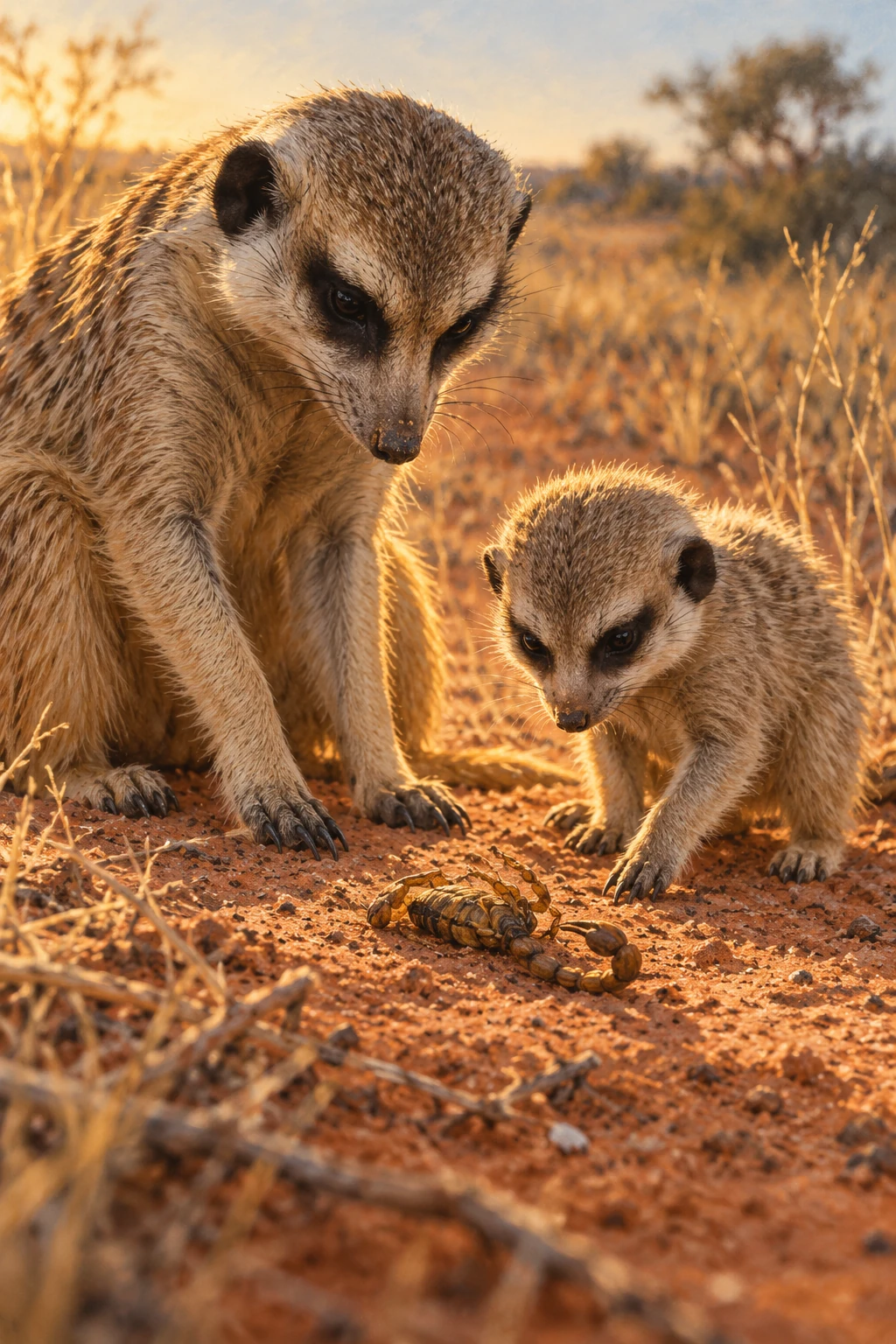
Learning to handle dangerous prey presents a problem for a young meerkat. Trial and error can be expensive when an error has a sting. Older group members help bridge the gap by changing what they give pups: easier prey first, then more challenging opportunities. The youngster's lesson is built into the condition of its meal.
This behavior is not merely a charming resemblance to a classroom. Researchers used observations and experiments to ask whether helpers altered their behavior in ways that accelerated learning. The case became an influential example of animal teaching defined through its consequences, without requiring an animal to explain its intentions.
The meal can contain a graduated task
A 2006 study by Alex Thornton and Katherine McAuliffe followed wild meerkats, Suricata suricatta. Helpers supplied young pups with prey that was dead or disabled, then provided more intact live prey as pups grew. This gave inexperienced animals opportunities to practice handling while reducing some of the initial difficulty.
The Cambridge account describes helpers monitoring the interaction and sometimes retrieving escaping prey or further disabling it. Food delivery therefore included more than transferring calories. It altered the learning opportunity available to the pup.
That distinction matters. Handing a pup a finished meal can nourish it without giving much handling practice. Providing a manageable live item can teach a skill while still supplying food. The same broad category, “feeding the young,” can conceal different developmental effects.
How does a helper know which challenge to offer?
The researchers investigated the role of pups' begging calls, which change with age. Playback experiments helped test whether helpers responded to the acoustic cues rather than simply judging a pup's visible size. Changing the calls available to the helper altered provisioning in the expected direction. The cue was experimentally separated from the pupil's actual developmental stage.
This is a powerful design because age changes many things together. A larger pup may move differently, beg differently, and already be more skilled. Merely observing older pups receive more intact prey cannot identify which cue drives the helper's response. Playback lets one part of that package change while others remain more nearly the same.
It also limits the mental claim. Responding to an age-related call can produce adaptive teaching without a helper explicitly representing what the pup knows. The behavior can be sophisticated in function while relying on a comparatively simple cue. Explaining that possibility does not diminish the result; it explains how teaching could evolve.
Learning needs a comparison, not just a successful pup
The study's experimental component examined whether experience handling prey improved later performance. That addresses a different question from whether helpers give age-appropriate items. An adult could alter its behavior around young animals for reasons that do not benefit their learning. Demonstrating an accelerated skill provides evidence for the teaching function.
A useful thought experiment is to compare two hypothetical pups receiving the same amount of food. One gets every item already fully processed; the other receives progressively manageable handling opportunities. If the second later handles difficult prey better, calories alone cannot explain the difference. A real experiment must also account for age, prior experience, prey type, and the opportunities each animal actually received.
The classic research paper joins such developmental outcomes with observations of helper behavior. It is that combination—not an isolated image of an adult standing over a pup—that makes the example scientifically useful.
The group is part of the developmental environment
Meerkats live in cooperative groups, and care is not supplied only by a pup's mother. Understanding who contributes requires following recognizable individuals and their relationships over time. Cambridge's account of the Kalahari project describes the value of a long-term field study for connecting individual behavior with survival and reproduction.
Such familiarity can make natural behavior observable without making the animal a tame performer. The research context is therefore different from a visitor trying to feed wildlife or stage an encounter for a camera. Dangerous prey should remain a subject for documented observation, not a home teaching experiment.
The scene in the generated illustration is deliberately quiet: an adult, a pup, and a small prey-handling opportunity. It is not a step-by-step guide to handling a scorpion and does not identify a particular study event. The real evidence lies in repeated behavior and controlled comparisons.
The larger insight is that teaching need not begin with a lecture. It can begin by arranging an encounter at a level a learner can manage, then changing that level as the learner develops. In meerkats, the relevant adjustment is carried in the meal itself. A social group helps shape not only whether a pup eats today, but what it becomes capable of obtaining tomorrow.
Follow the evidence: Thornton and McAuliffe: teaching in wild meerkats; Cambridge: helpers change prey provisioning as pups grow; Cambridge: the long-term Kalahari research project; Thornton and McAuliffe: research paper copy.
More curious connections, art and independent projects at Incoprea.