Showing posts with label Andean History. Show all posts

Wednesday, October 14, 2026

The Andean Pottery Vessels That Sing When Water Moves

A small ceramic bird can contain a second surprise after its shape. In some Andean vessels, moving water shifts air through a concealed whistle and produces a warbling sound. The sculpture is also a container, and the container is part of a musical mechanism.

These objects reward a change in the usual order of attention. First look at the outside, then listen, then ask how the interior makes the sound possible. A potter had to plan all three experiences in clay that would eventually be fired into a durable but difficult-to-alter form.
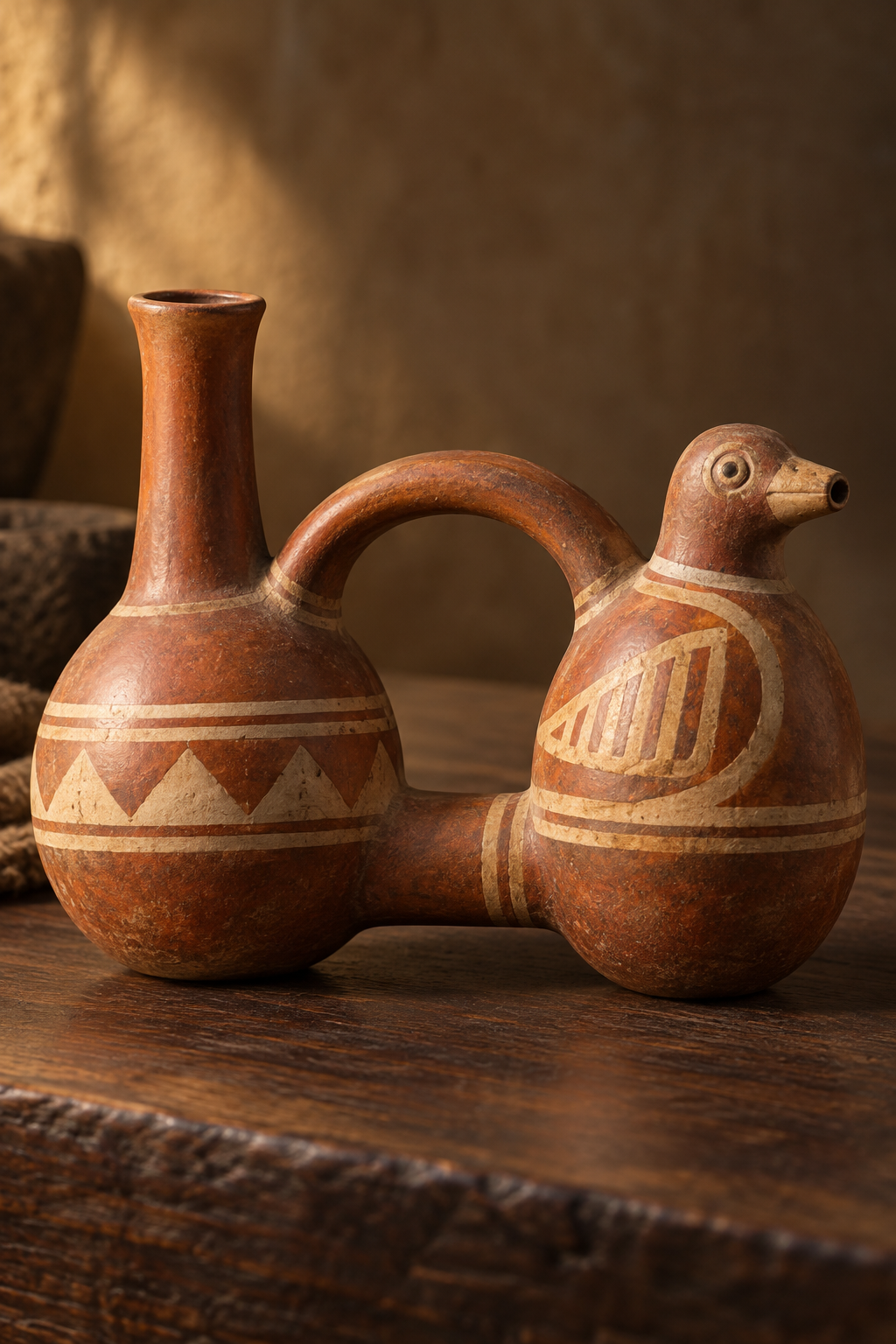
Illustration of a two-chamber Andean-inspired pottery vessel with a pouring spout and bird-shaped whistle.
An interpretive vessel inspired by Andean ceramic sound-making traditions.

Listen to one particular jar

The Metropolitan Museum of Art's Chimú Whistling Jar, object 89.4.689, comes from Peru's north coast and is dated in the museum record to 1000–1476. Its collection page includes an audio feature with a transcript describing the sounding object.

The transcript explains that the jar is partly filled with water and rocked so liquid moves between two chambers. Displaced air reaches a whistle in the bird's beak. The recording's warbling effect gives the viewer another route into a form that might otherwise be treated as a silent decorative animal.

The distinction between water and air is essential. Water helps drive the air's movement; the whistle is an aerophone, an instrument in which air participates in producing sound. The vessel's chambers and passages make liquid motion useful to that process.

Follow the hidden route

Imagine water moving into a space that already contains air. The air has to move somewhere. In a vessel designed with an appropriate path and whistle, the changing flow can produce sound. The shape of the inside is therefore as consequential as the profile a museum visitor sees.
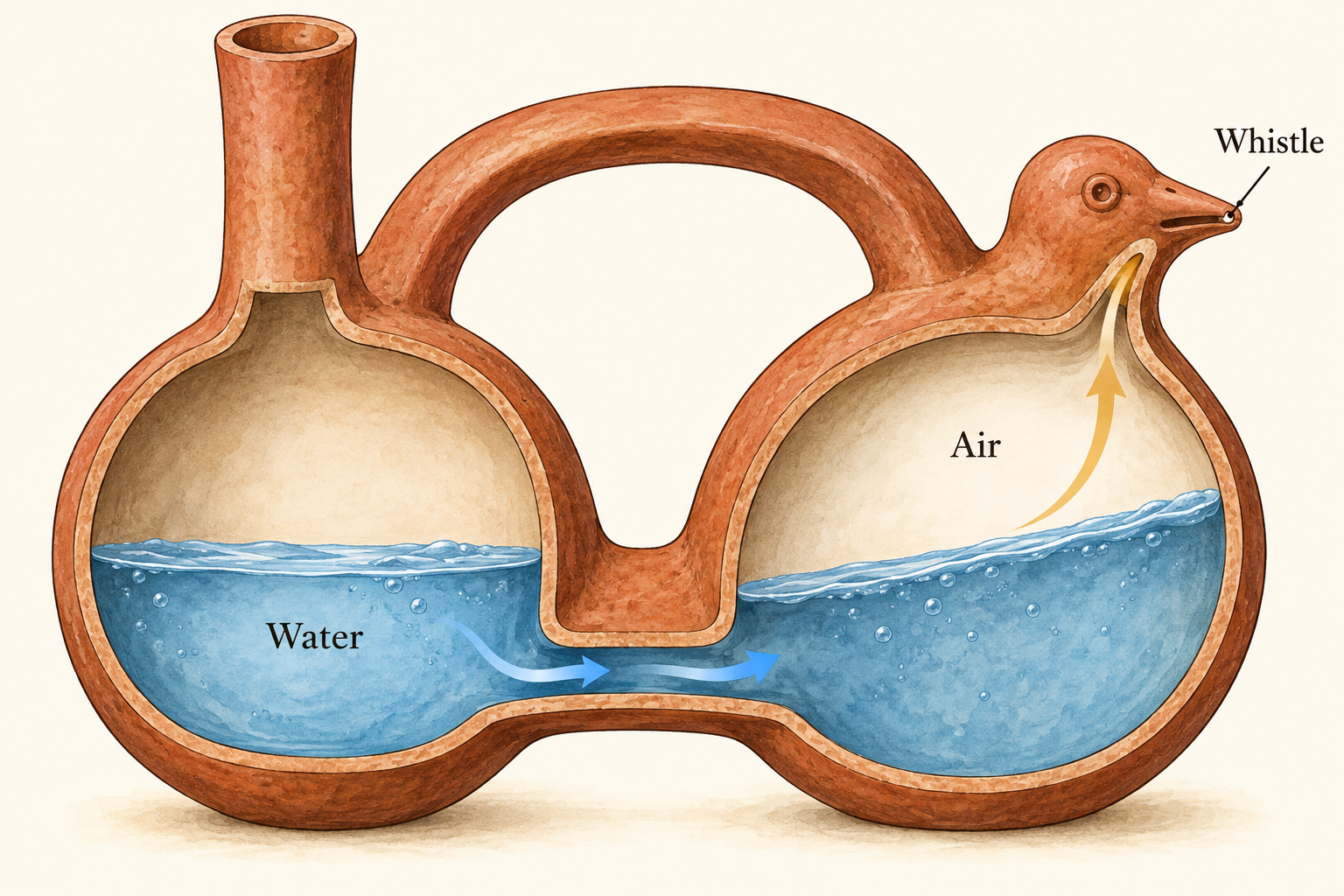
Conceptual cutaway showing water moving between vessel chambers and air passing toward a whistle.
A simplified cutaway explains displaced air; actual vessel passages and whistle forms vary.

The cutaway separates those ideas conceptually. It is not a measured section through the Met jar. Actual chamber connections, apertures and whistles vary across examples. Use the museum's account to connect a mechanism with a named object rather than assigning one universal interior to every whistling vessel.

Tilting is also an input. A person does not simply reveal a sound already stored inside the clay; handling sets the water and air in motion. The object's behaviour emerges through the relationship between form, contents and movement.

A feline offers another design

The Met also holds a Wari feline-shaped whistling jar, dated around 500–900. Its description identifies a spout on the animal's back and a bridge joining the spout area to the hollow head. Tilting the partly filled vessel forces air out and produces sound.

The surface is richly worked too: coloured slips, a spotted coat, a striped tail and a burnished finish. The catalogue notes that the tail may suggest a pampas cat, despite the object's conventional title “Jaguar Whistling Jar.” Even the animal identification invites close looking rather than automatic acceptance of the title.

Set the Wari and Chimú records beside one another. They belong to different periods and cultural settings. Their shared capacity for sound is a reason to compare them, not a reason to collapse them into one timeless Andean instrument.

Architecture can conceal a voice

Architectural vessels add a further variation. The Met publication “Design for Eternity” discusses objects in which a sound mechanism is concealed within a modelled structure or one of its features. A miniature building can organise airflow as well as represent space.

That creates an interesting relationship between seen and unseen form. An external feature may have a visual role and a functional connection to the interior. The hidden passage is not necessarily something a viewer could reconstruct correctly by looking at the outside alone.

The wider lesson is about craft. A ceramic artist working on an acoustic vessel has to anticipate changes during making and firing, the relationship of connected parts, and the behaviour of the finished object. The charming animal or building is only the visible part of that planning.

A two-pass listening visit

Open the Met's Chimú jar page and use its “Whistling Jar” audio feature. On the first pass, listen without looking closely at the image. Describe the sound in terms of continuity, pulses, pitch movement and pauses. Avoid deciding immediately what it must imitate.

On the second pass, read the transcript and follow its account of rocking, moving water and displaced air. Can you hear changes that you would want to relate to the handling? The recording supplies a particular demonstration; it does not let you measure every movement or infer every possible sound the vessel could make.

Then open the Wari record and examine its different views. Locate the spout, bridge and hollow head identified in the description. Which features are visible immediately, and which become meaningful only after reading the account of sound production?

What the recording cannot tell us by itself

A modern demonstration can show what the particular object does under the demonstrated conditions. It cannot establish a complete ancient ceremony, its participants or its meaning. Those historical questions require archaeological and cultural evidence alongside the sound.

Hear the object without inventing its occasion

The original uses of many pre-conquest sound-producing objects remain uncertain. Museum interpretations can suggest ceremonial or other roles, but a compelling sound should not be turned into a detailed ritual narrative without support.

There is already enough to hold our attention. Liquid becomes a moving component, air follows a planned route and clay gives the mechanism an animal or architectural form. The vessel joins visual imagination with practical understanding. Listening makes that achievement perceptible in a way a photograph alone cannot.

Sources and further reading

Explore more art, stories and discoveries at Incoprea.

Khipu: The Andean Records You Could Hold in Your Hands

Imagine lifting an archive by its main cord. Pendant cords hang below it; some branch into smaller cords; knots occupy particular positions. The record has order, but it is neither a page nor a carved tablet. Andean khipu, also spelled quipu, make information physical in a form that can be handled.

The most accessible doorway is numerical. Many khipu record numbers using decimal relationships. The harder question often follows immediately: numbers of what, organised for whom, within which activity? Reading a quantity is a substantial achievement, but a quantity does not supply its own heading.

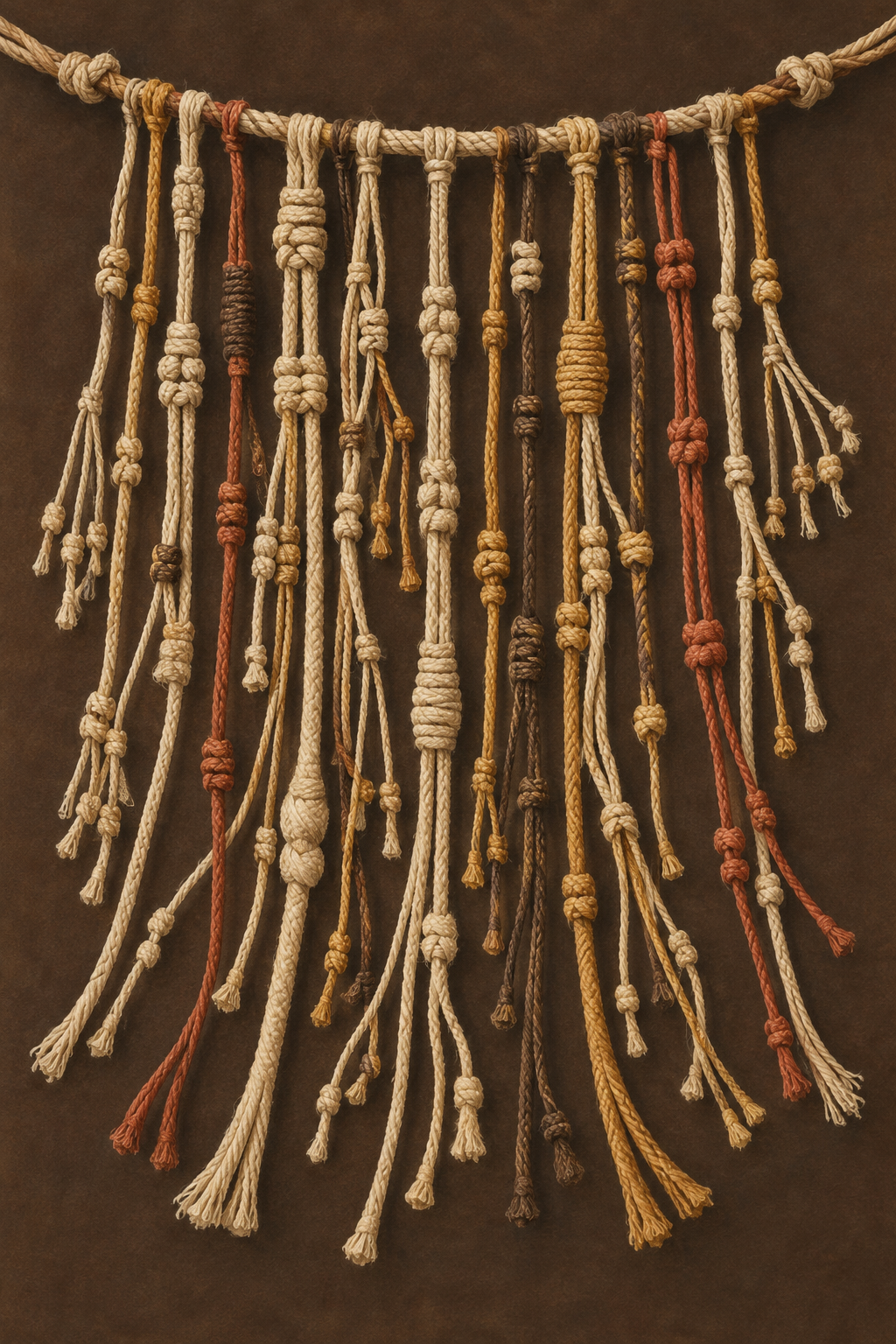
Illustration of an Andean khipu with multicolored hanging cords and grouped knots.
An interpretation of khipu cordwork, not a transcription of a particular record.

How a number occupies a cord

In a conventional numerical khipu, knot type and position help distinguish units from higher decimal places. Pendant and subsidiary cords organise further relationships. The National Institute of Standards and Technology's museum explanation illustrates this base-ten arrangement and its connection to Inka administration.

Position does real work. A group associated with hundreds is not equivalent to the same number of knots in a tens position. The structure therefore differs from a simple tally in which each mark represents one more item. It encodes relationships among places as well as counts.

A modern analogy is a spreadsheet made tactile. It is useful if it reminds us that a value belongs to an organised field. It becomes misleading if it makes us imagine that every khipu follows one universal table with modern labels hidden inside it.

A small place-value exercise

Consider the number 243: two hundreds, four tens and three units. Now compare 234. The same three digits appear, but two have changed positions. Their relationship to place changes the value.

A numerical khipu uses its own knot conventions to maintain such distinctions. The example here explains decimal organisation; it is not an instruction for making an authentic historical record. To study the actual knot types, use the labelled illustrations in the mathematical and museum resources below.

Next ask what 243 means. It could count people, goods or something else entirely. Without a category and a context, the number is incomplete as a historical statement. This is where cord grouping, colour, attachments and comparisons with other records become important questions.

When cords meet a written census

Manny Medrano and Gary Urton compared six colonial-period khipu with a Spanish census associated with Peru's Santa Valley. Harvard's account describes correspondences involving social organisation and named people. The match offered a way to relate particular cord structures to an independently documented record.

The achievement depends on the specificity of the comparison. A census supplies categories and relationships that an isolated khipu might not reveal. The khipu supplies an Andean material record that can be examined alongside the colonial text. Neither should be treated as a transparent substitute for the other.

It does not follow that all surviving khipu become readable through the same key. A strong interpretation of one group is a basis for further testing. It must be checked against other objects and contexts before being generalised.

Colour needs a community of readers

Harvard's account of later work on khipu from San Juan de Collata emphasises the difficulty of assigning meaning to colours across different regions and periods. A red cord is visible. Its intended category or sound value cannot be recovered simply from the modern viewer's associations with red.

That is a familiar feature of information systems. A colour has meaning because users share conventions. Remove the legend from a complex map and some relationships remain visible while others become ambiguous. The loss is contextual, not evidence that the map never carried useful information.

Researchers also investigate whether some khipu record narrative or linguistic content beyond conventional numerical accounting. The proposals need to be attached to particular evidence. Announcing a fully decoded lost alphabet would erase both the diversity of objects and the work still required.

Examine the craft before searching for a message

A cord has material features: fibre, twist, thickness, colour, attachment and knots. The maker had to produce and arrange those features through textile knowledge. Information and craft are not separate layers pasted together afterwards; the choices are embodied in the object.

The Khipu Field Guide offers an independent research resource with renderings and documented features. Its descriptions distinguish that database from the earlier Harvard database. Treat a rendering as a structured representation, then ask what measurements and observations underlie it.

  1. Follow one pendant cord from its attachment towards its end.
  2. Notice where knots form groups and where space separates them.
  3. Identify a subsidiary cord or a change in grouping, if present.
  4. Compare the rendering with its description. Which details represent observed material, and which values follow a reading convention?

The exercise slows the urge to search immediately for a hidden sentence. A good account begins by preserving the object accurately enough that different interpretations can be compared.

An archive larger than our idea of writing

Khipu were important in Inka administration and continued in varied forms after the Spanish conquest. That long history is another reason to resist one explanation for every object. Contexts changed, and practices could change with them.

The surviving cords also represent an uneven sample, affected by preservation and collecting. Losing a shared interpretive tradition can make a sophisticated record difficult for outsiders to understand. Difficulty belongs to our present access to the system, not to an absence of thought in its makers.

A numerical value, a secure grouping or a successful match with a census can restore part of that access. Each makes the archive a little less remote. The reward is a broader understanding of how people organise knowledge: with fibres and fingers as well as ink and eyes.

Sources and further reading

Explore more art, stories and discoveries at Incoprea.

Famous Last Meals is now in paperback — stories, history and 25 recipes

Famous Last Meals: Stories, History, and Recipes is now available in paperback on Amazon. The illustrated collection brings together 23 his...
