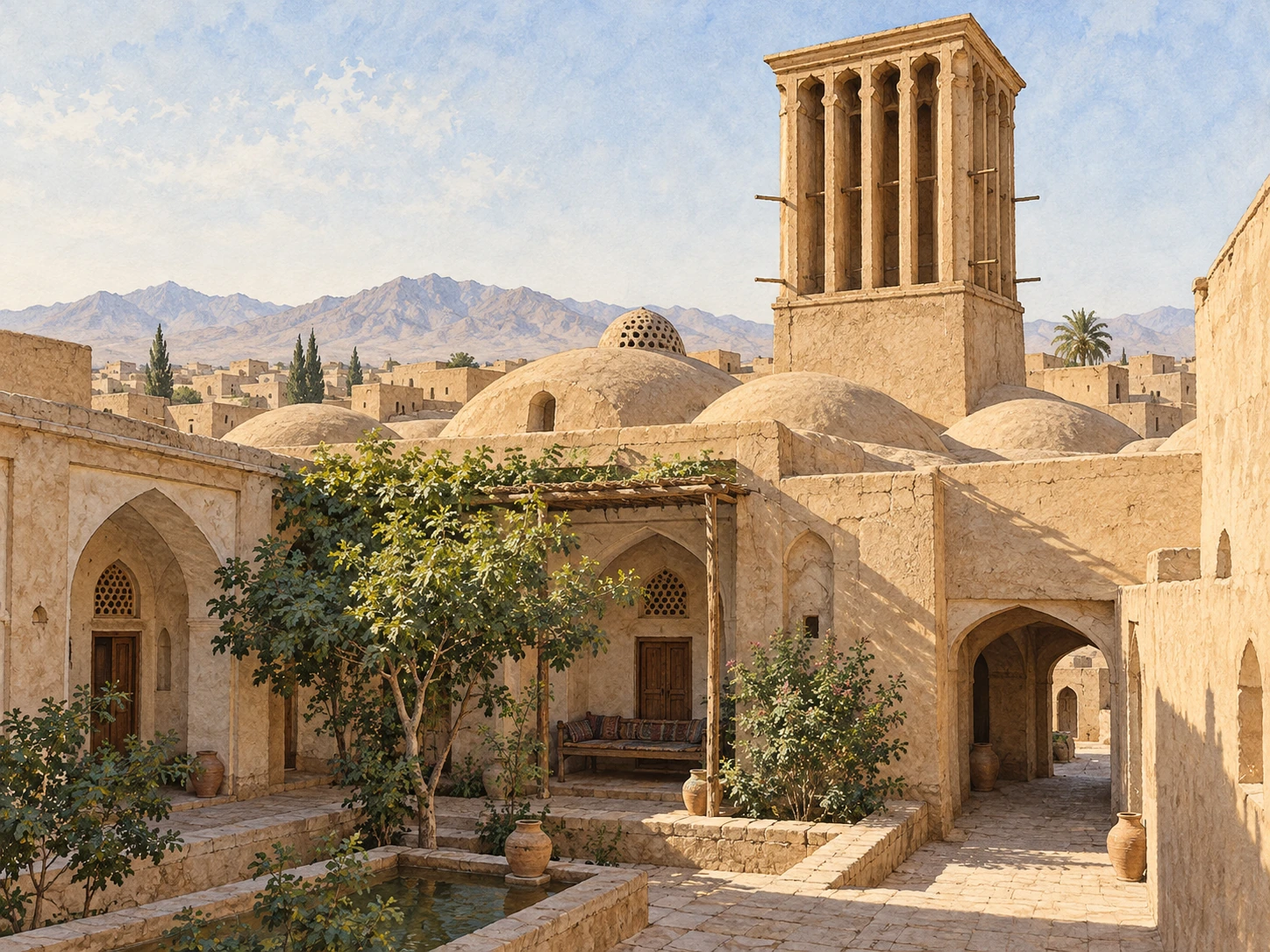
A tall rectangular tower rises above the earthen roofs. Its vertical openings look almost like the windows of a small building balanced on a larger one. The name windcatcher invites a simple picture: a tower scoops a breeze and pours cool air down into a room.
That image is a useful beginning. To understand the mechanism, however, keep tracing. Air entering a building has to displace air already there. The tower belongs to a route through openings and rooms, embedded in weather and a surrounding city.
Start with two places, not one opening
Wind interacting with a structure produces different pressures around it. An opening on one face can connect to a different pressure than an opening elsewhere. If a passage joins those places, air may move through it. The direction and amount depend on the actual pressure differences and flow resistance.
Elmualim and Awbi’s wind-tunnel and computational study examined windcatcher systems connected to a test room. Their work measured how ventilation varied with wind speed and direction. The result supports a careful statement: orientation matters. It does not supply a universal cooling performance for every historic tower.
Make a route list rather than a tower portrait: outside opening, vertical channel, room, exit opening, outside again. If you cannot identify an exit in a photograph, write “not visible.” Do not assume that the missing part of the route does not exist.
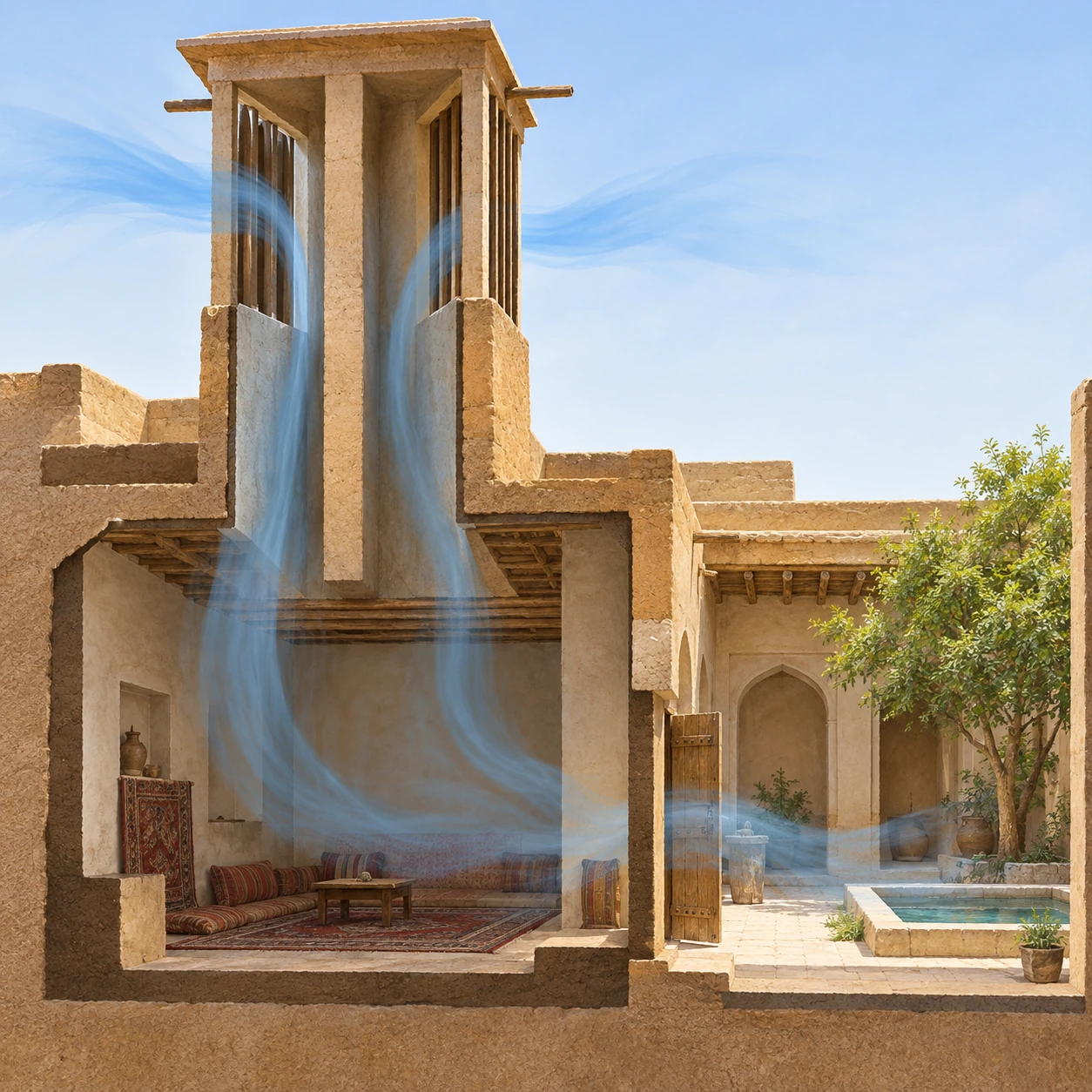
The conceptual cutaway makes the connection visible, but the blue wash is not measured flow. Real air can circulate, reverse or distribute unevenly. A beautiful illustration cannot determine the pressures at its openings.
Ventilation and cooling are related questions
Moving air can carry heat out when conditions favor it, and air movement can affect how a person feels. Yet ventilation rate and air temperature are different measurements. Bringing in hot outdoor air is not automatically the same as refrigerating a room.
That distinction gives you a useful test for any striking claim. If an article says a building is “cooled,” ask what was measured: indoor temperature, surface temperature, air speed, a comfort index or a comparison with another room. Also ask when it was measured and what the outdoor conditions were.
UNESCO’s description of historic Yazd places windcatchers alongside courtyards, thick earthen walls, underground spaces and a qanat water system. The thermal environment belongs to this ensemble. Attributing every benefit to the most photogenic tower would hide the contributions of shade, material and spatial arrangement.
The neighborhood is part of the experiment
A tower standing alone in a test setup and a tower surrounded by other roofs do not experience identical approach winds. Upstream buildings can redirect, slow or disturb the air before it reaches an opening.
A 2023 wind-tunnel study of buildings with windcatchers and surrounding arrays investigated that very issue. Its experimental context is important: a result for a particular arrangement should not be carried unchanged into every street in Yazd. It demonstrates why surroundings must be included in the question.
Try this close-looking exercise using the exterior illustration. Sketch the windcatcher’s height relative to nearby roofs. Add a hypothetical wind arrow from one direction, then rotate it a quarter turn. Which surfaces now face the wind? Which openings might sit behind another building? The arrows are your thought experiment, not a forecast.
Investigate airflow without smoke
At home, you can observe an ordinary open doorway using a light strip of tissue held securely in your hand. Compare still and breezy moments. Stay away from fans, flames and moving mechanisms, and never place loose material inside a vent. The movement shows a local current; it does not measure the air-change rate of the whole room.
Write down what remains unknown: the velocity across the rest of the opening, simultaneous currents elsewhere, and whether the pattern persists. This modest observation is a useful antidote to inferring a whole building’s performance from one fluttering ribbon.
Admire the system at the right scale
Traditional architecture often earns praise through a modern efficiency number. The more interesting achievement can be the way many decisions cooperate: an opening oriented to a climate, a shaded courtyard, substantial walls, a social practice of moving between spaces and a maintained water infrastructure.
A windcatcher is a striking silhouette, but its real intellectual invitation is a path. Follow the air through the building and back outdoors. The tower becomes more impressive when its performance is connected to the parts that the skyline leaves out.
Sources and further exploration: Elmualim and Awbi: windcatcher tests; UNESCO: historic city of Yazd; Wind-tunnel study: surrounding buildings and windcatchers.
Explore all 50 new articles · Browse the complete illustrated collection
Explore more art, ideas, and independent projects at Incoprea.


