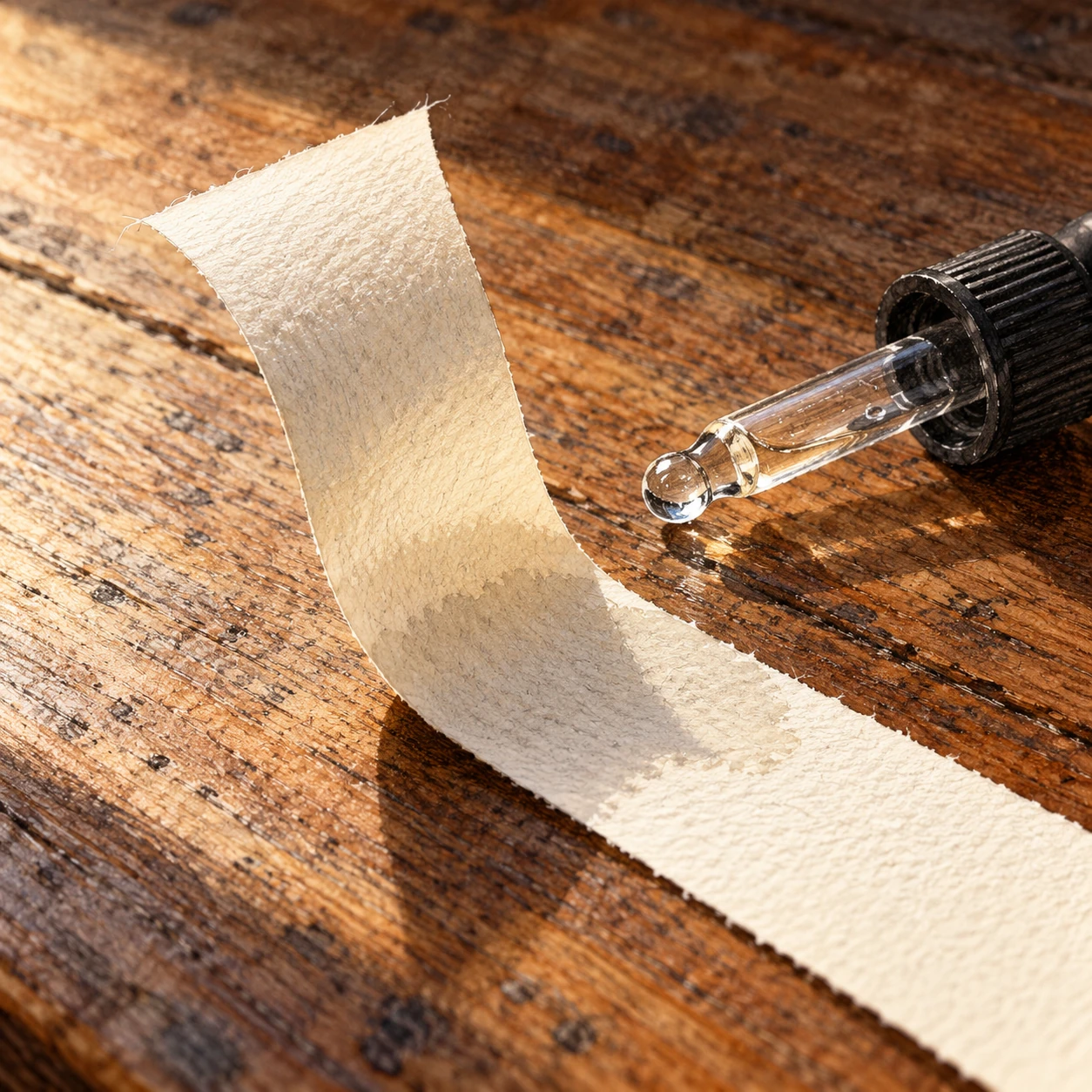
A drop lands on a paper strip and the strip begins to bend. The water has not become a little weight levering the edge upward. It has changed the material. Cellulose fibers take up moisture, their dimensions and mechanical behavior change, and different parts of the sheet may no longer fit together comfortably in a plane.
The familiar curl is a small materials experiment performed by accident on a desk. But a useful explanation has to distinguish what happens immediately during wetting from what remains after drying. Those two shapes can have different causes.
A sheet is a network with a history
Paper is a bonded fibrous network rather than a uniform slab. Fiber orientation, processing, coatings and drying history can make one direction or side behave differently from another. Water uptake can expand fibers and soften parts of the structure. If those changes are uneven through the thickness, bending can help the layers accommodate different preferred lengths.
Imagine bonding two very thin strips together. If the upper strip wants to become longer while the lower one does not, they cannot both remain flat and fully attached without developing stress. Curving lets the longer side occupy a longer path. This simple bilayer analogy explains a route to bending; real paper does not consist of two neat homogeneous layers.
Minhee Lee and colleagues' 2016 study quantified a wetted paper strip's geometry and mechanics. It connected the rate of swelling across thickness with water transport in the sheet and developed a model for the resulting deformation. The point was to measure a changing process, rather than assign all wet-paper behavior to one final photograph.
One side is not automatically the other side
A study of one-sided linerboard wetting reported that the settled curl axis depended on which face was wetted in the tested commercial grade. This is a useful boundary on a kitchen-table rule: two pieces that look similar may contain different structural directions or sides.
A strip cut across a sheet and a strip cut along it may therefore pose different experiments. So may a coated face and an uncoated face. If you mix these conditions unknowingly, a repeated test can appear inconsistent even though the material is responding systematically to different inputs.
The useful question is not simply “Does paper curl toward or away from water?” It is “Which paper, which face, which direction, how much water, and at what time?” That longer question is less catchy, but it can actually organize observations.
Dry again does not necessarily mean reset
Alexander Maaß, Julian Selinger and Ulrich Hirn's 2024 research specifically examined permanent curl after wetting and redrying. They tested paper with fiber bonds modified to resist opening in water. Reduced permanent curl in the treated sheets supported a role for opening and rearrangement of fiber-to-fiber bonds in the wetted layer.
The study separates residual deformation from immediate moisture-gradient bending. Merely saying “one side swelled” does not necessarily explain the shape left after the moisture has departed. A material can retain a processing history because its internal connections changed during the cycle.
That distinction has a practical implication for printed work: an initially flat sheet can acquire a shape through a water-based process and retain some of it. Explaining the residual shape requires looking beyond the amount of water present at the final moment.
| Observation | Possible next comparison |
|---|---|
| Two directions bend differently | Compare strips cut consistently along each direction |
| The initial curl relaxes | Track the time course rather than only the final shape |
| A curl remains after drying | Distinguish residual deformation from current wetness |
| One face absorbs a drop slowly | Check for surface treatment and unequal spreading |
The ordinary object rewards a precise question
None of these observations alone lets a home experimenter identify fiber chemistry or reconstruct a manufacturer's process. They do let you replace a vague statement with a useful record. A curling edge can be a response to a transient gradient, a structural asymmetry, a changed network or several factors together.
The strip's movement also makes an abstract engineering idea tangible: a material does not have to be pushed from outside to change shape. Internal parts can develop incompatible preferred dimensions. The resulting motion is the sheet finding another geometry in which those parts can coexist. A drop on a desk is enough to make that hidden negotiation visible.
Sources and a closer look: Lee and colleagues: bending and buckling of wet paper; Monash: one-sided wetting of linerboard; Maaß and colleagues: fiber bonds and permanent curl.
Explore art, experiments and other unexpected connections at Incoprea.