Showing posts with label Fungi. Show all posts

Friday, October 23, 2026

Bacteria Can Travel Along a Fungal Highway

Soil can look damp while remaining a broken landscape for a swimming bacterium. Water does not necessarily form one continuous pool between mineral grains. Air-filled gaps can interrupt the route. A fungal thread crossing that gap can change the geography.
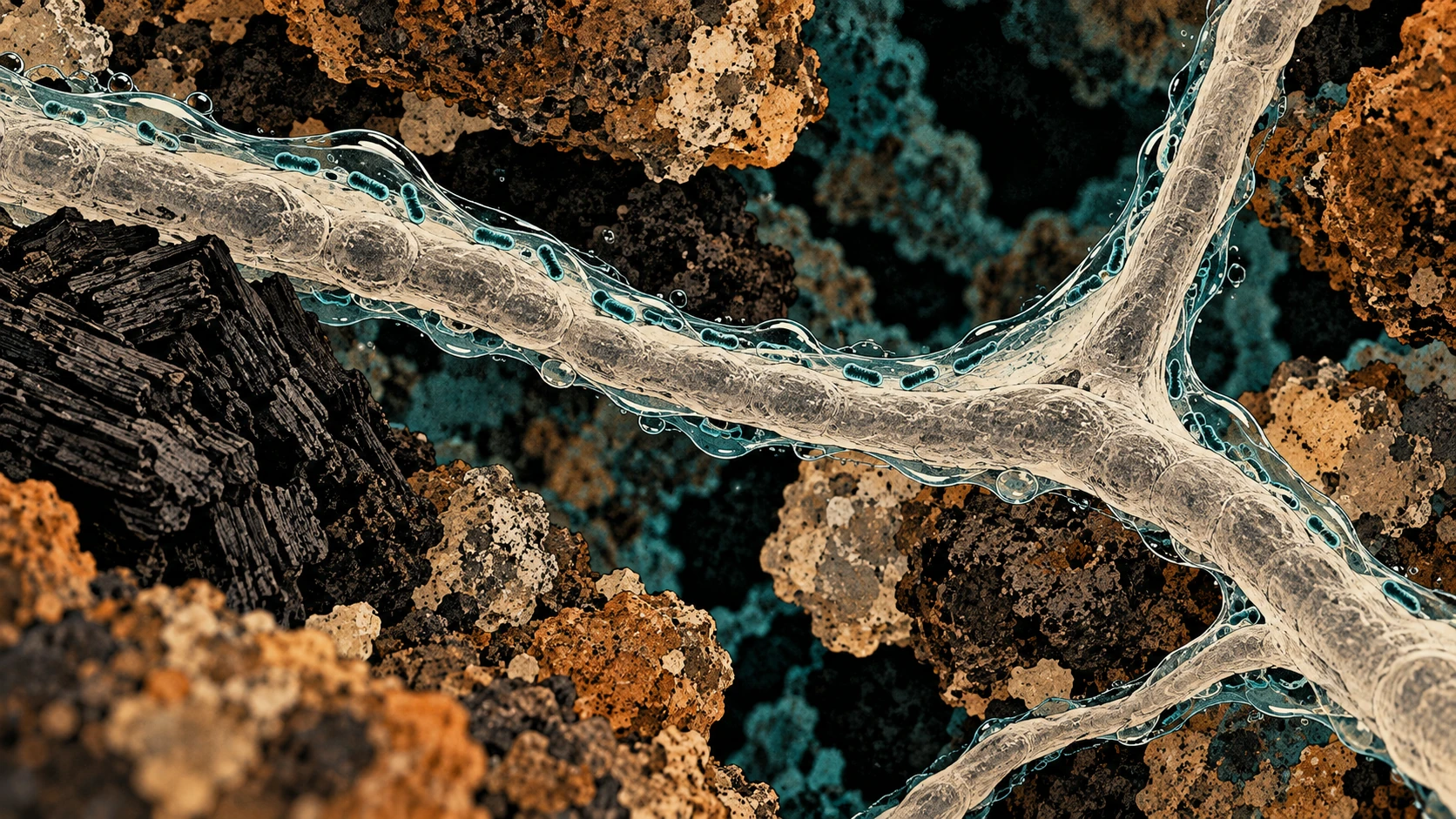
Microscopy-inspired soil pore with bacteria in a water film along a branching hypha
A conceptual view of a connected water film; the artwork is not a micrograph or a measurement of scale.

The phrase “fungal highway” describes bacterial dispersal associated with fungal hyphae. In an important version of the process, bacteria move through a thin water film along the fungal surface. The fungus supplies a connected route through a landscape that would otherwise be difficult to cross.

The picture is appealing, but it needs careful unpacking. It does not mean that every bacterium rides every fungus. It does not imply that bacteria are always carried inside the thread. Nor does the presence of two organisms in one soil sample demonstrate that one transported the other.

Make the obstacle small enough

Imagine a person describing a forest as continuous because trees cover the map. A small ground animal may instead encounter fences, streams and clearings that determine which route is possible. Scale changes what counts as a connected habitat. The same reasoning becomes more extreme for organisms moving within films of water.

A 2005 laboratory study tested selected bacteria with fungi in agar-surface and glass-bead systems. A motile bacterial strain dispersed especially effectively with a hydrophilic fungal partner. Nonmotile strains did not disperse with that fungus in the tested comparison. A hydrophobic fungus gave different outcomes depending on the experimental setting.

These details matter more than a single headline speed. The result depended on the organisms and on how the surrounding environment was constructed. The liquid-film explanation is a mechanism to investigate, not a permission to erase all of that specificity.

Build a route without building a miniature soil

The connectivity explorer below has five fictional wet patches. A and B are connected, and D and E are connected. Two optional bridges can connect B to C and C to D. An optional bypass joins A directly to D.

Connect the wet patches

An invented five-node network separates route connectivity from arrival and motility.

Open connect the wet patches in its own window.

Switch bridges on and off. The tool reports whether an active route exists from A to E under its deliberately narrow rules. It also lets you turn the hypothetical swimmer's motility off. Nothing in the calculation is fitted to real hyphal growth or bacterial speed.

First connect B to C alone. You have increased the reachable habitat, but you have not connected the target. Next add C to D. A small additional connection changes the result for the entire route. Finally remove the first two bridges and activate the bypass. The same arrival can now arise through a different path.

This is why a destination sample alone cannot reconstruct a journey. Detecting bacteria at the target establishes presence. To identify the route, an experiment needs to constrain alternatives or observe movement directly. A model can help make that logical distinction without pretending to be a physical replica.

From selected pairs to organisms in actual soil

A 2015 study developed “fungal highway columns” to enrich fungi and potentially associated migrating bacteria from soil. The device separated an attractive medium from a target medium. Fungi could bridge the intervening structure. Researchers then tested isolated bacterial-fungal pairs for migration rather than assuming every co-isolated pair represented a working highway.

Most of the bacterial isolates with confirmed migration were motile, but not every motile bacterium used its potential partner. That is another useful interruption to an easy story. Having a means of locomotion and encountering a fungal surface do not guarantee dispersal under the test conditions.

The column is also a selective habitat. A nutrient medium rewards some organisms more than others. Fast-growing fungi can outcompete slower arrivals. The organisms recovered by the method therefore cannot automatically be treated as a census of everything capable of this interaction in the original soil.

What the inventory can and cannot count

A follow-up inventory in three forest soils used two culture media and molecular identification. The columns selected fungi in the genus Mortierella alongside a diverse bacterial community. The authors described potentially associated migrating bacteria, preserving the distinction between an enriched association and the direct demonstration of each organism's journey.

For a reader, “potentially associated” can look like timid language. Here it does real work. It states which step has been observed and which still requires a test. Removing that phrase would make the story simpler by making it less accurate.

Consider two possible follow-ups. One could film a marked bacterium moving along a known hypha under controlled conditions. Another could measure how a fungal network changes the rate at which a target resource is reached in intact soil. The first would sharpen the route mechanism; the second would sharpen its ecological consequence. Neither would make the other unnecessary.

Useful roads, uneven consequences

Reaching a place can matter only if something useful happens afterward. Early highway work investigated pollutant-degrading bacteria, raising the possibility that dispersal could improve access to otherwise separated material. Turning that possibility into a reliable field method requires attention to the organisms, moisture and resources involved.

The highway metaphor should therefore end with questions rather than a universal soil treatment. Which organism gains access? What does it do there? Does the fungus benefit, pay a cost or simply provide a surface? Those outcomes need not be identical across partnerships.

A handful of earth is not merely a crowd of species. It is a set of routes, interruptions and temporary connections. The fungal-highway story makes that hidden geography visible, while the experiments show why arriving at the same destination does not always mean taking the same road.

Sources and further reading: Taking the fungal highway (2005); Exploiting the fungal highway (2015); An in situ inventory of fungi and associated migrating bacteria (2017).

Explore all 80 new articles · Browse the complete illustrated collection

Explore more art, ideas, and independent projects at Incoprea.

Wednesday, October 14, 2026

Leafcutter Ants: The Leaves Are for Their Crop

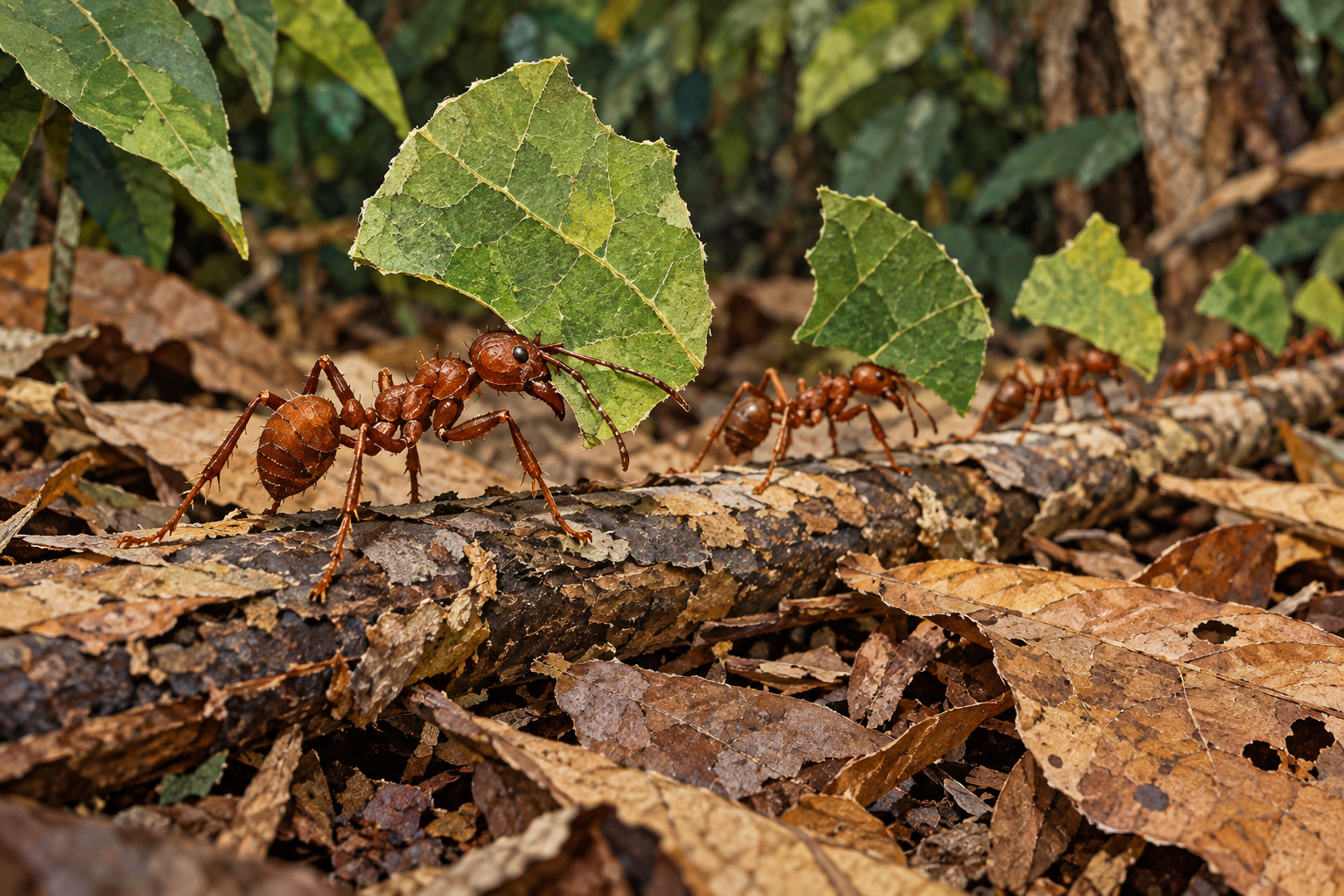
Illustration of leafcutter ants carrying green fragments along a twig.
The familiar leaf procession supplies material for a fungal garden beneath the surface.

A leaf fragment moves along a forest path like a small green sail. Look beneath it and you find an ant. Follow the procession and you can easily imagine the colony sitting down to eat its harvest. The more interesting meal is still being grown. Those pieces of vegetation are material for a fungal crop.

The visible trail is one stage of a system that also includes food production, the movement of enzymes, crop protection, and waste. Once you know what to look for, the procession becomes less like a queue of identical workers and more like a glimpse of an agricultural relationship whose important transformations are hidden underground.

From a leaf to something the colony can use

Leafcutter ants cultivate fungi on plant material. The fungi make specialized swollen structures called gongylidia, which provide food, especially important for the larvae. The leaf is therefore a resource for the crop rather than simply ready-made food for the ants. The Smithsonian’s account of fungus-farming research places this leafcutter strategy among several different forms of ant agriculture.

Harvesting is only the beginning. Ants fragment the plant material and incorporate it into a living garden. The crop has to grow into new substrate, while the colony needs a continuing supply of food from existing growth. Young material entering the system and older material leaving it are at different stages of transformation.

This helps explain why a garden is more than a storage chamber full of leaves. A store preserves something for later use. A fungal garden changes the material through the activity of another organism. Keeping that organism productive is central to the colony’s own survival.

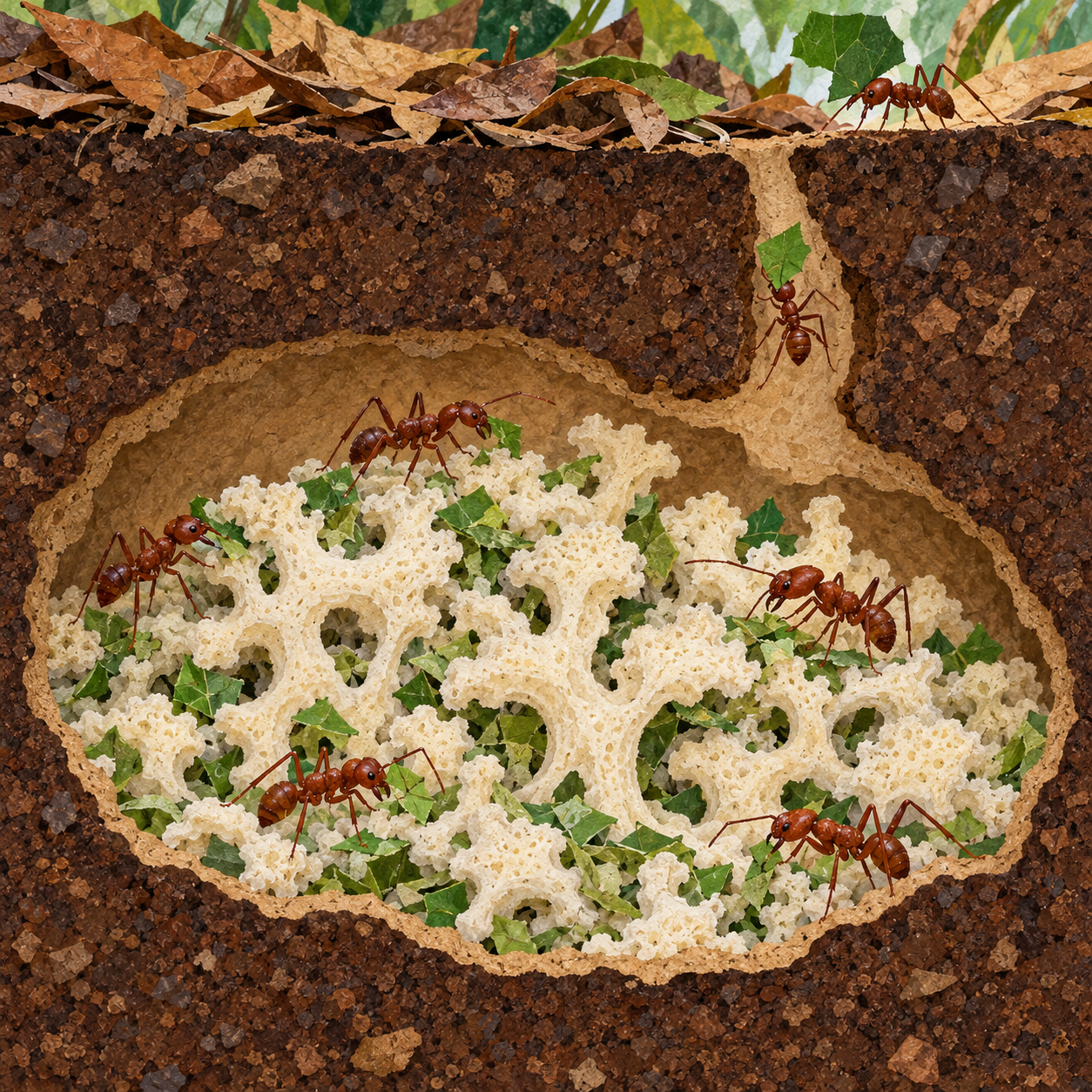
Nest cutaway showing ants tending a pale fungus garden among chopped leaf fragments.
A garden is the hidden destination of harvested vegetation. Nest form, garden texture and relative scale are simplified.

The crop helps prepare its next meal

One particularly revealing discovery concerns the droplets ants put onto new garden material. In a 2004 study, Stig Rønhede, Jacobus Boomsma, and Søren Rosendahl examined enzymes in the faecal droplets of two leafcutter species. They found active enzymes of fungal origin, rather than enzymes produced only by the ants themselves. The implication was that the ants could move useful fungal chemistry from mature garden material to fresh substrate. Read the enzyme-transfer study.

Later work on Acromyrmex echinatior identified plant-cell-wall-degrading enzymes that remained active after passing through the ants. Expression of several corresponding fungal genes was elevated in the gongylidia the ants eat. The crop thus supplies both food and part of the chemical equipment that helps prepare new plant material. The pectinase study explains the evidence.

That loop changes the picture. The ants transport the fungus’s products as well as transporting leaves. The fungus is a participant in the work, not a passive ingredient waiting for a helpful insect. The relationship combines growth, digestion, and behaviour in a way that neither a photograph of a leaf trail nor a sample of fungus grown alone could fully reveal.

A garden has neighbours and enemies

Growing a useful fungus does not mean every other microbe becomes useful too. Research on Acromyrmex leafcutters describes bacteria called Pseudonocardia maintained on the ants’ bodies. They produce antifungal compounds that help defend the crop against a specialized parasitic fungus, Escovopsis. A 2018 study also showed that the parasite produces compounds that can interfere with those defences. Read the chemical-interaction study.

This is a particular system, not a claim that all leafcutters carry identical bacteria or use the same chemical defence. The study describes differences between the leafcutter genera Acromyrmex and Atta. Even within an apparently familiar agricultural lifestyle, the details of crop protection can differ.

The lesson is larger than a miniature comparison with pesticides. A productive partnership creates a resource that other organisms may exploit. Maintaining the garden therefore involves relationships beyond the two familiar partners. Calling it an ant-and-fungus system is a good introduction, but it is not a complete species list.

Follow what leaves the garden

Jarrod Scott and colleagues compared the microbial communities of gardens and refuse dumps in 2010. The two compartments contained different communities, and those differences appeared in both laboratory and field material. Partly degraded vegetation was leaving the garden, but its biological story was continuing. The research record describes the comparison.

Waste is consequently more informative than the word suggests. It tells us that the garden does not reduce every incoming leaf to ant food. Material passes through stages, with different conditions and microbes associated with them. Looking at the input alone would miss both the leftover matter and the distinct environment produced where it accumulates.

You can think of the system through four questions: What arrives? What transforms it? What is taken as food? What leaves? These questions work better than a tidy picture of perfect recycling. They leave room for losses, residues, and other organisms whose roles still need investigation.

A five-minute trail observation

If you encounter an accessible leafcutter trail, watch from beside it without blocking the route. Choose one fixed point, such as a root edge, and observe for a short, recorded interval. Count ants crossing in each direction. Separately note which crossings involve a visible fragment. You need only a notebook and a clear definition of what you are counting.

Now ask what those counts could establish. They can describe traffic at that point during that interval. They cannot directly measure how much fungus the colony grows, how much food the larvae receive, or the number of leaves collected over a whole day. Ant size and fragment size also vary, so a count of loaded ants is not a measurement of plant mass.

Compare a second interval if you have time. A change raises useful questions about conditions and activity, but one short observation cannot identify its cause. The exercise turns a fascinating sight into evidence while preserving the distinction between what is visible and what happens inside the garden.

A partnership that travels with a new queen

The crop also has to pass between generations of colonies. Young leafcutter queens carry a fungal starter from the parent nest when founding a new one. Smithsonian’s account of crop domestication describes this continuity. The new colony begins with inherited biological material as well as a queen’s own body.

How old is the broader relationship? A 2024 genetic study compared evolutionary trees built for hundreds of ants and fungi. It placed the origin of ant fungus farming around 66 million years ago and a later transition to tightly dependent crop cultivation around 27 million years ago. These are reconstructions from genetic data and dating methods, not observations of the first farm. Read the primary study’s institutional record.

The leaf trail is compelling because it offers an entrance to all this hidden work. A fragment carried past your shoe connects a forest plant with fungal enzymes, developing ants, defended gardens, and material eventually carried away as refuse. The leaves catch our attention. Following their transformations is what reveals the agriculture.

Explore more creative curiosities at Incoprea.

Pilobolus: The Fungus With a Pressure-Powered Launch

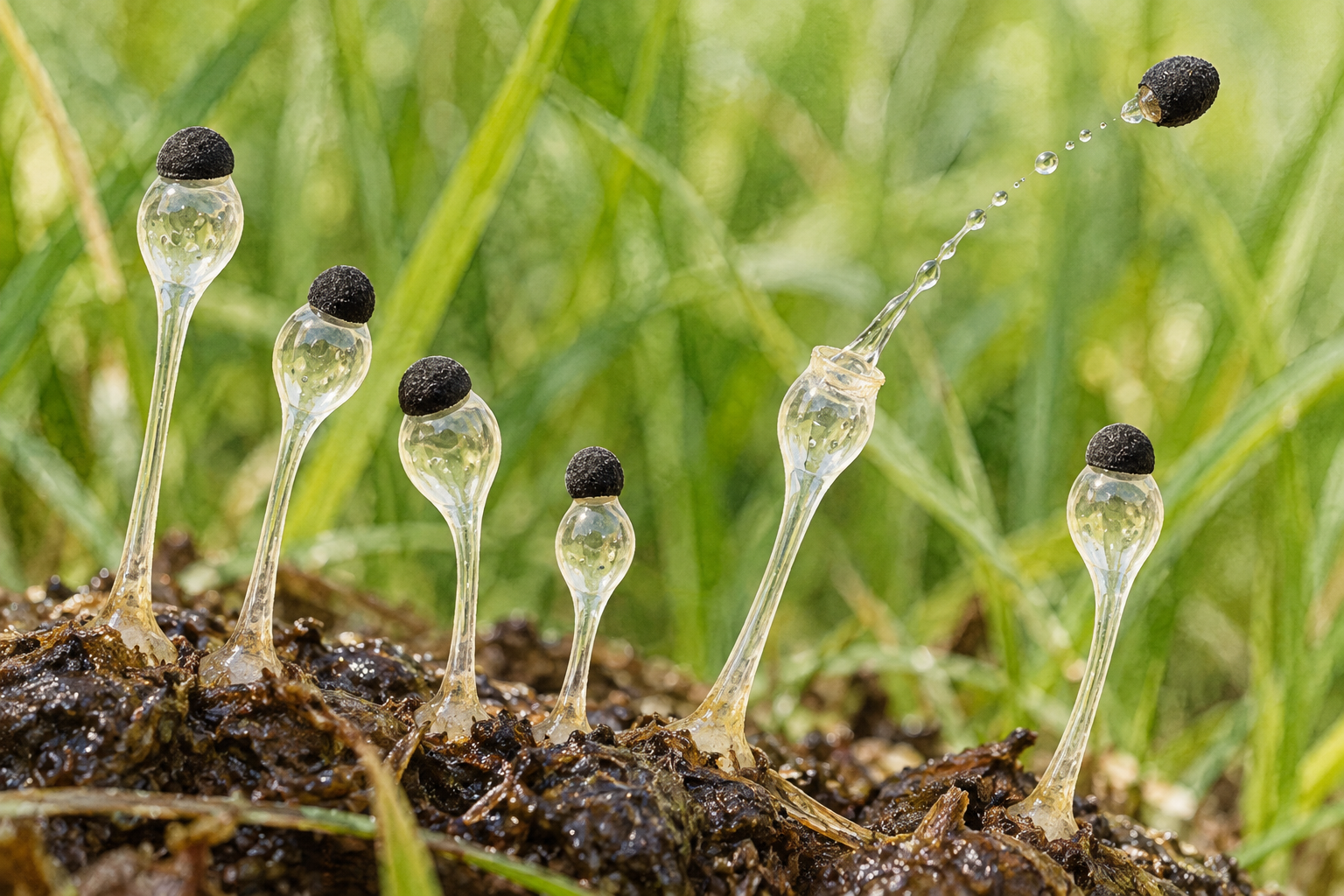
Enlarged illustration of translucent Pilobolus stalks and a dark spore packet being launched.
The spore packet and fluid jet are an interpretive enlargement, not high-speed footage or a true-scale measurement.

A translucent stalk supports a dark cap above a swollen, fluid-filled bulb. At this scale it looks more delicate than powerful. Then the cap is gone. Pilobolus has launched a packet of spores away from the dung on which it grew, beginning a journey that may take it onto vegetation and through a grazing animal.

The impressive number in this story is often the acceleration. Yet “very fast” is only the opening clue. To understand the launch, we need to know what moves, how pressure becomes motion, why the stalk’s direction matters, and what happens after the packet leaves. Each question reveals a different part of the fungus’s solution.

The projectile is a package

The dark cap is a sporangium, a structure containing spores. Beneath it is a swollen region of the stalk with fluid inside. As the pressure-driven mechanism releases, a jet of cell sap helps propel the whole packet. The spores are not simply falling individually from the underside of a miniature mushroom.

Aimée Sakes and colleagues place Pilobolus among the fluid-pressure launchers in their systematic review of natural shooting mechanisms. Water uptake, pressure, and deformation are linked. The wall can store elastic energy, then release it over a much shorter interval than the period needed to prepare the structure.

This separates the power of an event from the pace of the whole organism. A structure may build gradually and act abruptly. There is no need for a miniature muscle to contract at the instant of release. The arrangement of fluid and elastic walls supplies a different route to rapid movement.

What changed when researchers could watch

In 2008, Levi Yafetto and colleagues used high-speed video to investigate discharge in several fungi. For Pilobolus kleinii, the recordings showed the sporangium moving away with a stream of fluid behind it. The study also examined dissolved substances contributing to the pressure system. Its chemical results did not require an exceptional new way of accumulating solutes to explain the launch. Read the original study.

Direct recordings matter because earlier launch estimates often started from a landing distance and worked backwards through a model. That approach depends on how well the model describes air resistance. A camera provides positions at known times, allowing researchers to test assumptions about the motion rather than silently treating those assumptions as observations.

The paper compares several fungi with different projectiles. Keep that distinction when reading spectacular figures. A maximum measured for one species is not automatically a measurement for every fungus in the article. Even a well-supported number becomes misleading if it travels without the organism and quantity to which it belongs.

Watch the liquid, not only the cap

Open Video S3 in the paper’s Supporting Information, labelled Pilobolus kleinii. The research file is a high-speed recording, presented for slow viewing. On the first pass, follow the dark packet. On the second, look for the fluid extending behind it. On the third, inspect what remains of the launching structure.

Try describing the visible sequence in three short statements without using “explosion” or “cannon.” For example, identify what was attached before release, what moved together after release, and what changed at the starting point. Familiar metaphors are useful, but they can also hide the very feature the recording makes visible: the moving packet is accompanied by liquid.

Now ask what the clip cannot tell you by itself. A close view of the first part of the trajectory does not show the eventual landing site. Slow playback also does not reveal the real elapsed time unless you know the recording rate. The paper supplies those measurements; your eye supplies a starting observation.

Acceleration, speed, and distance answer different questions

Acceleration measures a change in velocity over time. Speed describes how fast something is moving at a particular moment. Range describes how far it gets. A brief, large acceleration can produce a fast launch without producing an enormous journey.

Three claims to keep separate
ClaimWhat would you need to know?
The packet accelerates sharply.How its velocity changes during a measured interval.
The packet leaves quickly.Its speed at launch, with units and species identified.
The packet travels far.Its landing distance and the conditions of the flight.

For a simple thought experiment, imagine two packets that both reach the same speed. One reaches it in half the time. Its average acceleration over that interval is twice as large, but the shared final speed still does not determine the distance either packet will travel. Their mass, size, launch direction, and surroundings would also matter. This is a hypothetical comparison, not a measured pair of fungal launches.

Small projectiles meet a different balance of forces

Mark Fischer and colleagues investigated how air viscosity slows fungal projectiles. Their 2010 analysis compared predictions with high-speed observations and measured discharge distances. Across different fungi, a relatively simple drag model matched those distances better than the more complicated comparison model. More detail in an equation was not automatically a better description of the observed flight. Read the fungal-flight study.

Scale helps explain why the issue matters. When a roughly similar object is made smaller, its mass and its exposed area change at different rates. The balance between inertia and resistance changes too. Pilobolus launches a packet rather than an isolated microscopic spore, so the thing being launched is a central part of the explanation. You cannot compare two launch systems only by comparing their initial speeds.

Direction is prepared before departure

The stalk also responds to light. Robert Page and George Curry studied young Pilobolus kleinii stalks using illumination from one side and different wavelengths. The growth responses showed a sensitivity to the light environment. This aiming happens through growth before launch, a different process from steering a projectile already in flight. Read the phototropism study.

A useful sequence now comes into view: grow a structure, orient it, build the conditions for release, and launch. Calling the fungus a good shot is entertaining. Dividing the task into those stages makes its biology more understandable.

The landing is only halfway through the story

In an account for Yellowstone Science, mycologist K. Michael Foos describes packets adhering to vegetation, where an appropriate herbivore can ingest them. Spores passing through the animal can reach a fresh dung substrate. Moving off the original dung therefore helps connect one generation’s growth site with another. The same account discusses lungworm larvae that can exploit Pilobolus dispersal, showing that a successful transport system may become useful to another organism too. Read Foos’s article on printed pages 17–20.

The launch is impressive, but the complete route is more revealing. A pressure-filled structure, a response to light, a packet moving through air, a blade of vegetation, and a grazing animal all contribute. The fungus does not need to travel an impressive distance by human standards. It needs a journey suited to its own scale and life cycle.

Explore more creative curiosities at Incoprea.

Ghost Pipes: Flowering Plants That Borrow Their Carbon

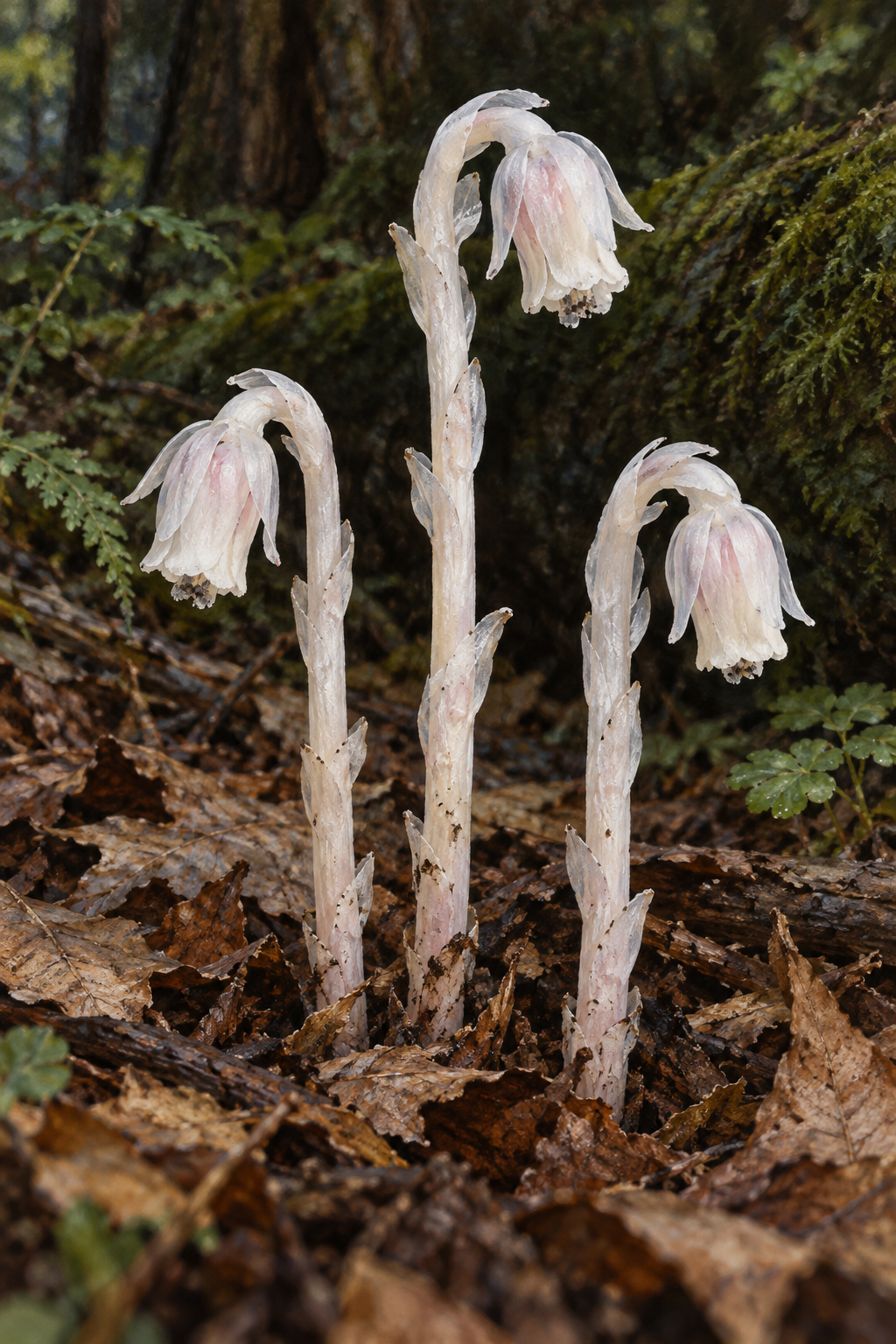
Illustration of ivory ghost-pipe stems, each bearing one nodding flower.
Scale-like leaves and nodding flowers belong to a plant whose carbon supply depends on fungi.

A cluster of pale stems appears through woodland leaves. Each bends near the top, carrying a small hanging flower. The colour is so unlike an ordinary green plant that your eye may put it in the mushroom category before you have properly looked. Ghost pipe asks you to reconsider two things at once: what makes an organism a plant, and where a plant’s carbon can come from.

Monotropa uniflora is a flowering plant in the heath family, Ericaceae. Its lack of chlorophyll prevents it from making its own food through the usual green-plant route. It instead obtains resources through fungi connected with trees. The pale flower is the conspicuous part of a relationship whose important connections are below the leaf litter.

Look for the flower before deciding what it is

North Carolina State’s plant account describes the small scale-like leaves and unusual pale stems of Monotropa. In ghost pipe, a flowering stem generally carries a single flower. These are useful features because whiteness alone is a poor classification tool. A mushroom and a ghost-pipe flower may share a colour while belonging to entirely different groups of organisms. Explore the university’s plant account.

A photograph that shows only a white stalk can preserve the initial confusion. A view of the flower, its attachment, and the scales on the stem gives you more information. You do not need to pull the plant apart to improve your observation. Changing your viewing angle can be more useful than taking a closer crop of the same feature.

The University of Texas makes the central distinction especially clear: this is a wildflower that depends on fungi, rather than a fungus itself. An organism’s relationship with another organism does not change which group it belongs to. The unusual nutritional strategy and the botanical identity answer different questions. See the species page and herbarium records.

Follow the carbon past the visible stem

The term for obtaining resources through fungi is mycoheterotrophy. In the ghost pipe’s case, the fungi are associated with photosynthetic trees. Carbon fixed by a tree can enter the fungal relationship and reach the nonphotosynthetic plant. Kew describes ghost pipe as parasitic on these fungi. The title’s “borrow” should therefore be read as an image of indirect dependence, not a claim that the plant repays a carbon loan. Read Kew’s species profile.

The absence of green tissue does not remove sunlight from the larger chain. A plant in deep shade can depend on carbon that another plant captured using light. This is a more precise explanation than saying ghost pipe simply lives without the sun. The immediate provider and the ultimate source are not always the same thing.

A simplified carbon pathway, not a map of one measured individual
ParticipantRole in the explanationWhat a casual photograph cannot establish
A photosynthetic treeFixes atmospheric carbon into organic compounds.Which particular tree supplies a particular ghost pipe.
An associated fungusConnects the tree relationship with the ghost pipe’s roots.Its identity from a nearby mushroom alone.
Ghost pipeObtains fungal-derived resources without its own photosynthesis.The quantity or timing of resource transfer.

This simplified pathway is useful because it distinguishes roles. It is not a claim that every tree, fungus, and pale flower in a patch is connected to every other one. The actual partners and transfers need evidence. A line drawn between organisms in an illustration would be a hypothesis unless the connection had been investigated.

DNA puts names to the hidden partners

In 2006, S. Yang and Donald Pfister studied ghost pipes at four sites in eastern Massachusetts. They sampled root-associated fungi and nearby fungal fruiting bodies, then used DNA sequences to investigate identity and diversity. All 56 sampled ghost-pipe fungal associates belonged to the Russulaceae, a family including Russula and Lactarius. They were not all the same fungal type. Read the Massachusetts study.

The result is both selective and diverse: a restricted family of partners, with variation inside it. That distinction matters. “Uses many fungi” and “uses any fungus” are not equivalent statements. Nor does a result from a set of Massachusetts sites become a complete inventory of every ghost pipe across its range.

The study also helps explain why the nearest mushroom is not automatically the answer to the partnership question. A fruiting body is a visible fungal structure. The fungus associated with a plant root must be identified from the root association itself and compared with other samples. Proximity can suggest a question; a DNA comparison can test an identity.

Identity is not the same measurement as nutrition

Researchers can investigate carbon sources as well as fungal identity. A 2009 study of a different mycoheterotrophic plant, the orchid Gastrodia confusa, included Monotropa uniflora as a comparison. Its authors combined fungal identification with carbon and nitrogen stable-isotope measurements. The two plants showed different isotope patterns consistent with different fungal relationships. Read the comparative study.

The comparison prevents another shortcut: all pale, fungus-dependent plants do not necessarily obtain resources through the same ecological route. Stable isotopes are naturally occurring forms of an element with different masses. Their relative abundance can help researchers examine sources and processing, when suitable reference samples and biological context are available. A result is interpreted through those comparisons; the method is not a direct photograph of a sugar molecule travelling between two organisms.

Make a record without uncovering the roots

If you find ghost pipe on a woodland walk, record what is visible. Photograph the cluster from the path, including one view of the flower and one of its setting. Note the date, whether the flowers are nodding or more upright, the colour of the exposed stems, and the general canopy. Keep “observed” and “inferred” as separate parts of the note.

If you can return later, compare the same small area without assuming every stem belongs to one individual. Have the flowers changed position? Are seed capsules visible? Which stems remain? A missing aboveground stem is not, by itself, evidence that the entire perennial plant has died. Your record concerns the visible structures at the times you visited.

Leave the surrounding leaf litter and roots in place. The Missouri Department of Conservation notes that ghost pipe rarely survives transplantation because of its complicated fungal requirements. Its field account also describes flowers becoming upright as seeds mature and the exposed structures darkening. These changes give you a useful subject for repeat photographs without removing the plant. Read the conservation field guide.

A small flower reveals a larger dependence

Ghost pipe changes the scale of a woodland observation. At first it is an unusual white object. Then it becomes a flower with recognisable structures. Finally, it points toward a carbon pathway and a set of selective relationships that cannot all be seen from aboveground.

The interesting answer is not simply that a plant found a way to avoid being green. It is that a different way of living brings different dependencies. The pale stem draws attention to itself; the evidence asks us to look beyond it, to the fungi, trees, and conditions that help make its brief appearance possible.

Explore more creative curiosities at Incoprea.

The Forest Underground Is Fascinating Without a Talking-Tree Story

Lift a handful of forest soil in your imagination and slow down the view. A root is only one of the living structures threading through it. Much finer fungal filaments extend into spaces a root does not occupy. At particular root–fungus interfaces, organisms with very different ways of obtaining energy meet and exchange resources.

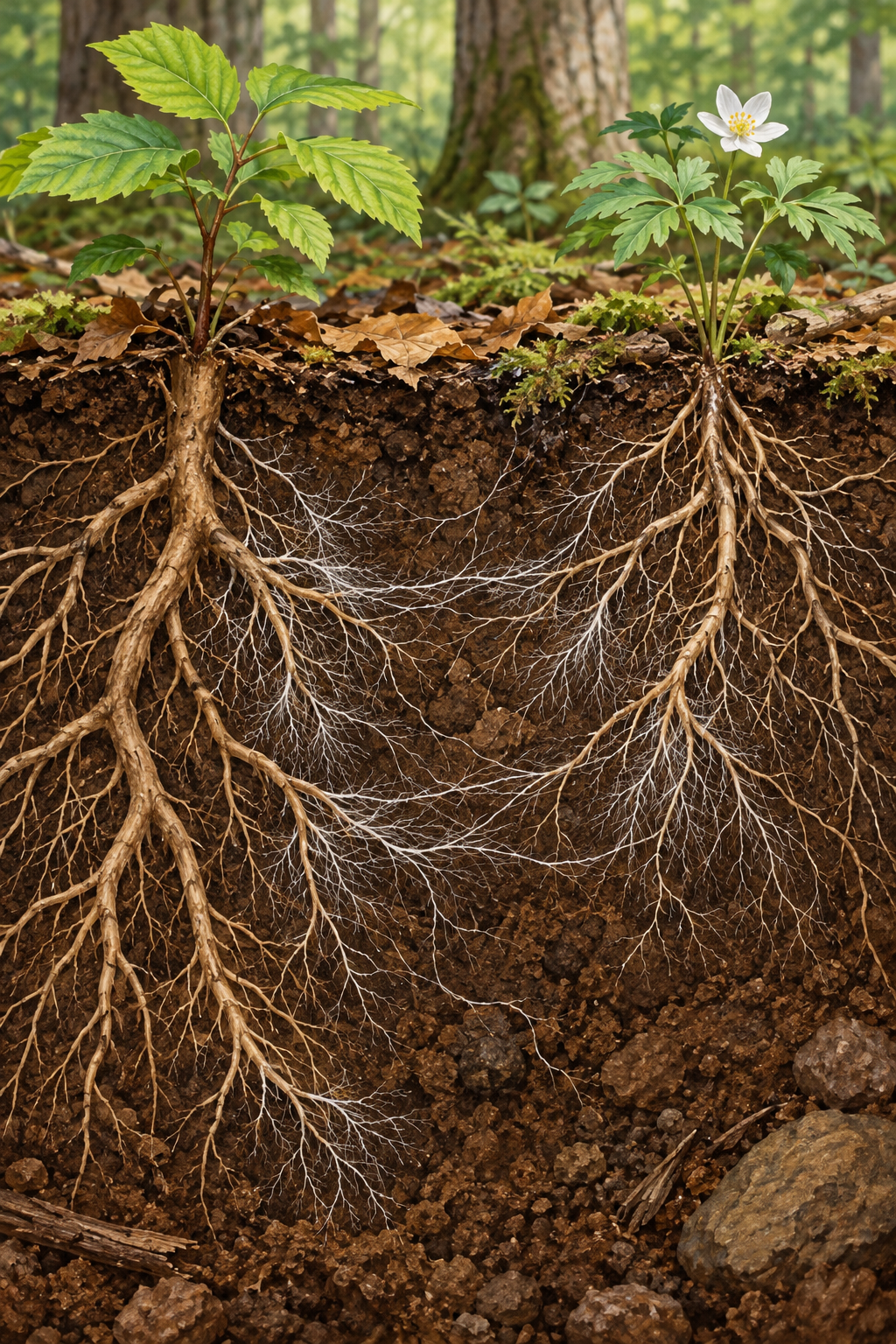
Soil cutaway showing plant roots and fine fungal filaments.
This simplified cutaway distinguishes roots from fungal filaments. It is not a map of a measured forest network.

These associations are called mycorrhizas. Plants supply carbon compounds made possible by photosynthesis; fungi can help plants obtain mineral nutrients and, in some circumstances, water. The partnership is interesting at the scale of one root. Moving from that relationship to a claim about communication across an entire forest requires several additional steps.

The fungus has a life of its own

It is tempting to picture a hypha, a fungal filament, as a cable carrying a tree's supplies. But the filament belongs to an organism that grows, maintains itself and uses resources. Its relationship with a plant affects both participants. The fungal side of the exchange is not an inert extension of the root.

Kew's mycorrhizal research examines diversity and distribution as well as ecosystem function. That emphasis matters: “mycorrhizal fungus” describes a relationship, not one interchangeable organism. Different fungi and plants meet in different soils and environments. Before asking what a network does, researchers need to establish who is present and what kind of association they form.

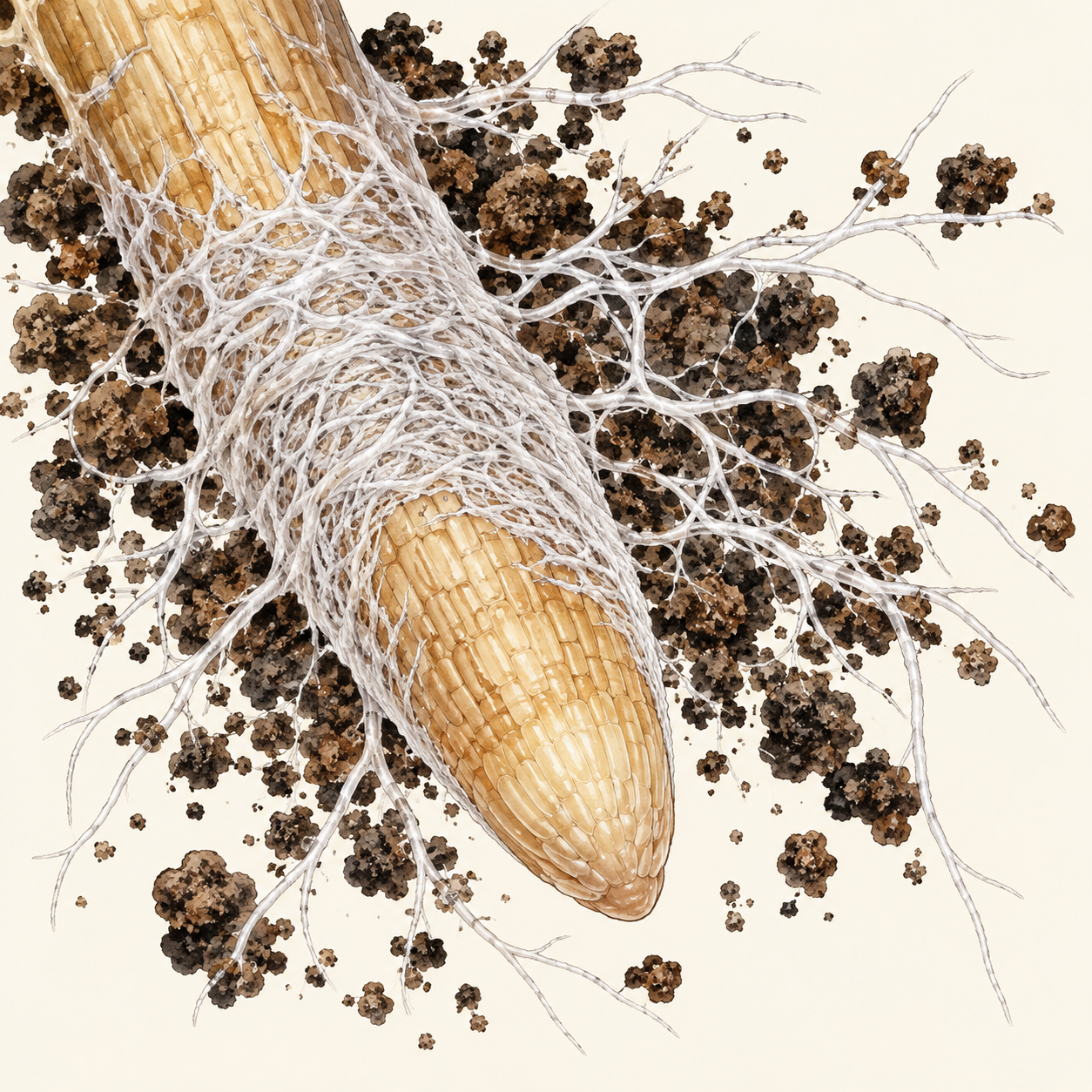
Enlarged schematic of a root tip with an associated fungal sheath and outward-growing hyphae.
A root–fungus association is a partnership between organisms. This enlarged schematic is not a microscope image or a measured specimen.

A 2011 experiment led by E. Toby Kiers investigated resource allocation in arbuscular mycorrhizal partnerships. Plants allocated more carbohydrates to better-providing fungal partners, while fungi increased nutrient transfer to roots offering more carbohydrates. The study provided evidence of adjustment on both sides of the association. It did not require a gardener directing the exchange.

The everyday language of “rewards” can help describe the result, provided it does not smuggle in human intentions. Changes in resource allocation can arise through biological responses and evolution. Nor does this experiment demonstrate that mature forest trees generally feed their offspring through fungal networks. The organisms, setting and question of an experiment all delimit its conclusion.

A connection is the beginning of a question

A common mycorrhizal network occurs when fungal hyphae connect the roots of more than one plant. Such connections exist. That fact does not establish their extent in every woodland or determine what crosses them. It also leaves open whether the receiving plant benefits, pays a cost or experiences little measurable change.

Consider a railway analogy cautiously. A track connecting two stations establishes a possible route. It does not tell you what was transported last Tuesday, who received it, or whether that delivery improved their circumstances. A biological network is much more dynamic than a railway, but separating those questions prevents the picture of a connection from doing the work of an experiment.

In their 2023 review and perspective, Justine Karst, Melanie Jones and Jason Hoeksema evaluated prominent claims about forest networks. They found that general claims about their prevalence and benefits to seedlings ran ahead of the field evidence. They also examined how later publications cited earlier results, finding a tendency toward positive and sometimes unsupported interpretations.

Follow an imaginary tracer

Here is a small investigation to think through. A researcher labels carbon taken up by one plant. Later, a small amount of that label is detected in another plant nearby. What can you conclude immediately? The labeled material reached the second plant. Pause there before deciding which route carried it or what purpose the movement served.

To test a fungal route, the study must consider alternatives, including movement through soil. A barrier that excludes roots but admits hyphae might help ask one question. Yet barriers can also alter water movement, soil conditions or which fungi grow. The control must address those changes, rather than treating the barrier as an invisible on-off switch for a network.

Then ask about quantity and consequences. Detecting a trace is different from showing that the recipient obtained a meaningful fraction of its carbon that way. Measuring increased growth or survival asks another question again. A beautifully sensitive instrument can establish movement at a scale too small to support a story about substantial nourishment.

Finally, ask whose outcome was measured. A transfer that benefits a fungus might not benefit every connected plant equally. A seedling's short-term response might differ under shade or drought. These are not reasons to dismiss underground exchanges. They are reasons to investigate them at the level where the proposed effect actually occurs.

Watch the organisms come back into view

Kew introduces mycorrhizal fungi and the work of studying them. Watch on Kew's page if the player is unavailable.

In the film, notice the scale changes between a landscape, a root and the structures examined by researchers. Each view answers a different question. A woodland photograph cannot reveal the identity of its fungi. A close view of a colonized root cannot by itself reveal the map of connections across that woodland. Combining observations is what makes the hidden system accessible.

The evidence also invites better stories than a universal forest conversation. Plants and fungi can form persistent associations, alter exchanges and respond to changing resources. Neighbors can compete as well as influence one another. Following those interactions replaces a single comforting metaphor with organisms whose relationships are contingent, active and still being discovered beneath familiar ground.

Explore more creative curiosity at Incoprea.

Zombie-Ant Fungi: The Real Biology Behind the Dramatic Name

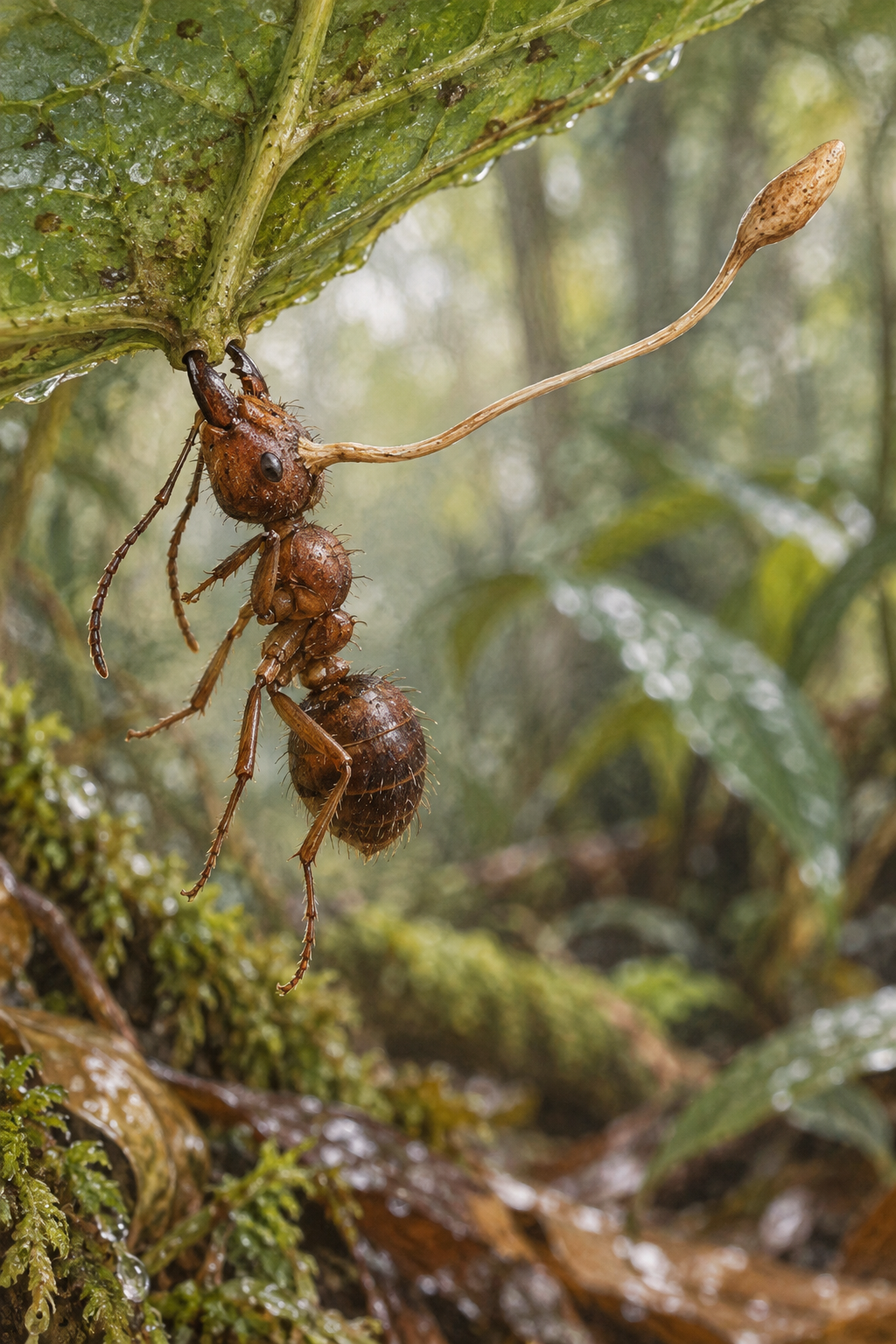
Illustration of an ant attached beneath a leaf with a slender fungal stalk extending from its head.
An interpretation of the characteristic ant-and-fungus scene, not a specimen photograph.

An ant grips vegetation with its jaws and stays there after death. Later, a fungal structure emerges from the body and releases spores. The scene has earned certain Ophiocordyceps fungi the name zombie-ant fungi. It is an arresting nickname, but the actual biology is more specific and more puzzling than a simple story about taking over a brain.

A change of behavior serves the parasite

In well-studied carpenter-ant systems, infected workers leave normal activity, move onto vegetation and perform a final bite. The resulting position can provide a suitable place for the fungus to develop and disperse infectious spores.

These are specialized relationships involving particular fungi and hosts. Ophiocordyceps unilateralis is often used as a convenient name, but researchers also discuss a complex of related species. The details can differ among hosts and environments, so one spectacular observation should not become a universal script.

Calling the ant a zombie is a metaphor for altered behavior. It is not a scientific description of what the ant experiences. The visible outcome can be documented much more confidently than an imagined inner state.

The brain was not filled with fungus

A 2017 study used detailed microscopy and image analysis to examine infected ants. Fungal cells were widespread in the body and associated with muscles, including those controlling the jaws. The investigators did not find fungal cells inside the brain at the studied stage.

That result corrected a common picture of the infection. It did not show that the brain was unaffected. Chemical signals can alter tissue without fungal cells physically occupying it. Penn State's account explicitly notes that the brain's role and the coordination of the behavior required further research.

The finding is therefore more subtle than a switch from brain control to a completely understood muscle puppet. Changes in muscles, chemicals, physiology and neural function are pieces of a mechanism that scientists are still working to connect.

A three-dimensional reconstruction is a map, not a command recording

The 2017 team examined tissues at a crucial stage, when the ant fixes itself to vegetation by biting. Their microscopy built a spatial account of where fungal cells were and how they associated with host tissues. This adds much more detail than a photograph of a stalk emerging from a dead ant.

Serial imaging works by relating many successive sections rather than interpreting one lucky slice. A structure that looks isolated in one plane may connect with other structures outside it. Reconstructing the volume can therefore reveal relationships that a two-dimensional section alone conceals.

The map still does not record a message telling the ant to climb or bite. Location, tissue damage, chemical action and behavior are different levels of explanation. A fungal network near a muscle supplies evidence relevant to a mechanism; establishing exactly how behavior changes requires additional tests.

The comparison with a generalist fungal pathogen was useful for the same reason. Some effects could belong to infection and illness broadly, while others might be associated with the specialized manipulator. A change becomes more informative when researchers ask whether an appropriate comparison organism produces it too. The dramatic endpoint is the start of that comparison, rather than a replacement for it.

Infecting is not the same as manipulating

A separate set of experiments reported in 2014 found that the studied fungus could infect and kill some non-target ants without producing the characteristic manipulated behavior. Experiments with ant brain tissues also found different patterns of chemical production in the presence of different host species.

That distinction is striking. Causing disease and producing a particular behavioral sequence are not interchangeable abilities. A parasite's effects depend on the host and the relationship between them, rather than on one all-purpose command chemical.

Arrange the evidence in time

Make a short sequence: infection, altered activity, final attachment, death, external fruiting-body growth and spore release. A familiar photograph often shows only the later stages. It cannot by itself reveal whether a particular chemical changed before the bite, whether a tissue was affected during the behavior or what occurred earlier in the colony.

The brain-tissue experiments simplified a different question: which chemicals did the fungus produce in the presence of tissues from different hosts? Isolated tissue can make that chemical comparison tractable, but it does not perform an ant's complete behavior. Linking the result back to the whole organism is a further step.

These distinctions make the nickname easier to use without allowing it to take over the explanation. “Zombie” points to an uncanny observed outcome. The scientific investigation asks which host, which stage, which tissue and which comparison establish the process. It becomes a story of relationships across cells, organs and behavior, with uncertainty located in specific unanswered connections.

Sources and further reading: Penn State: the 2017 imaging study · Host-specific chemical and infection experiments · NIGMS interview with the researchers

publications

New this week Two novels in six stories each, from The Night Shift . New — a novel in six documents Small Print A Novel in Six Do...