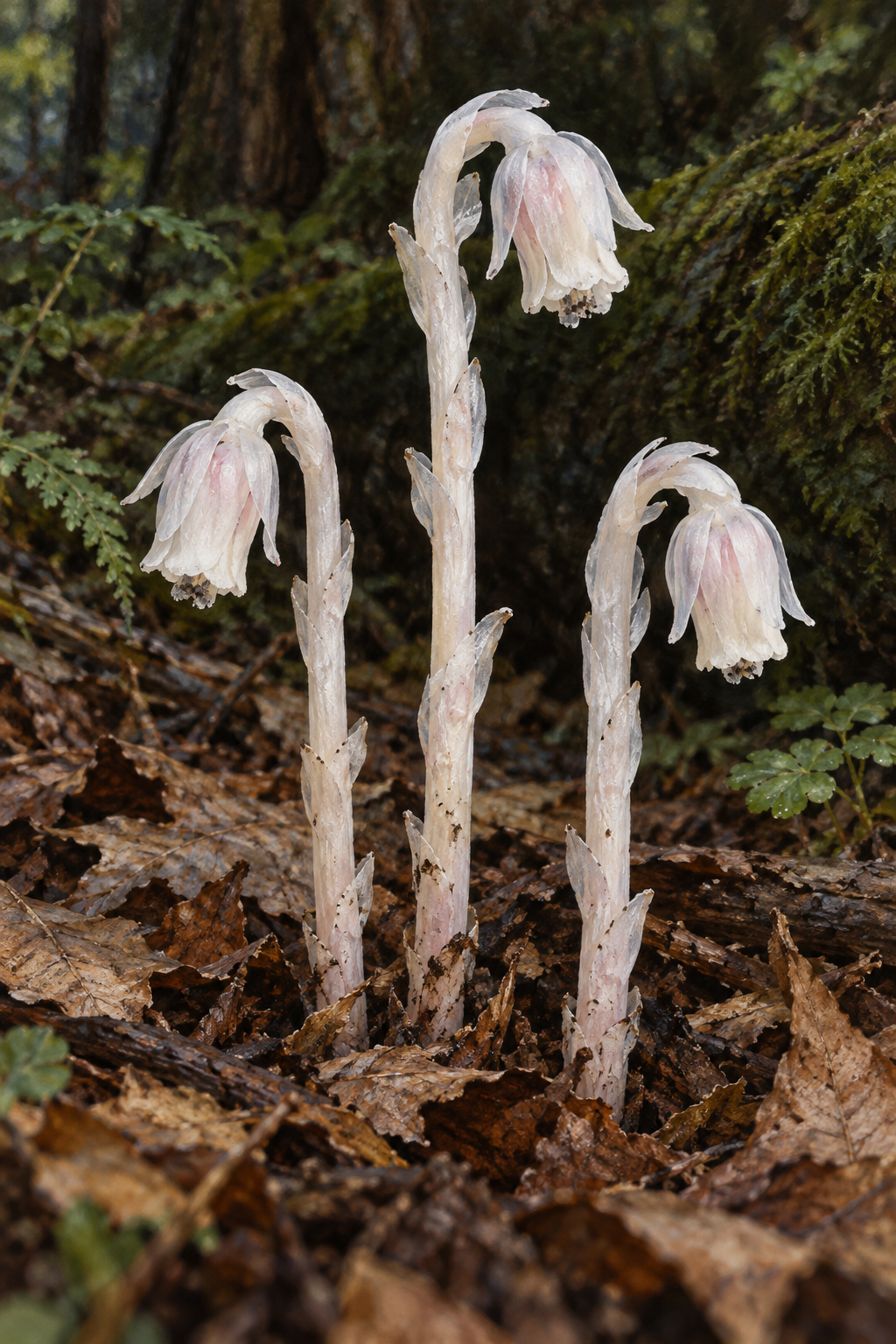
A cluster of pale stems appears through woodland leaves. Each bends near the top, carrying a small hanging flower. The colour is so unlike an ordinary green plant that your eye may put it in the mushroom category before you have properly looked. Ghost pipe asks you to reconsider two things at once: what makes an organism a plant, and where a plant’s carbon can come from.
Monotropa uniflora is a flowering plant in the heath family, Ericaceae. Its lack of chlorophyll prevents it from making its own food through the usual green-plant route. It instead obtains resources through fungi connected with trees. The pale flower is the conspicuous part of a relationship whose important connections are below the leaf litter.
Look for the flower before deciding what it is
North Carolina State’s plant account describes the small scale-like leaves and unusual pale stems of Monotropa. In ghost pipe, a flowering stem generally carries a single flower. These are useful features because whiteness alone is a poor classification tool. A mushroom and a ghost-pipe flower may share a colour while belonging to entirely different groups of organisms. Explore the university’s plant account.
A photograph that shows only a white stalk can preserve the initial confusion. A view of the flower, its attachment, and the scales on the stem gives you more information. You do not need to pull the plant apart to improve your observation. Changing your viewing angle can be more useful than taking a closer crop of the same feature.
The University of Texas makes the central distinction especially clear: this is a wildflower that depends on fungi, rather than a fungus itself. An organism’s relationship with another organism does not change which group it belongs to. The unusual nutritional strategy and the botanical identity answer different questions. See the species page and herbarium records.
Follow the carbon past the visible stem
The term for obtaining resources through fungi is mycoheterotrophy. In the ghost pipe’s case, the fungi are associated with photosynthetic trees. Carbon fixed by a tree can enter the fungal relationship and reach the nonphotosynthetic plant. Kew describes ghost pipe as parasitic on these fungi. The title’s “borrow” should therefore be read as an image of indirect dependence, not a claim that the plant repays a carbon loan. Read Kew’s species profile.
The absence of green tissue does not remove sunlight from the larger chain. A plant in deep shade can depend on carbon that another plant captured using light. This is a more precise explanation than saying ghost pipe simply lives without the sun. The immediate provider and the ultimate source are not always the same thing.
| Participant | Role in the explanation | What a casual photograph cannot establish |
|---|---|---|
| A photosynthetic tree | Fixes atmospheric carbon into organic compounds. | Which particular tree supplies a particular ghost pipe. |
| An associated fungus | Connects the tree relationship with the ghost pipe’s roots. | Its identity from a nearby mushroom alone. |
| Ghost pipe | Obtains fungal-derived resources without its own photosynthesis. | The quantity or timing of resource transfer. |
This simplified pathway is useful because it distinguishes roles. It is not a claim that every tree, fungus, and pale flower in a patch is connected to every other one. The actual partners and transfers need evidence. A line drawn between organisms in an illustration would be a hypothesis unless the connection had been investigated.
DNA puts names to the hidden partners
In 2006, S. Yang and Donald Pfister studied ghost pipes at four sites in eastern Massachusetts. They sampled root-associated fungi and nearby fungal fruiting bodies, then used DNA sequences to investigate identity and diversity. All 56 sampled ghost-pipe fungal associates belonged to the Russulaceae, a family including Russula and Lactarius. They were not all the same fungal type. Read the Massachusetts study.
The result is both selective and diverse: a restricted family of partners, with variation inside it. That distinction matters. “Uses many fungi” and “uses any fungus” are not equivalent statements. Nor does a result from a set of Massachusetts sites become a complete inventory of every ghost pipe across its range.
The study also helps explain why the nearest mushroom is not automatically the answer to the partnership question. A fruiting body is a visible fungal structure. The fungus associated with a plant root must be identified from the root association itself and compared with other samples. Proximity can suggest a question; a DNA comparison can test an identity.
Identity is not the same measurement as nutrition
Researchers can investigate carbon sources as well as fungal identity. A 2009 study of a different mycoheterotrophic plant, the orchid Gastrodia confusa, included Monotropa uniflora as a comparison. Its authors combined fungal identification with carbon and nitrogen stable-isotope measurements. The two plants showed different isotope patterns consistent with different fungal relationships. Read the comparative study.
The comparison prevents another shortcut: all pale, fungus-dependent plants do not necessarily obtain resources through the same ecological route. Stable isotopes are naturally occurring forms of an element with different masses. Their relative abundance can help researchers examine sources and processing, when suitable reference samples and biological context are available. A result is interpreted through those comparisons; the method is not a direct photograph of a sugar molecule travelling between two organisms.
Make a record without uncovering the roots
If you find ghost pipe on a woodland walk, record what is visible. Photograph the cluster from the path, including one view of the flower and one of its setting. Note the date, whether the flowers are nodding or more upright, the colour of the exposed stems, and the general canopy. Keep “observed” and “inferred” as separate parts of the note.
If you can return later, compare the same small area without assuming every stem belongs to one individual. Have the flowers changed position? Are seed capsules visible? Which stems remain? A missing aboveground stem is not, by itself, evidence that the entire perennial plant has died. Your record concerns the visible structures at the times you visited.
Leave the surrounding leaf litter and roots in place. The Missouri Department of Conservation notes that ghost pipe rarely survives transplantation because of its complicated fungal requirements. Its field account also describes flowers becoming upright as seeds mature and the exposed structures darkening. These changes give you a useful subject for repeat photographs without removing the plant. Read the conservation field guide.
A small flower reveals a larger dependence
Ghost pipe changes the scale of a woodland observation. At first it is an unusual white object. Then it becomes a flower with recognisable structures. Finally, it points toward a carbon pathway and a set of selective relationships that cannot all be seen from aboveground.
The interesting answer is not simply that a plant found a way to avoid being green. It is that a different way of living brings different dependencies. The pale stem draws attention to itself; the evidence asks us to look beyond it, to the fungi, trees, and conditions that help make its brief appearance possible.
Sources and field references
North Carolina State: plant structures · University of Texas: species and herbarium records · Kew: carbon dependence and classification · Yang and Pfister (2006): fungal DNA evidence · Ogura-Tsujita and colleagues (2009): comparative isotope evidence · Missouri Department of Conservation: seasonal changes and observation.




