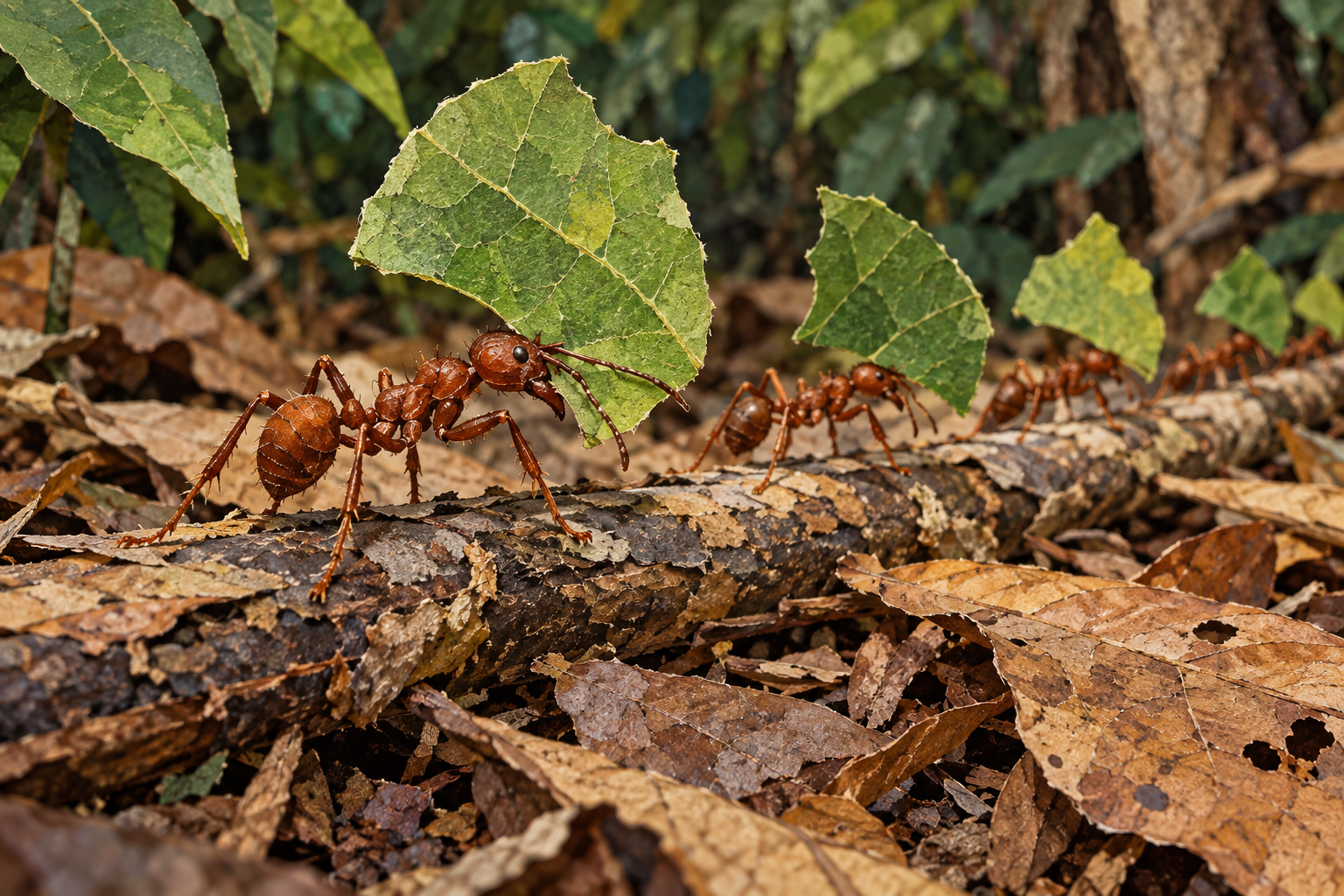
A line of ants carrying leaf fragments looks like a harvest heading straight for a meal. For leafcutter ants, the main destination is a crop. They use fresh vegetation to cultivate fungi, which in turn provide food for the colony.
Calling this agriculture is more than a charming metaphor. The ants maintain a living food source, provide its growing material and manage a system on which they depend. The fungus is an active partner in that arrangement, with its own nutritional requirements.
Turning vegetation into fungal food
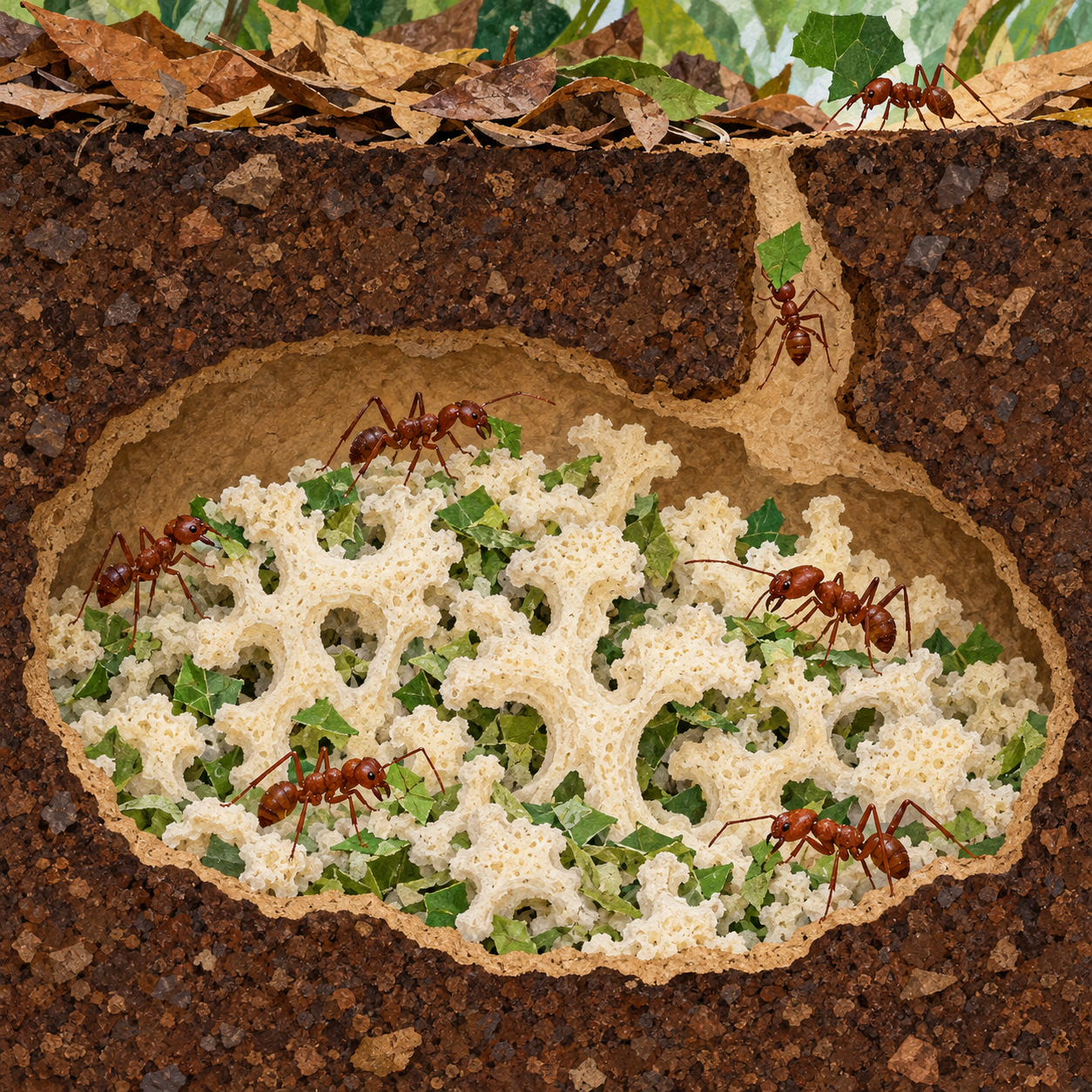
Leaf fragments become substrate for a fungus garden. The cultivated fungus transforms plant material and produces structures that feed the ants. Different tasks therefore belong to a linked process: harvesting outside, processing inside and sustaining the crop.
Smithsonian researchers describe specialized food-bearing fungal structures called gongylidia. These help connect the garden's growth with the colony's nutrition. A leaf procession is the visible supply chain; the crop that explains it is generally hidden.
The arrangement also has a future beyond one colony's current workers. In modern leafcutter lineages, young queens carry a small fungal starter from their original nest when establishing a new one. The crop is part of colony continuity.
Gardens produce waste too
A cultivated system cannot be understood only by looking at what enters it. Partly degraded plant material and other refuse accumulate. Research by Jarrod Scott and colleagues compared the microbial communities of fungus gardens and refuse dumps.
Their work treats these as distinct environments along a plant-material degradation process. A living garden and its waste are chemically and biologically different. Studying both reveals a larger system than the tidy image of ants simply feeding leaves to fungus.
It is useful to think of the colony as managing flows: plant material arrives, microbes transform it, food supports ants and residues move into another compartment. Each stage creates opportunities for other organisms.
An old partnership, reconstructed from genes
A 2024 study described by the Smithsonian compared large genetic datasets from ants and fungi to reconstruct their evolutionary histories. It placed the origin of ant fungus farming around 66 million years ago, near the mass extinction at the end of the Cretaceous.
That is an inference from evolutionary reconstruction, rather than a directly observed first farm. Estimates and interpretations improve as datasets and methods change. It also does not mean every fungus-farming ant uses the leafcutter strategy: several agricultural systems exist.
The study suggests that some fungal crops later became tightly dependent on their ant cultivators. This adds a deeper question to the familiar leaf trail: how does a partnership change when neither participant lives in the same way without the other?
Leafcutter ants are compelling because their work connects behavior with microbiology. The large green fragments draw our eye, while the essential transformation takes place in small fungal structures. A forest walk can therefore reveal the entrance to an agricultural system whose crop we never see.
Sources: Smithsonian: ant agriculture research in 2024 · Smithsonian: crop domestication and colony founding · Scott and colleagues: fungus gardens and refuse dumps
Explore more creative curiosities at Incoprea.




