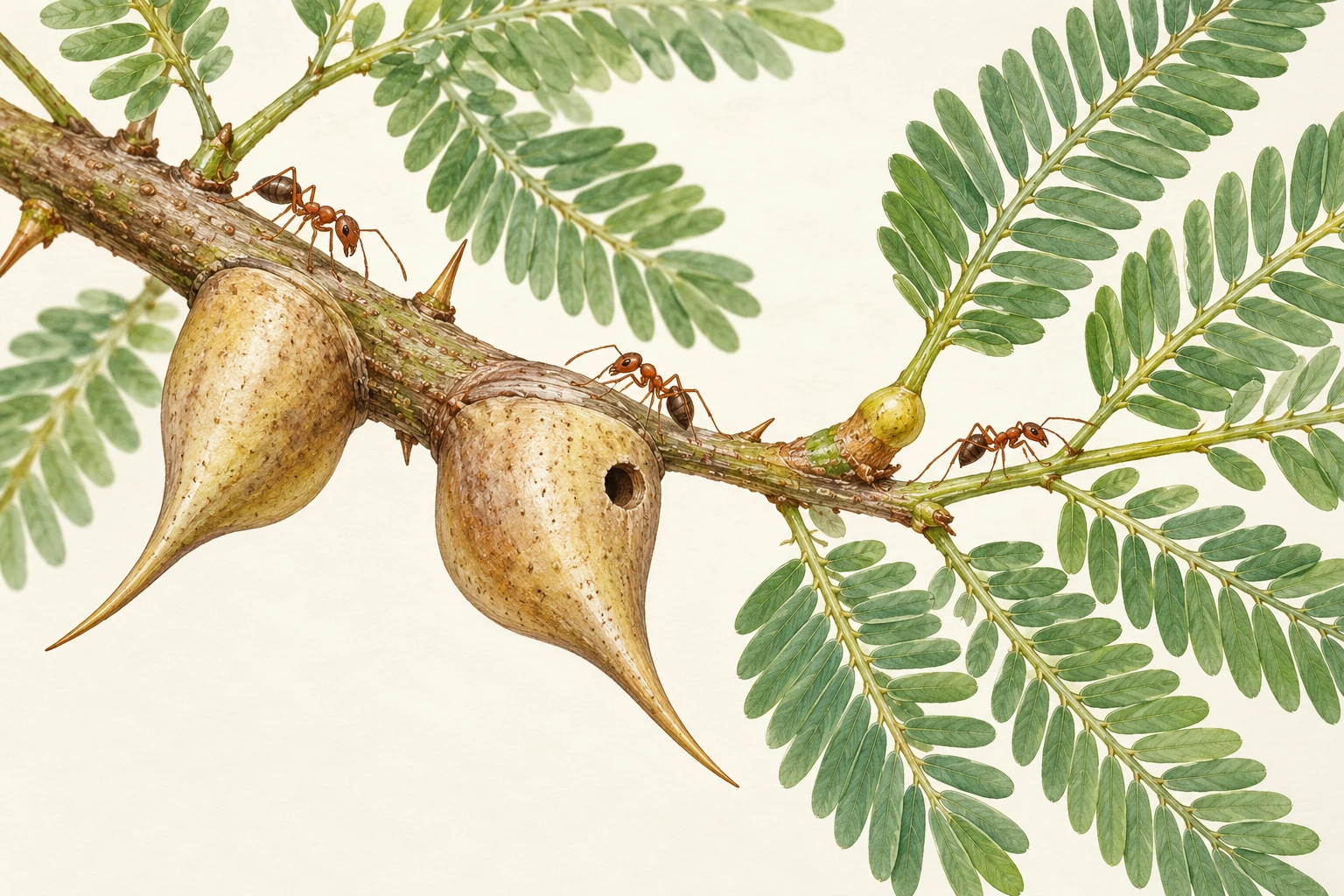
A tree can grow its own thorns. It can also provide accommodation for animals that bite. In several acacia–ant partnerships, hollow thorns or other nesting spaces, nectar outside the flowers, and sometimes food bodies help sustain resident ants. The ants patrol the plant and can attack herbivores. The defense moves because the defenders are alive.
It is an elegant exchange, but calling it a perfect partnership would hide the main scientific questions. Food costs the plant resources. Ant species differ in their behavior. Other plants compete with the host, and flowers may need insect visitors that aggressive defenders could disturb. The value of the arrangement depends on circumstances.
Start with the terms of the exchange
The rewards must be distinguished. A nesting cavity is shelter. Extrafloral nectar is food produced outside a flower, so it need not function as a pollination reward. Food bodies are another investment. A study of short-term variation in acacia rewards examined how occupancy and herbivory relate to plant provisioning. The plant's contribution is a measurable biological allocation, not a free surplus with no consequences.
Likewise, an ant on a branch is not automatically a defender. Its behavior toward herbivores, its abundance, and its dependence on the host all matter. A visitor collecting nectar could provide a different service from a resident colony occupying the plant's shelter. Observing the insect is the beginning of the inference, not its end.
Different acacia systems should not be merged. Central American swollen-thorn acacias and East African whistling-thorn trees involve different plants and ant communities. Botanical names have also changed: the East African tree often studied as Acacia drepanolobium is now commonly placed in Vachellia. Following the species name across sources helps keep the evidence attached to the correct partnership.
A grass can change the relationship without attacking either partner
Field experiments in a Kenyan savanna tested a plausible prediction: grasses competing with acacia saplings for resources should make it harder to support Crematogaster mimosae, an aggressive defender that consumes substantial nectar. The lower-cost, less-protective ant Tetraponera penzigi does not consume that nectar and was expected to be less affected. Researchers manipulated grass presence and ant identity, then followed colony survival and sapling growth for 40 weeks.
The surprising result ran against the competition prediction. C. mimosae colonies survived better with grasses present. Grass-shaded soil held more moisture, and those saplings had more active nectaries; reduced water stress appeared to help the tree support its ants. Grass removal did not significantly change T. penzigi colony survival, and grass neighbors had no significant net effect on sapling growth. Neighboring vegetation can therefore facilitate an interaction as well as compete for resources. The observed result, rather than the attractive initial explanation, has to guide the story.
A comparative study of indirect plant resistance also distinguished induced nectar production from more continuous provisioning in obligate ant-associated acacias. Some defenses increase in response to damage; a resident defensive workforce may require ongoing support. Those are different allocation strategies, each with costs and conditions under which it can be useful.
Benefits do not erase conflict
Research on different investment strategies considered the coexistence of mutualistic and more exploitative ant partners. A host that offers less reward may save resources, but can also alter the ant community it supports. The relationship is not classified adequately by saying “ants present” or “ants absent.” Which ants are present can be central.
There is another potential conflict at flowering. Aggressive guards could interfere with pollinators, yet the plant needs successful pollination as well as protection. A 1997 study examined how ant guarding and seed production interact. The broader lesson is to look for spatial or temporal ways in which a plant can accommodate two kinds of insect activity, rather than assuming all defense should be maximized everywhere.
That is a recurring evolutionary theme: the best amount of a trait is not always the largest amount. More nectar is costly. More aggression can have side effects. A flexible arrangement can be favored when circumstances change. None of those outcomes requires the plant to calculate a budget consciously; differential reproductive success can shape the allocation.
The generated branch illustration makes one part of the arrangement visible: swollen thorns, a possible entry hole, leaves, and patrolling ants. It is a generic conceptual view. A field identification or a claim about the resident species requires the photographs, descriptions, and local evidence in the research.
The compelling feature is not a tree hiring tiny soldiers. It is a defense assembled across species, with its success depending on the resource demands and behavior of both partners. A branch can support shelter, food, danger, and reproduction at once. Understanding how those uses fit together turns a charming mutualism into a much richer piece of ecology.
Follow the evidence: Short-term plasticity in acacia ant rewards; Palmer and colleagues: neighboring grasses alter a protection mutualism; Heil and colleagues: induced and constitutive indirect defenses; Divergent investment strategies and exploiter ants; How ant guards and acacia pollination can coexist.
More curious connections, art and independent projects at Incoprea.