A hand approaches a metal rod and the pitch rises. Another hand hovers above a loop and shapes the loudness. Nothing visible connects the fingers to the instrument, yet a slight movement can make a musical entrance, a long slide or an abruptly silenced note. The theremin gives the player a continuous space to navigate.
That freedom is also the difficulty. A piano key supplies a repeatable place to land. A traditional theremin asks the performer to find and hold a pitch through movement, listening and adjustment. The instrument’s unusual appearance is the beginning of the story; the practiced coordination behind a clear phrase is the more revealing part.
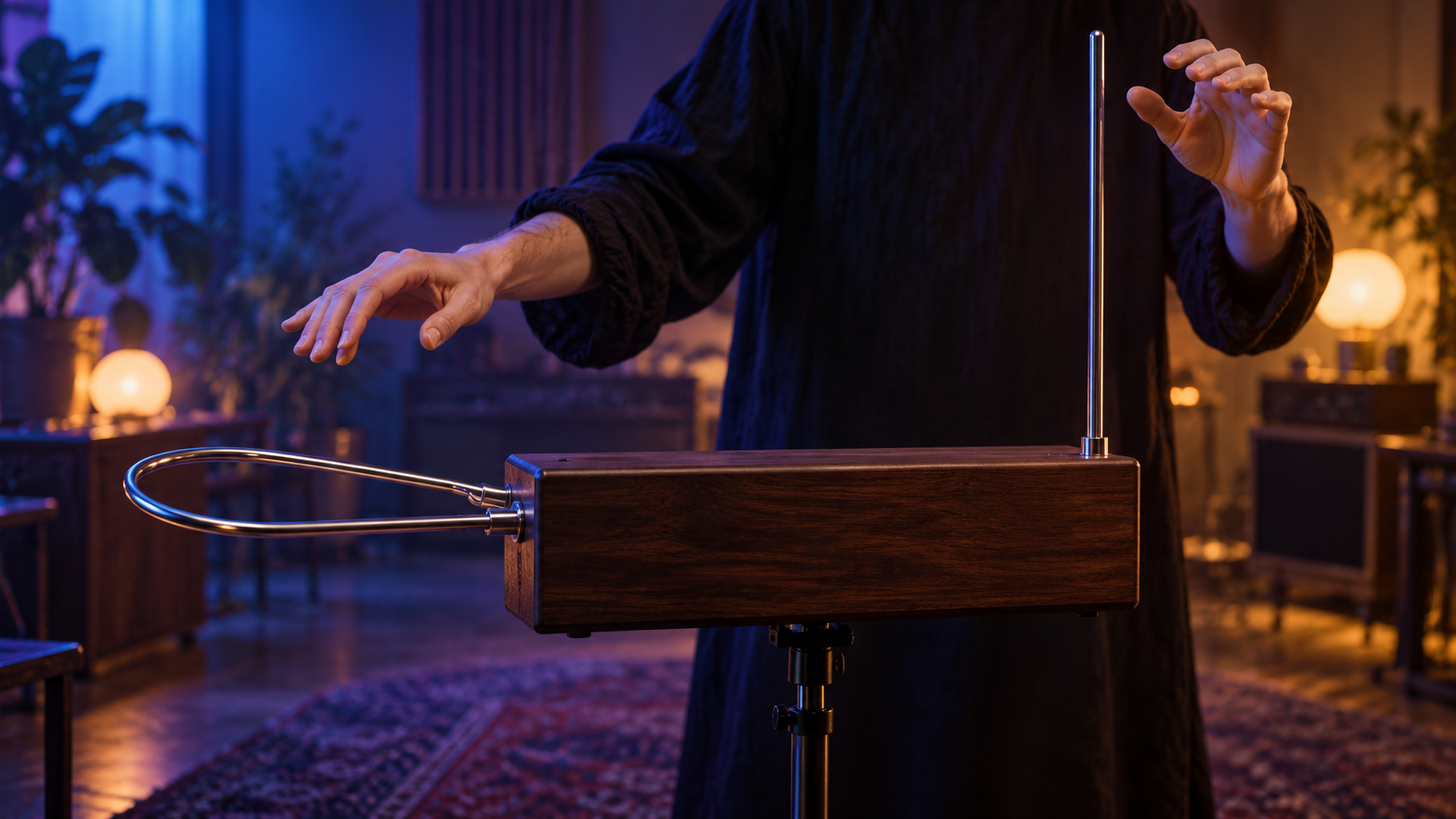
Pitch and loudness are separate musical decisions
In the familiar two-antenna arrangement, the straight antenna controls pitch and the loop controls volume. For the Etherwave, Moog’s own setup guidance describes finding useful responses for each antenna. Bringing the volume hand near the loop can silence the sound; moving it away allows the phrase to speak.
This division gives the player more than a way to make a note louder or higher. It separates the note’s destination from its entrance. A player can reduce the volume during a pitch change, then let the next settled pitch become audible. Alternatively, keeping the sound present during the journey produces a continuous slide.
Try a small vocal comparison. Hum a comfortable note, glide to a second note, and listen to the whole connection. Now try two separate hums with a pause between them. Your voice is not modeling a theremin circuit, but the contrast makes articulation audible. Two identical pitch destinations can become different phrases because of what happens between them.
The hand changes an electrical condition
The Bob Moog Foundation’s archive discussion describes theremins as capacitance-actuated instruments. A nearby hand and body influence capacitance in the instrument’s electrical surroundings. Those changes become changes in the sound. The hand does not need to pluck a string or break a beam of visible light.
One established way to obtain the audible pitch is heterodyning: combine two oscillator signals and use their difference frequency. Designer Arthur Harrison’s account of his 203 theremin gives a concrete circuit example, with one fixed-frequency oscillator and another influenced by hand capacitance. It is an example of the principle, not a claim that every theremin has the same circuit.
Use invented numbers to see the idea. Suppose one oscillator is at 260,000 cycles per second and the other at 259,560. Their difference is 440 cycles per second, an audible pitch. If the second changes to 259,340, the difference becomes 660. A comparatively small adjustment to a high-frequency signal can produce a substantial change in the audible difference.
The example isolates subtraction, not the full behavior of an instrument. Real circuitry has to establish useful sensitivity, produce a controlled output and manage the response near silence. Even a simple arithmetic explanation becomes a musical instrument only when the player can use the resulting field of control.

Listen for a contour before listening for a melody
The short example below is an eight-second synthesized sine tone that rises and falls continuously. It is useful for hearing a pitch path without a sequence of keys or separate note attacks. It is not a theremin performance, a recording of a named musician or a simulation of the instrument’s electronics.
On the first listen, trace the pitch’s journey with one finger in the air. Notice where it turns from rising to falling. On the second listen, imagine where a volume hand might close the sound to divide that contour into two or three phrases. The audio itself remains continuous; you are planning articulation rather than hearing a second version.
Keep pitch and perceived loudness distinct. A tone moving higher does not, by that fact alone, mean the performer has made a volume gesture. In a real performance, listen for whether the change is a new pitch, a new attack, a change of strength or several coordinated actions.
The room becomes part of the setup
Moog emphasizes that theremins are sensitive to their immediate surroundings and that antenna adjustment belongs in preparation for playing. The response a musician learns is affected by the electrical setting around the instrument. Moving equipment or changing position can matter before a phrase has even begun.
That makes steadiness a useful musical resource. If an unintended body movement shifts the electrical conditions, the performer must hear and correct the result. Control involves deciding which movements belong to the phrase and which should remain quiet. The player’s space is continuous, but that does not make it arbitrary.
A sliding tone does not identify its instrument
Clara Rockmore demonstrated the theremin’s capacity for deliberate musical phrasing. The foundation’s account of Bob Moog’s 1993 interview with her also records their long relationship: Moog helped produce her 1977 album and repaired the instrument Léon Theremin had built for her in the 1930s. Technique and instrument-making developed through sustained contact between people.
The foundation’s history of Moog and the theremin places his early instrument-building before the modular synthesizers for which he later became famous. It also distinguishes the mechanically controlled Electro-Theremin heard on the Beach Boys’ Good Vibrations. A familiar sliding sound can suggest the theremin without proving that a performer controlled it through space.
The next time a phrase seems to float without a visible point of contact, look for the two jobs. Where does the pitch settle? How does the sound begin, connect and end? Those questions move attention from the novelty of empty space to the musician’s choices within it. The remarkable interface becomes most interesting when the listener can hear the skill it makes possible.
Sources and further exploration: Moog: tuning the Etherwave; Bob Moog Foundation: capacitance-actuated instruments; Arthur Harrison: the 203 theremin’s circuit; Rockmore and Moog; Moog’s theremin history.


